A Concise History of Ireland
Broad outline of the history of Ireland as a way of identifying patterns and similarities with the currently occuring genocide against the Palestinians.
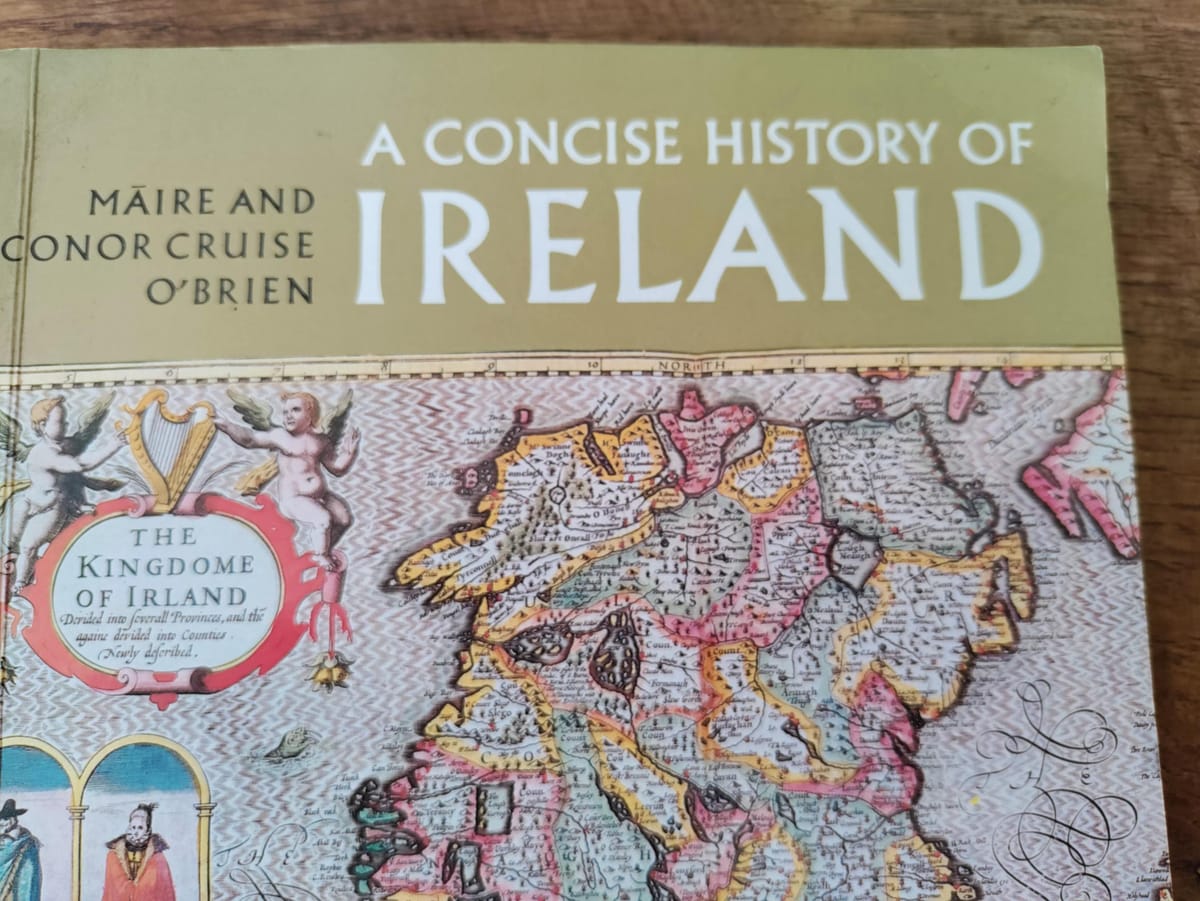
I heard it said somewhere that the British perfected the system of colonialism in Ireland. With this in mind, I wanted to read a summary of Irish history as a way of comparing to Palestine. Connor Cruise O’Brien has also written a text named The Seige, which is a comparison of Ireland to Israel and Zionism, in which he draws parallels between the two. I would like to propose that the parallels between the experiences of the Irish and the Palestinians are stronger, with the British in this context mapping to Israel
The O’Brien’s position their history in the middle stone age, where fisherman and food gatherers arrived from post-glacial Europe following the coastlines and forest edges crossing from modern-day Scotland into Antrim. As with all peoples and nations, their origins begin with a migration from some place to another place (to another place, back to another place, and so on).
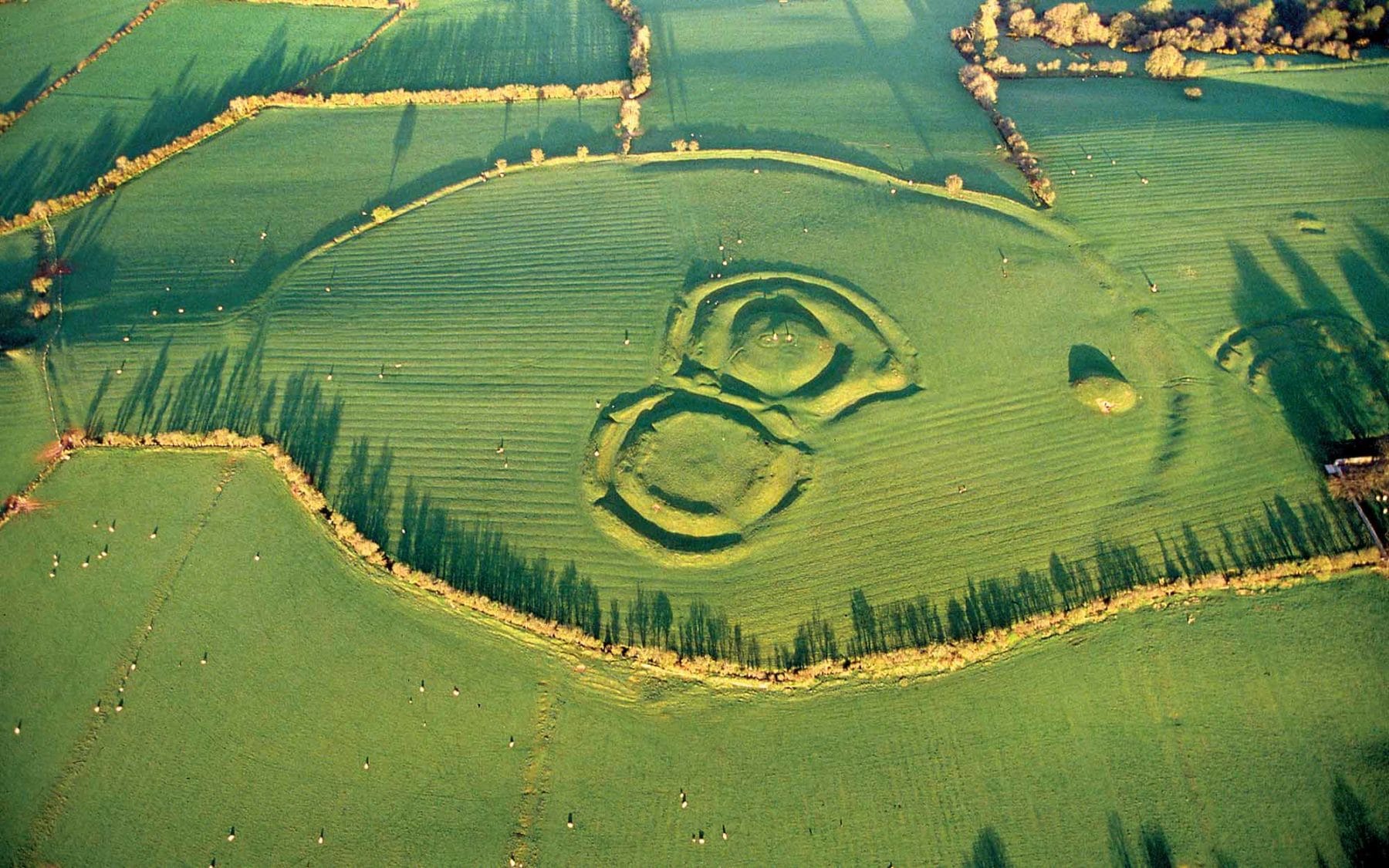
In the neolithic age, the people inhabiting Ireland were farmers using sophisticated stone axes, making pottery, spinning, and weaving. Thousands of megaliths remain from this time, and the O’Brien’s suggest that there are two distinct and probably independent traditions tracing back to the Mediterranean. Tara is one “outstanding example”. This was the seat of legendary kings, the centre of superstitious awe.
The bronze age lasted some 1,500 years, and the people of this time left no records. The traces of the people descended not from Rome but from the movement of people across the western Eurasian plateau from east to west. They brought with them an Indo/Germanic language which we term ‘Celtic’.
At this time we have the establishment of small-scale invasions and conquests of culturally and linguistically related, but politically independent, tribes. We have references to Ierne, or the Latin Hibernia, and of course Albion, once Britain, now Scotland. There is also Gwyddel, Goidel, or Gael, employed by literate Welsh speaking missionaries to designate the population of the island.
The customary law of Celtic peoples was highly developed and transmitted orally. The “Brehon Law” of Irish school books. Under this law a man’s identity was defined in terms of tribe and family. Only men of art and learning passed freely. Land was the common property of the family. Wealth was reckoned in cattle. Slavery was practised. Wars, in many cases, were highly formalized.
Towns and villages were not part of the island scene until the Norse raids and settlements began. The O’Brien’s note the famous St Patrick, a historical figure who was captured on a raid in his native Britain and brought as a slave to Ireland.
In 431 Pope Celestine appointed the bishop Palladius to Ireland. Christianity brought with it the written word. The old insular Celtic culture was hostile to the written word, feeling that it was destructive to the memory and to concentration.
The church was based on the Roman model, but there was no substructure of towns and cities, and therefore the monastery became the equivalent of a petty kingdom. The so-called “Dove of the Church”, St Columba, brought the church to Scotland.
By the ninth century, Irish learning had achieved considerable recognition, reaching as far as Charlemagne’s court. At this time we have the expansion of the Viking era. The O’Brien’s refer to them as pirates and traders. They “fell upon” the privileged monasteries, the depositories of both holy and secular treasures. Settlement followed raids. Irish kings built fleets; the Norse built towns. Churches, made of wood and thus burned down, were re-erected in stone, with the belfry becoming a de-facto lookout tower.
By 1002, the High King of Ireland was Brian (or Boru). He saw himself as an Irish Charlemagne. In 1014, the war against the Vikings was ended at the Battle of Clontarf. The Norse were aided by the “rebellious” kingdom of Leinster. Their king, Dermot Mac Murrough, sought various alliances and support, including to King Henry II (of the Plantagenets), who was already considering a conquest of Ireland. Dermot formed an alliance with the Marcher Lords, including the Earl of Pembroke (‘Strongbow’). Henry acquired a papal bull, a most useful thing, for the authorisation of the conquest of Ireland with a “view to remedying the deplorable condition of religion and morals.”
With this the Normans entered Ireland, settling and fortifying. The Irish resistance was “ineffectual”. The tide turned, however, and several major battles ended in Norman defeat. The Crown of Ireland was offered to Haakon IV or Norway in 1263, though he died before he could accept. It was later offered to Edward Bruce in 1318.
“The north of Scotland and the Isles produces families of professional soldiery or Norse/Gaelic stock and these the Irish chiefs imported and settled on their lands.”
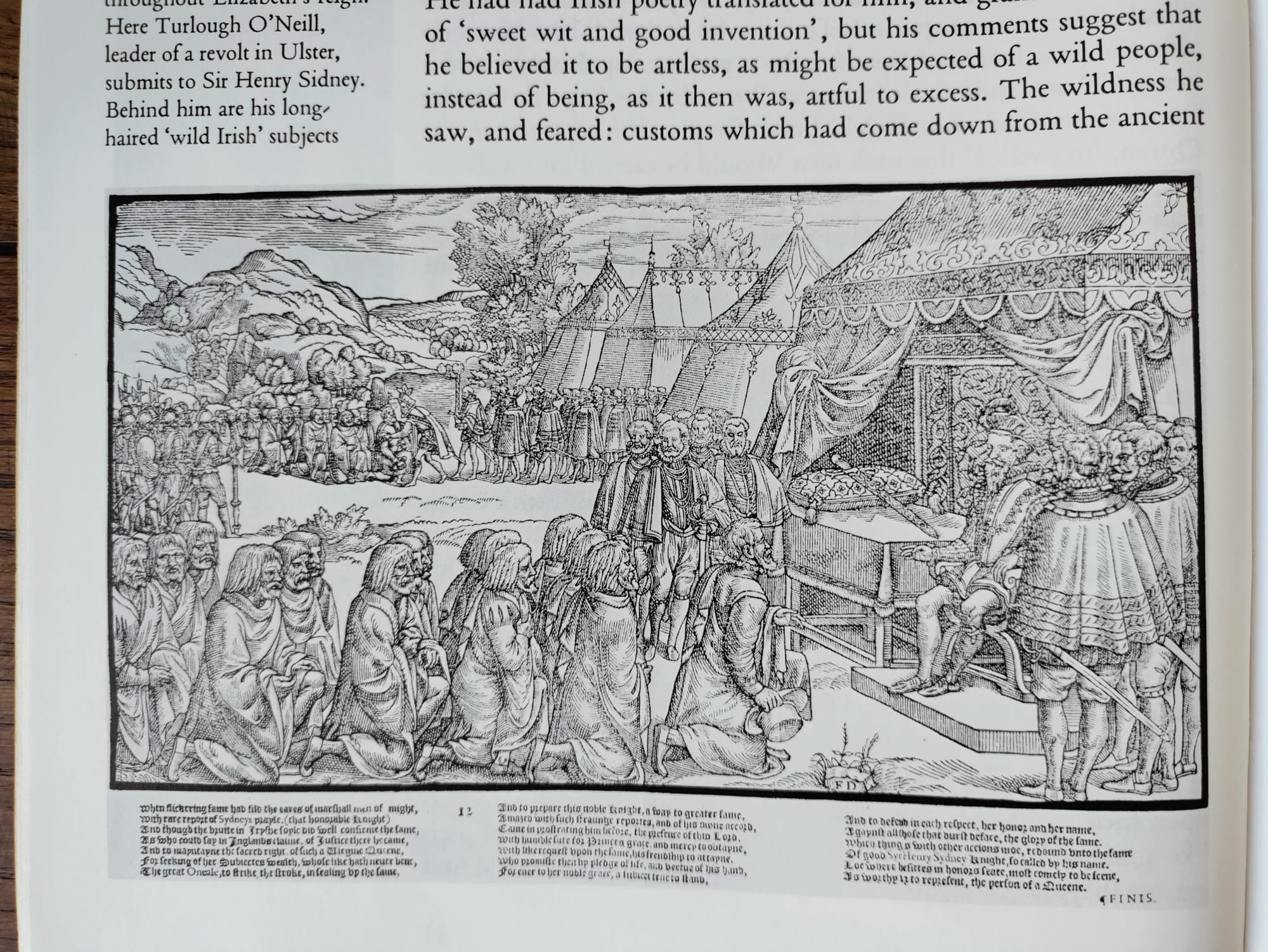
In 1580 a Spanish and Italian force of some 600 landed at Smerwick and were defeated by an English force under the Lord Deputy, Greg of Wilton, who had with him his secretary, Edmund Spenser.
Spenser urged a thorough reformation in Ireland, both religious and civil, necessarily by the sword. He is described by the O’Brien’s as a humanist who believed that this was a matter of civilization, which sounds similar when we consider the arguments used to justify the creation of Israel in Palestine.
The O'Brien's argue that, in turn, the conquest of Ireland provided the psychological basis and training for the British colonization of a great part of the world. One of the young captains at Smerwick, for example, was Walter Raleigh.
With the accession of Elizabeth I, the "pacification" of Ireland “was felt to be a necessity of national survival: and pacification required the destruction of the Gaelic order whose forms of liberty were, in English eyes, anarchy.”
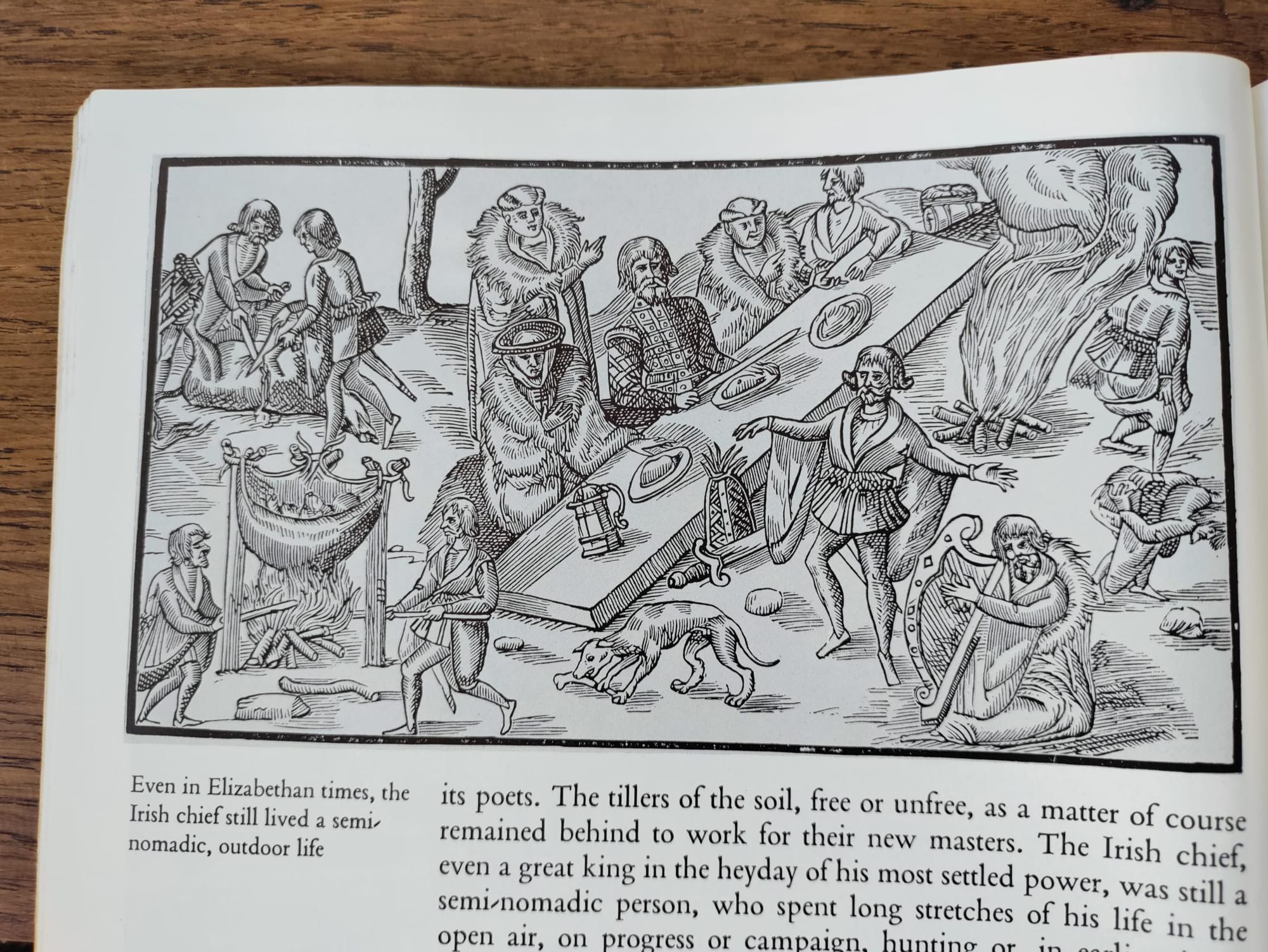
The Irish were constantly in revolt against the English rule at a time of Reformation and Counter-Reformation. Help came from the Spanish in the form of infantry, money and ammunition, specifically, something similar, perhaps, to the reported support of the Iranian state to the Palestinians.
A pattern was established that was to “prove enduring”: Catholic Ireland dominated by the superior force of Protestant England.
“Religion hardened, sharpened and preserved national animosities.”
The English, an occupying and invading force, were “heretics, their power was illegitimate” and therefore “rebellion against them was lawful”. Indeed, any enemy of the British were the “friends of Ireland and of the Faith.” For the English, their occupation “produced a feeling of insecurity […] the need for security produced strong measures”, which is interchangeable with the Israeli Iron Wall framework.
The best answer, notes the O’Briens. “from an English point of view, was to uproot the hostile native population, and replace them with loyal Protestants from England, Scotland, and Wales.” This the process, of course, by which Israel was created in Palestine.
Two Irelands were coming into being: a Catholic and Gaelic speaking Ireland, and a Protestant and English speaking Ireland. Economically and socially, conquest is said to have depressed the condition of the natives “to all but a very few.” Also, the O'Brien's note that if you weren’t Protestant (that is: the religion of the ruler), you were prevented from opportunities for learning and for social mobility or access to elite roles. One consequence of this is that the educated elite (all from the same social group) grew a contempt for the people they ruled.
In 1649 there was the execution of Charles, the death of Owen Roe, and the arrival of the great antagonist, Oliver Cromwell. In England, anti-Protestant “atrocities” had been widely publicised. Cromwell and his comrades “therefore felt fully justified in treating the Irish revels with the greatest ruthlessness.” By 1653 the Cromwellian forces had subjugated all of Ireland.
James II, an avowed Roman Catholic, aceeded to the throne in 1685. Many Irish Protestant left Ireland to go to England. These refugees became one of the “most important factors in turning James’s subjects actively against him,” a kind of equivalent to the modern-day Zionist lobby. In 1689 James arrived in Ireland, fleeing the ‘Glorious Revolution’ of 1688. Although he was supported by French advisors, French king Louis, who was at war with the Emperor and the Dutch (and England), could spare little time for Ireland.
William of Orange landed in Ulster in 1690, defeating James’s forces at the Boyne. “The Protestant conquest was now complete. The Catholic population was both crushed and hated by its masters.”
“English and Irish, pressed into closer contact by these forces, discovered how diversely history had formed them. Each side reacted to this discovery with that ethnocentric reflex of shock, disgust and anger, which is only the strongest and most terrible forces in human history. The weaker party was doomed to be oppressed, and the weaker party was the native population of the smaller and more remote island.”
The O'Brien's spend time outlining the Penal Laws, which were a series of anti-Catholic statutes introduced under William, which then continued through Anne and the first two Georges. This prohibited Irish Catholics from sitting in parliament; they were excluded from the bar, the bench, the university, the navy, and forbidden to possess arms. Much land passed into Protestant hands.
Edmund Burke described the system as follows:
“a machine of as wise and elaborate contrivance for the impoverishment and degradation of the people, and the debasement in them of human nature itself, as ever proceeded from the perverted ingenuity of man.”
It would be interesting to hear what this fellow would make of the system of colonial control that Israel has imposed upon the native people of Palestine. Indeed, the O’Brien’s note that the system was not meant to altogether exterminate the natives, as they were required for labour. For Israel, it might be said that they see an opportunity to source labour from elsewhere, and therefore the restless natives are to be removed by any means necessary. As the O’Brien’s remark, the system of the Penal Laws bore some resemblance to South African apartheid, which was previously used to reference Palestine, especially following the Six Day War and First Intifada.
“Had the chronology of conquest been different, a penal code based not on religion, but on a theory of preserving the purity of the ‘Anglo-Saxon race’ from ‘Celtic’ contagion, might perhaps have produced a more enduring conquest.”
This specific point is pertinent not only to Palestine, where the delineation is clear, but to modern society in Britain, where toxic actors are paid to fragment the populace and have them blame their problems and the ills of society on Islam or immigrants, where they speak of Great Replacements and contamination.
Nevertheless, there are always rays of hope. The O’Brien’s note that the “undoing” of this system was the division between the conquerors, that is: the English government, the Irish parliament (read: Irish ruling class and colonial outpost), and the Presbyterians of Ulster.
The English legislation and government practice, “by operating against Irish interests” including, principally, Protestant interests, served to foster a growth in a sense of Irish unity. They became “increasingly aware” that the distinctions of Catholic and Protestant was much more blurred in England. Over time, then, the parties who are manipulated come to see the hands of their manipulators; there is a struggle for power amongst the rulers; from within the system itself the people begin to recognise the flaws or shallowness of the narrative constructed for them.
The 1770s saw a relaxation of the panel laws, and concessions generally. This was, the O’Brien’s argue, in part impacted or influenced by the “outbreak” of the American War of Independence. In Ireland, there were many pro-American voices, and the parallels between the colonies would have been all too apparent.
The French Revolution followed and this influenced the Movement of United Irishmen, led by Theobald Wolfe Tone, who “sought to make Ireland a republic on French principles, and to break the connection with England.”
Rebellions, such as in Ulster in 1797, were put down with severity. An alternation of conciliation and repression was to be the rhythm for more than a century to come. In 1800 we had the terms of Union presented, and in 1801 the United Kingdom of Great Britain and Ireland came into being. This raised hopes of Catholic emancipation, but none was forthcoming.
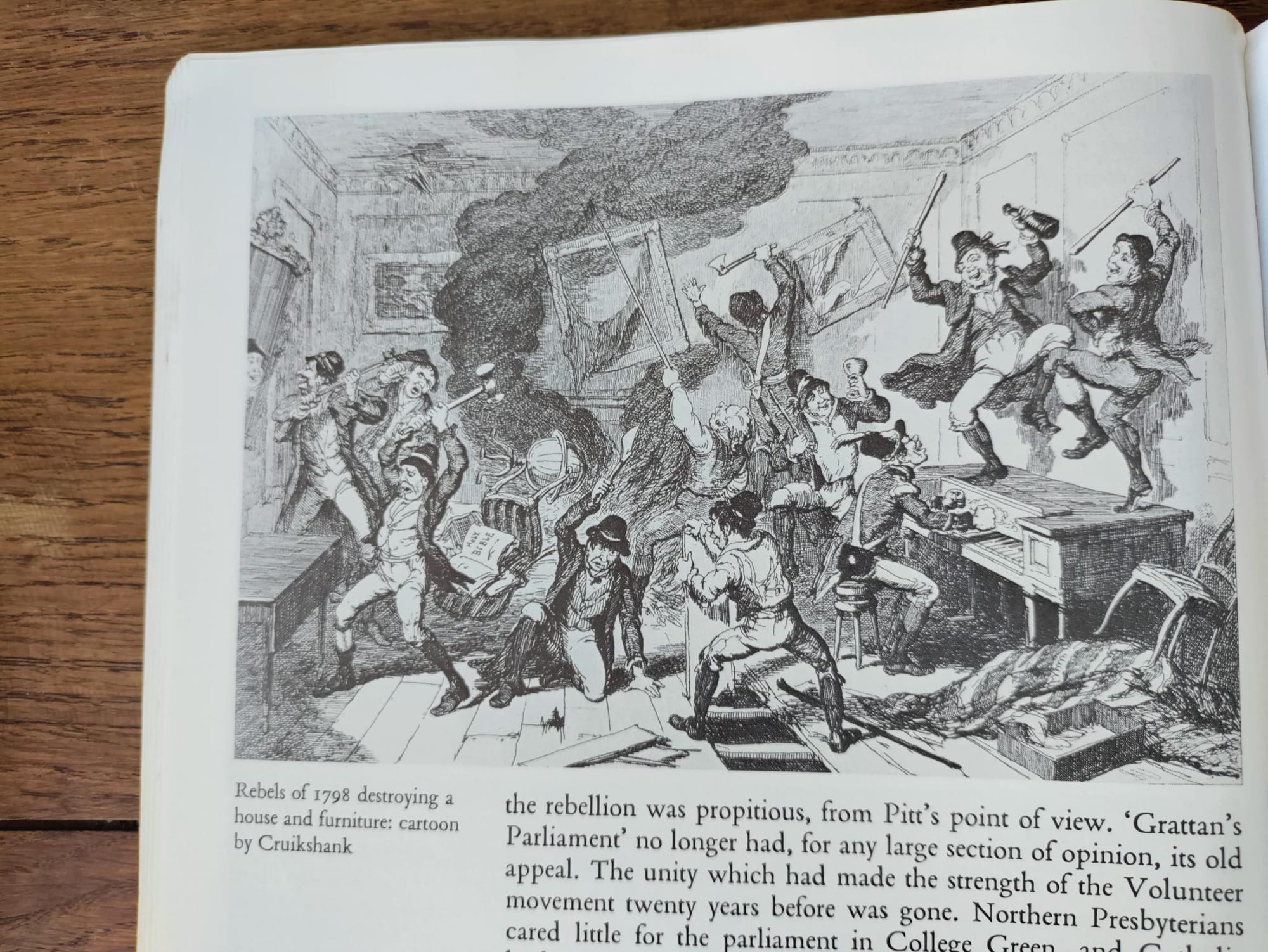
Catholic leaders felt betrayed. The lines became clear again: Protestant and Unionist became synonymous with one another. Catholic rejection of union had various names: Repeal, Home Rule, Sinn Fein.
The Protestants, write the O’Brien’s, had become what they were in 1690: England’s garrison in Ireland. This, too, bears some connection to Palestine today, where some argue that the role of Zionism and Israel is overstated, and that in fact the atrocities are done in their name only, with the direction from the USA (and, by extension, parties such as Britain and Germany).
The O’Brien’s describe how over the next century there was a “process” of winning emancipation for Catholics to sit in parliament. Ultimately, as so often is the case, when the oppressed or under-represented people won a voice, this led to the breaking of chains over time.
There came a well-documented failure of potato crops in 1845, 1846, and 1847. The population sat at 8 million in 1841, up by 5 million at the time of union. The O’Brien’s ask whether the famine, which they describe as “the great dividing-line of modern Irish history” could have been avoided? Perhaps, they state. The government and economists of this time “were inclined to regard the sufferings of the poor, of whatever nationality, as part of the natural order of things.” They also note that the Industrial Revolution had largely passed Ireland by, except for in the north-east. In addition, trade between Ireland and England (and elsewhere) meant there was a dependency on the potato crop, further perpetuating the crisis.
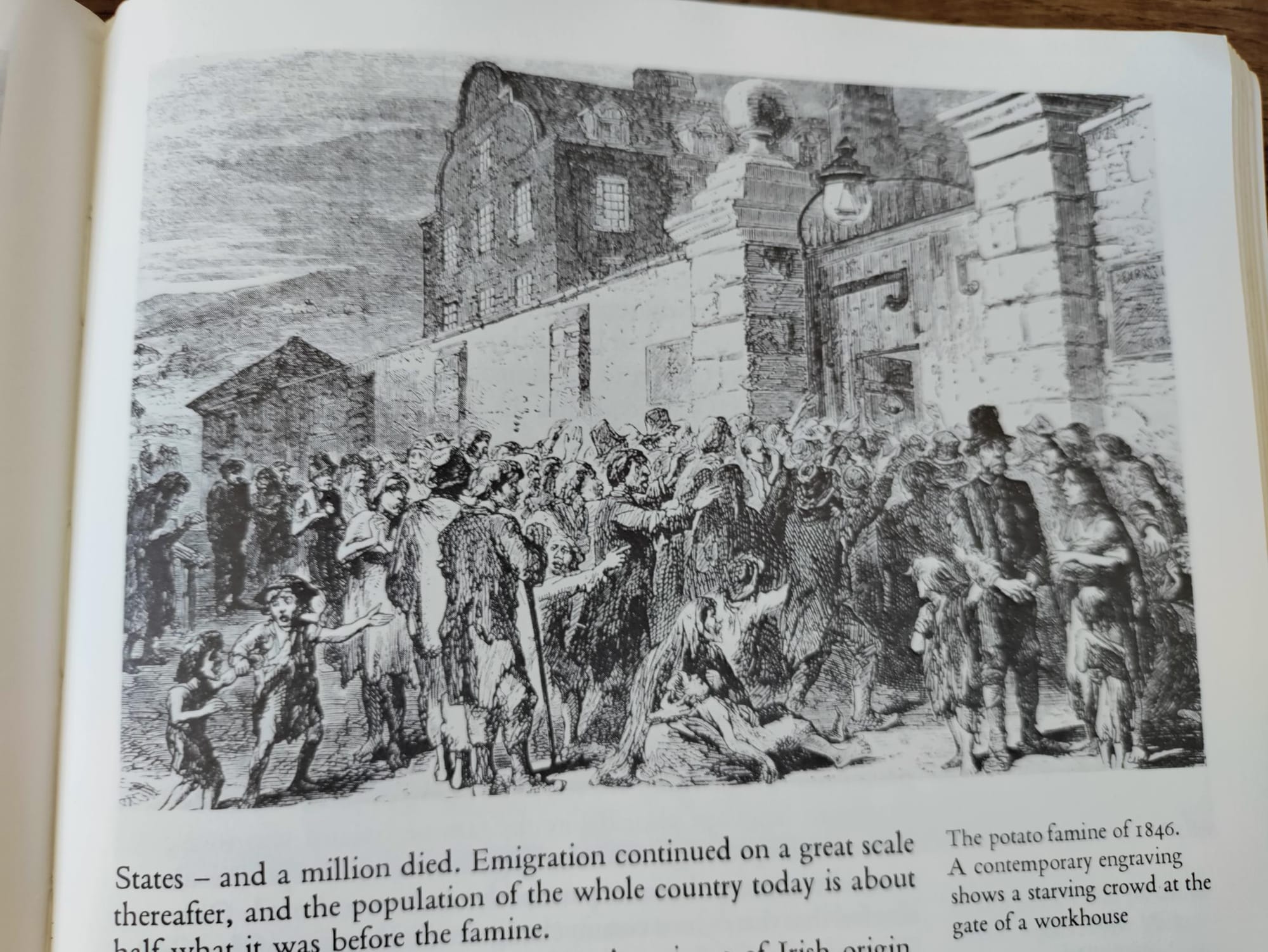
We should note here that there is currently an engineered famine taking place in Palestine, with the use of starvation seemingly an intended tactic by Israel. There are other examples of colonial famines, such as in India, but the links may be argued by some to be tenuous.
One unintended outcome of the Great Famine, in which around 1 million people died, however, was a great migration to the USA. This would come to have some significant importance on the founding of a republic as Irish-Americans increasingly became a factor:
“by the 1920s, the government of Lloyd George could no more afford to ignore the Irish of New York […] than Ernest Bevin at a later date could ignore the reaction of the Jews of New York to his policy in Palestine.”
In other words the diaspora, having built cultural, economic, and political capital abroad (specifically, that is, in the USA), were able to exert influence on the ruling power of the oppressed peoples. The clear difference here is that whilst the Irish diaspora were able to advocate for the Irish in their homeland, the Jewish diaspora (or, more accurately, perhaps, the Zionists) exerted influence that can be said both to have been advocating for settlers in Palestine but also detrimental to the native indigenous peoples: the Palestinians.
The O’Brien’s compare the post-Holocaust Jews to the “dour generation of Irishmen that broke the landlord power.” He adds how the “efforts of those at home were sustained by the many of the diaspora.” They mis-step, however, in my opinion, and there are significant flaws in their reasoning. For one, the Irish had not invaded a land, or, if we are being more careful with our language, the Irish were not escaping persecution from one land and settling in another, already inhabited, land. The Jews of Europe were oppressed and mistreated, that much is sure, but their oppressors were not the Palestinians, so comparing this to breaking landlord power is demented.
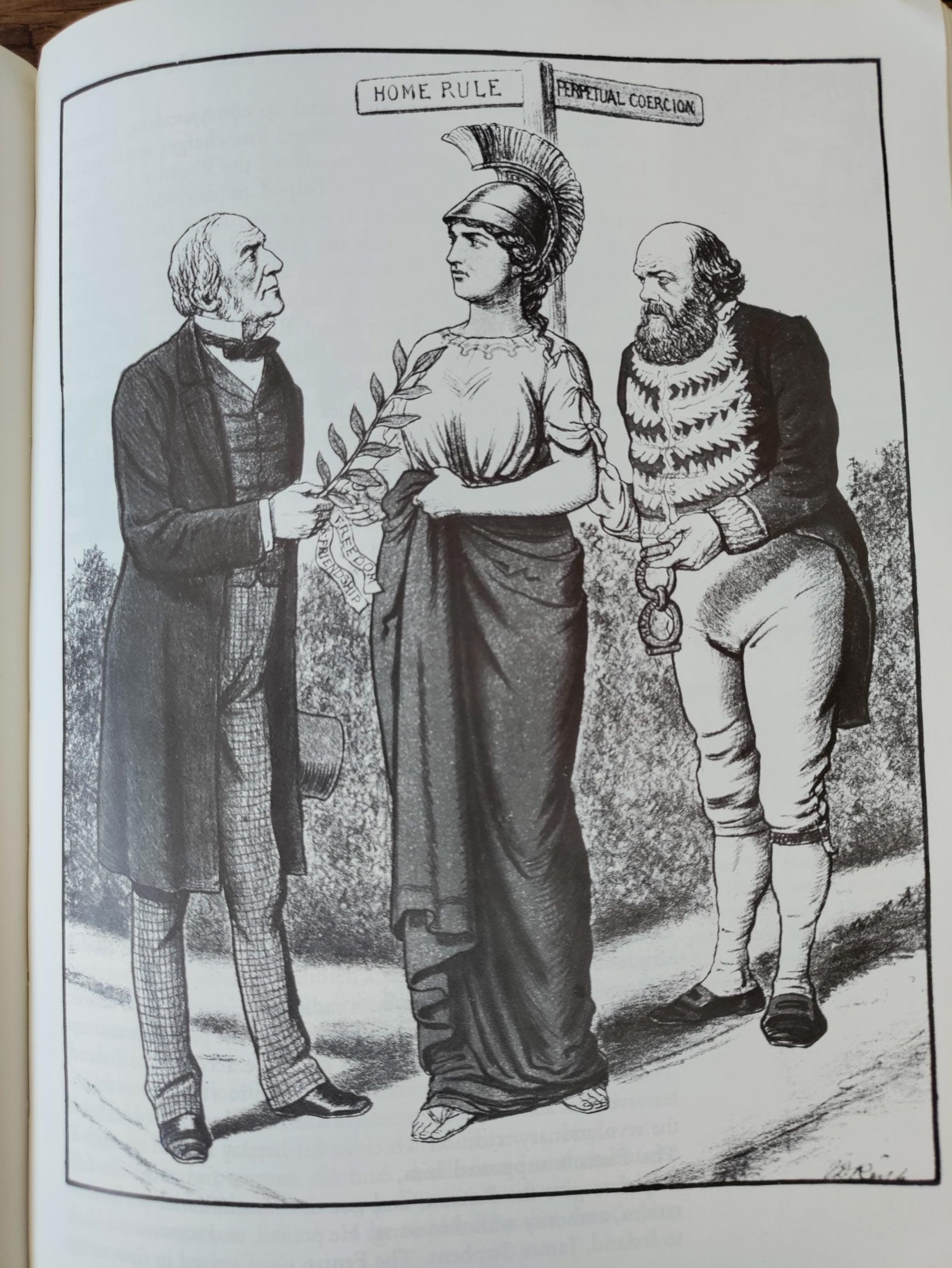
The next key figure is a giant of modern Irish history: Charles Stuart Parnell, “an unrivalled master of political tactics.” He was a Protestant landlord, elected for Meath in 1875, whose family contained an anti-English strain. He took up the Land League cause. In 1881, Gladstone had carried through a Land Act, “conceding a number of principles which the tenants had long been demanding,” such as legal assessment of fair rents and security against arbitrary eviction.
Gladstone then attempted to introduce a Bill granting Home Rule to Ireland, but this was defeated by a section of Liberals and the Tories. The English were no longer the enemy; it was only a section of them: the Tories and Joseph Chamberlain.
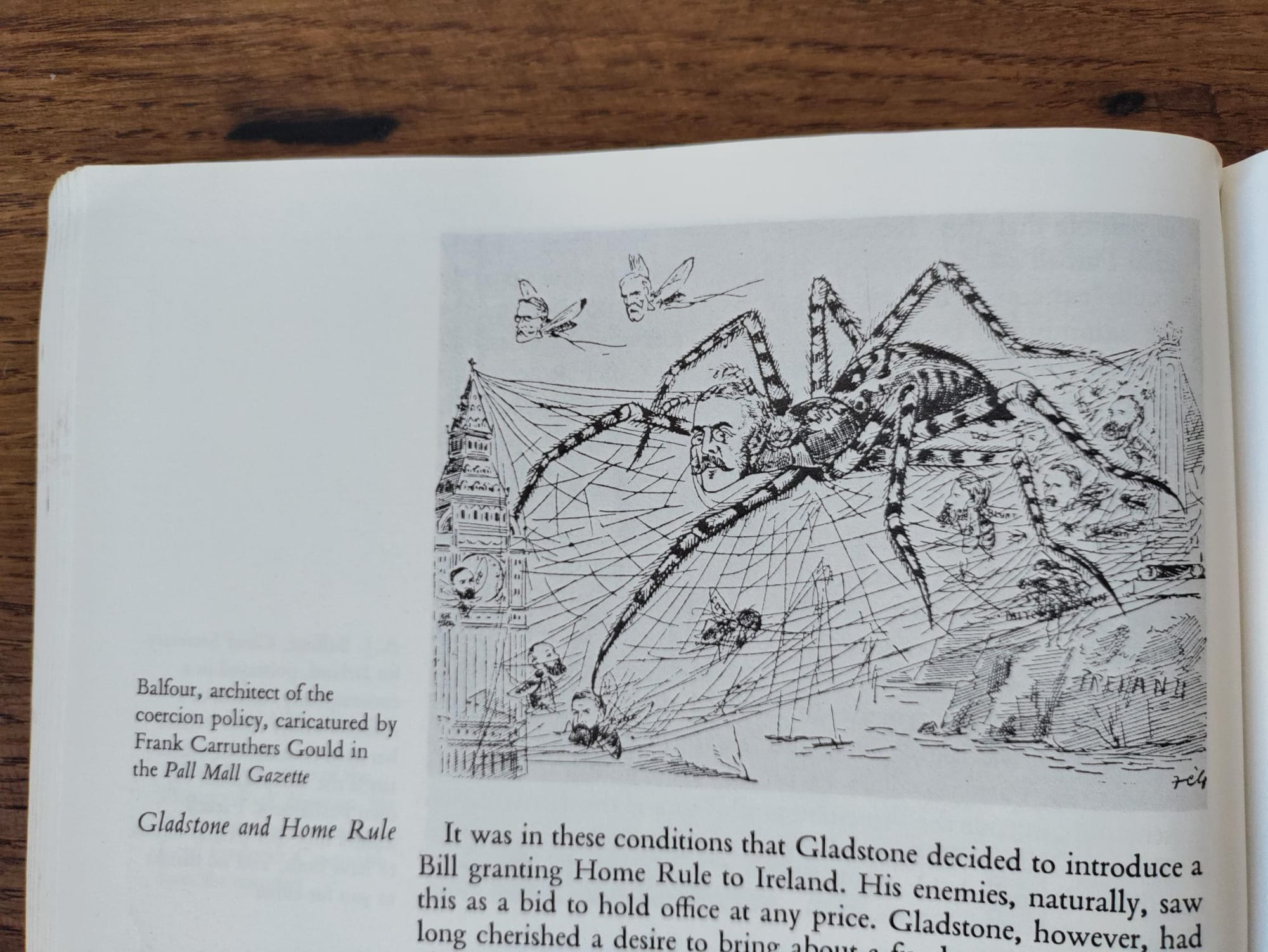
Parnell fell from power in 1891. In the words of Yeats: “a disillusioned and embittered Ireland turned from parliamentary politics.”
The Land League generation felt “shame at the passivity” of the sheep-to-the-slaughter generation of the Great Famine, and in turn the Land League generation were looked upon as treacherous by the next generation (Joyce and Yeats, for example) for throwing Parnell to the wolves. One other effect of this time was that the Catholic clergy’s authority was impacted. It was felt that politics lay outside of this “sphere.”
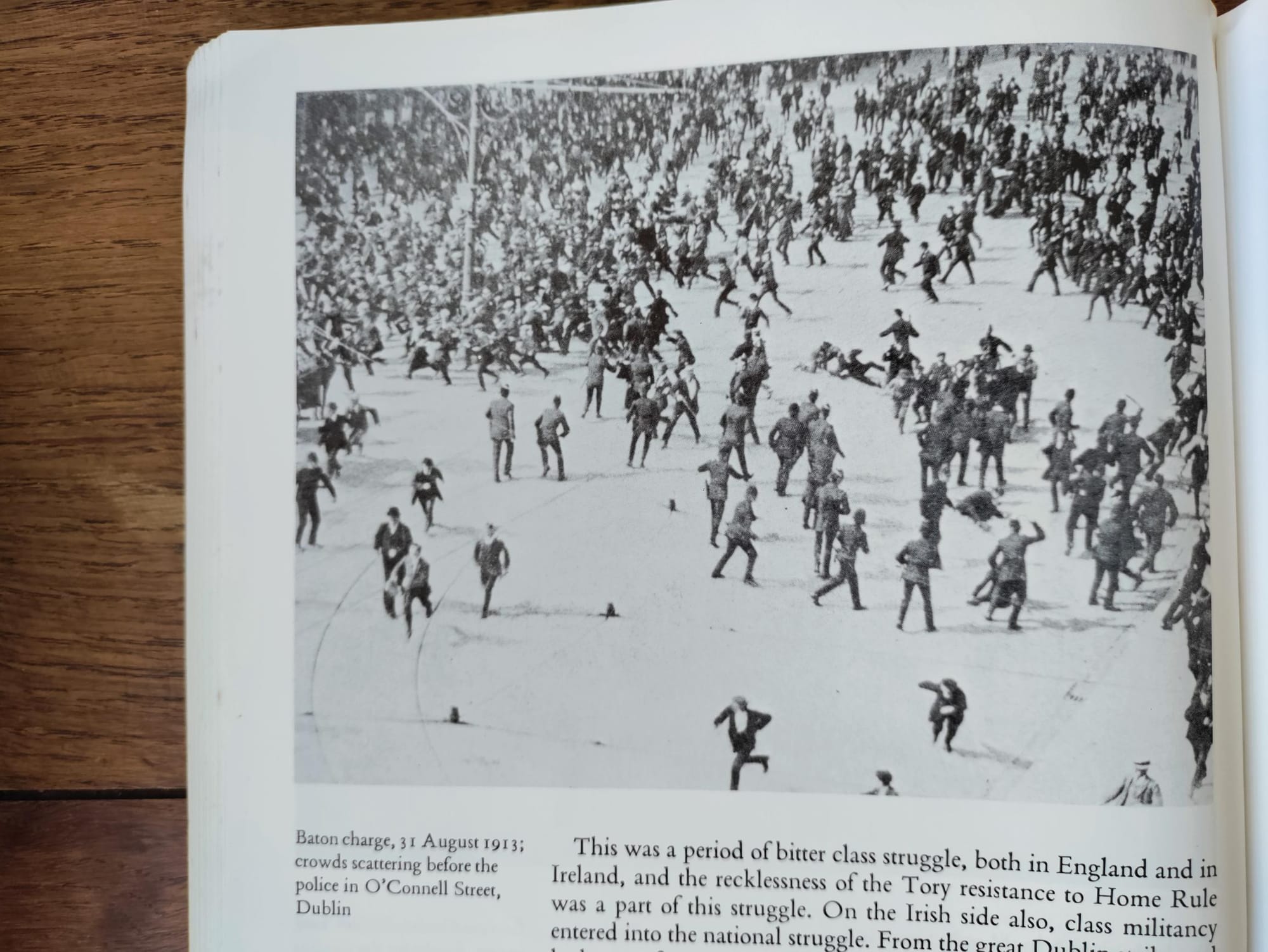
A third Home Rule Bill was put forwards in 1912, but again was rejected by the Lords. Ulster Protestants were also opposed, however, as Home Rule, for them, meant “Rome Rule.” This opposition went to the length of threatening civil war. They formed an Ulster Volunteer force in 1913. The Bill was amended to allow for Ulster counties to opt out.
During this time the O’Brien’s note the bitter class struggles in England and Ireland. The Ulster Volunteers were emulated, with a focus on nationalism, and an Irish Republican Brotherhood was formed in 1913.
The brewing civil war, however, was postponed by a World War. In 1916, on an Easter Sunday, an uprising occurred in Dublin in which a Republic was proclaimed. After a week’s fighting they surrendered, were court-martialled and executed. Popular support swung towards Sinn Fein, who in turn set up a Republican parliament, the Dail Eireann, who first met in 1919.
They demanded the “evacuation of our country by the English garrison.” The British government were now committed to partition.
There followed two-and-a-half years of guerilla war. The guerillas were known as the Irish Republican Army (IRA). There were some 1,500 men against 43,000 British, including the Royal Irish Constabulary, strengthened by recruits from England, called ‘black-and-tans’ for their half-military and half-police uniform.
The British tried to break the sympathy that citizens had for the guerillas by “counter-terrorism”: that is: collective reprisals (cough cough, Israel). This was conducted on a “brightly-lit stage” (cough cough, Israel) and “horrified many people in Britain” (cough cough, Israel). Many were “revolted by the spectacle of what was necessary to repress them”. The parallels to events in Palestine today are too obvious to expand upon.
“In these conditions the repression would have had to be conducted with exceptional efficiency and speed in order to achieve political success.”
There was a small window of time for the oppressor to conduct itself. Over the course of last few decades, however, the ability of the oppressor to extend this window of time, or to shift people away from the window, has become more subtle. And yet people still have eyes that can see, ears that can hear, and hearts that can feel.
There are many disturbing outcomes from the ongoing genocide taking place against the Palestinians by Israel and the USA, with the support of nations such as Britain. The first is clearly the suffering being wrought against people, children included, non-combatants, prisoners, the voiceless. The next is the impact of this on observers. Why can’t we stop this? What can we do? How do we oppose this? Some actions feel incredibly futile, but there is a feeling of madness and incredulity when people ignore or try to rationalise the acts: it goes from ‘we didn’t bomb a hospital’ to ‘Hamas bombed the hospital’ to ‘we bombed the hospital but there are Hamas operatives there’ to ‘the hospital is covering a military base or network of tunnels’ to ‘all hospitals are covering tunnels’ until, of course, there are no more hospitals. We can then substitute hospital for any number of terms, be it university or aid camp or journalist or child.
With this in mind, we must consider what will mean for humanity as a whole? We watch this unfold before our eyes and only a small minority takes some steps of action. The only physical actions being taken (in terms of meeting force with force) outside of Gaza appear to be some direct action protests (such as by the proscribed Palestine Action) and states such as Yemen. But if this is the system of oppression in place and the lengths the oppressor will go to secure their ends then the citizens within the USA and Britain etc need to consider what it means for them also.
We can also consider: what does this mean for the ways in which Israel, the USA, and others are perceived? Clearly the whole idea of a rules-based international order has been, at best, undermined. Any state can now take abhorrent actions against others and simply dismiss or divert/distract. Perhaps it has always been this way?
In fact, we have been here before, such as with the First Intifada, or even with the revelations about how the USA has operated in lands across the globe, and yet the people are unmoved. In this summary of Ireland, even, we have some detestable practices by the British, and yet we can always point to the omissions of history, the lens being applied. Empire had its benefits, didn’t it?
The Government of Ireland Act of 1920 established separate parliaments for “southern” and "northern" Ireland. In 1921, President de Valera received a letter from the the Prime Minister proposing a conference, with a truce declared on 9th July. There were “complex and ambiguous” negotiations.
Lloyd George’s “masterstroke” was a Boundary Commission which could review the border between north/south. The Treaty was signed on 6th December 1921. Troops and black-and-tans would go home. There was some relief, but some who felt the government were treacherous. Sir Henry Wilson, advisor to the north and former Chief of the Imperial Staff, was assassinated by the IRA in June 1922. There were clashes between the pro-treaty and anti-treaty factions on Sinn Fein.
De Valera’s constitution of 1938 established sovereignty of the former free state, which was now named Eire (Ireland). During the Second World War, neutrality was thought to be the “wisest policy for a small country”, though de Valera supported sanctions against Italy in the “Abyssinian Crisis” despite Catholic sympathies. He also enacted a wartime policy of not allowing Ireland’s territory to serve as a base of operations against England.
The O’Brien’s note that Ireland had, for many years, a “censorship of literature, aimed against obscenity but so interpreted as to attempt to exclude all modern imaginative prose writings of importance.” This also included laws against divorce and contraception which were passed under clerical pressure, which sounds like something you would find about Iran in The Economist.
The link with the Crown was severed by the forming of the Republic of Ireland in 1949, placing them outside the Commonwealth. From 1951 to 1969, “Irish politics and Irish generally followed a fairly humdrum course.” Government policy became more “conventionally western, and more congenial to the United States.”
The Population of the Republic, note the O’Brien’s, was “almost homogenous”. In the south, Protestants accounted for 5%; in the north, Catholics accounted for 33%, so there were some potential demographic flashpoints. As a result, the Ulster Protestants regarded the Catholic population “as a kind of fifth column, against which precautions had to be taken.” Fears of this became the “stock in trade” of the Unionist party. “These fears have furnished that party with an unbroken monopoly of political power.”
This power was used against the Catholics. Key localities with Catholic majorities were “gerrymandered” to produce Protestant councils, who in turn gave jobs and houses to Protestants in preference to Catholics, pushing them to “emigrate”.
The O’Brien’s write about the move for civil rights. In August 1969, a Catholic quarter of Derry known as Bogside resisted police attempts to enter. As a result, “serious sectarian fighting broke out in Belfast.” The British government intervened, sending the army. Some Catholics actually welcomed their arrival as a kind of protection against Protestant extremism, but were also suspicious of their bias and reliability. They sought arms from elsewhere, including from the United States and the Provisional IRA.
The O’Brien’s assert (and this is from a revised third edition from 1985), that “the policy of the Provisional IRA has been, and still is, to unite Ireland by a combination of para-military violence and effects to mobilise public opinion.”
They began a “long series of bombings and shootings – mainly in Northern Ireland but occasionally in Britain, and more rarely in the Republic.” There were “equally savage acts” carried out by Protestant extremist para-military groups, but “more rarely.”
The British reacted to the violence, which the O’Brien’s note included “systematic stonings by unarmed youths”, was to turn the Catholic propaganda against them. In January 1972, British troops fired at rioters in Derry, killing 13 men. There was “indignation” in the Republic and in the USA, which led to a “reconsideration” of policy. They prorogued the Stormont parliament and government.
The Edward Heath government attempted an agreement/solution such as the Sunningdale compromise of 1973, which was rejected by both extremes in Northern Ireland. “Since then, the reality in Northern Ireland has been that of direct rule from Britain.”
The O’Brien’s end by noting two “realistic” (their emphasis) prognostications for Northern Ireland: one “uninviting”, and the other “terrifying”. The former would be “indefinite continuation of direct rule from Britain against as much resistance on the part of the IRA as they can muster.” The latter would be British disengagement, following which civil war would follow.
For the O’Brien’s, only two things were within British power: to stay and to govern, or to pull out and let events take their course.
They end with words for the future historian:
“We do not believe that Britain will abandon Northern Ireland during the present century, and by the end of the century it is possible that a realistic historian, surveying the state of the problem as it will then present itself, may be able to end his work on a more optimistic and encouraging note than it has been possible for us to do realistically now. We pray, for the sake of both historically bedevilled communities in Northern Ireland, and for all the people of the British Isles, that that may be so.”
Following this specific publication, which were the early years of my life, I seem to recall that the news was often dominated by events in Ireland. I recall a bombing at a hotel targeting Margaret Thatcher, for example, and I seem to recall another such event (perhaps involving a bus?). There are then some hazy recollections of a Good Friday agreement, and of Tony Blair being praised for something or another.
Aside from this I don’t have much knowledge of Ireland save for some visits, which were mostly decent experiences. There seems to be a lot of chat now, as there is elsewhere in the so-called West, about immigrants and the impact on the supposed natives. One of the key factors we can notice in the history (or more recent) history of Ireland is the fragmentation of people through such as thing as religion, which for the most part was a kind of allegiance to a polity and power structure. This fragmentation occurs today in the discourse around immigration and what it means to be Irish or English or British and so on.
The other key learning we are focusing on here are the links to Palestine. It is clear that the British in this example equate to the Israelis in terms of the role of colonial oppressor, especially in their practice. The British, however, accepted at an early point that they would not, or could not, exterminate the native population, and instead refined their system of control until they could do so no more, though still retaining a kind of outpost on the island itself. The Israeli method, perhaps with the example of Ireland in mind, favoured outright appropriation, mass evictions, and the extermination that we see today, for which we are all, to varying degrees, accountable.