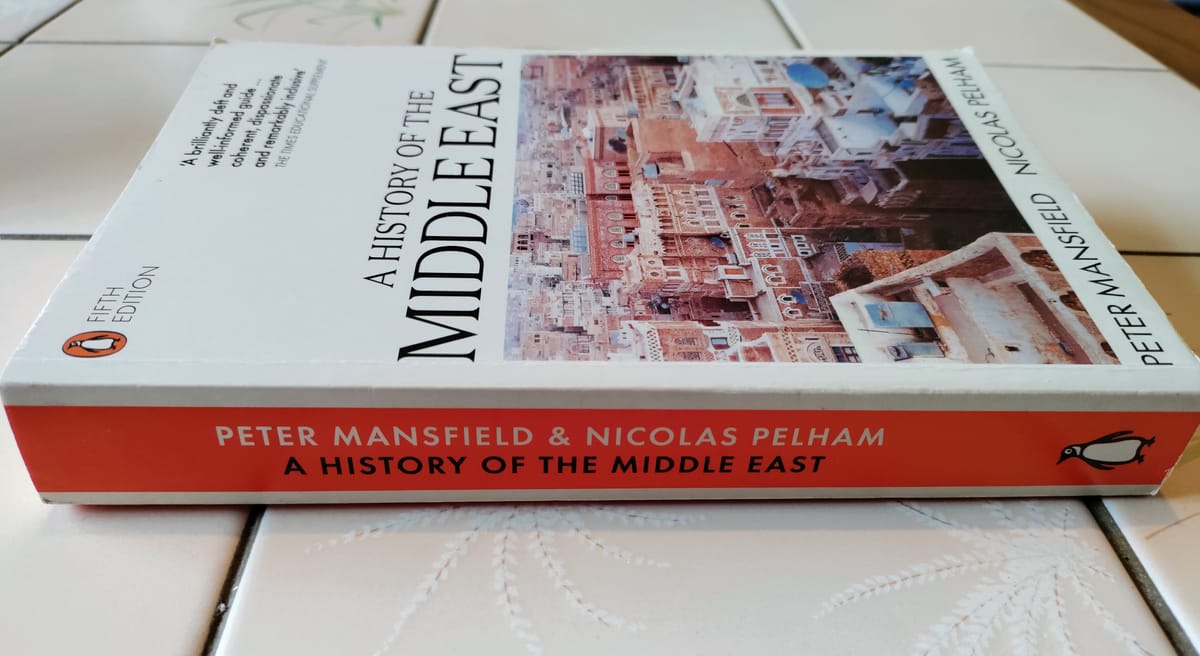
A History of the Middle East (Peter Mansfield and Nicolas Pelham)
With so much going on in the so-called Middle East, including an ongoing genocide, it felt only right to try and learn about the region in more detail, including looking at some of the key events that have led us to where we are now.
Peter Mansfield and Nicolas Pelham’s A History of the Middle East (5th Edition, 2019), which will surely need an update to recount the events of the past 5 or so years, is a fine accomplishment in giving an overview of the magnitude of human history taking place in this region. With so much history, however, the bulk of the text is devoted to the past 200 or so years. The introductory chapter offers us a very broad overview.
Broad Brushstrokes
Mansfield introduces the term Middle East as a “eurocentric” term which “assumes a western domination of the world”. It is certainly a handy, if slippery, term to refer to a general geographic region for someone living to the west of the landmass. It is east of western Europe, to be sure, but it is to the west of China, to the north of Mozambique, to the south of the Eurasian steppes.
We can centre the region as the so-called Cradle of Civilization, with the Nile Valley and Delta, Mesopotamia, and the twin rivers of the Tigris and Euphrates where Hammurabi wrote his codes, Akhenaten embraced the worship of the sun, and Ramesses II (or Ozymandias) led military expeditions into the Levant and Palestine. “All the great powers” writes Mansfield “fought over and occupied this stretch of land” by which he refers to the so-called “Fertile Crescent” which stretches from Egypt through to modern-day Turkey.
It is “an astonishing and productive mixture of peoples and cultures” - not only of the Non-Semitic and “highly civilized” Sumerians, but also of the Semitic Amorites, the Babylonians, Egyptians and Hittities, the settled inhabitants of Syria and Palestine (Mansfield refers to them as Canaanites, who “did not constitute a single race”), of Phoenicians, Arameans, and the Hebrews who supposedly escaped Egypt and invaded “the land of Canaan” but who “had to contend with a new wave of invaders […] the Philistines,” which Mansfield equates with Palestine. It should be noted that he regularly references the Bible as historical fact, so there is some fragile ground in his overview. He also makes references to the “religious genius” of the Jewish people. This was, he writes, “by far the highest system of morality to be developed by mankind before the coming of Christ.”
With Egypt in decline, the Assyrians arrived. They were in turn defeated by the Chaldeans, until Medes and the Persians and Cyrus II (the Great) became “masters of the whole civilized world […] apart from China.” Huge epochs of time are covered in the introduction – each civilization deserving of their own volume.
The Biblical references are questionable, but there are also some worrying steps into race science in Mansfield’s introductory overview. He writes of the “racial origins” of the Arabs as being “highly obscure” and makes reference to their distinctive noses. He again references the Bible when noting that the word “Semite” derives from Shem, the “eldest son of Noah, from whom all Semitic peoples are supposed to be descended”, though he notes that this is not a “racial term but a linguistic term, invented in the late eighteenth century […] to denote languages.” His odd fixation with races continues when he writes of the “fruitful synthesis” of races in the region. By all means classify people according to civilizations or empires or political units (as difficult as that may be), but it becomes extremely murky when we try to assign race to such as huge spread of humanity within a huge spread of geography and time.
Following the conquests of Alexander, Hellenism took root. Next came the Romans and the Parthians and the Nabataens. Already so much history, so much ebb and flow, so much rise and fall, centuries contained within a single sentence. The Pax Romana declined; the Sassanian Empire arrived. Emperor Theodosius split the Roman Empire into two.
With the arrival of the Prophet Muhammed, Islam “completes and perfects” Judaism and Christianity (which has been widely accepted ever since and has not led to any difficulty whatsoever). According to Mansfield, with Islam there was no separation between religion and politics, and no secular state.
The Arabian peninsula was a “conglomeration of petty autonomous states grouped around tribal confederations […] largely nomadic […] animists by religion [with] no written codes of law […] not a high culture […] but it had a matchless asset in the Arabic language, with its limitless power and flexibility and supreme artistic achievement of its poetry.” Islam rolled through the region, despite its first and only great division between Sunnis (who are the majority) and the Shia (attributed to about 10%). There was the triumph of the Ummayads until their defeat to the Abbasids, who shifted the centre of power to Baghdad “inaugurating the Golden Age of Islam – one of the high peaks of human civilization.”
During this process of “Arabization” and “Islamization” three languages remained: Arab, Persian, and Turkish, whilst three important minorities “resisted assimilation and retained their national identity – Armenians, Kurds, and Berbers.” Mansfield notes that under the so-called Islamic Middle East “the principle of ethnic equality came to be accepted” with language and religion as the “cement”.
The mercenary army of the Mamlukes seized power in Egypt, as did the Fatimid Dynasty (969 CE). At this time “Syria/Palestine resumed its historical role as the battlefield for struggle” between powers. The Byzantine, Abassid, and Fatimid Empires were all in decline when Seljuks (Turkish nomads from the central Eurasian steppes) “burst onto the scene”. With the Byzantine Empire “in danger of collapse” Emperor Alexius appealed to Pope Urban II for help to fight “infidel invaders,” leading to the First Crusade. Byzantium, Mansfield writes, had “protected western Christendom from Islamic invasion and expansion.” These Crusades led to Islam’s “retreat into isolationism.”
The Mongols, such a “terrifying threat,” seized Persia, captured Baghdad, and “eliminated the last ghostly relic of the Abbasid Caliphate.” But the Mamlukes defeated the Mongols in 1260, saving the Muslim “heartlands.” This, writes Mansfield, was one of the “decisive battles in the history of the world.”
Following this we have the rise of the Ottomans. Distinguished by their “wisdom and statecraft”, they applied principles of toleration, and they were a multilingual and multi-ethnic entity that had “much in common with the Roman Empire.” The Ottomans eventually conquered Constantinople in 1453. Mansfield writes, however, that “all great multiracial empires decline and dissolve.” I wonder why the need to refer to the supposedly racial element of the empire? Isn’t it more accurate to say that all empires decline and dissolve, regardless of the human population within them?
The Ottoman Empire
Understandably, the Ottoman Empire occupies a key part of the text, as this precedes what we might consider to be the more recent, modern-day events (that is, up to the end of the First World War, when the empire fell). The Ottoman Empire was active from the 14th Century, but as the nineteenth century was closing it was known as “the Sick Man of Europe” (of Europe, that is, not of the Middle East or of the Arabic lands and so on, but “of” Europe). Mansfield lists some of the key characteristics for this decline:
- Huge military organisation;
- Highly centralised and feudal (but not a European style of feudalism by which land could be inherited leading to a feudal nobility to balance the power of the monarch);
- The Sultanate as a “rigid despotism” with imperial fratricide, elimination of rivals, and the Sultan’s palace as a “cauldron of mistrust and fear”;
- A “contempt for industry and commerce”.
It was, on the plus side, socially egalitarian, encouraging a meritocracy where anyone could rise through the social hierarchy regardless of where they had been born or what they had been born in to. Despite its proximity to Europe, however, the “great movements of ideas in western Europe from the Renaissance through the Reformation and Counter-Reformation left the Ottoman world almost untouched”. But Western Europe would soon take a keener interest in the Ottoman world when Napoleon defeated the Mamluke army in 1798. This brief episode in Egypt aroused a “wave of interest in the Arab/Islamic regions of the Ottoman Empire” and led to a “prolonged struggle for influence and control over these territories.”
Enter Great Britain, whose interests at this time were primarily over the Gulf waters for trade. Various treaties and truces were held with the rulers of the Gulf coast, and Britain’s interests were largely maritime (for access to the Indian ocean) and commercial rather than imperial. This would not hold, though.
Egypt, Mansfield writes, “lends itself to centralised rule: anyone who could control the river and its delta would dominate the country.” In the mid-18th Century, the religious reformer Muhammad Ibn Abd al-Wahham formed a formidable alliance with an “outstanding local tribal dynasty, the House of Saud.” They spread north into the Gulf and Mesopotamia. Muhammad Ali, in control of Egypt, was asked by the Sultan in 1807 to send an expeditionary force to the Hejaz to recover the holy places of Islam from the Saudi/Wahhabi invaders. He succeeded in 1818. Muhammad Ali’s conquests in turn laid the foundations of the modern Sudan, “the giant of Africa – part Arab and Muslim and part Christian and pagan and black.”
Muhammad Ali, emboldened by his successes, then sought to challenge the Sultan. He requested the support of the Royal Navy, but the cabinet refused. Lord Palmerston regarded this as a great error. Ali then requested the support of the Russian Empire, which in turn alerted Britain and France to the danger of Russian ascendancy. In this way, the “Palmerstonian doctrine of imperialism was developed” which was “not directed at the acquisition of colonies […] but to the instant protection of British interests wherever they were threatened.” At that point this concerned the trade route through the Gulf and Red Sea, Alexandria and Suez. “Britain was determined to foil Muhammad Ali’s ambitions.”
Following Mahmud II’s death, there were some notable changes in governance, including the recognition of “all Ottoman citizens to be perfectly equal before the law, regardless of race or creed.” There was also the demotion of the Sharia courts, and the “process of the secularization of the world’s leading Islamic power had begun.” This reorganisation (or ‘Tanzimat”) occurred in 1839. In addition, military schools would have foreign instructors, there would be a creation of a state university, a Ministry of Education was established with a secular education being created. These reforms were expensive, which related to the “single greatest weakness of the empire and the primary reason for its failure to match the power of Europe – finance,” especially Britain and France who were by this time in the second stage of their Industrial Revolutions. In fact, the Ottoman Empire needed loans from the British and French in 1851.
In a sense this brings to mind Japan’s Meiji Restoration following the arrival of Western gunboats, though without external financing. There is always a need to learn from others, to absorb and evolve rather than stagnate. It could be argued that this is the curse (and responsibility) of the ruling class: to ensure that the society or state or political entity does not stagnate, and to ensure that the ruling class is self-sacrificial rather than predatory and decadent (is this ever the case?).
One of the main consequences of the rivalry between European powers was the Crimean War. Russia proposed to Britain that they partition the Ottoman Empire, but Britain remained suspicious – it wanted, Mansfield writes, to keep the sick man alive for as long as possible “to prevent any of his vital organs from falling into Russia’s hands.”
In addition, there arose a dispute between Russia and France over “control of the holy places in Palestine.” War was declared when Russia occupied the Danubian principalities of Moldovia and Wallachia, and in March 1854 Britain and France declared war on Russia. This ended with the Treaty of Paris 1856, which is regarded as an “admission of Turkey into the so-called Concert of Europe” but which, Mansfield writes, was “highly patronising.”
There was no prospect of a Great Leap Forward for the Ottoman Empire: “expenditure always outran revenues”. They needed to take the “fatal step of using receipts from foreign loans to meet the growing deficits.” As is often the result, revolution grew out of disaffection with the ruling class. This took the form of the Young Ottomans, a collection of people who had been travelling and studying abroad, who were familiar with concepts such as the Enlightenment and the French Revolution, who “reacted with shame and anger that Ottoman society had become so backward and impoverished in comparison with the west.” Could it be argued that within the next decade or so we will see an inversion of this, where people in the western societies see the differences in standards of living between them and places such as East and South Asia? Who will be the dominant voices in disaffected communities and societies – will there be voices of reason, tolerance, of critical thinking and innovation? Or will the voices be hateful, vengeful, ignorant and dulled?
At this time, some of the Young Ottomans wanted to introduce western concepts such as constitutional government, though others wanted to revive and restore the true principles of Islam. Indeed, Mansfield notes that “these opposing trends exist throughout the Muslim world to the present day.” Is there a corollary in the west? It can’t be said that Christianity has the same unifying factor as Islam – in name it professes peace and tolerance, but in practice it seems more likely to be closed and destructive, although perhaps it has enough room for adaptation? Populist nationalist movements seem more likely to grow, but these have only a limited scope for unity, and at their core lead to exclusion and force. Interestingly, the Young Ottomans was a secret revolutionary society created in 1865 and they were strongly influenced by French writing and ideas but also “intensely patriotic.” Their discontent was “fed by the constant, humiliating erosion of Ottoman power at the hands of Europe.” Perhaps the unity within a state such as the UK will come about from recognition of the true causes of people’s difficulties and disaffection: in some minds these are equated to the ultra wealthy and the gross inequality within society.
Much of the 19th Century development of the Ottoman heartland, such as railways and banking, was due to privileged foreigners. Abdul Hamid and his ministers, however, were keen to keep the telegraph in their hands: this was to maintain their despotic and centralised power over the empire. Control over what the citizens hear and have access to is a key aim for the ruling powers.
In 1895 and 1896 there were brutal massacres of Armenians, who were seeking a fully independent homeland. News of this struggle and of the massacres was not being heard outside, so in August 1896 a group of Armenian revolutionaries raided and occupied the Ottoman Bank in Istanbul. A reprisal followed. As an interesting contrast to current events in Palestine, “now the powers of Europe could not ignore what was happening.” Nevertheless, as with today, the main powers only had an interest in maintaining their empires rather than justice for humanity.
Whilst the Ottomans attempted to forge new alliances, including with Wilhelm II of Germany, who was “unstable, autocratic and ambitious,” there was a more comprehensive development taking place in Egypt due to their “open-door policy” in which foreign entrepreneurs paid little tax, and the structures of modern society such as railways and telegraph, bridges, and the Suez Canal were built. But the mass of Egyptians had little improvement to their lot. In fact, as a further corollary to modern Britain, more and more land passed into the hands of the ruling classes.
Ismail’s debts (which may or may not be the title of the debut album of Finland’s heavy metal pioneers The Eternal State) grew so great that he was obliged to sell his 44% share of the Suez Canal Company to the British government, secured through a loan from the House of Rothschild. In the aftermath of this embarrassment, the Egyptian army (“the only institution which Egypt now owns”) came to dominate the nation, with the mass of people giving it support. Britain was obliged to intervene/invade, taking control and installing a khedive puppet. Their power was “overwhelming, but it always had to be exercised with apparent restraint.” They were fearful of provoking a European War.
Evelyn Baring (later Lord Cromer), took control in 1883 for 24 years seeking to stabilise and protect the regime. He wrote: “when once a civilized Power lay its hands on a weak State in a barbarous or semi-civilized condition, it rarely relaxes its grasp.” Here we have the 19th Century Social Darwinist, race-conscious imperialist mindset in full flow. The uncivilized and barbaric brutes needed the master race to practice its statecraft. It was justice; it was ordained. He regarded them as a natural “subject race” in contrast to the supreme Anglo-Saxon “governing race.”
Egypt was now “better administered than before”, though Cromer purposefully neglected education save for the basics (and some trade-based skills). It is additionally important for the ruling-class (and those wonderful governing races) to ensure the education system fits the ideals of the system. In most cases, this means suppressing critical thinking skills.
Eldon Gorst succeeded in 1906 with the intention of making the British occupation more “acceptable.” He didn’t last long. Enter Kitchener, who shared the dream of Cecil Rhodes of “an Africa coloured red on the map from Cairo to Cape.” He imposed repressive measures to scatter the nationalists.
Mansfield brings us to the First World War. Britain, he writes, hoped that Turkey (the Ottomans, that is) would remain neutral, but when Turkey (the Ottomans, that is), chose to join the central powers, Britain declared a protectorate (or puppet ruler). But “the spirit of Egyptian nationalism, although forced underground during the war, emerged with renewed vigour when the war ended. The existence of an Egyptian nation became undeniable.” The British had two immediate concerns in the Middle East during World War 1: protection of the Suez Canal, and protection of the Gulf, both of which were vital links to India.
In Palestine, where “intercommunal relations between Muslims, Christians, and Jews (roughly 4% of the population) were generally harmonious” the “European rivalries were peculiarly intense”. In addition, Mesopotamia, or Iraq, remained “the most backward and ill-governed of the Arabic-speaking provinces” but the European powers were “fully aware of its potential importance,” such as being a gateway to India.
Following the loss of his Christian subjects in the Balkans, Sultan Abdul Hamid was “determined to assert his leadership” as Sultan or Caliph and world leader of Sunni Islam. He is described as “naturally pious and sober,” but “despite his efforts to secure the loyalty of the Muslim faithful, in the Arab provinces there were stirrings of opposition.” In particular, there was resentment among local leader of clans when he favoured a rival, and a general dislike of his despotic and unprincipled method of government. In 1908, the Young Turks revolted. A new constitution was drafted, but Abdul Hamid encouraged the “disgruntled and reactionary elements who opposed the new order.” Nevertheless, he abdicated in 1909. Mansfield notes that there was a mixed reaction to his reign: on the one hand, he is criticised for his inability to prevent the fall of the House of Ottoman, but there were also some pan-Islamic policies (and he refused to lease part of Palestine as a national home for Zionists).
The Young Turks (or Committee of Union and Progress, or CUP) had a secular and nationalist outlook rather than pan-Islamic. Most of its leaders, writes Mansfield, “were Freemasons, and they were closely associated with the Jews of Salonika.” He also notes that their greatest achievement was in expanding education, including state education for girls. The Turks were threatened by insurrection of the embittered Armenian subjects, which led to mass deportation and murder. Armenian nationalists still seek revenge/justice against representatives of the Turkish state.
Returning to the Arabian peninsula, we learn that Hussein Bin Ali, a member of the Hashemite family, was made the Grand Sharif of Mecca. The Ottomans had encouraged him to extend its authority into the interior (of Arabia) which brought him into conflict with the House of Saud. In the end, this would lead to the downfall of the Hashemite family. Mansfield briefly introduces Ibn Saud as “one of the outstanding figures of the modern history of the Middle East.”
On Persia
Mansfield begins to recount the more recent history of Iran, starting with Shah Ismail I who ruled from 1501 to 1524 and founded the Safavid Dynasty, establishing Shiism as a state religion. This became the foundation of a “proud and even xenophobic Persian nationalism which still flourishes in the modern age.” The apogee of the Safavid Dynasty was under Shah Abbas the Great. This included reform of the army and various building works. When he died “he left his country immeasurably stronger” than when he had come to the throne aged 16. Mansfield also notes that “Persia’s isolation from the west was the best guarantee of its empire’s integrity.”
In 1709, Sunni Afghans rebelled and secured Isfahan. Persia was gravely weakened. Tsar Peter the Great, seeking a trade route to India across the Caspian Sea, invaded in 1722, prompting an Ottoman invasion which led the two powers to partition the land. In 1729 the Safavids returned with the help of Nadir Quli Beg, who then deposed the Shah. He forced both the Ottoman Turks and the Russians to relinquish and then sought to invade India. In 1739 he succeeded, entering Delhi where “the accumulated wealth of 348 years changed hands in a moment.”
He didn’t seek to hold India, however, instead extending into the Uzbek states and into the Caucasus. “By 1740 he had not only restored and extended the borders of Persia but also established the country as a great military power.” But he was “harsh, cruel, and suspicious.” He was murdered (and “little mourned”), and eventually succeeded after years of chaos by a eunuch named Agha Mohammed in 1794, who became the founder of the Qajar Dynasty which would last through to 1925.
In the 19th Century, Persia was caught in a “pincer-like pressure” between Britain (who had control of India and the Gulf) and Russia. Treaties went back and forth, including a ceding of territories such as modern-day Georgia and Baku (to Russia). During this time we also see the founding of Afghanistan (1857). The only way for Persia to resist Russian pressure was with British backing, which required granting a series of concessions to British commercial interests.
Throughout the 19th Century, writes Mansfield, the Shahs ruled as despots with little restraint on their power. The great majority of the population were illiterate peasant farmers. Landlords were absent. There was no cohesive feudal class to challenge the absolutism of the throne. There was no European-type bourgeoisie or professional class. There was limited modernisation (such as roads and telegraph). The Shah and his court were “extravagant and demanding”. State revenues were minimal. Further concessions were made to foreign interests, such as Baron Julius de Reuter, a German-born British “entrepreneur” and founder of the Reuters news agency, with George Curzon noting that the concession agreement signed in 1872 “was found to contain the most complete and extraordinary surrender of the entire industrial resources of a kingdom into foreign hands that has probably ever been dreamed of, much less accomplished, in history.” This was cancelled shortly afterwards.
Another concession would prove to be as important in 1901 when William Knox D’Arcy (a British millionaire) negotiated an oil concession, assuming exclusive rights to prospect for oil for 60 years. By 1908, due to dwindling funds, he ordered his geologist George Bernard Reynolds to stop working, though shortly afterwards Reynolds discovered a huge oilfield. D’Arcy sold to his rights to the Burmah Oil Company, leading to the formation of the Anglo-Persian Oil Company (APOC), later renamed to the Anglo-Iranian Oil Company (AIOC), later renamed to The British Petroleum Company.
Following WW1
In 1916 we had the infamous Sykes-Pictot agreement which outlined the partition of Syria and Iraq, as well as large parts of southern Turkey, into spheres of influence. At this time, Britain had been negotiating with Sharif Hussein for an Arab Revolt against the Turks. In fact, Britain had made a number of conflicting promises which would lead to further difficulty in the region through to this day.
On Theodore Herzl, the foremost Goliath of Zionist Israel, Mansfield notes his views of a Jewish state as follows: “the important thing was that Jews should enjoy sovereignty over a piece of territory to suit their national requirements. If it were in Palestine, the European Jews would help civilize the surrounding region.” We have seen this idea of ‘civilizing’ the land of Palestine, as if it were a backwards terra nullius, as a construct of settler-colonialism.
Mansfield also acknowledges the important role played by the non-Jews of the British establishment “who saw huge advantages in a Jewish Palestine as part of the Empire.” The British establishment made a Declaration to the Seven (that is, seven prominent Arabs living in Cairo at that time): “that future government of Arab territories liberated by the action of Arab armies would be based on the consent of the governed.” This is noted by Manfield to be “barefaced hypocrisy” with the consent of the governed being an “empty phrase” - we might consider other such empty phrases used today.
Following the collapse of Ottoman rule, the vast majority of people living in this huge landmass were “confused and disorientated.” The dismemberment led to the creation of new states: Syria, Lebanon, Transjordan, Iraq, and Palestine (all under the “tutelage” of Britain and France). In this space, advantages were taken by predatory powers (such as in Palestine), whereas the Turkish heartland of the Ottoman Empire “only narrowly avoided its dismemberment” largely down to the “indomitable” Mustafa Kemal. Kemal (later Ataturk), was “a secular nationalist who believed that the inheritance of the Ottoman Empire should be abandoned and Turkey should be transformed into a modern European state.” In July 1923, the Treaty of Lausanne recognised full Turkish sovereignty in “nearly all territories which are now those of the Turkish Republic” - this, in turn, cancelled the creation of a Kurdish state. This co-called “Kurdish problem” remains to this day and is regarded as a destabilising factor in three nations: Turkey, Iran, and Iraq.
A revolution took place in Egypt in 1919. Although the natural wealth of the nation increased, there were “powerful social grievances,” such as a steep cost of living, famine, rioting and strikes. Mansfield notes that no British statesman, however, wanted to abandon control of Egypt.
Emir Faisal (Sharif Hussein’s son), managed to secure a place at the Paris Peace Conference following the end of World War 1. He proposed that a commission of inquiry be sent to Syria and Palestine, and President Wilson “enthusiastically accepted the proposal.” Henry King and Charles Crane “found that the inhabitants of Syria/Palestine overwhelmingly opposed the proposal to place them under great-power mandates which were a thinly disguised form of colonial administration.” The King-Crane Commission “started out strongly favourable towards Zionism but soon concluded that Zionist programmes would have to be greatly modified” and that the Zionists looked forward “to a practically complete dispossession of the present non-Jewish inhabitants of Palestine.”
On the Arabian peninsula, Ibn Saud had extended his rule, overcoming old rival and enemy King Hussein of the Nejaz. He now had the task of unifying and administering “a vast but thinly populated territory.” Mansfield writes that “his policy was to make each tribal chief responsible for security in his own area and accountable to him” with a Wahhabi army in the background as “the ultimate sanction.” He also arranged for several dynastic marriages, one result of which means that today there are “some four or five thousand Saudi princes in direct line of descent from the king.”
In the Inter-War Years (that is, between the First and Second World Wars), Mansfield offers a summary from the perspective of the colonial powers in each newly formed state (or the mandated territories), each of which was at a different stage of political and social development:
In Egypt: the Anglo-Egyptian treaty meant that the Egyptian army was now theoretically an ally of Britain. Their military academy began to accept a wider cohort (including Nasser and al-Sadat). As war broke out in 1939 Egypt became an important military base for Britain.
In Iraq: there were many problems relating to national unity, with the “centrifugal forces […] powerful”. There were Kurds, Turkomen, Christian Assyrians, Sunni and Shia Muslims. Iraq was, however, perhaps the “most successful of the mandatory regimes.” It gained independence in 1932, though “parliamentary democracy failed to take root”. A failed coup in 1936 led set a “precedent for military coups in the Arab world.”
In Syria/Lebanon: France was mainly concerned with strategic control and how any concession would impact upon its North African “possessions.”
In Palestine: the Arabs were concerned that the “true intention was to grant self-government until the Jews in Palestine had grown sufficiently in numbers and power to become dominant.” This view is supported by Rashid Khalidi, who refers to a “critical mass,” and there was a sharp rise in immigration due to Hitler’s rise in power. Furthermore, following the rescinding of a government White Paper (1930), “Palestinian Arabs became convinced that recommendations in their favour would always be annulled at the centre of power.” A brief overview of the experience of the Palestinian people in their homeland over the past 100 years shows a constant theme of promises being broken or undermined and their voices being ignored and misrepresented.
The British offered a legislative council of 28 members to govern the land: 14 would be Arab, 8 would be Jews, and 6 would be British. This offer was rejected, and “some Palestinians later came to regret this rejection.” In 1937 we have the Peel Commission which concluded that Britain’s obligations were “irreconcilable”, recommending a partition.
A further White Paper in 1938 proposed to limit Zionist immigration, with an aim to establish within 10 years an independent Palestinian state. This, too, was rejected because experience showed that the British government could not be trusted to carry out recommendations against the Zionist opposition.
In Transjordan: Mansfield notes that there was much more social and political cohesion, though they were not at all insulated from the ongoing injustices in Palestine. “Transjordans felt emotionally involved in the unfolding tragedy of Palestine.”
In Persia/Iran: at the end of the war, Persia joined the League of Nations but “the country was in chaos”. The armed forces were divided and the treasury was empty. Colonel Reza Khan assumed control in 1921. He reunited and built-up the armed forces and became a monarch, taking the name Pahlavi for his dynasty. In 1935, Persia became Iran. There was a westernization in the land which included improvements to infrastructure such as internal air travel, postal services, and telecommunications.
Following WW2
In 1945, a League of Arab States was established with Egypt, Iraq, Saudi Arabia, Transjordan, Yemen, Syria and Lebanon.
“Britain was divided” writes Mansfield “between Zionist sympathisers and those outraged by Zionist atrocities.” There were a great many repercussions from al-Naqba – blame was put on Britain, the US, and Arab leaders, and Arab opinion in general was “radicalized.”
It was Egypt, however, who felt the most “momentous long-term effects”. Younger officers who had served in the war “became convinced of the criminal incompetence of the men ruling Egypt.” This led to the rise of Nasser, who was “grave, thoughtful and reticent in manner, but with considerable charismatic charm.”
Prior to this, King Farouk had lost his youthful charm. Guerilla attacks against the British intensified, followed by countermeasures. “The Free Officers realised that the regime was crumbling.” In 1952, they seized power and allowed Farouk to abdicate and go into exile.
The Free Officers (or Executive Committee) rebranded as the Revolutionary Command Council (or RCC). They had been planning their revolution for a decade and had very clear aims: rid the country of foreign (mainly British) influence, eliminate the power of the landlords and monarchy, and end the corruption of political life. In 1953 they dissolved the political parties and seized and confiscated their funds. A Republic was established.
Nearby, there was Sudanese independence in 1956, which is a point of ongoing tension as Mansfield notes that Egypt has always been conscious of the necessity to control the Nile, the “lifeblood of Egypt.”
Following this there were negotiations concerning the control of the Suez Canal. In 1956, British troops departed. Nasser’s popularity in the region increased, and he was perceived as a threat to British interests in the region. Nehru, Tito, and Nasser would “come to be regarded as the founding members of the non-aligned states.”
In Iran, the veteran aristocratic politician Muhammed Mossadegh began an ascent to power and had planned to nationalise the oil industry but was overthrown by a CIA-planned counter-coup. In joining the Baghdad Pact, Iran “indisputably joined the western camp in the Cold War.”
Mansfield takes some necessary time to introduce further context on Russia and the Soviet Union. For 250 years, he notes, Russia had been ruled by Islamised Mongols, but after the “restoration to Christendom” it absorbed millions of Muslim subjects. In addition, Russia had long frontiers with the Ottomans and Persians. The Russian Bolsheviks created six Muslim Soviet Republics (Azerbaydzhan, Uzbekistan, Tazdhikistan, Turkmenistan, Kirigizia, and Kazakhstan). The Communists, however, were “somewhat hostile to Islam”. Lenin favoured the support of bourgeois nationalism to “enforce the retreat of imperialism” in order “to prepare the way for the downfall of capitalism.” Stalin reversed this to focus on local communist parties with a policy of “subversion”. The situation transformed again with Krushchev, who sought to back popular national leaders who were “prepared to show independence from the west.”
In 1955 Nasser arranged for a deal to purchase arms from Czechoslovakia and the west was “outraged.” Hostility (and Israeli concern) rose. Then in 1956 Nasser announced the nationalisation of the Suez Canal: “there existed no more potent symbol of western colonial domination than the Suez Canal.” This led to the French and British colluding with the Zionist Israeli state against Egypt: “world opinion was overwhelmingly hostile to the tripartite invasion.”Although this led to a military defat for Egypt, they scored an “almost total diplomatic victory.” We might look at events in occupied Palestine today and conclude that these moments (and atrocities) will be regarded as epic blunders (if we can term a genocide in such a flippant way) by the Zionist Israeli state and its backers.
Mansfield notes that in 1958 Egyptian and Syrian ties were so close that they began speaking of a United Arab Republic, joined by Yemen (which until this point has not featured in Mansfield’s history but will become an increasingly important part of the narrative). Further revolution in Iraq led to an alignment with Egypt. Syria, however, seceded from the union in 1961 citing disaffection with being a junior partner. Other Arabic states, such as Saudi Arabia, expressed concern regarding the socialist policies, describing them as atheistic.
In 1962 the Yemeni army revolted and declared a republic. Egypt intervened, sending an expeditionary force up the Red Sea. This feels very much like the Egyptian state under Nasser growing into a power with almost imperial intentions, and in fact Mansfield refers to this prolonged intervention as “Egypt’s Vietnam.”
By 1964, Egypt’s “commitments were dangerously over-extended.” The Six Day War led to an irreversible decline of Egypt’s Arab leadership, and their defeat also strengthened and enhanced the position of King Feisal, leader of the conservative and pro-western oil states. Furthermore, Mansfield notes that the Palestinian people no longer looked to the Arab armies for advocacy: “a genuine new political entity in the Arab world – the embryo of a future Palestinian state – had emerged.”
And so ended the Nasser era, where the shift in power and influence went to the oil states. In addition, Zionist Israel grew in confidence in the region (and in the lands they had occupied). Nasser’s successor, Sadat, abandoned Egypt’s claim to Arab leadership. New forces of leadership would arise in Syria in the form of al-Assad, and in Iraq with Saddam Hussein.
Oil - A Whole Lot of Oil
Mansfield moves on to discuss the rise of the oil states, and of oil in general (which is synonymous in many people’s minds with the Middle-East). Prior to the Second World War, the Middle East produced less than 5% of the world’s output of crude oil. By 1949, this had risen to 25%, and by 1970 it was up to half the oil of the “non-communist world.”
Kuwait was the first of the “oil city states” and was tied to Britain by an Anglo-Kuwaiti treaty of 1899. The “unstable Iraqi dictator” Karim Kassem “revived a long-standing claim” to Kuwait. Britain supported the Kuwaitis at first, until the Arab League Force joined. Kuwait thereafter adopted a position of neutrality between the conservative and radical camps of the Arab world. They also adopted a position of non-alignment during the Cold War. It made efforts to share its wealth through the Kuwait Fund for Arab Economic Development.
Britain withdrew from the Gulf in 1971. Bahrain and Qatar opted for independence, whilst the seven shaikhdoms of the Trucial Coast formed the federation of the United Arab Emirates.
When major oil companies began cutting prices without first consulting their host countries, the governments (and leaders) of these countries formed OPEC (The Organisation of the Petroleum Exporting Countries) in 1960. The first five members were Iraq, Iran, Kuwait, Saudi Arabia, and Venezuela.
The Arab oil boycott of countries supporting Zionist Israel during the fourth Arab-Israel War (1973) led to a sharp rise in prices. Iran, with its “ambitious westernising Shah” took the lead in exploiting the situation with OPEC, demanding higher increases in prices. Mansfield notes that he wanted to extend his aim of establishing Iran as a regional superpower. But there was a limitation to the power of OPEC, not least when there were collapses in oil prices. Mansfield becomes a little wistful when stating that “the creator of the universe gave Arabs and Persians an instrument of power which was discovered and realised in the 20th Century and will no doubt continue to be wielded in the 21st.”
During this time Saudi Arabia spent heavily on the development of their infrastructure with the pace of development “enormously accelerated.” There was the creation of two new industrial cities (Jubail and Yanbu) at a cost of 70 billion USD. By 1975, despite the massive spending, Saudi Arabia had accumulated greater financial reserves than the USA and Japan combined. Despite the assassination of King Feisal in 1975, continuation of the ruling structure was smooth.
In Iraq, Saddam Hussein established command. In 1972 they renationalised the Iraq Petroleum Company, whilst there was ongoing political instability from their Kurdish minority. In Egypt, Sadat was emphasising an “Egypt First” policy. In 1972, he ordered the withdrawal of all Soviet military advisors and personnel. In Syria, Assad wanted to drive Israel out of Syrian territory, whilst in Egypt Sadat wanted the west (primarily the USA) to take Egypt seriously. The ebb and flow of relations between Egypt and Syria (and their relations to external powers) is a particularly striking part of the more recent history of the region. Everything is extremely clouded when it comes to geopolitical alliances and fractures.
In 1973 there was the Yom Kippur War. Whilst there was initial success for the Arab states (including Egypt and Syria), the Israeli military recovery was swift, “helped by an immediate and massive airlift of the most sophisticated arms from the Unites States.” Despite the war, Egypt continued to lean west, whilst Syria remained reluctant to do so. Sadat secured a peace treaty with Israel before his assassination (the assassins used AK-47s, as memorably described in Roberto Saviano’s Gomorrah) in 1981. He was succeeded by Hosni Mubarak. Mansfield notes that Egypt (in terms of leaning west and in dealing with Israel) had been isolated from the Arab world, and their isolation “had drastically reduced the Arabs’ political strength in the world.”
Occupied Palestine
In Occupied Palestine, the right-wing Likud party gained politically from the Yom Kippur War, though there was a cost to Israel which, Mansfield argues, was “partly psychological” in the sense that although the Arab losses were greater, their performance was enough to “destroy the myth of Israeli military invincibility.”
We may regard current events as further evidencing the myth of Israeli superiority over the occupied territories, and we may even say that it has gone further than this and revealed the true nature of Zionism to a more globally-connected generation. This includes the targeted bombing/destruction of institutions such as hospitals, schools, mosques, refugee camps, and so on; it includes collective punishment such as starvation; it includes the systematic torture and rape of prisoners; it includes the specific targeting of children and journalists and aid workers; it includes ignoring UN Resolutions and orders from the ICJ. Our screens are filled with daily atrocities which are seemingly ignored or twisted to support/defend the actions of the aggressors.
When Jimmy Carter was elected in the USA he appeared to be sincere in negotiations with the Arabs, including referring to the need for a Palestinian homeland. Israel, however, refused to have any dealings with the PLO for some time.
Until this time, the permanence of Israel’s occupation was “underlined” by a “colonization drive” in 1968. Jordan began to expel Palestinian guerillas and by 1971 all bases had been eliminated. This led to the PLO concentrating activities in the one remaining Arab country where they could enjoy some freedom of action: Lebanon. This was to have further tragic consequences when Lebanon erupted into civil war. Assad viewed Lebanon as a vital Syrian interest and this led to a “bizarre alliance” between right-wing Lebanese Christians against the leftist-Palestinian coalition.
Mansfield notes that since its earliest days (that is, in the time that it was formed following al-Naqba), Israel’s leaders had seen the “advantages of promoting Christian separatism in Lebanon.” It is also noted that they viewed the southern regions of Lebanon as a place of expansion, and it is here that Israel next attempted to further tread its blood-stained boots. In 1977, with Begin in power and Egypt no longer a concern, they turned to this northern front launching a full-scale invasion in 1978 and a further invasion in 1982. This led to “negative but important” Arab gains. There were heavy civilian casualties, the destruction of property, and a “callous saturation bombardment of Beirut” which moved the public perception and world opinion against Israel. This included massacres at the Sabra and Shatila refugee camps. The Arabs could only “denounce the USA for breaking its promise that Palestinian civilians would be protected” after fighters had been withdrawn. Israeli objectives in their invasion of Lebanon were far from achieved: although the PLO structure was destroyed, it survived; and their dream of a friendly neighbour (or capture of more territory) had faded. It would soon have to contend with the rise of Hizbollah (The Party of God).
In 1982 President Reagan announced proposals for a Middle East settlement which “for the first time showed equal concern for Arab and Israeli interests.” Not the Palestinians, though. Their voice was still ignored, and the creation of a Palestinian state (or the re-creation of a Palestinian state, and the end to the occupation of Palestinian lands), was not included.
Aside from this stage, Mansfield argues that a more “immediate problem was the US strategy in the Middle East ignored the role of Syria and, by extension, Russia.” As we shall see, Russia’s influence would serve as a counter-balance against US imperial interests, though not for some time.
Mansfield writes that the “Israeli occupiers had faced a relatively easy task for two decades” in terms of their living, their encroachment and theft. In this context, the Intifada was completely unexpected in the context of the day. For the Palestinians, however, Mansfield notes that “half the population who had not yet reached twenty years of age had known only foreign occupation. As the occupiers seized more land and water and planted new Jewish settlements on their territory they saw a future that could only become darker.” And who can argue with this summary? If a person (or group of people) is abused, their voice ignored, how can we expect them to respond? How do we think they might communicate their feelings, their pain, their disaffectedness? Do we expect them to sit at the table once more, having been previously ignored, or having promises made and then broken? How do we expect them to respond? Do we expect them to accept? Is it a surprise if they use the same language as has been used against them? We would have no respect for ourselves, or for someone we knew, if we did not respond with resistance when faced with such horror and injustice.
Mansfield notes that “it remained a cardinal principle of the US-Israeli alliance that the United States would sustain Israel’s military machine and economy to ensure that Israel remained the most powerful state in the Middle East.” The question we must ask here is: why? Considering all we have learned from Mansfield’s account so far, is it a case of US strategic depth in having an outpost in the region? Did the US-Israeli alliance, or union, allow for, or reduce the risk of, their interventions in Afghanistan and Iraq (not to mention less direct inputs such as Egypt and Libya and Syria)? Perhaps it is simply this: in order to sustain their power, they must have a physical presence in each geopolitical area. The US has this in Japan, in the Pacific and various island chains, in western Europe, in the Indian Ocean and through organisations such as NATO and AUKUS.
There could also be a simpler answer in that Zionist Israel is the USA and the USA is Zionist Israel. Perhaps they are both the same entity, presented to the world as two independent nation states in much the same way the spectacle of US politics is presented as a binary choice between Democrats and Republicans?
But there is a tendency when discussing the recent history of the Middle East to end up talking about the USA (or Britain and the western powers). This is for a good reason, however, as their handprints stain the region.
A New Century - Iran, Iraq, and Ongoing US Intervention
Mansfield writes that “the Arabs of the Middle East formed an alliance with the European colonizers to overthrow Ottoman Turkish rule, but when this succeeded they were left with weak Arab nation-states under European domination.” Another form of rule, then. Cycles of revolution take place. As the century drew to a close our minds were being primed to the idea that Islam was equated with radicalism and terrorism: this viewpoint was bombarded into the western public consciousness.
Fundamentalists, or militant Islamic fundamentalists, had always been a minority across the region, notes Mansfield. Their refusal to compromise and willingness to use violence “alienated potential allies”. One exception was in Arabia, with the “puritanical Wahhabi reformers”, allied to the House of Saud. The Saudis were initially perceived as poor, but they were soon found to be “endowed with unimaginable natural wealth” and they needed non-Muslims in order to develop and to be protected. Their alliance with the west deepened due to “Saudi fear and detestation of Communism.”
The Pan-Arab nationalism of the 1950s and 1960s led to an underestimation (in the west) of the importance of Islam as a political force. The Islamic Revolution “which did occur took place not in the predominantly Sunni lands but in Shiite Iran.” Since the overthrow of Mossadegh in 1953, Iran “had come to be seen as an example of the progress and development which were widely held in the west to be synonymous with westernization.” But anti-western feelings persisted. The Ayatollah Khomeini was the “most effective spokesman” of the mullahs, and he was sent into exile in 1964: “for more than a decade the shah could rule without serious opposition pressure.” Mansfield writes with Shakespeare in mind when he says that the shah displayed increasing self-confidence and “vaulting ambition to make his country the indisputably dominant regional power.”
A huge increase in Iran’s oil revenues in 1973-1974 “drove the shah’s ambitions to the border of megalomania.” But overspending placed strains on the social and economic fabric leading to a recession and continued inflation – even the middle class were disaffected, while the mass of the population regarded the “hasty westernization and un-Islamic modernization […] as the source of all evil.” The mullahs were best able to “articulate the discontent of the majority.” It is surely times like these, times of discontent and disaffectedness for the masses, these tipping points, where there can arise voices of restraint and innovation, or of hatred and divisiveness. Voices to unify and heal, voices to divide and shatter, voices of control and of subversion.
When the shah left in 1979, twenty-five centuries of Persian monarchy ended. The new ruling elite compared the Islamic Revolution to the French (1798) and Bolshevik (1917) revolutions, but Mansfield asserts that in order for the comparison to be “sustained” it was necessary to extend their influence. With this in mind, “they proclaimed that all the regimes of Muslim countries in the region were corrupt, unworthy and un-Islamic and therefore deserved to be overthrown.” They further denounced these regimes’ association with the west, with the USA labelled “the Great Satan”. They reversed the shah’s de-facto alliance with Israel and invited the PLO’s leader Yasser Arafat to Tehran. The new hierarchy was based on the doctrine of “government of the Islamic jurist”, that is: the Islamic state must be based on the Koran and administered by a clerical class.
This caused serious alarm amongst their Arab neighbours, specifically Iraq. Saddam Hussein “decided to act first.” He invaded in 1980. The following war was brutal, lasting 8 years “on an epic scale.” Although Iraq initially advanced deep into Iranian territory, it soon retreated. The six Gulf States supported Iraq, as did Jordan and Egypt. Syria sided with Iran. The war widened the Persian-Arab rivalry as well as the Sunni-Shiite divide. A “murderous stalemate” continued from 1982-1987 until the UN Security Council passed Resolution 598 calling for an end to hostilities. Iran refused this on grounds that Saddam Hussein’s responsibility should be internationally recognised. They eventually accepted in 1988. The two regimes, notes Mansfield, remained “deadly enemies.”
In 1989 Khomeini died. “Pragmatists” who wanted to normalise relations with the world succeeded. One thing was certain: “Iran’s Islamic Revolution would not permanently change the face of the Middle East.”
In Iraq, Saddam Hussein’s ambitions were not exhausted by the war. He maintained a huge military machine. In 1990, he threatened Kuwait “because of its reluctance to allow Iraq secure access to the Gulf through its territory.” He also blamed Kuwait for a fall in oil prices, costing revenues in Iraq. Few expected him to invade Kuwait, but he did so, annexing it. “As Iraqi troops advanced to the Saudi Arabian border there arose the alarming prospect that Saddam would seize the Saudi oilfields […] which would make him master of more than half the world’s oil reserves.” The USA denounced Hussein as an “international outlaw”. The Americans, British and French began to mobilise their forces; they were then joined by Saudi Arabia, the Gulf States, Egypt, Syria, Morocco, Pakistan, and Bangladesh. Mansfield notes that it was vital for the western powers “to demonstrate that this was not one more western crusade.”
Hussein acted with “some guile,” such as linking the Gulf Crisis to the Palestinian cause, and he appealed to popular Arab and Islamic sentiment. But he also made “gross miscalculations” such as the detention of foreigners as hostages, as well as overestimating his own military power. The coalition launched a devastating air assault leading the Iraqi forces to flee. Before they left, Iraqi forces sabotaged 90% of Kuwait’s oil wells. Following this, there were uprisings from Kurds in the north and Shiites in the south, but these were “brutally suppressed.” Hussein remained in power for the time being.
Spawn of the USA
The collapse of the Soviet Union led to a “vacuum” in the Middle East, with powers “rushing to realign” with Washington: “those that refused to submit to the American yoke – Libya, Iraq and Iran – were punished with UN or US sanctions.” In 1991, George Bush Sr outlined a “four point plan to bring his new world order to the Middle East”. These were as follows:
- Strengthen military ties to the Gulf
- Rid Iraq of weapons of mass destruction
- End Arab-Israel conflict on a basis of “land for peace”
- Bring “economic freedom” and “human rights”
As we observe and consider this in 2024, some 3 decades later, we may read these terms in a new way. The strengthening of military ties simply means American military presence in the region, with the Gulf States as satrapies of the US. Ridding Iraq of WMDs could simply have been a message to Hussein from the US: “we’ll be back”. The ending of the Arab-Israel conflict was to close the door on any consideration of Israel losing any land – they would in fact be strengthened and supported in claiming the territories they had stolen. And the terms “economic freedom” and “human rights” have lost all meaning when we consider the injustices of the modern day: economic freedom could simply mean vulture capitalists being able to claim the resources of the nation/land, and human rights has by now been rendered meaningless when considering the actions of Israel in Palestine and how the western leaders have supported these actions and become fawning apologists for Israel.
“From 1995 onwards,” Mansfield writes, “the history of the Middle East is of a clear pattern of uncoordinated but manifest dissent at US hegemony – from defiance in Iraq and resistance in Palestine, to the wildfire spread of militant Islam across the Sunni world.”
A UN Special Commission (UNSCOM) was assigned to search out and destroy Iraq’s WMDs, with sanctions in place until this was completed. The effect of the sanctions on the general population was “appalling” - this included huge inflation, semi-starvation, and brutal infrastructure difficulties such as untreated sewage (leading to outbreaks of cholera and typhoid).
In addition to these challenges, there were the aforementioned uprisings of the Kurds and Shiites. Washington, although advocating for “regime change” was concerned with Iraq fragmenting into three (Kurdish, Sunni, and Shiite) states which would have implications for Turkey, Iran, and Saudi Arabia.
Throughout the 1990s, there was an ongoing conflict with Iraq, including bombings and sieges. Despite this, “located atop known reserves of 100 billion barrels of oil, the second largest reserves in the world, Iraq made a tempting object of investment.” By 1999 Baghdad had “much to celebrate”. They had secured UN Security Council approval for a surge in oil exports, healed some ties with neighbours, rid the country of UNSCOM, maintained the largest military force in the Arab world, and “above all, sanctions had failed to unseat the regime. Saddam Hussein had challenged the world’s only superpower and survived.” Bush (in the form of one of his sons, George Bush Junior), Cheney and Powell returned to power following Clinton and “vowed to unseat the Iraqi leader by force.” All they needed here was a good reason for more overt military intervention, and to manufacture the consent of the general populace to do so.
Mansfield spends some time considering the Madrid Peace Conference which, he writes, was based on “total withdrawal from territory in exchange for peaceful relations.” That is: acknowledgement of Israel’s original sins in exchange for peace (we shall see that this largely meant peace for the Arab powers rather than the Palestinians). Syria and Lebanon “readily accepted” and so too did the Jordanians and the Palestinians. Israel was reluctant, however. Shamir believed that time was on Israel’s side in their ongoing “West Bank colonization.” The Israeli left, however, were “convinced the demographic clock was ticking against them.” Although the collapse of the Soviet Union led to a “mass influx of Russian Jews”, Arron Soffer estimated that Jews would soon become a minority in “Greater Israel.” Rabin took power and calculated that an isolated Arafat might offer “the best terms for peace for the minimum territorial price.” This led to the Oslo Accords, which was more a timetable of actions than a treaty (and, as Rashid Khalidi notes, a failing for the Palestinian people). In Rabin’s last Knesset speech, he “made an admission which for a stalwart Zionist amounted to heresy: we did not come to an empty country.” He would soon be assassinated.
“Tentative moves towards normalization between Israel and Arab states followed fast on the heels of agreements with the Palestinians.” By 1995, the USA “had much cause for satisfaction at the stability of its post-Gulf War hegemony.” They had a dual containment of Iran and Iraq, with Jordan, Syria, and Egypt on their side (in addition to the Gulf States). In the same year, and following Rabin’s aforementioned speech, an Israeli law graduate, Yigal Amir, assassinated Rabin, claiming he had “betrayed the Messiah by preparing for an end to Israeli rule of Biblical land […] a logical outcome of religious Zionism” which necessitated conquest of the West Bank (Judea and Samaria) as “inaugurating the messianic age.”
Israeli settler violence and terrorism had been ongoing for some time (one example of which was in 1994 when Baruch Goldstein, an American-born settler, had murdered 29 Muslim worshippers). Mansfield notes, of course, that “wildfire religious fanaticism among Palestinians was similarly destructive” in response to Israel’s terrorism. Following Goldstein’s terror attack, for example, Hamas launched reprisals in Jerusalem and Tel Aviv.
Peres succeeded Rabin and unleashed his “Grapes of Wrath” offensive. Mansfield writes that this restored “Israel’s reputation as a colonial bully.” Netanyahu then came into power and revived the spirit of “religious Zionism.” The Arab world was portrayed as “the perennial enemy of the Jewish people.”
In terms of perceptions of the peace process, Mansfield writes that Israel regarded this as “seven years of concessions rewarded with suicide bombs,” whilst Palestinians saw “the subversion of their dreams into the creation of an Israeli puppet police state.” Between Oslo and Camp David (2000), Palestinians saw a dramatic decline in living standards, whilst the settler/coloniser population doubled, with a particularly “intense period of construction under Netanyahu.”
Some outside observers find it challenging to decide who to sympathise with: the people who moved to a land (escaping persecution) claiming it as their own (using a text as basis for the claim to ownership), who antagonised their neighbours, massacred and murdered, raped and stole, destroyed and oppressed ... or the people they did it to (and who sometimes responded to their oppression in violent ways, having attempted a number of times to voice their oppression in diplomatic ways).
Nevertheless, Mansfield notes that “guerilla warfare in Lebanon had shown it could nullify Israel’s overwhelming technological superiority.” This would prove to be the most suitable form of resistance moving forwards. The Al-Aqsa Intifada is referred to as “the first Israeli-Palestinian war.”
Following supposedly democratic elections in Jordan, Yemen, and Algeria, Washington concluded that “pro-western military tyrants were better guarantors of the new Middle East order than unpredictable, unstable democracies.” He further notes that “across the Arab world, rulers and generals used the fig-leaf of cosmetic elections and referenda to prolong their mandates and secure legality.” The standard form of transition was military coup, which was countered by forms of dynastic succession such as Syria, Jordan, Morocco, Bahrain and Qatar. There were, Mansfield writes, some reforms in the nations before reverting to the mean: “the young leaders were all deterred from reforming the system that had installed them in power.”
In terms of economic freedom, the Middle East got a “regional variant of crony capitalism”. In both monarchies and republics alike, “members of the ruling families used their influence to win the largest contracts.”
“Unlike nationalism, socialism and liberalism” writes Mansfield, “Islamic activism was the first home-grown ideology in the Arab world.” It thrived on the “one non-government institution no Arab regime dares ban: the mosque.” In addition, it arose not from the poor, but from frustrated middle-class students. The various regimes of this time are described by Mansfield as “vast bureaucracies, often little more than welfare employment schemes.”
Disaffection in the masses led to further movements such as the Afghan jihad (“just struggle”) against the Soviet Union, which is regarded by Mansfield much like when left-wing counterparts in the 1930s took up arms in the Spanish Civil War. Islamist activists in this context were often from privileged backgrounds, or schooled in secular natural sciences: “the movement rooted its grievances in the carve-up of the Sunni-led Ottoman Empire by western powers.” In Palestine, Zionist Jews became prominent; in Lebanon, the Maronite Christians; in Syria, the Alawites: “after 900 years of hegemony, Sunni elites found themselves booted from power, and subjugated.”
Interestingly, Mansfield notes that “pro-US regimes across the region gave the Islamist movement a certain room […] to counter what at the time appeared to be more threatening leftist dissent.” In one example, Mansfield notes that Zionist Israeli governments fostered political Islam as an alternative to the Palestinian national movement; in another example, Mansfield points to Sadat in Egypt releasing Muslim Brotherhood activists from internment camps; and indeed the US, moving as all great powers do, “encouraged the movement as a means to upset the underbelly of the Soviet Union in Muslim Central Asia.” Jihadism became more global once the Soviet Union left the arena, and the Afghan veterans became exiled. They came to view the Arab leaders not as “towering pharaohs, but as American puppets.”
Effects of The War on Terror
The post-9/11 world led to the so-called War on Terror, which for most people in the west became synonymous with Islamic jihadism and extremism. As we see today, there are significant ripples from this, including a terrible Islamophobia in western nations. The so-called war on terror was “multi-pronged, global and open-ended […] led by Washington, western governments adopted measures they had once berated Arab states for – military and in camera tribunals, internment, indefinite detention, guilt by association – and tightened asylum procedures.”
Mansfield asks whether jihadi violence was a product of “internal and unaddressed ills inside the Arab world,” noting that neoconservative ideologues in the USA had been arguing for externally-engineered regime change. Was it a case that the War on Terror offered the USA opportunities for various economic, geopolitical, strategic defence, and ideological gains?
The Bush administration launched the first offensive against Bin Laden’s hosts, the Taliban in Afghanistan (who had been supported and trained by the US). They next invaded (or returned to) Iraq, which made for an “apt starting point for instituting regional change and rebalancing America’s regional alliance away from autocrats and towards more representative social forces.” Perhaps the US ruling elite felt that control of these nations would be easier through the facade of democracy and the illusion of choice rather than an overt tyrant/autocrat, who could be subject to change and who only knew force. Mansfield does not assert an opinion on this, but he does state, no doubt with tongue firmly away from his cheek, that “in the name of promoting democracy, America opened Pandora’s Box of sectarianism.”
The rapid American conquest of Iraq is likened to the speed of the Six Day War. Hussein’s regime collapsed, “but a plethora of well-armed local chieftains and religious leaders filled the vacuum.” Corruption was rife. US corporations grabbed large contracts, all the oil revenues were spent, and “of the promised reconstruction, there was no sign.” Mansfield goes as far to state that America’s actions “reversed the process of state-building. People increasingly identified and expressed a sense of belonging to pre-existing tribal or other bonds, not their nation.” And this is only natural. The nation-state of Iraq was a very recent invention, and there are numerous other more tangible things which can serve as unifying factors, not least our common humanity. For the most part, however, many people have a sense of local communities which is often (though not always) based around some shared cultural factors and practices which are sometimes conflated with ethnicity.
But this is all tricky territory, made ever more tricky in the age of information and access to the internet. Our access to information has many positive factors, such as being able to “circumvent state narratives” and to hear of events as they happen, not to mention aspects such as “communal organisation,” though spaces on the internet can also radicalise in negative ways, can lead to the vulnerable and isolated and disaffected being manipulated and misdirected and misinformed – certainly to a greater extent than the more traditional forms of information such as TV, which is perhaps a more passive form of manipulation. What is important now is to be able to discern whether a source of information is trustworthy, to be able to recognise bias and forms of rhetoric, to be able to encourage and engage with genuine debate and avoid echo chambers.
Manfield writes that one of the most remarkable “Iraqi-influenced Shia awakenings was that of the Houthis in northern Yemen.” Most of the population in the north of the country are Zaydis, a “Shia offshoot whose rites are considered to be closer to Sunni Islam than the Twelver Shiism predominant in Iran and Iraq.” A Zaydi imam had been toppled in 1962, but before this they had ruled over the north for a millennium. Yemen’s president, Ali Abdullah Salih, nervous of the sect’s stirrings, likened ruling Yemen to “dancing on the heads of snakes.” He turned to Saudi Arabia for backing against the Houthis (who were named after Hussein Badr al-Din al-Houthi). The Zaydis took up arms in 2004 and their impact became more and more prominent in the region. In 2009, Saudi Arabia formally engaged in its first cross-border war since 1991.
Mansfield takes some time to consider Salafism, which he notes is a renewal movement that seeks to purify Islam. It originated in the Wahhabi schools of Saudi Arabia where the teachers considered the influence of infidels, particularly Shiites, as detrimental and harmful of a God-serving community. After the first decade of the 21st Century, Mansfield notes that jihadists had evolved from isolated cells into multiple, region-wide networks.
From Mowing the Lawn to a Bitter Uprooting
Returning to Palestine, Mansfield writes that Zionist Israel’s electorate had shifted “sharply” right to Netanyahu and the Likud, who aligned the secular right wing with the religious right to form a “nationalist bloc”. The peace process remained frozen. “Into its sixth decade, the evolving Israeli occupation was no longer a temporary aberration. It controlled Palestinian life, society and space and Palestinian access and movement.” Israel exercised great leverage over Hamas by controlling both movement and trade.
In the first two decades of the occupation following 1967, Israel was killing an average of 32 Palestinians a year; by the third decade this was up to 106; by the fourth decade it was over 600. Taking October 7th 2023 as a starting point, and up to June 19th 2024, 37,396 people had been killed by Israel in the Gaza Strip, and this figure was likely to be underestimated, with The Lancet stating in July 2024 that “it is not implausible to estimate that up to 186,000 or even more deaths could be attributable to the current conflict in Gaza”
No matter the events of October 7th 2023 (many of which have been now been contested and proven wrong, such as the accusations by Israel of babies being beheaded and women being raped), the response by Zionist Israel has been overwhelmingly disproportionate. As noted elsewhere in these reflections, the horrific actions undertaken by Zionist Israel have amounted to claims not only of collective punishment and war crimes but literal and by-the-book genocide. Israel’s presence in the occupied Palestinian territory (that is the Gaza Strip and the West Bank, including East Jerusalem) is unlawful, along with their associated resettlement regime, annexation and use of natural resources.
Mansfield references Yohoshafat Harkibi, who in Israel’s Fateful Hour (1988) warned that the “destruction of Palestinian national rights would erode Israel’s democracy and alienate international sympathy which had sustained Israel since its foundation. The result, he predicted, would be national suicide.” This makes me think of a kind of enhanced tale of Sisyphus, whereby Sisyphus (that is, Israel), has spent all this time rolling a huge boulder up a hill (that is, the actions it has taken since the creation of Zionism as a movement, all of which take enormous effort – and they are most certainly efforts with intention). Sisyphus strolls back down the hill (trampling over rubble and bodies), only for the boulder to roll back down and crush him. In this adapted tale, Sisyphus remains crushed and will not rise again.
The Palestinian electorate had by this time chosen Hamas as their political representatives. They were frustrated, writes Mansfield, with corruption, incompetence, and “vacillation in the face of Israel’s settlement expansion […] but rather than address the causes, western powers followed Israel in punishing the electorate,” for example through the withholding of aid. The “despotic trajectory of Palestinian governance” writes Mansfield (he refers to PLO here rather than Hamas), “matched the time”, in which the governments of Syria, Lebanon, Jordan, Algeria, Libya, Qatar, Bahrain, and Saudi Arabia are referenced. The oil wealth of the Arab Gulf monarchies, however, “insulated” them from the “popular pressures” that would lead to the Arab Spring.
Arab Springs and Cold-ish Wars
Returning to Iran, Mansfield notes that following 9/11, the USA and Iran largely shared the same enemies, but that a series of regional changes shifted this. One example would be Iran’s nuclear enrichment programme, as well as the launching of a satellite into orbit. It is interesting to see that when these steps are taken by some nations they are regarded/described as “development”, and at other times are described as dangerous or threatening. The USA reverted to what it knows best: “supporting unpopular regimes and deeming tyranny a lesser evil than political Islam […] it rallied Sunni Arab security regimes and Israel against transnational forces backed by Iran,” which in turn led to engagements in Yemen, Lebanon and the Gaza Strip.
Mansfield asserts that both Egypt and Israel were now led by the USA. In 2009, Egypt publicly allowed Israeli submarines to pass through the Suez Canal, and before this, in 2007, Israel destroyed Syria’s nuclear facility. From 2009-2011, however, there appears to be a US retreat under Obama. Mansfield argues that this was not merely a matter of saving “money, men and prestige”, but that “increasingly the Middle East mattered less.” There was a diminishing interest in projecting power, with alternative energy sources making the region less necessary. Or could it be that they had achieved some of their imperial goals?
In 2010, in Tunisia, Mohamed Bouaziz self-immolated, triggering a wave of protests. Five thousand people attended his funeral and marched north to Tunis. The president fled to exile shortly afterwards. “Not since the Fatimids set forth from Mahdiya on Tunis’s coast to conquer North Africa over a millennium earlier had Tunisia played such a pivotal role [in the Middle East].” The protests spread to Cairo where, lasting a month, they ended Mubarak’s 30-year rule. They spread to Bahrain, Libya, and Syria. The social unrest even spread to Israel. “Democracy seemed contagious”, notes Mansfield, with jihadists swapping bullets for ballots. He also references a Beduin adage: “promises are a cloud, implementation is the rain,” which can certainly apply to the puppet show of politics in the UK also.
The dismantling of Arab regimes led to chaos: “Bouazizi set not just himself on fire” noted a diplomat in Beirut, “but the order Mark Sykes and Charles Picot mapped for the Middle East.” It is generous on the part of this diplomat to describe the Sykes-Picot agreement as giving order, or even intending to give order. It could be argued that the delineation of lines across maps by colonial powers in this region (and the African continent) was intended instead to ensure fragmentation and friction, and, with it, ongoing external control.
The old masters of the Middle East – Turkey and Iran – sought to project their power and influence, with Erdogan taking a “dim view of the western-oriented secularism” that had been in place since Ataturk. He invoked the splendour of the Ottoman Empire. Iran’s ayatollahs recalled their Sassani and Safavid heritage. Both took opposing sides in the horrific civil war which was to break out in Syria.
Turkey had gradually returned to the Middle Eastern theatre. Their exports to the region reached 31 billion US dollars by 2008, and Turkish companies completed many projects (such as airports in Cairo, Libya, Tunisia, Kuwait, Qatar and the UAE). Erdogan also moved to defuse the war against Kurdish separatists.
Iran had few of Turkey’s advantages, however. They were not a member of NATO, they had a smaller economy which was “crippled” by war, isolation, and sanctions; they were encircled by American bases and the sea/navy. In much the same way as “America’s domino theory against Communism”, Iran operated with the mindset that if “one Arab country fell to its enemies, others could follow; and if one could be salvaged, so could others.” With this in mind, the rebellion and civil war in Syria “threatened not Iran’s long-standing alliance with the Assads but the conduit to Hizbollah.” Their most effective weapon was their Qods Force, led by an “inspirational commander” General Qasem Soleimani. He helped the Assads to broaden their base, and the force began to operate in Iraq against the Islamic State, referred to as ISIS. Iraq’s government became heavily reliant/dependent upon militias to hold back the jihadists. Additionally, in Yemen, Soleimani’s force, alongside Hizbollah, extended material support to the Houthis.
Mansfield compares Islamic State to the Arab Legion, a guerilla force comprised of Beduin tribesmen raised by T.E Lawrence (of Arabia): “they blew-up bridges, left no prisoners, and ransacked old, cosmopolitan cities”. With terrorism, Mansfield notes, they “chased out the Ottoman army.”
Following the Arab Spring, the old forces quickly reorganised: “All but four of the regions 19 authoritarian states kept their heads of state,” with monarchies proving to be “less ruthless and more dextrous than the brittle republics.” It is at this point that the narrative it taken-up by Nicolas Pelham.
In Egypt, the defence minister and commander-in-chief, General Abdel Fatteh el-Sisi proclaimed a corrective revolution (in other words, writes Pelham, a military coup). In the Gulf, the new leaders were “young and brash”. Qatar’s new emir, Tamin Al Thani, was 33 (in 2013), and Saudi Arabia’s crown prince Mohammed Bin Salman was 32 (in 2017) – they were “kings who aspired to be presidents”.
Mohamed Bin Salman consolidated his power by pruning the sprawling House of Saud, “imprisoning 200 relatives and potential pretenders in Riyadh’s opulent Ritz-Carlton hotel,” stripping them of their assets and patronage base. The kingdom, however, needed a “post-oil economy for a post-oil age.” Pelham has it that actions such as the murder of journalist Jamal Khashoggi “confirmed the kingdom’s descent into tyranny”, though he notes it is a country “pulsating with youthful energy.”
The other Gulf States in addition to Saudi Arabia (most notably Qatar and the Emirates) make a significant entry at this time. Qatar is described as a “larger than life agent of regime change.” They deployed soft power (take for example Qatari-state owned Al Jazeera news television network), whilst the Emirates chose military action (such as in the capturing of a part of the Yemeni coastline in 2015). “In extent and ambition, Prince Mohammed was resurrecting the Sultanate of Oman whose 19th Century Empire had stretched from Baluchistan to Tanzania. He even spoke of colonising Mars.” This is reported to have inspired Mohammed Bin Salman, and the two “vowed to roll back the Persian Empire.”
With this, they waged war on what they viewed as Iran’s proxies: the Houthis. By 2017, their forces had carved a land corridor through to the Indian Ocean, bypassing the choke points of the Gulf and Red Sea. Their next target was Qatar.
In addition, “having contained Iran’s economic expansion, Gulf States contemplated ways to reverse its military strength” making more common cause with Israel. For the Gulf States, “Turkey, Iran and the Brotherhood stood on one side of the regional divide; Sunni Arab despots and Israel on the other.” Given all we know, and given current events, the grouping of allies and potential enemies/targets is no less confusing. On one hand Turkey and Iran are considered to have significant friction, on the other they are grouped together; Israel is both enemy and potential ally – at the centre of all this appears to be Palestine, where none of these powers appears to have a clear position: do they oppose the murder of the Palestinian people, or do they permit it in the interests of wider considerations? A key battle that we underestimate is regarding public perception and action, which makes it all the more likely that regimes and ruling elites both in the west and elsewhere look to control the narratives, doing so in increasingly sophisticated ways such as through social media and in public events.
This mixing and merging of positions between antagonists is evidenced in Iraq, where Pelham notes that ISIS was defeated by a “peculiar alliance” of America supporting the army and Iran supporting the militia. In Syria, Russia played America’s role. These wars “displaced ten million Syrians and six millions Iraqis. Millions were confined to sprawling tent cities. Sunni might in both countries had been crushed. They make a desert, the Roman historian Tacitus had said of his Empire’s conquests, and call it peace.”
Out of this wreckage Russia, Iran, and Turkey “carved up Syria into zones of responsibility.” This certainly sounds familiar, and with this mind we could bring in another famous quote, this time from the chap Mark Twain who said “history does not repeat itself, but it does rhyme”, or something to this effect.
In closing, Pelham writes that the autocrats of the region tried increasingly to push clerics from the public sphere: “it signalled a redrafting of the social contract”. This seems to be a dangerous game, however, and one which could easily backfire.
Pelham also writes that there are a number of issues facing the regions’ states, such as demographic expansion, and the outpacing of oil revenue growth, with other issues such as water scarcity, environmental degradation, and systems of patronage in society. The rulers, he believes, are trying to reduce the influence of religious establishments to “release social pressures and sexual frustration” which “propelled” young populations to rebel. Without opportunity, without releases, the masses always have the potential to rebel against their masters, no matter the distraction.
It feels only right to complete the reflection of this text on Palestine where, Pelham writes, the people “were tired of a conflict that appeared self-defeating” and where:
“Hamas amended its manifesto. It continued to champion resistance to liberate the occupied territories, but stopped short of calling for Israel’s destruction. It enforced ceasefires with Israel and upheld prisoner releases […] only when Israel refused to respond in kind, did it pursue more violent ways of making its voice heard.”