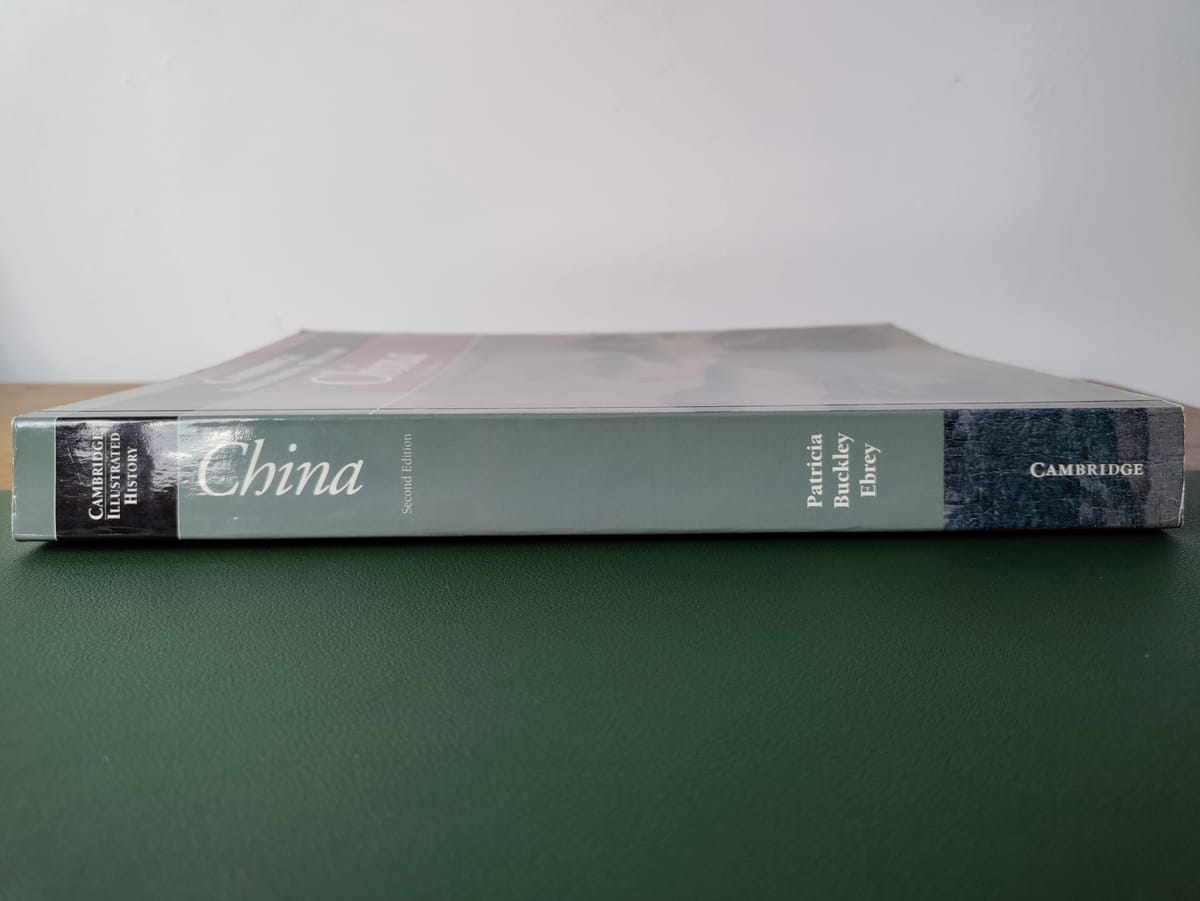
Cambridge Illustrated History of China (Patricia Buckley Ebrey)
A reflection on Patricia Buckley Ebrey's overview of the immense history of the Chinese civilization.
The image of China that is presented to the Western consciousness may be said to be something like this: a one-party autocratic state of billions of people in a vast land in which all dissent is censored and there are no human rights (or in the very least where human rights are compromised compared to the wonderful freedom and peace of mind we have in the west).
We might also consider the following common negative tropes: a monolithic and introverted culture; a Great Wall to keep people out, and keep people in; cheap ‘Made in China’ products which in many cases steal the intellectual property rights of western companies; mass surveillance and spying on their own citizens (as well as citizens of the west); human rights abuses in Xinjiang province against Uighur Muslim minorities; shifty behaviours in the South China Sea and beyond; and occupation of lands (Tibet, Taiwan) which are not considered to be a part of China proper. We might also be presented with a view of a land in which there are constant environmental abuses, catastrophes, corruption and cover-ups.
Some of the more positively inclined commentators may regard China as the longest-running continuous civilization in the world, a civilization which grasped early the importance of diligent record-keeping, placing high regard for academia and for innovation, which in turn makes for a plentiful and rewarding study. We may also point towards the many contributions made by China to the world (though some western commentators may state this begrudgingly).
In a way, the criticisms aimed at China are used to contrast to the supposed positive aspects of the west. The west has democracies, for example, where the people elect representatives into office to serve them – and of course there is never an issue with these people being compromised in any way, and the citizens continue to gain greatly from this system. The nations of the west have never engaged in any form of surveillance over the citizens of their countries, and have never engaged in any form of surveillance or meddling in the matters of other nations. The west is a beacon of human rights, and their rulers have great regard for the people. Western nations have never occupied any other lands, and have always treated their neighbours with kindness and respect. In western lands the media and press are completely free and absent of manipulation and bias, and the west has a spotless record when it comes to the environment. With tongue firmly in cheek, this is not an attempt at some kind of false equivalency, and the fact that western nations engage in these things does not make them right and does not mean that China engages in these things. The bigger picture is cloudy, with a chance of a terrifying storm.
Whether we call the negative portrayal of China “Orientalism” or a kind of “Yellow Peril”, whether we consider it the result of ignorance, or of manipulation, or even define it through the lens of western hypocrisy, we can challenge the picture through study and experience. The modern world is afflicted by a number of difficulties, and these difficulties are, in a sense, being compounded due to the scale of our connection and fragmentation. It is no longer acceptable (or advantageous) to hold shallow viewpoints or to disseminate disarray. The new imperative in this age is to fight the bombardment of information with a considered and critical mind, which in itself is sharpened by dialogue, experience, and study.
Whilst it goes without saying, Free Palestine, let us also consider: What is China?
With this in mind we consider China, starting in this reflection with a very broad overview of its history. In further reflections we will consider the new Silk Road (that is: the Belt and Road Initiative), and the modern Chinese state since the Revolution (or say, the last 100 or so years). I also hope to be able to look at the thought of Xi Jingping, Chinese folklore, the Red Army, and other connected reflections such as the aforementioned Yellow Peril. I also intend to read through classical Chinese literature.
It goes without saying that the history of China is an enormous subject and discipline. This specific post is intended as a way of summarising the main points in a linear, chronological order.
Preliminaries
Patricia Buckley Ebrey writes that educated Chinese scholars from the time of Confucius onwards (around 500 BCE) defined China as a “single-stranded narrative or genealogy” defined by “technology and statecraft”. Modern scholars, however, have given “more weight to the role of ritual and religion” and, “equally important, they do not see Chinese history as a single-stranded story […] but as a multi-stranded one in which a great many distinguishable cultures interacted.” As we shall see, the constant movement, ebb and flow, and cycles within the history of China make it challenging to argue for the former (though there is a line of reasoning for this), just as it would be difficult to argue that the history of Britain is a single-stranded narrative, though we could argue that China has more claim to this than perhaps any other modern nation-state.
“Unlike other peoples who pointed to gods as their creators or progenitors”, writes Buckley Ebrey, “the Chinese attributed to a series of extraordinary brilliant human-beings the inventions that step-by-step transformed the Chinese from a primitive people to a highly civilized one,” such as Fu Xi, an ox-tamer who led the domestication of animals and who invented the family, and Shen Nong, the divine farmer who invented the plough and hoe, and Huang Di, the Yellow Lord, who invented the bow and arrow, boats, carts, ceramics, writing, and silk – these were the Three Sovereigns, the first three demigod emperors of China.
As we shall see, this perception of the Chinese being highly civilized is a key theme of the character of their history. The modern world, informed as it has been by the ripples of European colonialism and Darwinist Enlightenment thought, has led the West to regard itself as clean and civilized, predisposed for rule, whereas the rest of the world (those east of Greece and Rome), have been presented as barbaric, backwards, sedentary, ill-equipped to govern. But a broad overview of human history sees civilization being refined in places such as China, India, Egypt and the Sudan, and of course Mesopotamia, at a time when western Europeans still dwelt in caves (and modern Americans had not emigrated or been captured and transported to the Americas). The rise of Ancient Greece and the Empire of Rome, not to mention the industrialised colonial nations and the post-war American machine, can be said to be outliers (significant as they may be) in the course of human history.
First Settlers
The first human settlers in China were established in river valleys: the Yellow in the north, and the Yangzi in the south. This is in much the same way as we find elsewhere, such as the Nile, the Indus, the Harrapan, the Euphrates, and the Tigris. But whereas there would be very close contact between the peoples establishing civilizations in those places, there was more of a separation for China: “large stretches of land ill-suited to crop agriculture separated the Chinese subcontinent from Mesopotamia and the Indus Valley, the nearest sites of other early civilizations.” In turn, Inner Asia was never populated primarily by Chinese, though as we shall see, the peoples there would come to have a great impact across the Eurasian continent, most notably for the Chinese in the form of the Xiongnu and Mongols, who Buckley Ebrey refers to as China’s “traditional enemies.”
We can tick off one of the first assumptions about China, however, in that it is certainly a vast land. In fact, Buckley Ebrey notes that the Chines subcontinent is so vast that by the first millennium BCE the Chinese thought of it as All-Under-Heaven (tainxia), “the entire earthly stage on which human-beings acted out the drama of civilization.”
Homo erectus appeared on the Chinese subcontinent over a million years ago in the form of the so-called Peking Man (or Homo erectus pekinensis), which is regarded as a subspecies of Homo erectus. This whole area needs a study of its own because of the weird events surrounding the findings in 1921, the subsequent loss (or theft) of specimens, and the cultural importance of the Peking Man, not to mention the challenges to the “Out of Africa” theory of human evolution.
Modern human-beings appeared in China around 100,000 BCE, and a “distinctly Chinese history […] begins much later […] about 10,000 BCE”. By 5,000 BCE we have records of agriculture, pottery, villages, textiles – all signs of neolithic society. Due to climactic factors, we had a division in China between the “southern rice zone” and the “northern millet zone.”
The late neolithic age (3,000 – 2,000 BCE) saw an increased contact between regional cultures, and this contact included conflict. In turn, we see record of walled settlements appearing, such as the wall at Chengziyai in Shandong province: “By this time there must have been chiefs capable of commanding men and resources in considerable quantity.” There is also evidence or indication of human sacrifice.
By 2,000 BCE, we find evidence of remains being buried under the foundations of major buildings in the north: “social differentiation also was expressed in burials”. This is nothing new to the study of ancient civilizations – we see the same evidence across the world, from Egypt to the Indus and to the Americas.
The First Three Dynasties
The first three dynasties were the Xia, the Shang, and the Zhou. The Xia was founded by Yu and his son, the first two kings, who established the precedent of hereditary dynastic rule. Yu had been tasked with tackling the issue of flooding, and he travelled the land dredging channels. The first examples of leaders within Chinese society, then, are figures who are either inventing things or fixing problems.
The Xia were overthrown by the Shang who lasted through thirty rulers “until a self-indulgent and obstinate king lost the support of his nobles and people, making it easy for the armies of Zhou to come from the west to overthrow the Shang.” With so many dynasties, and with so many cycles of rule, we do need to hold in mind that with ancient history the records and presentation of a figure, a ruler or a dynasty, may have been written with bias in mind. We need to approach ancient historical record with much caution. This problem of ancient propaganda is explored further in The Persians.
Soon after 2,000 BCE, in the northern China plain, we find “a more complex bronze-age civilization marked by writing, metal-working, domestication of the horse, class stratification, and a stable political-religious hierarchy administering a large territory from a cult centre”. There is uncertainty, Buckley Ebrey notes, as to whether there ever was a “fully fledged” Xia dynasty.
We certainly know more about the Shang, as their kings “communed with their ancestors through sacrificial rituals and through divination” such as oracle bones. Professionals diviners would prepare bones for divination, and the king himself would interpret these. There were frequent sacrifices of humans and animals. In this period it is noted that a “literate elite associated with the polity begins to give us their version” of events. We can also learn what they considered to be important to them.
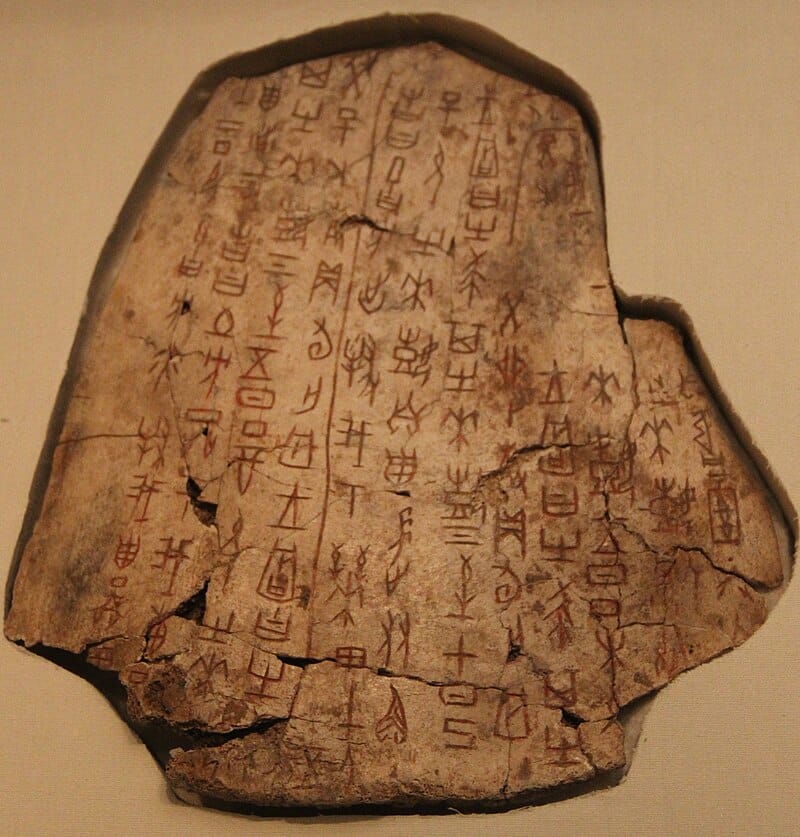
The Shang “probably did not encompass all of Henan, Anhui, Shandong, Hebei, and Shanxi provinces”, though their influence spread far. It is noted that they established five capital cities, including Zhengzhou and Anyang (or Yin). Inscribed oracle bones at Anyang “present the picture of an embattled central power.” Chariots arrived in the land around 1,200 BCE, “probably as a result of diffusion in western Asia.” The Shang kingship were “firmly grounded in religion and ritual”. The king represented a kind of priest, worshipping the high god Di. The kingship passed from elder to younger brother, and from father to son, but never to or through sisters or daughters.
The Shang perfected a system of writing which aided the “organisational capabilities” of the society and had “profound effects on social and cultural processes.” As elsewhere, writing led to “list-making and efforts to organise thoughts” which facilitated “higher-order mental processes of abstraction and theorizing.” This language was a direct ancestor of modern Chinese, a written script which evolved into the standard logo-graphic system in use today. This becomes particularly important when we consider the first full unification of China under the short-lived Qin Dynasty, in part because the logo-graphic rather than phonetic system had “momentous consequences” for the development of Chinese civilization: “it shaped the nature of the elite” and also impacted positively on their cultural expansion and assimilation. For example, instead of being phonetic based, the logo-graphic nature of the language meant that it the written language could be understood even in places where the pronunciation of the word (representing the idea) was different.
We can also note how, in much the same way as in other civilizations, the written word held an immense power for control and was weilded by the powerful to consolidate and perpetuate their rule. As the discipline of historiography developed, the written word was also deployed to legitimise dynastic changes.
To the west of the Shang were the “fierce Qiang, considered barbarian tribesmen and perhaps speaking a proto-Tibetan language.” There were also the Zhou who, in 1,050 BCE, defeated the Shang in battle. The Book of Documents (Shujing), one of the Confucian classics, describes this turning-point as the victory of “just and noble warriors over decadent courtiers led by a dissolute, sadistic king.” Once the Zhou were the prominent force, we see a decline in human sacrifice, as well a decline in the use of oracle bones for divining. The Zhou were often regarded as the exemplary dynasty of Chinese civilization, particualrly for later dynasties.
At this time we have the concept of heaven being introduced. This was “conceived as something like the sacred moral power of the cosmos" whereby "a king and a dynasty could rule only so long as they retained heaven’s favour.” This is often referred to as the Mandate of Heaven. The reasoning goes something to this effect: moral values are built into the way the cosmos works, and history is a “mirror” of heaven’s will, with the ruler mediating between heaven and the realm of human-beings.
The first three rulers of the Zhou represented important leadership qualities: King Wen is regarded as the “cultured king”, notable for forming alliances with neighbouring states and tribes; his son, King Wu, is regarded as the “martial king”, who built a new capital and launched an expedition to defeat the Shang army; his brother, the Duke of Zhou, acted a regent for King Wu’s son, and he also consolidated new territories whilst establishing a new city at modern Luoyang in Henan province. It is reasoned that the three leadership qualities required for enduring states are: military prowess, morally-based civic arts, and loyalty.
The Zhou did not have direct rule over the vast territories. Instead, they sent out relatives and trusted subordinates to establish walled garrisons, or instead they recognised local chiefs as representatives. By 800 BCE, there were some 200 lords with domains large and small. Each domain came to have aristocratic families: “society was conceived in strongly hierarchical terms.”
At this time we have evidence of the earliest Chinese poetry, such as the Book of Songs (Shijing). Buckley Ebrey notes that although most of the basic elements of Chinese civilization were not unique to China (such as the domestication of animals, kingship, religion), it was much less common for the leap to be made to a complex civilization. One important theme of this broad history will be the sense of innovation within Chinese society as well as the respect and valuing of education and the arts.
Indeed, in the Eastern Zhou period (770-256 BCE), “the intellectual foundations of Chinese civilization” were established. The first half of this era is known as the Spring and Autumn Period, a “violent age” during which a “code of chivalrous or sportsmanlike conduct still regulated warfare between the states”. Over time, military conflict became “more frequent and deadly”, which led to innovation and a kind of philosophical arms race on the nature of statecraft.
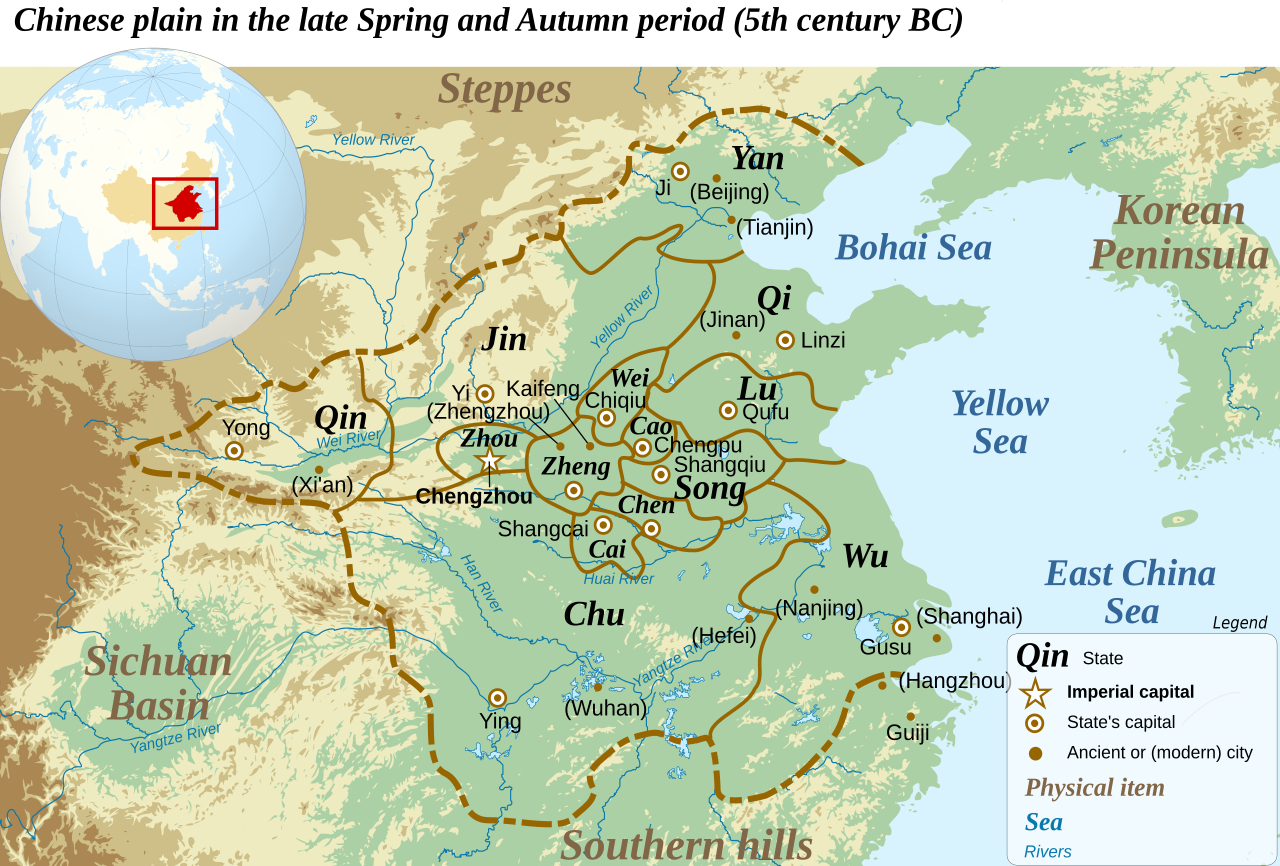
The second half of this period is known as the Warring States period. One-by-one the smaller states were conquered and absorbed by the half-dozen larger ones. The ruthless competition also led to social, technological, and economic advances, such as iron casting, infantry armies, coinage, private ownership of land, and social mobility.
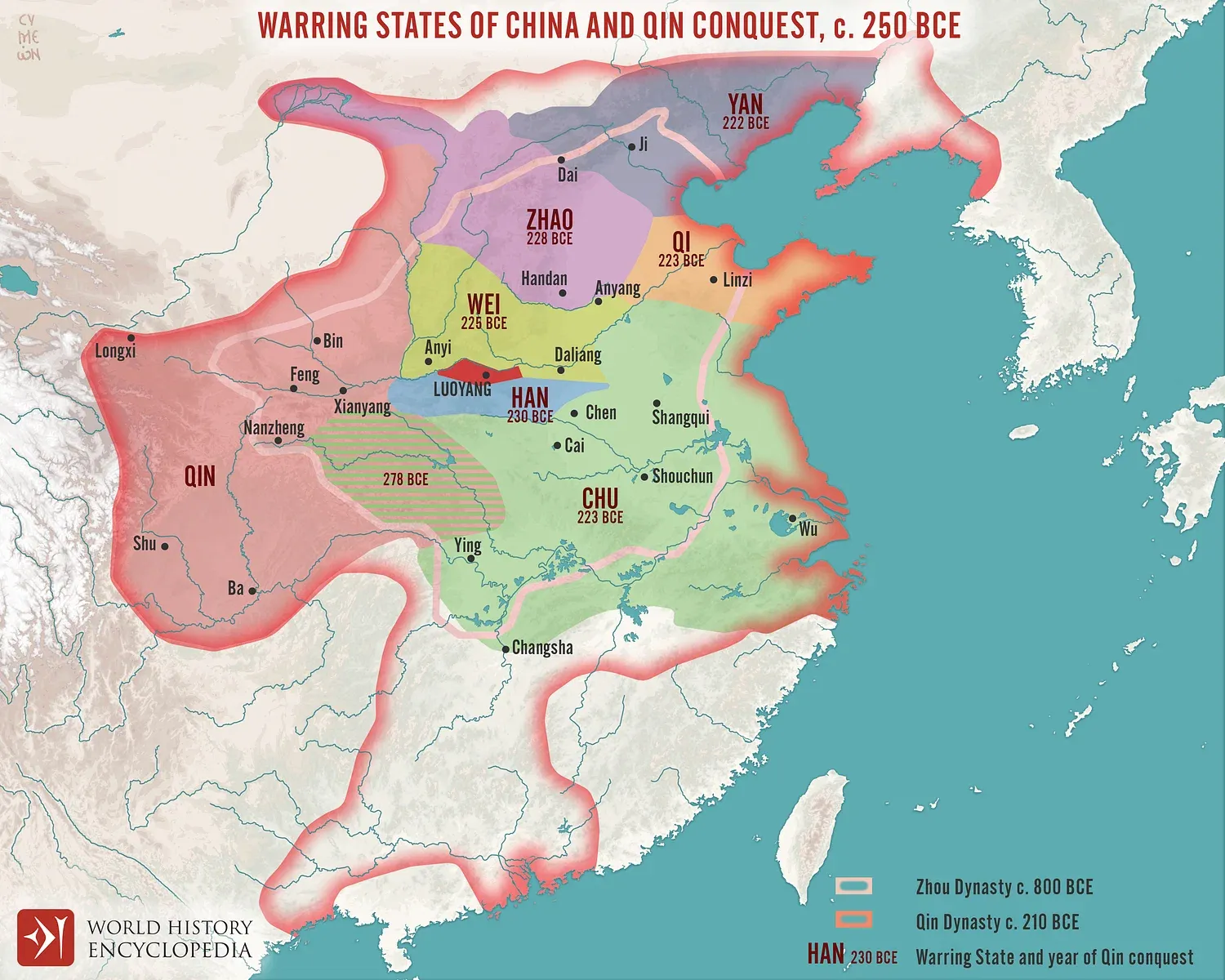
This period is known for the significant space open for people to advise rulers, to reflect on the practice of a state, and to question established assumptions and values. During this time there was a need for states to form alliances, and rulers would regularly marry their sons and daughters into ruling families of other states. There was also the practice of concubinage, and the ruler could select the son of a concubine to be his heir which led to “much scheming” and “succession disputes.”
In this difficult time, victory went to the rulers who could raise and outfit the largest armies (including farmers wielding crossbows), and those who could deploy the largest workforces to build defensive walls. “Ambitious rulers began to worry about ways to increase their populations and revenues.” Serfdom declined, with rulers rewarding farmers for their efforts in order to have “access to their labour power.” New techniques of governing also arose, including centralised bureaucratic control, which “created opportunities for social advancement.”
The so-called states of the "periphery": the Jin, Qi, Chu, and Qin, had an advantage in that they could expand outward and then turn inward.
“Soon they were conquering the small states of the central plain between them, each lord aspiring to be the great unifier.”
By 300 BCE, only seven major states survived.
In the race to survive and thrive, rulers were “more willing to patronise men of ideas”. This led to great debate within states, a long series of proposals and rebuttals, the study of strategy and logic. This is commonly referred to as a time when “a hundred schools of thought contended” and there was “exuberant intellectual creativity.”
Confucius is perhaps the best-known figure of this time, and is regarded as the “first moral philosopher”. He lived from 551-479 BCE. Born in Lu, Shandong province, he spent some years at court “without gaining much influence” before wandering through neighbouring states “finding much that disgusted him – greed, insecurity, irresponsibility, callous disregard for others’ needs and interests.” He became a great “defender of the Zhou order” and his “ideal world […] was one where conventions governed actions and hierarchical differentiation resulted in harmonious co-ordination.”
His approach also valued (or placed an emphsis on) considering the intention of acts towards others, something which is a corollary to the Hindu idea of karma, which views the intention of an act as being at least as important as the act itself, with perhaps a slight distinction: for Confucius, the intention of acts towards others was as important as those acts towards gods or ancestors (rather than to everyone). In addition, Confucius extolled “filial piety”, a respect for parents (from their children). This was not limited to the nuclear family, however, and extended outwards: “society could be seen as the family writ large.” He also proposed the concept of Ren, that is: perfect goodness, benevolence, humanity – a deep concern for the wellbeing of others. It is easy to see how this countered the fragmentation in the land at this time and set a precedent for mutual aid within the Chinese society.
The first important successor to Confucius was Mencius (370 BCE – 330). He showed great concern for “the common people” as well as officials. He was positive about the “incipient nature” of human-beings, and was “strongly on the positive side, stressing human potential for goodness.” He used the example of a baby trapped in a well, asking what our response to that is likely to be. Isn’t it likely that if you were passing by you would try and get the baby out, or call for help, and that it would be reasonable to expect your fellow human-beings to do the same? Of course, in our current day we can substitute the well for an incubator in a hospital being bombed by an occupying army. In fact, the baby need not be in an incubator in a hospital, but a child in the tent of a refugee camp being bombed by an occupying army.
Following Confucius and Mencius we also have Xunzi, or Master Xun (310 BCE – 220). “He argued that heaven is impartial and human affairs result from human efforts.” He also argued that “men’s inborn tendencies are wayward and require curbing through education.”
Buckley Ebrey also references Great Learning (Daxue) and Doctrine of the Mean (Zhongyong), of unknown authorship, and quotes the following passage:
“Peace in the realm cannot be achieved without first transforming people. A ruler must perfect his own virtue before he can regulate his family; not until his family is in order can he hope to govern his state effectively; and only on the basis of a well-governed state can he bring peace to the entire realm. In other words, one must change oneself before one can change other people or improve the world.”
Confucius and his followers “were activists” in the sense of government control. Daoists, another important philosophical movement, “defended private life and wanted the rulers to leave people alone.” They affirmed ‘The Way’ or ‘Dao’, the “indivisible, indescribable” force or energy that is the source of everything. The person synonymous with Daoism is Laozi.
Zhuangzi (or Zhuang Zhao) is also a key figure in Daoism: “whereas Laozi was concerned with protecting each person’s life, Zhuangzi searched for a conception of man’s place in the cosmos that would reconcile him to death.”
Buckley Ebrey notes that “Confucianism, with its focus on human affairs, it properly labelled a humanistic philosophy. In Daoism human society is seen as only a small part of the total reality, and to gain freedom and power people must come to see their continuity with the natural world.”
In addition to the humanistic and the more spiritual/ephermeral approaches, we also had Legalism, which would come to bear the most immediate significance. “These advisors argued that strong government depended […] on establishing effective institutions and structures” with an emphasis on laws.
During this time we find texts such as The Art of War being written as well as the conception of Yin and Yang being formulated. This golden age of thought also coincides with the Upanishads, the Buddha, as well as Greek thinkers such as Socrates, Plato and Aristotle. The “visions” of each region were “rather different” which, for Buckley Ebrey, marks a “major step in the divergence of civilizations.” Perhaps, in our more connected age, there will be a unifying school of thought to counter against the fragmentation and division.
Today the western world (or certainly Western Europe) views itself as the inheritor of the Ancient Greek and Ancient Roman lineage, though this is problematic when we consider the schism of the Roman Empire and the Ottoman Empire that rose from Constantinople, not to mention the Russian Empire and its claim to be the successor of the Holy Roman Empire. As we shall see, there is a divergence from south Asia into China and beyond in the form of Buddhism which makes these two areas perhaps more closely aligned than is first thought.
One example of the divergence between the three areas is also that in China there is no emphasis or full conception of there being a creator god of the cosmos in the sense of the Abrahamic faiths and Zoroastrianism in the lands of Palestine, Persia, and this extended area. Buckley Ebrey notes that in China this led to an emphasis on interconnectedness instead of mechanisms, as well as avoiding the arrangement of nature into opposites – “rather, they saw all oppositions as complementary polarities.” This is well-expressed in the conception of Yin Yang, which are sometimes mistakenly viewed as binary oppositions; instead, we can see that each contains the seed of the other (the implication being that one can never be fully negated).
Chinese society also came to regard devotion to family as an “obvious good” and this was/is stressed much more, or embedded much more, in society (in spite of the warring!). One divergence from the philosophy of caste, most closely associated with Hinduism, is that the Chinese thought that life in this world could be improved, even with a strict social hierarchy.
Returning to the narratives of the warring states, we have the rise of Lord Shang (390 – 338 BCE), who was born into the Zhou vassal state of Wey. He became chief minister of the state of Qin, who abolished the aristocracy and introduced a hierarchy of military titles awarded on the “objective criterion of the number of enemy heads cut off in battle.” It is not immediately clear which school of thought this links to, but we can view this state along Legalist lines in the sense of other changes made by the Qin state, such as offering settlers lands and houses (a form of settler colonialism), abolishing private serfdom (farmers were free to buy and sell land), imposing “heavy obligations” on ordinary citizens (such as taxation and labour service, as well as permits for travelling), and forcing vagrants and criminals into penal labour service. One way we can view Legalism in modern-day terms may be the striving for “corporate efficiency."
Han Fei, a Legalist political philosopher, argued in Han Feizi (some have argued that this text is a kind of blueprint for totalitarianism) that rulers needed to be firm but consistent, and he thought that “common people had about as much understanding of what is good for them as infants.” He had a “highly authoritarian vision of order.”
The Warring States period, therefore, gave rise so a range of positions and theories about how best to arrange and manage a society and state. One implication of this was the consideration of what constituted the people and outsiders, or “us” and “them”. Buckley Ebrey notes that “the weakness of the Zhou dynasty as a political force unifying the known civil world encouraged people to give more thought to the issues of who belonged together”. Furthermore, “the concept of ‘barbarian’ was not invested with what we would call racial characteristics". What made Us/Them was not physical, rather it was around the variability of customs.
In the late-Zhou period, we also have “considerable evidence” that the Chinese world was being extended, with groups previously being labelled as ‘barbarian’ coming to “participate in the Chinese world as full members.” In this sense, 'barbarians' could become Chinese, which is not a possible outcome in the western imperialist vision.
The Qin
The Qin dynasty is said to have first unified China, brining a short end to the Warring States period. They introduced a “centralised bureaucratic monarchy” which would come to characterise much of Chinese history. King Zheng (259-210 BCE) came to the throne aged 9, and “with the aid of two key advisors, Lu Buwei and Li Si, he led Qin to one military victory after another.” From 230-221 BCE the Qin defeated the Han, Zhao, Wei, Chu, Yan, and Qi. He became the first emperor: Shi Huangdi, or August Lord. Many will be familiar with this chap as his burial site at Xi’an in Shaanxi province, which is associated with the Terracotta Army.
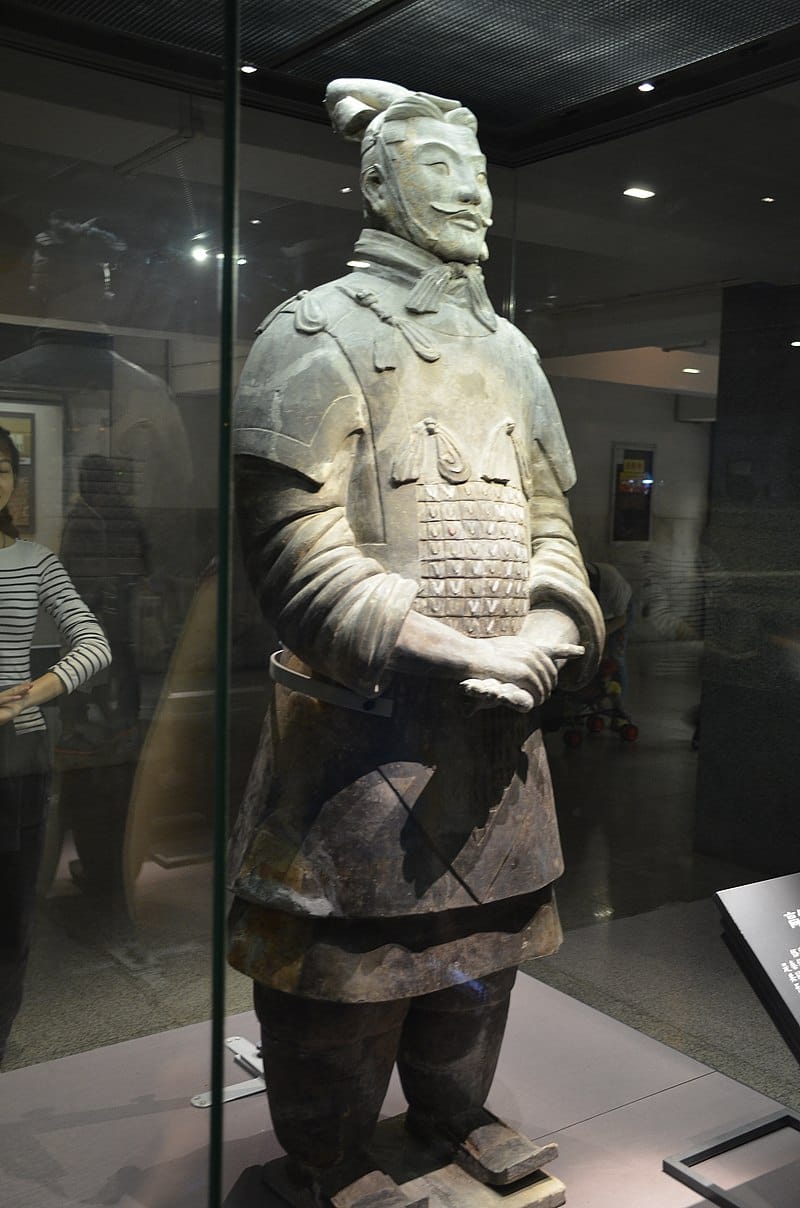
Later Chinese historians came to “castigate” him as a “cruel, impetuous, suspicious, and superstitious megalomaniac,” which is quite something when you consider that he is regarded as the first ruler of a unified China. His depiction in the film Hero is a bit more sympathetic, but there are many negative portrayals of him, not least from Sima Qian, the grand historian.
In unifying the land (or in his subjection of the other states), he was determined to impose uniformity, and ordinary citizens “suffered harsh treatment”. When he died, the “Qin imperial structure fell apart,” leading to a series of uprisings of conscripted peasants, generals, and former nobles. The eventual victor was Liu Bang (Emperor Gaozu of Han), who established the Han dynasty. His first challenge was to “develop a form of centralized power that could secure order and dynastic stability without undue harshness.”
The Han
A key figure in strengthening the approach taken by the Han government was Wudi (ruled 141-87 BCE). He confiscated the domains of princes and other lords and decreed that domains would have to be divided amongst all the lord’s heirs, “thus guaranteeing that they would diminish in size with each passing generation.” He also curbed the power or merchants, “gaining new sources of revenue through state monopolies and commercial taxes.”
During this time we have another key milestone of human development in the form of Sima Qian’s Historical Records (Shiji). This “set the pattern of government-sponsored histories compiled by later dynasties”. His outline of Shi Hunagdi, the first emperor, contributes much to the negative portrayals, and of course it can be argued that part of his intention as a historiographer was to legitimise the Han government, which had succeeded the Qin. An additional result of his creation of historical narrative in China was in creating an “Other” in the Xiongnu tribes.
The “success of unified bureaucratic form of government” owed a great deal to “military necessity” which were the result of ongoing incursions from people in the northern steppe, for whom raiding was an alternative to trade. The Inner Asian steppe is a “vast region of grasslands, mountains and deserts, capable of supporting only a sparse population.” The peoples in this area developed great skill as horsemen, including the ability to shoot arrows while riding. They were organised into tribal structures, with family and clan units held together through loyalty to chiefs “selected for their military prowess,” and “this structure could be exploited for efficient military mobilization.” Buckley Ebrey writes that “for most of the imperial period, Chinese farmers looked on horse-riding pastoralists as a scourge, as pitiless gangs of bullies who preferred robbing to working for a living.”
The first Emperor of Qin sent 100,000 troops against the Xiongnu, constructing the Great Wall (which was later enhanced, amended, and extended). The early Han emperors tried more “conciliatory policies”. In 166 BCE, 140,000 Xiongnu raided deep into China. The numerous expeditions taken by the Han in response were “enormously expensive”, though they gained territory in the north as a result.
The aforementioned Wudi sent Zhang Qian into Central Asia in 139 BCE in search of allies to fight against the Xiongnu. He was captured, however, and held prisoner for 10 years before escaping and making his way to Bactria and Ferghana. In turn, the “Chinese learned for the first time of other civilized states comparable to China that had developed independently of China.” In 101 BCE, a Chinese army went beyond the Pamir Mountains and defeated Ferghana, seizing “large numbers of its excellent horses.” This allowed China to establish control of important trade routes across Central Asia, which calls to mind present undertakings such as the Belt and Road Initiative (though this is much wider and ambitious than the Silk Road of antiquity).
In 55 BCE, the Xiongnu confederation broke into five contending groups. A tribute system was established which was “costly” to the Chinese but prevented ongoing war and conflict. Chinese silk was awarded to tributary states and made its way to the so-called western world.
For the Han, Buckley Ebrey notes, the danger was “over-extension” and “the need to support a huge military establishment kept pressure on the government to maintain its efficiency in extracting revenue and to improve transport facilities by building roads, bridges, and canals.”
Han art and literature is rich in reference to spirits, portents, myths, the strange and the powerful: “Han emperors attempted to make contact with the world of gods and immortals through elaborate sacrifices.” In addition, “notions of post-mortem judgement – so important in later Chinese religion – began to appear in Han times.” This included the rise in the cult of a goddess called the Queen Mother of the West (first mentioned in Shang times).
Han civilization was built on an agrarian base. There was the use of oxen and donkeys (introduced by the Xiongnu), better irrigation, and the wheelbarrow. Due to this, and in addition to the relative peace and extension of frontiers, the population grew rapidly. By CE 2, the population was “somewhat larger than the contemporaneous Roman empire.” There was, however, still insecurity and concern for the “fragility of the economy”, and farmers often had “barely enough to survive.”
The Qin gave political support to a Legalist approach, whereas the Han gave political support to Confucianism: “it became widely accepted that officials should be men trained in the Confucian classics and respected for their character”. Officials in turn could nominate their sons or other close relatives for government posts, but a man did not have to come from an official family to enter the civil service.
Han Confucianism comprehended the world as a “self-generating and self-sustaining organism governed by cyclical yet never replicating flows of yin and yang and the five phases (fire, water, earth, metal, and wood).” This in turn led to a conception of the nature of historical cycles and dynastic succession. It was also considered how disturbance in one category resonated in every other category. For the time, this seems like a very unique way of seeing the world, and in an age of increasing concern for the sustainability of the planet, the idea of disturbance and balance and harmony are key discussion points.
During the Han age we also see the importance of the role of the civil service and scholar class:
“because Confucian scholars were trained to view their relationship with the rulers in moral terms, they were not […] controlled primarily by a code of procedures and laws. Committed to a principled loyalty, they retained their stance as critics of government and resisted automatic compliance with the policies of their superiors, even the ruler.”
They even opposed policies such as government monopolies, aggressive foreign policy, and imperial extravagance. We could argue, however, that we can identify such opposition in modern democracies, and certainly the friction between opposing viewpoints (and the resulting synthesis, where possible) is healthy for a society.
We have already noted how important education is culturally within China to this day, and this emphasis appears to have been laid during this period (notwithstanding the long tradition of writing and record-keeping as tools of power and control, as evidenced with the Shang oracle bones). Buckley Ebrey notes that local officials “often promoted education, sending promising young men to the capital for advanced study.” At this time we also have the invention of paper, which would further enhance academic study.
The time of the Qin and Han dynasties was also a time of “great territorial expansion”. Settlers kept advancing with armies, who in turn were there to protect merchants. The government would then send officials to govern and tax the local population.
The fall of Han is attributed to three key areas:
- Eunuchs staged a coup in 124 CE and put a child on the throne (Emperor Shun of Han r. 125-144 CE) whom they could manipulate. This led to student protests (another important theme in Chinese history) at the imperial university.
- The central government was said to be in disarray, unable to support the population or offer relief during bad harvests.
- In 184 CE, a large-scale rebellion was staged by followers of the Way of Great Peace, “a religious cult inspired by Daoist ideas that offered mystical faith healing and social welfare programmes.”
Although the uprising was suppressed (there are two referenced, in fact: the Yellow Turban Rebellion and the Five-Pecks-of-Rice Rebellion), the generals who suppressed the uprising ended-up amassing power for themselves. Soon enough, civil war passed across the land.
Buckley Ebrey takes some time to note corollaries and contrasts to the other great empire of this day: the Roman Empire. She notes that both had strong governments, but that Chinese society was more focused on crop agriculture. Both empires promoted assimilation, but China had much more cultural cohesion, perhaps due to the imposition of a common language. Both empires invested heavily in infrastructure, and both empires struggled against barbarians at their gates.
The Age of Division
The next period of Chinese history, “one of the most complex in Chinese history”, is referred to as the Age of Division (220-589 CE) which leads through to the Sui dynasty. At this time, there were three contenders, or the Three Kingdoms of Shu, Wei, and Wu, as well as some brief unity under the Western Jin (265-316) until foreign rule took both the north and south. During this time “aristocracy developed at the top […] and personal bondage expanded at the bottom.”
As noted, the generals who were assigned to put down the Yellow Turbans became stronger than the throne. By 205, a “poet-general” Cao Cao became dictator in northern China. He used the Xiongnu as cavalry, captured rebels to work the land, and established military colonies. His son, Co Pei, formalised dominance by forcing the abdication of the last Han emperor and establishing the Wei dynasty at Luoyang. At this time, “Confucian ideals of public service lost much of their hold.”
The Western Jin succeeded in reuniting China, but failed to establish an “autocratic imperial institution.” They also eroded centralised imperial power by “their policy of parcelling out enormous tracts of land to imperial princes”, which led to more bloody struggles for succession.
In 304 CE, the sinified Xiongnu chief Liu Yuan declared himself the King of Han. This was a period of sixteen kingdoms (304-439) in which northern China was once more a “battleground.” Warfare led to banditry and famine.
The Eastern Jin was established at modern-day Nanjing. They were followed by other short-lived dynasties: the Song, the Qi, the Liang, and the Chen. Hereditary aristocracy was becoming entrenched, with a focus on genealogies, with families building-up landed estates.
The Tuoba clan of the Xianbei established the Northern Wei dynasty from 439-534. Originally from southern Manchuria, they occupied lands in northern Shaanxi province and extended by raiding, forcing massive relocations of people. In 486, with advice from educated Chinese, they implemented a “major overhaul of its fiscal system […] based on the premise that the state owned all the land.” All families were allotted land, though larger holdings were reserved for families of officials.
Emperor Xiaowen (r. 471-99), moved the capital to the ruins of Luoyang and built a new city: “within twenty-five years Luoyang had become a magnificent city with half a million people, vast palaces, elegant mansions, and over a thousand Buddhist monasteries.”
More civil war, however, led to Luoyang being sacked in 524. Two principle rivals emerged: Northern Qi and Northern Zhou. There was “ethnic tension” between the sinified Xianbei, Chinese aristocrats, and unsinified warriors.
The Zhou were assisted by the Chen to join and overthrow the Qi, but the Zhou were subsequently usurped in 581 by one of its generals, Yang Jian (541-604) who founded the Sui as Emperor Wen of Sui. He is regarded as one of the most important emperors of Chinese history for reunifying China and overseeing a period of prosperity.
At this time, Buddhism was flowing into China. The belief system proposed that sentient beings went through endless cycles of rebirth (Samsara) in which our lives were full of desires and attachments which were the source of all our suffering.
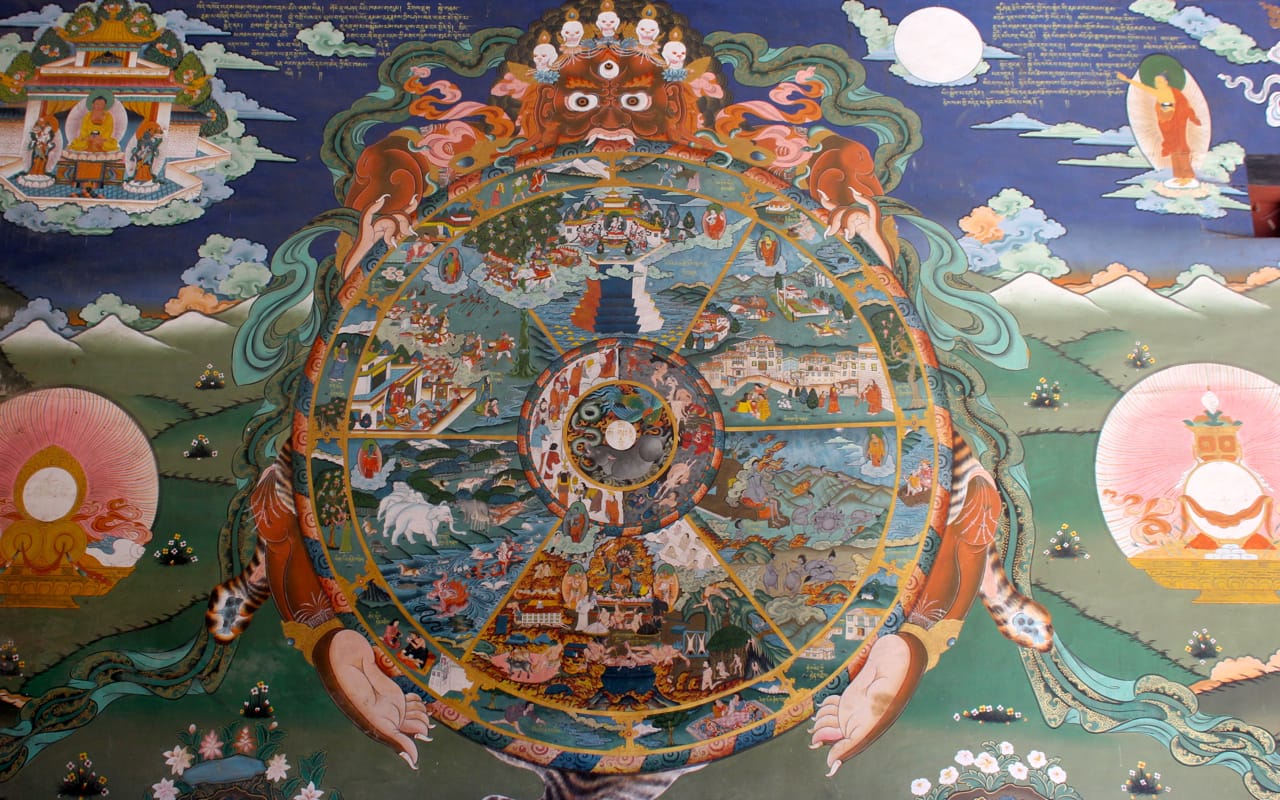
By the time of the Western Jin, many members of the Chinese upper levels had become attracted to the ideas of Buddhism. This was a time when people were “yearning for a new and better age”, so there was a longing for change. Leaders rose such as Zhuang Jue, leader of the Yellow Turbans, and Zhang Daoling, the First Celestial Master.
At first glance, Buddhism seemed to be a variant of Daoism, but “by the end of the Age of Division, Buddhism and Daoism were in competition with each other for the patronage of ordinary Chinese in the cities and countryside”. This had a profound impact on the physical landscape of China, with the building of temples and monasteries, which slowly became an “integral part of Chinese life.” For example, monasteries acted as schools, they provided lodging for travellers, and contributed to economic activities by building finance (such as through mills): “they often extended into money-lending and pawn-broking”. The negative consequence of this was that there could be backlash and suppressions against them (such as the Huichang Persecution of Buddhism, 841).
Buckley Ebrey notes that the political divide between north and south led to a cultural shift, with each “going their own ways,” such as in the styles of aristocracy. The northern aristocracy, Buckley Ebrey notes, emphasised the preservation of Confucian traditions, seeking posts in government for prestige and power.
This period of Chinese history is “treated as a negative example: the disorder and dislocation, the ethnic hostility and bloody court struggles, the tyrannical rulers and enslaved captives all demonstrated why powerful, intrusive, centralised, imperial governments were necessary.” Some historians/commentators also label this age as medieval due to the similarities following the fall of Rome, but Buckley Ebrey notes that in China there was still an attempt at a centralised, bureaucratically administered political order, rather than a decentralised and feudal society. It is also noted that the emphasis of education continued.
The Tang
There was a short-lived unification under the Sui dynasty (581-617) before the Tang dynasty (618-907). The Sui conquerors razed the capital at Nanjing and forced nobles to relocate to the Sui capital at Chang’an which, under the Tang, would grow to be the largest capital in the world. Emperor Wendi presented himself as a Buddhist Chakravartin King (that is: using military force to defend the Buddhist faith). Rebellions overthrew the Sui, however, and out of the many contenders arose Li Yuan (or Gaozong). His son, Taizong, would prove to be a “wise and conscientious ruler” despite a “ruthless beginning".
By this time the Xianbei presence had faded as they became assimilated into China. In addition, the Sui and the Tang used armies of volunteer farmer-soldiers (divisional militias) to extend control into the inner Asian frontier, such as against the Turks of the steppes.
The Sui also introduced written exams to appoint government officials (in order to identify true Confucians), which the Tang in turn expanded. This was, in effect, a civil service exam system. Opportunities for access were extended, but men from aristocratic families tended to do well in examinations.
The Tang constructed the Grand Canal, which was achieved by using “enormous levies of conscripted labour. They extended almost 1,200 miles, allowing the government to draw on the growing wealth of the Yangzi valley”. This also allowed for the north and south to be more closely linked. Furthermore, the Tang were “remarkably open” to what other cultures had to offer.
The union of north and south is contrasted by Buckley Ebrey to the schism of Rome which led to a split between east and west. This was a result of centuries of “cultural flowering” and led to the view that “permanent division into independent states seemed less and less a natural, reasonable, or desirable state of affairs.”
The late seventh-century court was “dominated” by Empress Wu. Originally a concubine of Gaozong, she was made Empress when he suffered a stroke. She took full charge and in 690 proclaimed herself emperor of a new dynasty, the Zhou. She suppressed rebellions and “maintained an aggressive foreign policy” before being deposed in 705 when she was over 80 and ailing.
The Tang dynasty was an era of prosperity, however, including in terms of maritime trade at Guangzhou, Quanzhou, and Fuzhou. But society remained highly aristocratic. There was rebellion in 755 led by An Lushan against Xuanzong, whose troops staged a mutiny, forcing Xuanzong to abdicate to his son. The government “never fully recovered” from this rebellion, leading to a set of military governors who “acted like rulers” of independent states.
The central government at this time abolished the equal-field system, but this in turn facilitated a monopoly on property for those with money. The equal-field system supposed that all land belonged to the government, who, in turn, would assign this land to families to cultivate. The idea was that this would generate tax revenue from the people and prevent large, disused (and untaxable) estates. The decline of this system is attributed as a major reason for the decline of the Tang.
The post-rebellion Tang government also “largely gave up supervision of the operation of urban markets.” One result of this was the flourishing of trade due to increased circulation of goods.
In the palace at Chang’an, this was a time of plots and counter-plots involving palace eunuchs. They also faced external pressures, most notably from “antagonistic states” such as Bohai and the Nanzhao, with the Turkish Uighurs noted to be a “burdensome ally,” whilst “bandit gangs, some as large as small armies, ravaged the countryside and even attacked walled cities.”
The Song
Following the fall of the Tang we have the period of the Five Dynasties (907-960) which would lead into the Song dynasty. The Tang times, Buckley Ebrey notes, displayed that China was not the “sole locus” of civilization, and that there was more to the world. “China’s neighbours could no longer be dismissed as primitives: Korea, Bohai (in Manchuria), Nanzhao (in Yunnan), Tibet and Japan all constructed states, adhered to universal religions, made use of writing […] built cities, and engaged in long-distance trade.” China could still be regarded as “superior”, but it could no longer be regarded as the only place with culture.
The modern historian, Buckley Ebrey notes, views the late-Tang as a period of elevation from “lamentable decline to one of exciting growth.” She also takes time to remind the reader that history is viewed differently in China than it is in the west, where the method is to try and fit analysis into decline and fall narratives, whereas the Chinese perspective is one of cyclical patterns.
We next move into the Song Dynasty (907-1276). This period saw an increased pace of migration southwards, leading the Yangzi valley to become central to the economy, which in turn experienced “dizzying” growth. In addition, civil service examinations became central to the elite, with Confucianism reinvigorated. However, “powerful neighbouring states had to be treated as equals, not vassals,” and limiting the incursions of these states became a preoccupation.
By the end of the Tang, political and military power had devolved to a local level, with strongmen organising groups of rebels and bandits. In 937, one contender in the north turned to the Khitans, a new power in Manchuria, to help him gain control of Kaifeng. He granted them territory around modern Beijing, but his successor renounced this deal.
The general finally able to bring military unification was Zhao Kuanyin, who reigned as Taizu. “To solidify his control over all military forces, he got his own commanders to retire on generous pensions and gradually replaced the military governors with civil officials.”
The Song were unable, however, to dislodge the Khitans from around Beijing, who ruled a Liao state, while Tanguts (a people related to Tibetans), ruled a Xia state. Agreements in 1004 and 1044 saw the Song make “substantial annual payments” to buy peace.
Buckley Ebrey writes that there were “no tyrants among Song emperors, no empresses suspected of anything but good intentions, and no coups staged by eunuchs.” But there were still two main weaknesses: factionalism and bureaucratism. The ease of printing led to a huge amount of regulations, and there was no legitimate means of resolving political conflicts, such as the difficulties faced by Wang Anshi in launching reforms under Emperor Shenzong.
During the period 750-1100 CE, the population doubled. Agricultural prosperity led to denser settlements and cities growing at rapid paces. Inland and coastal shipping grew, with the dynasty encouraging foreign trade. Demand for money also grew enormously, with paper money coming into existence. The invention of the compass in 1119 aided ocean-faring travel.
There was also the emergence of “one of the most distinctive features of Chinese civilization, the scholar-official class certified through competitive literary examinations, an elite unlike that of any other major civilization.” The early Song emperors were concerned to avoid the domination of government by military men, and so they greatly expanded the civil service examination system and government school system. For the examinations, papers were anonymised (copied by clerks and identified by a number). Candidates were expected to have memorised the classics and “master specific forms of composition, including poetic genres.” This period ended the dominance of officialdom coming from the north, and Buckleey Ebrey notes the remarkable intellectual breadth through figures such as the multi-disciplined Shen Gua. A “much higher proportion of the most powerful posts was going to men selected for their literary abilities.”
The “most cultivated” Song emperor was Huizong (r. 1100-26). Some argued that it was “because he was so absorbed in aesthetic and religious matters that not only did he lose the throne but the dynasty lost China.”
To the north, the Jurchens, an “agricultural, herding, and hunting people based in eastern Manchuria,” declared a Jin dynasty and began a war against the Khitans. The Song formed an alliance with the Jin but this alliance collapsed and in 1126 the Jurchens attacked Kaifeng. This led to the split of the Northern and Southern Song (referring to the locations of the capital cities). Chinese loyalists regrouped in the south. A treaty with the Jin in 1142 was seen as appeasing the Jin, with an annual tribute paid to them such as with the Liao.
The Tanguts, Khitans, and Jurchens were all “zealous Buddhists” which underlined their foreignness or otherness to China. As such, members of the ruling class looked to revitalise Confucianism which in turn led to new formulations such as the Cheng brothers (Cheng Yi and Cheng Hao) and theories of the workings of the cosmos in terms of li and qi. There was also consideration of reform at the local level, such as Zhu Xi, establishing academies.
“The basic realities of life did not change from century to century; planting and ploughing, paying rents and taxes, caring for the young and elderly, arranging and celebrating marriages, defending against bandits and bullies, worshipping at local temples and buying and selling at local markets.”
The increase of books, notes Buckley Ebrey, allows us to “discern more clearly” the role that women played in society. References to men vastly outweigh women in terms of descriptions of village and town life, but women had an undoubted major role in the family. At this time, more women were being taught to read and write, but there were other detrimental changes, such as the practice of footbinding, and some trends in Confucian thought regarding a woman’s role.
Alien Dynasties
The Liao, Jin, and Yuan dynasties followed in the period of 907-1368 CE, a time when inner Asian tribal peoples progressively conquered China, leading to the fall of the Song to the Mongols in 1276. As we have seen, the Khitans had occupied a strip of land along the northern edge of China, and the Jurchen Jin defeated the Liao and extended this “occupied zone” to all of the north. “These alien dynasties erupted into Chinese history because of the dynamics of the border zone.” In turn, the Mongols defeated the Jin and “built up the machinery needed to conquer all of China.” Despite the limitations of opportunity within the Mongol Yuan dynasty, Chinese civilization survived.
Inner Asia, notes Buckley Ebrey, is as large as China but much more sparsely populated, unsuited to crop agriculture. For these people, “all men learned to ride and shoot and were potential warriors”. Families were patrilineal, camped in clan units, with clans coalescing into tribes, and chiefs selected for their military prowess. Clans and tribes were regularly at odds with each other, “seizing cattle, horses, and women, thus setting off cycles of revenge.” The alternative to fighting was to form alliances.
One early example is given of Abaoji, of the Yelu clan, who united 8-10 Khitan tribes into a federation. He arranged for hereditary succession, and at their height the Khitan probably numbered 750,000. They created a “dual state” of distinct Chinese and Khitan areas. The southern capital of Beijing was, at that time, “little more than a border garrison city.” The Liao also intimidated neighbours in Koryo and the Tangut state of Xia. On the whole, they resisted sinification.
The Jurchens originated further east, “in the mountains of Manchuria.” In the early 12th century, Aguda, of the Wanyan clan, formed a confederation and proclaimed the Jin dynasty, attacking Liao who chose to ally with the Song. The Jin incorporated Chinese experts in siegecraft and took Kaifeng, capturing the Song imperial family. Unlike the Khitans, they adopted more Chinese political institutions and employed Chinese officials. They did not, however, show the traditional respect to officials, and their emperors “instituted the practice of flogging high officials in open court.” The Jurchens “rapidly adopted Chinese customs, including language, dress, and rituals.” From 1191, “a century later hardly anyone claiming to be Jurchen could be found in China proper.”
The Mongols were led by Chinggis, a “brilliant and utterly ruthless military genius.” He united and “subdued” various tribes, including “the Tartars, Kereyid, Naiman, Merkid, and other Mongol and Turkic tribes” before being named the Great Khan in 1206. He fully militarised the Mongol society, forming an army on a decimal hierarchy: 1,000 horsemen were a basic unit. A new military nobility was created. He issued simple but draconian laws: the penalties for robbery or adultery, for example, was death.
He then “initiated one of the world history’s most astonishing campaigns of conquest.” He would send envoys into lands to demand submission: those who submitted were treated as allies, whilst those who objected faced total destruction. The Mongols swept across the Chinese plain from 1212-1213, sacking Beijing in 1215. In 1219 they sacked Bokhara and Samarkand. They also conquered Mongolia, Manchuria, Korea, and plundered the Duchy of Kiev. The Great Khan’s death in 1227 created a crisis of succession with the empire divided into 4 sections, each governed by a line of descendants.
Ogodei, the third son, gained control of Mongolia. He defeated the Jin in 1234 and by 1236 he had taken all but 4 of the 58 districts ruled by the Song. People were slaughtered or taken as captives. Those who were loyal and who submitted were rewarded.
In 1237, representatives of all 4 lines (along with troops from Turkic and Persia) campaigned into Europe, taking Moscow and Kiev in 1238, and Poland and Hungary in 1241 and 1242 before retreating back into Russia.
One of the Great Khan’s son, Khubilai, had begun the conquest of the Song, using Chinese as well as Uighur and Central Asian advisors. In 1264 he transferred the capital from Karakoum in Mongolia to Beijing (Dadu), and in 1271 he adopted a Chinese name, Yuan, for his dynasty.
“China south of the Yangzi had never been captured by non-Chinese from the steppe” in part due to the system of rivers, canals, and streams. Khubilai took advice from a surrendered Song commander and constructed a river fleet. They employed “Chinese, Korean, Jurchen, Uighur, and Persian experts in naval and siege warfare.” By the time China was fully conquered in 1279, there was no longer a pan-Asian Mongol empire: “from Khubilai’s time on China proper was united with Mongolia, Manchuria, and Tibet, but not with Persia, Iraq or Russia.”
Like the Khitans, the ruling Mongols resisted assimilation. They continued to choose rulers through competition, often bloody. Chinese people, however, were “not forced to adopt the customs of their conquerors.” Large numbers of people had their lands expropriated, or they were forced into serfdom or slavery. In addition, taxation was often “ruinous.”
At this time, Buckley Ebrey writes, the Mongols made clear ethnic distinctions, such as between Chinese in the north and the south. They practised favouring of other groups which in turn further “aroused Chinese ethnic consciousness”, though “these sentiments should not be taken as equivalents to modern nationalism.” Perhaps aware of their status as an occupying force, the Mongols instituted laws to protect themselves. The Chinese, for example, were “forbidden to congregate in public or to own weapons,” and they were even prohibited from dealing in bamboo since this could be used to make bows and arrows.
Buckley Ebrey makes ongoing reference to the evolution, challenges and amendments to Confucian thought. Confucian thought held that “the ruler was the son of Heaven and he ruled over All-Under-Heaven”. There were “barbarians” at the fringes who did not obey, “but this was the result of their not yet having received the transformative influence of Chinese culture”. In other words:
“China was superior to all its neighbours, but that was because Chinese culture was superior, not because the Chinese, as a race, were physically or biologically better."
This, we could argue, contrasts with the Western imperialism of recent centuries.
The Confucian theory of the transformative power of the Chinese world “worked well for situations where China was the dominant force,” but this was put to the test in this period of alien rule. The Jurchens and the Mongols were “blamed for introducing more authoritarian forms of government” who “accomplished their goals more easily through violence and terror.”
All three of the alien dynasties patronised Buddhism, whilst Chinese inventions spread westward (the most prominent examples include gunpowder and printing), perhaps facilitated by the vast trade networks established. “In China, protecting what was distinctly Chinese culture became a higher priority than drawing from outside to enrich.” Moving through the alien dynasties, Buckley Ebrey writes, the Chinese gained “a confidence in its ability to survive […] to defeat aggressors through simple staying power.”
The Ming
Following the Yuan we move to the Ming Dynasty (1368-1644), which was “founded by a poor peasant turned rebel general.” Zhu Yuanzhang (1328-1398), or Taizu, was “shrewd, hardworking, and ruthless.” His parents died when he was 16 at a time of floods, famine, and epidemic. Wandering and destitute, he joined the White Lotus Society in 1352, and he rose quickly through the group, leading the capture of Nanjing in 1356.
He gradually became supreme in the southeast, before marching north and capturing Beijing. The Mongol court fled. In 1368, the Ming dynasty was declared. Taizu “saw his task as bringing into being a world where people obeyed their superiors and where those who did evil were promptly punished.” His “sympathisers did not extend to the commercial and scholarly elites” with “inordinately high tax rates imposed on the rich,” in addition to censorship and purges. Taizu dealt directly with officials on all matters, large or small.
His fourth son, Chengzu (Yongle), usurped Taizu’s successor and moved the capital from Nanjing to Beijing: “the city was arranged like a set of nested boxes” with the so-called Forbidden City at the centre of the Imperial City. At this time, Yunnan and Guizhou were fully incorporated into the realm. Buckley Ebrey notes the uprising between “settlers and the indigenous” which gives an interesting colonial perspective to extension of China. From 1464-1466 the Miao and Yao tribes in Guangxi, Guangdong, Sichuan, Hunan, and Guizhou attacked heavily populated cities, and military intervention was needed to resolve this.
Civil service examinations continued: “the Ming examinations are notable for their geographical and social breadth,” with provincial quotas being introduced. They also added in a lower tier to the degree system.
Buckley Ebrey notes Wang Yangming, “an official of some distinction” who objected to Zhu Xi’s teachings and the assertion that moral principles could only be understood and realised through study. For Wang Yangming, “universal principles existed in every person’s mind” or that “moral knowledge was innate in the mind.” Ultimately, sagehood existed in all.
Continuing the trend from Song times, “local society […] steadily became less isolated.” The second half of the Ming, however, “coincided with the great age of European exploration and the first phase of its expansion.” In turn, emissaries were sent outward, such as the legendary Zheng He, a Muslim eunuch sent by Chengzu to visit potential tributary states.
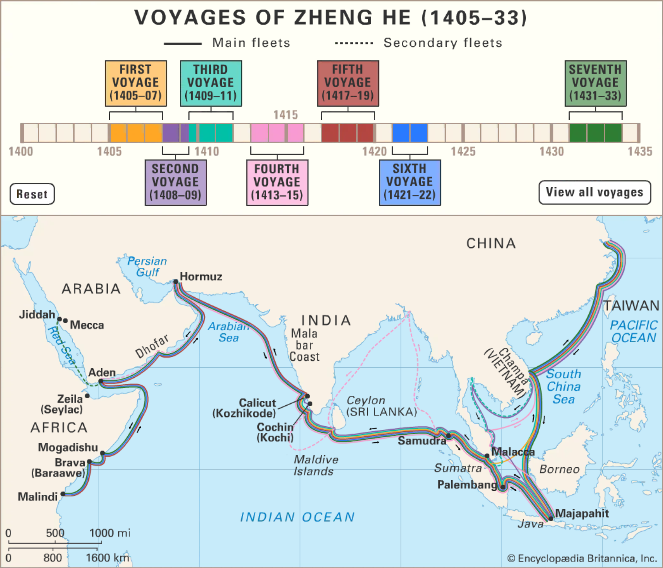
The tributary system “implied paternalistic obligations for China to come to the aid of loyal vassal states”. For example, they went to the defence of the Tran Dynasty in Vietnam and also into Korea to defend against a Japanese invasion.
The northern border remained porous. In 1449, Emperor Yingzong was captured after battling against Mongols. Due to events such as this, the Ming “invested heavily in reconstruction of the Great Wall.”
“Despite the expansion of the economy during the course of the sixteenth century, the government became progressively less solvent, and by the early seventeenth century was nearly bankrupt.”
Buckly Ebrey asserts that there were two key factors: the cost of maintaining the imperial clan through stipends, and the military campaigns. Of course, there was also the “dynastic cycle” to take into account.
Government expenses increased as the population grew and the bureaucracy became less efficient. Revenue did not keep up with expenses – peasants lost land and the rich evaded tax; the government were less able to respond to disasters (such as the “little ice age”) which led to low harvests. In the wake of famines (such as in 1627-8), gangs formed. The “social fabric unravelled.” Li Zicheng, a former shepherd and postal relay worker took control of Hubei, Henan, and Shaanxi – by 1644 he swept into Beijing where the last Ming emperor took his own life. “In the end it took an army from beyond the Great Wall to restore order.”
The Ming period is generally judged “rather harshly” according to Buckley Ebrey, in terms of the failure to control the Mongols, the Japanese, the eunuchs, and the flows of revenue. Just as Europe was sending ships into Asia, China was withdrawing. In addition, Europeans were putting Chinese technology and innovation to use (printing, gunpowder, the compass), whilst China was “letting its scientific and technological leadership slip.”
Buckley Ebrey argues that a better way to view the Ming period more positively is from the “bottom up”, in other words through the experiences of villagers and townspeople. Community bonds were significantly strengthened, and a clearer sense of common history and identity was formed.
The Qing
The next period of Chinese history is the Manchu (Qing) dynasty and the rise of imperialism (1644-1900). This was another period of alien rule in the sense that the Manchus were a “non-Chinese people living in the hilly forests and plains to the northeast of China proper.”
There were three key Manchu rulers in the eighteenth century: Kangxi, Yungzheng, and Qianlong, who “proved excellent managers, and by many measures that century was the high point of traditional Chinese civilization.” But thereafter, China’s standing in the world “plummeted”. Following defeat to the British in the Opium War of 1840 to 1842, western nations posed a significant threat.
The Manchus, however, were unlike the previous alien dynasties in the sense that they were not nomadic horsemen, but rather a hunting, fishing and farming people. They believed themselves to be descended from the Jurchens.
Nurchaci (1559-1616) led the creation of a Manchu state. The entire population was enrolled in military units under four coloured banners which then increased to eight, with a further eight Mongol banners and eight Chinese banners established. In 1616, with conditions in China deteriorating, Nurchaci “renounced fealty to the Ming”. Two years later he attacked Liaodong: “all men in the areas he subjugated were ordered to adopt the Manchu hairstyle.” Hong Taiji (r. 1626-1643) succeeded him and he “went further in adapting Chinese institutions and made increasing use of Chinese subordinates.” After 10 years of expansion, he declared a Qing (pure) Dynasty.
Some Ming generals worked with the Manchus to defeat the rebels, hoping to have them play the role of “barbarian auxiliaries”. But the Manchus intended to rule. In Beijing they forced all the Chinese to live in the south part of the city; they purged all the eunuchs; they confiscated hundreds of thousands of acres of farmland in north China to support their large armies. “In 1645 it was decreed that any man who did not cut his hair and start a queue within 10 days would be executed.” The Manchus offered the southern gentry “peace and stability” threatening them with destruction (such as the massacre at Yangzhou). And during the reigns of Kangxi and Qianlong, the Manchus “won over the Chinese gentry by restoring social order and reconfirming the gentry’s place in Chinese society.”
Kangxi (or Emperor Shengzu of Qing) was placed on the throne aged 7 (supported by four regents). He was an active ruler: he enjoyed hunting expeditions and he toured the provinces, extended military positions on the borders of Russia, Mongolia, and Tibet, patronised the Chinese literati, and was open to Western mathematics, science, and mechanical devices.
Over the course of this century, Taiwan, Chinese Central Asia, Mongolia, and Tibet all became part of China to form “a single polity.” Taiwan was acquired in 1683. A few decades earlier, Zheng Chenggong (Koxinga) had driven out the Dutch. Over 100,000 Chinese had emigrated there, “creating a booming frontier economy.” The Manchus conquered eastern Mongolia in the 1630s. The Western Mongols invaded Tibet in 1717, and the Qing responded by invading and taking Lhase in 1720.
Chinese Central Asia (modern-day Xinjiang province), had had Chinese troops stationed there during the Han and Tang dynasties, but not during the Song or Ming. The Qing acquired this territory in 1750s: “Like Tibet, these largely Muslim areas were ruled rather lightly” even so far as having no expectation or order to wear a queue.
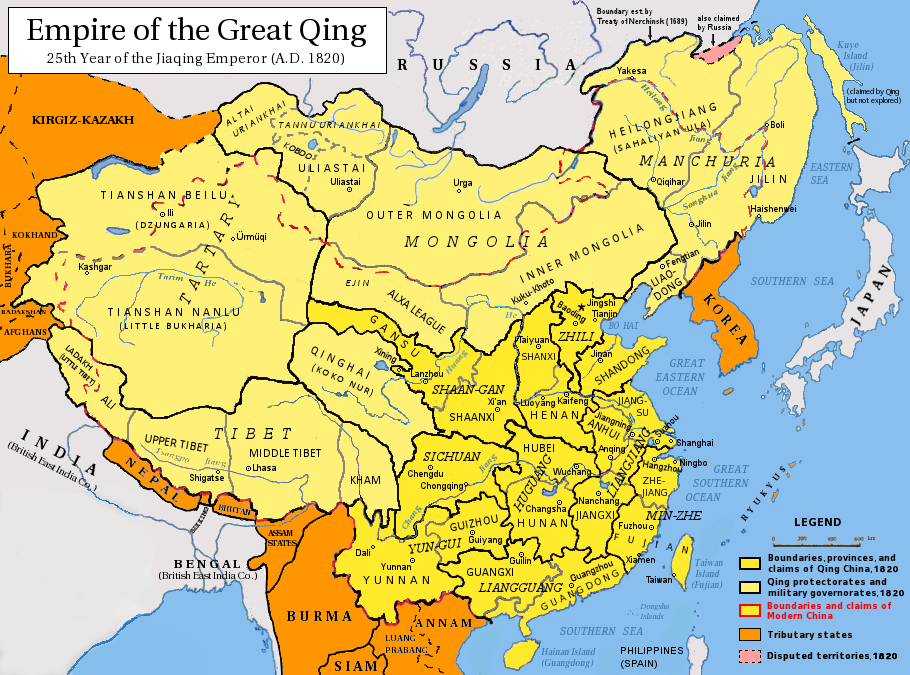
Russia was expanding into Central Asia, taking Samarkand, Tashkent, and Bokhara in 1865-68, “arousing fears in the British that Russia might threaten its interests in India.” China was therefore in danger of losing its claim to the central Asian plains, but eventually was able to reassert its position. In 1884, the region was named ‘New Territory’, or Xinjiang.
Culture took a more conservative turn during the Qin dynasty. The impulse came from within Chinese society, but the Manchus had nothing against this as they were “more inclined toward a more disciplined social style and were content to see the Ming condemned as a degenerate dynasty.” Laws against “degenerative behaviour” became harsher; there was a turn against fiction and drama, regarded by the literati as “socially subversive or licentious”; and “concern for the purity of women reached an all-time high.” This was also, Buckley Ebrey notes, a period of reflection, with some notable classics such as Dream of Red Mansions.
Until 1700, China’s material culture had been “unrivalled”, and the standard of living had been amongst the highest in the world. As the eighteenth century progressed, European estimation of China “grew less rosy”, with writers such as Montesquie, Rousseau, and Hegel describing China as “inferior […] because neither liberty nor progress was valued there.”
During the eighteenth century, trade between China and Britain had been handled mostly by government-recognised monopolies such as the British East India Company. Demand for silk and porcelain remained strong, and tea demand also increased – this would grow exponentially. The British wanted to change the rules of the market in order to improve profits. In 1793, Lord George Macartney was sent as an envoy to Qianlong (Emperor Gaozong), where he refused to kowtow to the emperor.
In the coming century there was the Opium War (1840-42), a controversial and unpleasant point of recent history for the British (of which there are, unfortunately, many). Buckley Ebrey notes that:
“in Chinese eyes there could not have been a more blatant case of international bullying, of the morally repugnant imposing their will on those trying to do the right thing.”
Opium had long been used in China for medicinal purposes, but by the eighteenth century people had taken-up smoking opium purely for its narcotic effect. After the British conquest of India, they invested heavily in the manufacture and distribution of opium. In China, the import and domestic production of opium was banned in 1800, and by 1813 smoking opium was outlawed. The British began to sell to smugglers (including Chinese smugglers), with a huge increase in criminal gang activity, just as there is today in the UK. “Soon the outflow of silver caused by the opium trade gave additional urgency to he need to solve the opium problem.” The conflict itself led to the ceding of Hong Kong to the British, in addition to indemnity costs.
In fact, throughout the coming nineteenth century, China signed many more “unequal treaties” with imperialist powers. China was unable to set its own tariffs and “eventually had to appoint European officers to collect them.” Europeans gained “treaty ports”, or concessions, which “came to resemble international cities.” This period, understandably, is sometimes given the name the 'Century of Humiliation'.
Until 1860, “no high-ranking official viewed the foreign adversaries along the coast as a major threat to the survival of the Qing dynasty,” which perhaps explains part of the stagnated response. Buckley Ebrey writes that “at all social levels from peasants to Chinese to Manchu officials, a majority probably kept hoping the west would just go away.” Once again, however, we see uprisings, insurgencies and rebellions amongst the people, such as the Taiping Rebellion of 1850-64, which spread over 16 provinces, led to the destruction of 600 cities, and “the deaths of twenty million people.”
Buckley Ebrey notes that this was the greatest peasant uprising in Chinese history. It took place in south China, which was the area most affected by the Opium War. The key figure associated with this was Hong Xiuquan, a Hakka who had failed the civil service exams and who, after reading a Christian tract, believed himself to be the younger brother of Jesus. He encouraged/instructed his followers to “destroy idols and ancestral temples, give up opium and alcohol” and there was a “virulent anti-Manchu strain to his teachings.” By 1850, he had 20,000 ardent followers at his base in Guangxi. He declared himself King of Heavenly Kingdom of Great Peace and defeated a major Manchu banner force. They setup a government in Nanjing and held on for a decade. He was eventually defeated by the scholar-official Zeng Guofan with his 120,000 troops of the Hunan army.
In turn, Zeng Guofan led more successes against uprisings. Buckley Ebrey notes the pattern of how uprising and rebellion from the people leads to the fall of the ruling powers: the Yellow Turbans had brought down the Han, White Lotus rebels had destroyed the Yuan, and Li Zicheng had brought an end to the Ming.
There were two important outcomes from the Taiping Rebellion: “post-rebellion period provinces gained greater fiscal autonomy” and “Manchu domination of the military establishment was brought to an end.” In addition, Li Hongzhang, a protege of Zeng Guofan, played an active role in the modernisation of the economy, such as the introduction of steam navigation, coal mining, telegraph networks, and cotton industries. In this era, we see merchants providing capital, whilst officials provided initiative and political connections.
China’s industrialisation, however, was not as rapid as the one taking place in Meiji Japan. In the 1870s, Japan laid claim to the Ryukus, islands that had “long tributary relations with China.” Japan then forced Korea to open itself in 1876. Rebellion broke out, and both China and Japan sent troops in to Korea. The Japanese, according to Buckley Ebrey, “were looking to provoke a war […] and so sank a steamer carrying Chinese troops.” China ceded Liaodong and Taiwan, as well as giving Japan a right to open factories in China (something the Europeans had also gained). The Europeans, however, are reported to have been unhappy with Japan’s gains. The western powers (already in the process of carving-up Africa and southeast Asia) “scrambled” for further concessions in China.
“At this juncture,” writes Buckley Ebrey, “when China seemed about to be dismembered, a group of young scholars […] presented a long memorial to the throne urging thorough-going reforms.” These reforms included the raising of taxes, development of a state bank, building a railway network and a commercial fleet, and establishment of a modern postal system.
Buckley Ebrey notes the “brilliant” Kang Youwei, who presented Confucianism “in a new light, as an institutional innovator and proponent of change.” The 23-year-old emperor Guangxu called on Kang to help with the reforms. Edict after edict was issued, but the Empress Dowager Cixi was “afraid the reforms would undermine the position of the Manchus” and she imprisoned Gunagxu. Kang himself managed to flee to Japan.
A further rebellion followed: the so-called Boxer Rebellion, which added the “explosive ingredient” of xenophobia to martial arts and shamanistic belief, blaming “China’s ills on the evil of foreigners.” It would be interesting to study this in more detail to make links between this and the extreme far-right islamaphobic groups in the UK today led by Zionist-backed figures with fake names.
The Boxers emerged in 1898 out of the impoverished region of Shandong and began to destroy foreign buildings such as railways, as well as attacking Christian missionaries and Chinese Christians. With so much disaffection in the UK today, it is no wonder that people are drawn to simplistic manipulations to blame X or Y for their difficulties.
Empress Dowager Cixi wavered but eventually decided to support them – in other words the group garnered and secured the support/approval from a leading political figure, and in turn they gained political legitimacy. In 1900 they gathered at Beijing. Western nations amassed 20,000 troops to lift the siege in Beijing and, having accomplished this, took to looting the city.
Republic of China
The next period of Chinese history covered by Buckley Ebrey is the early 20th century from 1900-1949 during which there was an “intense effort of an increasingly diverse elite to refashion China into a powerful, modern state.” During the first decade, the Qing were “undermined […] on nearly every front,” whilst in “localities across the country, a more activist local elite was emerging.” This would eventually lead to the overthrown of a 2,000 year tradition of monarchical rule.
Western ideas were making their way into Chinese thought through figures such as Yan Fu who studied in England and translated a number of key texts, including Evolution and Ethics, Wealth of Nations, and On Liberty. He “argued the western form of government freed the energy of the individual, which could then be channelled into collective goals.”
In 1905 the civil service examinations were abolished and steps were made towards a modern government bureaucracy. Emperor Guangxu died aged 33, a day before Empress Dowager Cixi. “The anti-Manchu revolutionary who would eventually be mythologized as the founding figure of the movement” was Sun Zhongshan (or Sun Yatsen, 1866-1925). Like Yan Fu, he had spent time abroad in the USA as well as England and Japan, and he showed an interest in Christianity and western medicine. He moved to Hong Kong where he and his friends “thought the best way to overthrow the Manchus would be to ally with the secret societies so pervasive in the south.” This included groups such as the Triads, who were anti-Manchu and who had large followings.
A revolutionary group took the city of Wuchang and soon this energy spread to other provinces who declared independence. Yuan Shikai (1859-1916) acted as negotiator with the revolutionaries, and he secured an agreement to establish a republic with himself as president. In 1915, however, he announced himself as emperor and then died unexpectedly in 1916.
The time following this is sometimes referred to as “China’s warlord period”. Commanders of Yuan’s old army, governors of local provinces, local strongmen and gangsters built-up power bases. Territories such as Tibet and Mongolia declared independence.
In 1914, Japan (as an ally of Britain) had seized German territories in China. In 1919, on May 4th, students in Beijing protested, which flared further protests throughout the country. “The cabinet fell and China refused to sign the Treaty of Versailles.”
The 1920s and 1930s is viewed by Buckley Ebrey as the New Culture Movement. With the success of Bolshevik revolution in Russia in 1917, intellectuals also took an interest in Marxist-Leninism: “the emphasis on class struggle and violent overthrow of those in power was diametrically opposed to Confucian emphasis on harmony and on respect for hierarchy.” This retreat, or abandonment, of the Confucian tradition marked a significant turning-point in the history of China – it would be very interesting to see a study on what aspects of traditional Confucianism have been retained within the culture and how this has shaped the socialist aspects of the society, as well as how far modern China can be seen as a strange fusion of Socialism and Capitalism.
The Soviet Comintern sent agents to promote Communist party cells, and from the 1920s onwards both Nationalists and Communists attempted to build states and armies, even twice joining forces, though “at bottom they were rivals.” Comintern, Buckley Ebrey notes, was advising both groups.
Jiang Jieshi (or Chiang Kaishek, 1888-1975) is the next key figure of this period. He had been trained in the Soviet Union and was married to Soong Meiling, the daughter of a wealthy Christian industrialist and sister of Sun Yatsen’s widow. In 1927, with the Nationalist army approaching Shanghai, Chiang organised members of the Green Gang, a “Shanghai underworld racketeering gang, to kill all labour union members and communists in the city.” Communist forces fought back, though Mao Zedong’s attempted “Autumn Harvest Uprising” was suppressed. The Communist leadership was driven underground. In 1928 the Nationalists “gained the allegiances of three key warlords to reunite the country.”
Buckley Ebrey notes that there were significant changes in the lives of those living in the cities, though not for those living in the countryside. Of all the changes, she asserts, “the most fundamental may be the changes in the family and women’s roles in society.” There was increased participation, for example, and she notes that progress was made in terms of ending the practice of footbinding, as well as the increase of women’s access to education. After 1920, opportunities for women in higher education “rapidly expanded.” The growing industrial cities also provided further opportunity for employment.
From the time of the May 4th protests, “Chinese patriots saw Japan as the greatest threat to China’s sovereignty.” The Japanese had been in Manchuria since their 1905 victory over Russia, and were “ostensibly there to protect Japan’s railroads and other economic interests.” In 1928, officers assassinated the warlord of Manchuria, and in 1931 set off a bomb on the Southern Manchuria Railroad to give a “pretext” to occupy Shenyan “in self-defence.” This phrase is particularly noteworthy in the present day (see reflections on texts concerning Palestine).
China appealed to the League of Nations who “recognised China as being in the right but imposed no real sanctions on Japan.” As we shall see, or as recent history evidences, where an empire or nation state commits crimes, when they act in terrible ways, the line is pushed further and further if a suitable stand or response (from the international community) is not made. In 1932, Japan invaded and attacked Shanghai. This was “widely condemned” and they exited after four months, but in Manchuria they installed a “puppet regime, making the last Qing emperor the nominal head of Manchukuo.” This period will be explored in further detail in Korea: A History, by Eugene Y Park.
In 1936, Chiang Kaishek was kidnapped by retreating/fleeing Chinese troops who urged him to form a united front with the Communists. In 1937, he decided to attack. Japan launched a full-scale offensive. Chiang abandoned Beijing and Tianjin. Shanghai fell, as did Nanjing, where the Japanese army “went on a rampage, massacring tens of thousands of civilians and fugitive soldiers, raping at least 20,000 women, and laying the city waste.”
The imperial Japanese army continued its expansion into Asia, with Britain unable to defend its interests in Hong Kong, Singapore, or Burma from Japanese invasions. This twisted conflict shifted into the Pacific, where the Japanese were destined to encounter the USA. Soong Meiling lobbied effectively in the States, and Buckley Ebrey notes that as a result of these sorts of geopolitical movements, China became one of the five permanent members of the UN Security Council following the second world war.
The People's Republic of China
The Communists would prove to be successful over the Nationalists in China. Buckley Ebrey considers the points informing this, asking whether this was due to a failing of the nationalists, down to the superior strategy of the communists, or whether we can attribute this to Mao single-handedly transforming the party?
Mao was from a farming village in Hunan. He emerged from the modern school system and, upon graduation, headed to Beijing where he worked in the library of Beijing University. (A farmer/librarian revolutionary is surely more attractive, and decidedly more trustworthy, than a billionaire tech oligarch!) He returned to Hunan to organise the peasants, leading a few thousand into the mountains along the Hunan-Jiangxi border, setting-up a government. They redistributed land and promoted various social reforms.
In 1934, 80,000 of them escaped a nationalist encirclement. This was the start of the “much mythologized Long March in search of a new base area.” Only about 8,000 of the original army made it the whole way. They settled at Yan’an, a city in central Shaanxi. Much of Mao’s most famous writings date from this period. Buckley Ebrey writes that he needed to reinterpret Marxist theory “in such as way that the peasants could be seen as the vanguard of the revolution.”
This was important because, in particular, peasants were “ready to be mobilised against the Japanese” as they “hated” them for seizing women for prostitution and men for forced labour, as well as their “three all” policy of retaliating against resistance by “killing all, burning all, looting all.” At this time, Japanese forces were occupying cities, towns, and structures such as railways – there was plenty of opportunity for guerilla operations for resistance.
After the surrender of Japan, the USA and Russia were present to support in China (as elsewhere), but their presence did not lead to the creation of oppositions such as in Germany or Korea. Russia entered Manchuria and dismantled much of the Japanese industrial plant to take back to the Soviet Union, but large stores of weapons made their way to the Red Army. The USA tried to convince Jiang to “establish a government in which opposition parties could participate.” This failed, however, and civil war followed. This was over in less than two years, upon which Jiang and much of his government retreated to Taiwan.
Buckley Ebrey delineates the period from 1949-1976 as The People’s Republic, in which China was once again held together by a “powerful central government […] committed to a more egalitarian social and economic order.” Peasants and workers were empowered, and the state looked to limit the influenced of landlords, capitalists, intellectuals, and foreigners.
For the new ruling party, struggle, revolution and change were good; compromise, deference, and tradition were bad. “Wealth and power were redistributed on a vast scale” and “everyday life was politicised as never before.”
“As the Red Army entered cities its peasant soldiers clamped down on vice – ending looting and rounding-up beggars, prostitutes, opium addicts and petty criminals to be re-educated and set to productive work.”
There must have been a jarring sense of inversion in many places, where people who had held power and authority for so long were now vulnerable, and people who had for so long been voiceless and powerless now had authority and support.
Such hand’s-on action was regarded as a necessity, as the state’s economic goals depended on reviving and restructuring. The state took control of banks and within a year brought inflation under control. The state also took control of key industries (rather than selling them off), such as the rail network, as well as foreign trade. Industrial plants opened with the assistance (including training) of the Soviets.
In 1950 war erupted in Korea. The USA came to the “defence” of the South, whilst China also intervened. This war “raised the legitimacy of the Communist Party in China: China had ‘stood up’ and beaten back the imperialists.”
Following this, there was a strong drive against corruption. In the “Five-Antis campaign” of 1951-52 there was a focus on bribery, tax evasion, theft of state assets, cheating in labour or materials, and stealing state economic secrets.
As the Communist Party took over new areas it taught peasants a new way to look at social order: “social and economic inequalities were not natural, but a perversion caused by the institution of private property.” The line also held that the old literati were cruel “exploiters.” Buckley Ebrey writes that “the pervasive attack on the old was extended to many features of traditional culture.” In addition, “society no longer tolerated men of leisure who derived income from investments and spent it on art or antiquities.”
The redistribution of land was a difficult process which included classifying people, and the reorganisation of the countryside “created a new elite of rural cadres […] who now had power over almost every facet of their lives.” The hand’s-on control, it is suggested, impacted on the privacy of the individual and of course this is a key clash between the supposed individualism of the West. This extended even to the mind of an individual, with so-called “thought reform” of intellectuals which “entailed confessing one’s former sub-servience to capitalist imperialism.” Some branches of intellectual work, however, such as archaeology, were given generous government support which helped with investigation of such sites in Anyang, Xilan, and Luoyang.
Another outcome of all this reform was an improvement in women’s equality, which perhaps evidences that positive (similar) outcomes can come in two seemingly opposing systems. The Marriage Reform Law (1950) granted young people the right to choose marriage partners, wives the right to initiate divorce, and wives and daughters the right to inherit property.”
In summary, the leadership of the state, of course, viewed things as follows:
“The Chinese people had been freed from the yoke of the past and now could rebuild China as a new, modern, socialist, egalitarian, forward-looking nation.”
China was also (and continues to be) a “multi-national state”. The state began to identify and label China’s ethnic minorities, with the Han as the majority. “In some cases where a particular minority dominated a region […] the region could be recognised as ‘autonomous’, giving it the right to use its own language in schools and government offices. Tibet, Xinjiang, Ningxia, Gunagxi, and Inner Mongolia were all made autonomous regions.”
By 1957, “to Mao at least”, China could no longer follow the Soviet model. The state had succeeded in stabilising and in embedding reforms (and power). In order to modernise, China needed to utilise what it was rich in: “labour power”. Mao began to speak of a Great Leap Forward. Some of these projects were a success, such as bridges, railroads, canals, reservoirs, power stations, mines, and other irrigation works. In some cases, however, or “all too often”, projects were undertaken with serious mistakes made.
One interesting corollary to today would be with the significant amount of overseas investments and infrastructure projects being undertaken by China today (see The New Silk Roads, by Peter Frankopan). Some commentators argue that the projects are poorly made or implemented, though it could also be argued that China is a leader in terms of large-scale construction projects. We could ask whether the “serious mistakes” were the result of input from others (it is already noted that the Soviet Union was supporting with these projects), and whether this period of construction may have been a key point of learning.
Ultimately, Buckly Ebrey writes, Mao’s “faulty economics ended up creating a famine of massive proportions.” And furthermore Chinese-Soviet relations began to strain following the death of Stalin. Krushchev visited China in 1958 and 1959, and he reneged on a promise to give China atomic weapons. In 1960, he ordered all Russian technical advisors out of China.
For Mao, “the revolution had to be continued to succeed […] he probably genuinely feared that China was slipping in the inegalitarian direction of the Soviet Union.” This led to the so-called Cultural Revolution which “quickly escalated beyond the ability of Mao [and others] to control or direct.” Students devoted their time to Red Guard activities, whilst “tensions and antagonisms that had been suppressed by tight social controls broke into the open as Red Guards found opportunities to get back at people or vent their fury.”
When judging the people of the past, it is sometimes easy to forget the trauma that they had experienced. When discussing the time following the First and Second World Wars it is important that we note that for places such as China, Korea, Japan, mainland Europe, Ireland, Britain, Palestine, Syria, Egypt and so on there were huge amounts of physical damage in addition to the mental traumas for the citizens, and this is without mentioning the traumas of imperialism and colonialism. In this sense, it is interesting to note the trajectories taken in each land, the adaptations to culture, especially when contrasted to the USA, which saw no fighting or destruction within its own borders (but would come to have more internal civil strife relating to the apartheid within its borders).
In 1968 Mao disbanded the Red Guards – he had “no choice but to moderate […] in order to prevent a full-scale civil war.” Regardless, the impacts of socialist policy in this period are very clear. Aside from the aforementioned progress in women’s rights and infrastructure, visible inequality was much reduced, a new architectural style was learned from the Soviets, and inexpensive healthcare greatly improved life expectancy. There were, however, great differences in social life between those in the cities and those in the countryside.
These improvements, Buckley Ebrey asserts, came at a cost: “life was much more regimented and controlled.” But Mao had “succeeded in making people proud of China.” This was perhaps an invaluable gain from the trauma of the many generations of war, both internally and externally (such as the British and Japanese).
After this period, Buckley Ebrey recounts the gradual opening-up of China to the west, including the noteworthy visit of Richard Nixon in 1972, arranged by Zhou Enlai, in which the Communist Party turned away from “more radical forms of collectivism and class struggle […] by the 1990s, the look on the streets had little in common with China of the 1960s.”
Following Mao’s death there was an inevitable power struggle. On one extreme there was Mao’s widow, Jiang Qing, and her allies; on the other there were “victims of the Cultural Revolution who had come to distrust mass mobilization and who wanted to restore economic incentives and other pragmatic policies.” The key figure of this was Deng Xiaoping. Hua Guofeng, however, was the immediate successor and, shortly after, ordered the arrest of Jiang Qing and associates, known colloquially as the Gang of Four.
Deng returned to the political realm at the age of 72 and succeeded Hua in 1978. He held an “impressive revolutionary pedigree” and pushed for reform in universities, including a reintroduction of college examinations, and ‘Four Modernisations’ in agriculture, industry, science and technology, and defence.
In 1985, the government “relaxed state control of vegetables, fruit, and meat, leading to more farmers to take up sideline enterprises such as growing vegetable and raising pigs or chickens.” The private sector was also revived in the cities, with large-scale opening of small businesses.
Deng also “abandoned Mao’s insistence on self-sufficiency and began courting foreign investors”. He visited the USA in 1979, famously attending a rodeo and wearing a cowboy hat. In 1980, Deng sponsored the creation of the first Special Economic Zone in Shenzen, designed to attract foreign investment with special tax treatment.” As a result, foreign manufacturers flocked to China “attracted to China’s low labour costs.”
The 1990s saw the collapse of communism in eastern Europe and the Soviet Union.
“In Deng’s view, the Soviet Union broke up because central planning had not produced prosperity. He told people not to worry if policies were capitalist or socialist, only whether they would make China more prosperous.”
The improvements in all measures of life have been stark, and continue to this day: GDP, exports, wages, literacy, academic attainment, infant mortality – by all measures China’s rise has sharply contrasted to the same measures in western nations.
Deng himself passed away at the age of 92. When Mao had died, 80% of the population was rural; by 2008, 50% were no longer employed in agriculture and lived in towns and cities. “In 2008, China had 92 cities with over a million people (the USA had 9 and the EU 17).”
Over these past two decades there has also been an ongoing building boom, as anyone who has visited China can attest. (I recall being in a taxi going from Shangahi airport to our allotted apartment in Minhang and seeing an enormous expanse of land, battalions of tower blocks everywhere, and over the course of the 40-60 minutes drive the city seemed endless.)
Private ownership grew from the mid 1980s, as did consumer culture. “Chinese, like people in more developed countries, were identifying more with the goods they consumed than with politics.” And why not? It seems very basic to state, but if people have their comforts, if they have their needs met, then they are less likely to be disaffected and perhaps less likely to have a desire to be engaged in politics: this could be said to be positive but also dangerous. Buckley Ebrey also notes how the costs to people in rural areas (such as healthcare costs and schooling) were addressed so as to reduce the gap and differences between rural and urban places.
Buckley Ebrey also takes time to consider some of the key criticisms aimed at China, including environmental damage and pollution: “Mao had encouraged the Chinese to harvest nature to increase production. Little thought was given to the ecological consequences or terracing mountains, ploughing grasslands, reclaiming wetlands, damning rivers, or killing all the sparrows.”
She also considers the stringent birth control policies, such as the well-known one-child family policy (she notes that this was in the cities, whereas it was one or two in the countryside). “By the 1990s, with increased prosperity, people talked about the pampered only children in the cities” with planners showing concern that one young couple could have 4 elderly parents to support. By 2050, almost a third of China’s population will be over 60, about three time the proportion in 2005. In addition, “men will outnumber women by a large margin.”
Considerations
In her epilogue, Buckley Ebrey writes that “when history is viewed from the western edge of Eurasia, the natural pattern seems to be for civilizations and empires to rise and fall.” Egypt, for example, eclipsed Sumeria, followed by Babylonia, Persia, Greece, and then Rome. Some civilizations were completely destroyed, whilst others were “simply overshadowed by new, more vigorous, more successful civilizations,” Even more recently we had the rise of the Italian city states, a Spanish empire, the Hapsburg empire, and of course the British.
When we view history from the eastern edge, however, there is a sense of civilizations progressing through a “series of yin-yang-like reversals and direction from excessive disorder to excessive order and back again.” Things fall apart, as Achebe quoted from Yeats.
When Europeans first began to study Chinese history, writes Buckley Ebrey, “they often unconsciously tried to discover where China stood in the scheme of civilizations on the rise and decline based on western experience.” But this is not an appropriate framework to study Chinese history, in part because of the vastness of the continuity of the culture. An additional error made by western thinkers is that Chinese civilization can be viewed as archaic and dusty, not realising that there is a rich vein of learning for the modern world that can be sourced from the study.
Buckley Ebrey also notes how some western thinkers have criticised the west by celebrating and contrasting it to China, such Voltaire, who “found in China a land without an established church where rational philosophers ruled,” or in the 1950s when “western feminists found in China a land where women held up half the sky,” or in the 1960s when “western radicals found in China a place imbued with a communal spirit so strong that streets were magically cleared by friction-free street committees,” or in the 1980s when “western conservatives found in China a nearly crime-free society where everyone learned the virtue of self-respect.”
As ever, bias plays a role in the historian’s task, selecting and presenting information, with further bias “in sources that makes it easier to say good things about earlier periods.” With such a long span of time covered, Buckley Ebrey notes that there are difficulties in “seeing any period except in terms of what came afterwards.” And of course, the closer to the present, the more evidence we have to inform our perspectives. We can say much of the study history is like this, and ancient history in particular is full of propaganda. The history of China is made more complex in the sense of the mandate of heaven and how, specifically from the Han onwards, historical writing was a way to legitimise the rule.
Finally, Buckley Ebrey further notes the problems she had writing this text in the sense of writing the history in English for a western audience in the style/form “strongly influenced by trends in history writing in Europe and the United States over the last few decades.” There is, she asserts, an East-West conceptual gap in addition to a modern-premodern gap. We could argue that the West/East conceptual gap is a major focus point for our modern world, and a space where there is potential for cultivation within the societies across this imagined divide, as well as for negative misunderstandings.