Geopolitics for the End Times
Macaes explores how responses to the Pandemic evidence global order changes, exposing our ongoing fragility in the Anthropocene.
Bruno Macaes has distinguished himself as a perceptive analyst of the modern world, notable for his clear position on the Israeli Genocide against the Palestinians.
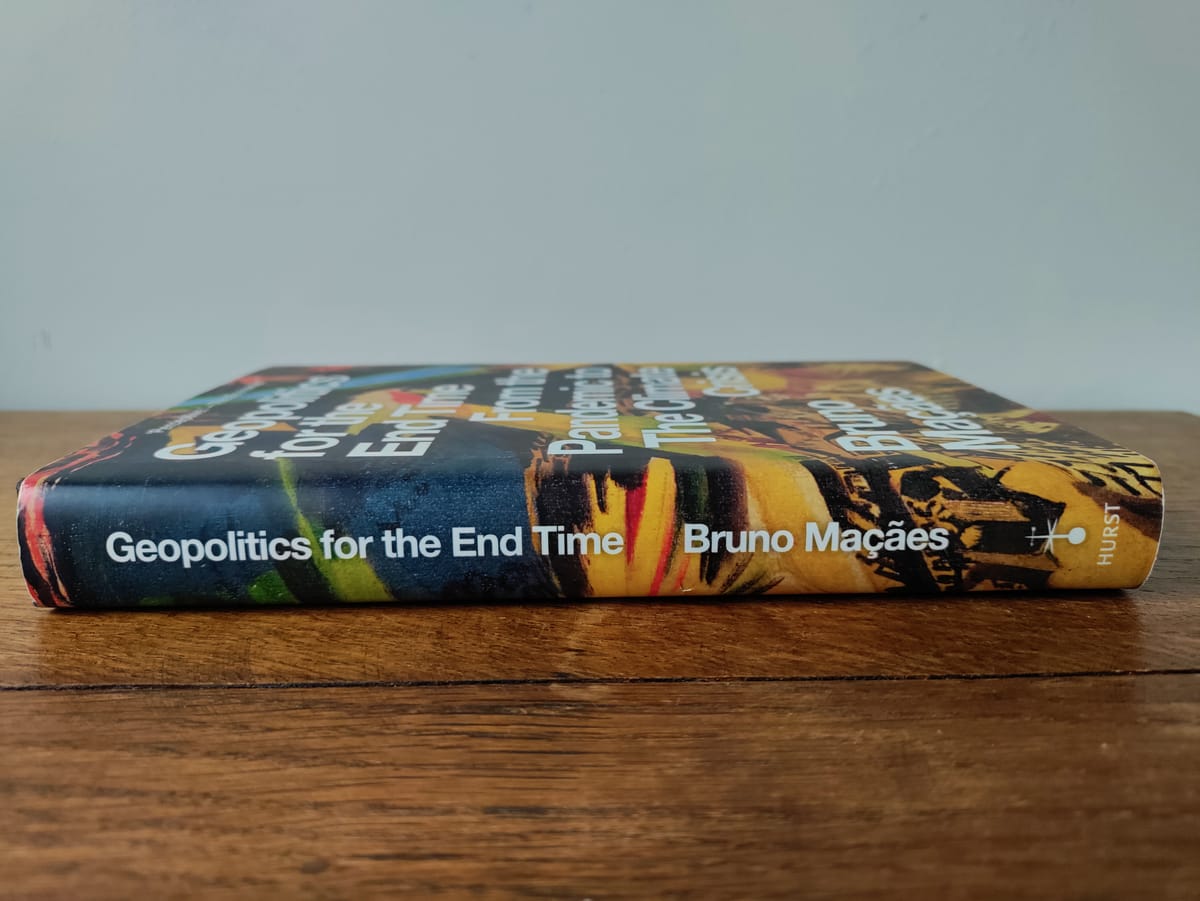
Geopolitics for the End Time: From the Pandemic to the Climate Crisis, followed his Belt and Road: A Chinese World Order (2018), The Dawn of Eurasia (2018), and History has Begun: The Birth of a New America (2020). This text has been followed by the 2025 publication World Builders: Technology and the New Geopolitics.
The key idea within this text is that of the power dynamics between modern Nation States and how these are impacted by Nature, which was brought into focus by the recent pandemic, which Macaes uses as a lens with which to view these state relationships. The pandemic served to inform us about subtle differences between nation states in the sense of how they responded to the crisis, and this in fact seems to have crystallised some of Macaes’s assertions in his previous works about the dynamics between these states, most importantly the perceived world powers of America and China and how the global order is shifting.
He opens by framing the pandemic through Buckminster Fuller’s idea of 'Spaceship Earth', which puts us collectively in the same boat, voyaging together through the experience of global events, the pandemic being fairly unique in scale. Macaes brings to mind those sci-fi films in which the crew are in a slumber, where time bends and we sacrifice “portions of our lives”. The pandemic was also, he notes, “a test” in terms of how people responded and how states responded, the political systems and structures, which revealed both subtle and alarming differences between cultures. He refers, for example, to the “Confucian cosmopolis”, that of Singapore, Vietnam, South Korea, and of course China, where there was a “moral system that emphasizes duties before rights” which is contrasted to the so-called democratic West whose reaction was one of “incredulity and complacency”. The pandemic arrived at a time of great “geopolitical rivalry” serving as a “perfect backdrop for a renewed clash of civilizations.”
For many, the pandemic was a kind of absence, and in the UK we are most reminded of the number of children whose school lives were, for the most part, disrupted. In some way, the move to virtual home learning revealed to many that there was another way to arrange compulsory education, and we now take the home working model, or virtual working (virtual meetings included), as something completely normal, though not without some inefficiences and sacrifices. Macaes writes that without our current technology, this adaptation would not have been possible in the past. He refers to this as a kind of “retreat from the world into a protected technological abode” and a “great migration to remote life.” Some argue that the impact on children of this loss of schooling has been so great as to impede the social communication skills of an entire generation, though we must take into account that the current generation have been exposed to smart phones and social media in the same way the preceding two generations were exposed to television.
It may too early to understand the specific impact of the pandemic on the population, and we may never be able to isolate factors to meaningfully test this impact, but we can assert that it can be viewed as a kind of collective trauma, not least in the sense of isolating people. It is also worth exploring in what ways the constant fear and sense of uncertainty has impacted on people.
For Macaes, in addition to the consideration of the human systems in place (that is in terms of governance, measures taken, and implementations of policy), there is also the consideration of Nature re-imposing itself. This of course brings to mind the so-called Anthropocene epoch, which he examines in the final chapter. He proposes that “the best image for our natural environment [is] empty space”. We have not yet mastered Nature, he notes, and Humanity is not yet in a place where its own survival is assured, regardless of how our actions impact on our environment. Our mimetic view of the world, a world which has order and meaning, is “no longer the way we regard the world. We are builders.” Indeed, with the advent of science as leader, and with a virtual world tentatively established, the idea that humanity rules over the planet seems easier to accept; until, that is, the collective mass becomes threatened across the globe and the habits of human-beings change drastically.
“As the pandemic progressed, it became clear to me that the question towards which it pointed was the modern conquest of nature, the passage from nature to civilization and the danger of a relapse.”
Humanity, perhaps, was collectively complacent, but it was in the reactions to the pandemic in which we saw the degrees to which different states and systems had become complacent. As noted, he regards some states as responding with distinction, and he quotes Peter Ho, Singapore’s former civil service chief, who states that public authorities must stay ahead of the curve, make risky projections, and frame their policy in response. The West, reactive rather than proactive, was responding to data which, of course, was “past data.” Macaes reads in these responses the ways in which the social organism is alive, displaying complex reactions, with European habits perhaps more robotic in habit, which he observes is a denigration often aimed at East Asians.
He writes that the “critical comparison” was between China and the so-called “liberal democracies”. The West, of course, was supposed to be a place of transparency, of freedom, and yet China achieved better outcomes against the pandemic. One key difference was that Chinese society responded “as a whole”, whereas we can say that in the West (at least from my vantage point in the UK), there was a very herd-like response, with mostly strict obeyance to government directives, including standing outside doorways clapping. This still seems incredulous. The government initiated a clapping movement rather than actually recognise the importance of these people in society in another, more meaningful way.
Macaes writes, concerning China, that one of the key questions for the Chinese today is “how to ensure that the individual is not fully replaced by technology.” For Macaes, we as a species are troubled by the idea that we will become objects rather than subjects, and with the pandemic he sees the digitization of people continue apace. Since the text was published, we have continued advances in AI and there are concerns about how this may replace some administrative (not to mention artistic) processes. We also have continued advancements in the field of robotics, such as those who can perform a rage of menial and physical tasks. Although people in Europe (at least at the outset of the pandemic) viewed China as a developing country, the reality is now that the Western nations can be regarded as stagnant and decrepit compared to the Middle Kingdom.
“In Europe, the general psychology too often reflects the ideology of development […] what no one considered was that a virus could bring this perfect system to the point of breakdown.”
Which moves us on to consider America where “for decades they had been consuming high doses of dystopian novels, dark miniseries and blockbuster disaster movies.” The collective mind of America was primed for such an event, with preppers and conspiracy theorists justified. Macaes claims to have detected three distinct part of America’s approach/response: denial or oblivion; turning the pandemic into a high drama; and then the use of advanced technology and the use of Big Data and predictive algorithms to counter.
He writes that “Covid left us with two main images of pandemic response. The Chinese success in containing the virus through social control and the American campaign to vaccinate its population at breakneck speed.” We can reasonably ask how each approach reveals the attitude taken towards the citizens; or, in other words, how the ruling elite views the populace.
He ends his first section with reference to the Bhagavad Gita, with Arjuna and Krishna in conversation. Arjuna wants to know his purpose, his dharma:
“To become masters and possessors of nature, invulnerable to gods, it is first necessary to answer the question of what exactly is our nature and for what purpose should all this power be executed.”
The virus, the global pandemic itself, becomes then a kind of threshold and testing ground of Humanity: some systems will survive and adapt, and those systems (and peoples) will usher in the new era in which Humanity once more attempts to conquer nature; this time, and perhaps for the first time (that we know of), a global era with a more pronounced emphasis on the collective of the species. This may be a leap too far, perhaps, as there remains great fragmentation between states, with the interstitial gaps of nature proving to be unassailable.
The next section is entitled 'Star Wars' and Macaes brings in ideas from his previous works to evidence how the pandemic may represent (or come to evidence) a changing of the world apex predator from America to China (or a multipolar organisation of states most recognisable as China-led), though it may be a disservice to China to label this new order as predatory.
He writes that in history there are wars “upon which the very fate of the world depends; what is at stake and what will be decided by the outcomes is how world politics should be organised, according to which principles and values and no less, which hierarchy.” He cites Athens vs Sparta as one such war, and we can certainly refer to more recent instances. This pattern, he writes, is repeated, whereby a dominant power is challenged and the change is determined by a momentous war. One exception, in part, was the “transition from British to American hegemony” as the two powers were not in direct conflict with one another (save for the War of Independence, though we could regard this as in part transitional). We are now, however, in a nuclear age, and this has brought the rules of war (for nuclear states) into a different arena.
China is rising: of this there is no doubt. Macaes writes that America, however, for now, has its hand on many important levers, as evidenced by the subordination of Huawei, and we can further add the rumblings with Tik Tok (one consequence of which was a vast number of Americans accessing Douyin in response/protest, which led to direct contact with Chinese people and Americans seeing the gaps in the narrative, including the difference in prosperity between the two). Covid itself forced America to compete “on equal ground” as the rules of engagement were shifted.
Macaes writes that Western political systems were “built for normal times” whereas China is still revolutionary:
“Chinese society is a mobilized army, which can quickly drop everything else and march in one direction.”
He frames it as such: in the West, Covid was a public health problem, and in China, Covid was a national security crisis.
This specific chapter is full of statistics, most notably that China is expected to claim the crown of world’s largest economy by 2028. How will China be viewed? Macaes asks, referring to Jamil Anderlini’s Financial Times piece published in February 2020 in which he argued that:
“the Chinese regime was now approaching one of those moments, recurrent in Chinese history, when the rulers lost the mandate of heaven and were overthrown.”
This doesn’t look to be the case, with the last 5 years only evidencing further stability (at least in appearance) in China and more turmoil (at least in appearance) in the USA. The pandemic brought very negative images of China to the West, but the Israeli and US genocide against the Palestinians, however, has challenged much of how the nations are viewed, with many citizens now considering how shallow the ideas of self-determination and a global liberal order is, not to mention so-called ‘rules-based’ exchanges or orders.
When people talk of a multipolar world, it is in the sense that there is not one dominant power, and this is perhaps what Macaes alludes to when he writes that “the age of global empires – even a liberal one – may turn out to have been strictly confined in time”, or an anomaly for Humanity. He also notes that “even though the ‘global liberal order’ is often a tool used to project American power, it also imposes some constraints on the United States,” and we can extend this by considering how the projection of America’s soft power has been greatly damaged by its support and cover for the Israeli Genocide against the Palestinians.
The pandemic exposed America’s vulnerabilities, not least its “supply chain vulnerabilities" including in key areas such as medical supplies, pharmaceuticals, military technology, semiconductors, telecommunications, and rare earths. The exposure of this, for unprepared and prepper alike, led to fear within the populace and likely the ruling elite also. Perhaps this explains why there has been increased America First movements over the past decade or so? Indeed, Macaes cites an article in the New York Times in which Noam Scheiber writes:
“It is the rise of China, above all else, that is bringing nationalistic management of the economy back into the political mainstream.”
In what ways, might we ask, is the Israeli/American Genocide of the Palestinian people connected to America’s fear of China? A kind of reassertion (or ongoing assertion) in the cradle of civilization, in the crossroads of the Eurasian and African continents. If the pandemic is one such existential threat to Americans (and the ruling order), then China is the other.
Macaes repositions his line of reasoning back to China, exploring the policy introduced under Xi of ‘Dual Circulation’ in which there is a clear distinction between a domestic and a global economy system. The “two economies” must follow different rules: the domestic is “governed by a general imperative of efficiency,” and welcomes competition, whereas in the global system “efficiency is a subordinate goal” – here, state power, national security and national greatness are much more important. This is perhaps best expressed in the Belt and Road Initiative and some of the works undertaken by China across the globe, including works which may appear to almost benevolent in nature, including debt forgiveness. For states such as the UK, seemingly in disarray, Macaes has a warning:
“The worst outcome for a country is to find itself in a position of dependency.”
Addressing the Belt and Road, Macaes draws upon his previous work to note the “explicit aim,” which is to expand Chinese influence “and make China the centre of a new international division of labour”. He writes that China recognises that there is a global political order (all nations are not created equal, in a sense), and that it must operate a “series of changes akin to a worldwide revolution” to remain at the centre.
Macaes astutely observes that with this comes a kind of re-orientation of the world map, in the sense that Central Asia (and the Eurasian landmass) once more becomes the centre of the world, with Western Europe at the extremity and the Americas off the map. There is much to be explored here, including how much (and indeed to what extent) the Central and South American states will be brought into the fold? The pandemic impacted upon the logistics of the Belt and Road Initiative, and brought a halt to some projects, though in some sense it also proved to be a testing ground for the efficiency or resilience of the undertaking.
Macaes recalls that during his time in China speaking with officials and intellectuals, one sentence he often heard was:
“Always remember that China is a civilization rather than a nation state.”
It would be interesting to explore how these two terms can be used independently and how other civilizations or nation states can make this kind of claim. The UK, for example, we can regard as an entity comprising four nation-ish states, but it operates as a bloc, and each nation state can make claims to being an independent civilization, but they are very closely intertwined. Is there something in the definition of civilization that implies a spread or transference of aspects of that culture? And isn’t there a constant shift in this across Nature and States, so that identifying origins becomes increasingly tricky the longer we look? As Macaes notes, Asia is regarded as a civilization in itself, and contains civilizations such as India, with many of these pre-dating European liberalism (and the idea of nation states).
“There was a time when […] liberal philosophy was taken seriously almost everywhere. Many of the independence movements in what used to be called the Third World fully subscribed to it, and used the language of human rights and the rule of law against the European colonizers.”
We might reasonably consider the shift in this and how the West is viewed, not least in light of its actions against the Palestinians people, its cover for the genocide committed by Israel. The West, Macaes observes, acts with a mask over its true intentions. He also writes that western civilization wanted its political values to be universal, which he likens as “something closer to an operating system”. This is a really beautiful way of framing the current age in the sense of how each state must subscribe to the entity, and in a way their practices depend on the operating system itself, with certain software preferred, processes embedded, and competition stifled.
Expanding on the idea of civilization, Macaes writes that the “key work of civilization is to create a human world out of the natural void.” It is jarring to read about Nature being described as a void, because this suggests lack of life or vitality. Certainly it is easier to apply this kind of idea to outer space, or great expanses, or expanses which seem beyond comprehension, but the natural world around us, our planet, seems much more tangible and alive, perhaps not in the sense of Mind but certainly in the sense of feeling. We can look at nature as cold, indifferent perhaps, but we can just as much say that nature is alive with us. It seems to be that distance is the key point for Macaes, as he writes that civilizations may be too distant to share common sets of values, but that we do share “a common environment.” If, by common environment, he means planet Earth, then this is inescapable, but I think we can challenge the assertion that civilizations are too distant to share X or Y, because these are very malleable things which human beings are very capable and skilled at shaping. It may take time, for example, but there is a possibility where a set of values from one civilization (let’s take China, for example) can overlap and compliment the set of values of the United Kingdom, because the sets of values themselves are constantly shifting. And who can say for sure what aspects of values haven't before been transmitted across the globe, back-and-forth, from Angle to Pict to Frank, and from Shang to Siberian to Saint to Scot? What are the values of the civilization of the United Kingdom, for example? Or is it that Macaes specifically has in mind the values of a so-called Western civilization (and what is that, exactly?), and the values of China, or Central Asia?
For Macaes, “the great questions are no longer religious or ethnic but organizational and technological”. By this we can assume he means that we have answered the religious and ethnic questions in the sense that the conception of the Abrahamic God has been superseded by scientific knowledge of existence, and what is more we understand that Human Beings are one species rather than a collection of competing branches. We can assert, however, that the questions which religion has attempted to address, questions about our place in existence, how we should live, whether there is an afterlife, will all remain, and some may read Macaes as suggesting that we are transitioning into an ultra-connected world of bureaucracy or techno-fascism in which the wonder of life is made grey. For Macaes, perhaps, we need not ask why we are here, but we can certainly still ask how should we live and where we may be headed, and for him these are addressed by how society is structured and governed, and how life is supplemented by technological innovation. He examines the dangers of this in the next section.
He progresses his line of argument with the spotlight back on China and the US, referencing his previous analysis of the Belt and Road Initiative to present the modern era as one in which new pathways are being presented.
He opens the next section, ‘Escape Velocity’, with the now classical allusion to Gregor Samsa’s metamorphosis as a frame for the changing world, punctuated by suddenness, as well as the bureaucracy which festers within our modern lives. The transition for us, he feels, is captured in the pandemic:
“It is difficult to assign great historical meaning to a pandemic, which is perhaps why they tend to be forgotten.”
Not forgotten, we can say, though certainly under-referenced. Notable examples would be the Spanish Flu (which he does cite later), as well the various Black Deaths and pestilences across the Eurasian plateau, and the voyage of smallpox to the New World. The impact of germs more generally is examined by Jonathan Kennedy in his work Pathogenesis: How Germs Made History.
How do we respond to the transition, then? For Macaes, of course, the pandemic illustrated the macro changes (that is, in how states responded), to the micro changes, in terms of how individuals and communities responded:
“The old individualism suddenly looked crass. Faced with an existential threat, societies pulled together and grave inequalities were exposed afresh.”
Although we can point to some aspects of community practices during the pandemic, we can also say that self-preservation was the key for many, as we would reasonably expect. Perhaps instances of threat and danger do expose the thin line between recognising whether our own preservation is enhanced by mutual aid (in the sense of our own ability to survive depends on co-operation) or by competition and Self above all else? He is right to state how inequalities were brought back into focus, but it is interesting how easily this can be forgotten.
It was also a “conversion moment, where one could finally see the social and economic system for what it is.” Indeed we can point to the importance of the so-called key workers, healthcare and social care and education (another round of applause, please!), not to mention refuse collection, food production, supermarkets and the like. There is a clearly defined social hierarchy (though pehaps much changed from the archaic terms of Upper, Middle, and Working), and the pyramid itself is only stable when a large mass supports the higher blocks, and indeed the higher blocks are far from essential to the structure itself.
Returning to the idea that life’s big questions are now being addressed by organisation and technologies, he notes that “we seem to have realised some of the darkest prophecies of cyberpunk: large multinationals are increasingly in charge.” They have our data, they operate across borders, they subvert our political systems and influence policy makers. How will governments respond to this when their economic systems are largely impacted by the practices of the multinationals? This only serves to add to Macaes’s analogy of the operating system. Well, he writes, the pandemic illustrated that there can be large-scale alternations to the system (system changes, updates). Could this also mean an inversion of the pyramid, which would really be a toppling of the peak, or a dismantling where the blocks are used to make other structures? Can there be large-scale changes to the social order? We would expect this to be so.
What is at the peak or the “apex” of the social order, then? For many, it is the ruling class, the monarchy, the billionaires; for others it is a hidden cohort of barons, satan worshippers and so on. For Macaes, it is not the market, by which I take it to mean the invisible hand, and he writes that it is “doubtful” that the state can replace it. Does he suggest that the apex is globalisation itself? The multinational corporation, which has become something of a lightning rod for blame? Where globalisation itself was threatened due to the fragility of the global supply chain, the pandemic, which intensified the “dash to digital” and “information flows”, in turn boosted globalisation.
Technology, then, will be the key to determining whether states are dependent or not. He warns, however, that in the West there is a “backlash” and, we can add, a suspicion, against technology. Responses to the pandemic, he writes, were more successful in places where they could “leverage” new and exciting technology. Each generation, to some extent, is aware of the dangers that new technology and innovation may bring, a sense perhaps of feeling disempowered or made redundant, as well as the feeling of threat similar to that of the pandemic. Life is changing; people are changing. Things are not what they were and not what they seem.
Interestingly, however, he ends this section pointing our gaze back towards the void:
“Nature is once again the problem […] dangerous and hostile to human life.”
The difficulty in picking this quote out of isolation is that it may be misinterpreted, presenting Nature as an enemy, which I don’t think is what Macaes is doing. Rather, my reading of this is that Nature is to be viewed with respect in the sense that it poses the biggest threat to our survival.
With this in mind, his final section opens with observations of the so-called Anthropocene, the age in which human actions have impacted Nature to such an extent as to threaten our survival. He notes, however, that there have been previous times when human actions have significantly impacted on the global environment, such as mass deforestation in neolithic times, as well as the voyage of smallpox to the New World.
He does not agree that human actions have replaced natural forces, only that we continue to struggle – and fail – “to control natural forces.” He argues that the “major threat to our collective existence […] continues to arise from a dangerous and inhospitable natural environment.” The pandemic, for example, did not arise from “our social and economic systems, just as past pandemics were not the product of feudalism”, the important distinction being that we must not fail to recognise how much diseases can be spread by human practices and institutions. He cites that pestilence spread as Chengghis Khan’s horde swept across the Eurasian plateau, for example. And we can say that public policy impacts the approach taken to waste and water management. Of course, a virus is a natural thing; it falls into the category of Nature, but so too do we. I think we can contend that pandemics do arise from the policies and practices of economic systems, in the sense that they are by definition pandemics because they are within those systems, they are linked to the structure of society itself (in that they would not exist outside of them). I may be entirely missing something obvious, of course.
He goes on to say that there was nothing particularly distinctive about the pandemic. In the past, plagues arrived by ship, or by following the tracks of conquest, and “infectious diseases have always resulted from the incorporation of wildlife into our diet.” Perhaps, then, he means to say that regardless of the economic or social system, plagues and pandemic will arise. We can say, however, that there will be instances where there are systems in which plagues and pandemics do not arise, or, in the very least, are contained or quickly mitigated. Ok then, so the plagues and pandemic are part of nature, but the significance or impact is greatly determined by the economic or social system.
He writes that the first human settlements struggled to “keep nature away,” and notes that our contact with animals was close, making zoonotic infections more likely, a change from the distance we had when animals were prey. He references Harald Brussow who writes about the founding myth of Europa, with the bull a “reference to the domestication of cattle” which was brought to Greece from the Fertile Crescent. Macaes explains that the Minotaur in this sense can be read to have been quarantined in the labyrinth. For Macaes, then, there was no “pristine age” in which humans were free from infectious diseases.
He returns to the idea that Humanity seeks mastery and conquest of nature, with science now for the first time placed in charge of human societies. State competition itself “acquires the nature of a game” in which technological power becomes the key to controlling external resources, an essential strategy. The Cold War, he writes, was an “unconnected game” where the players were largely separate. A connected game is similar to a wrestling match in which the environment is shared and the one acts against the other.
“To me it seemed that the pandemic was shining light on the structure of the international system. World politics is going through a remarkable transformation.”
To reiterate the point: there is conflict between great powers, though not necessarily in the sense of the conflicts which previously determined which states/civilizations would stand as apex predators. One way in which this conflict has played out has been in the response to the Covid-19 pandemic, which uncovered specific flaws and strengths between the great powers. Another way this is being played out is through trade disputes. Technology and related innovations will come to determine the winners and losers.
Although the title of the text contains the term geopolitics, it isn’t until this section that Macaes defines this term which, he writes, was coined at the beginning of the 20th Century to “capture the struggle or competition between states for the effective control over territory”. Today, he argues, this term refers to the “power of nature, the influence of the ‘earth system’”. There are multiple nation states (and multinationals, perhaps), with no overriding thing above them (though there are differences in power between them). In the Middle Ages, he writes, Pope Innocent III was a kind of feudal ruler over Christendom. For Macaes, the virus became a “new supervisor”, dictating how policies were made without the consent of the governed. But how, we might ask, does this differ from what we have in place? It could be argued that, to a certain extent, the consent of the governed is illusory, a façade, intangible. We don’t consent to our governance, at least not actively (taking away the illusion of choice in the puppet show of politics), or perhaps we do so implicitly through this participation and the acceptance of the narratives of the show?
He cites climate activist Andreas Malm who raised a “stimulating” question: why did the rulers of the Global North act on Corona but not on climate? In other words, recognising that the Coronavirus was an existential threat, they all responded. Does this mean the climate crisis is any less of a threat? Is the science behind the climate crisis still disputed? Malm seems to think it is to do with the identity of the victims, who will disproportionately be those of the so-called Global South. Macaes acknowledges this, whilst adding that the battle against the virus was seen as a battle that could be won.
“What history teaches us is that moments of transition are understood by state actors as a threat and an opportunity, rare moments when new orders may be created and new states may ascend to the commanding heights.”
The United Kingdom grasped opportunity with the fossil fuel revolution; the USA seized it with the Second Industrial Revolution. He writes that it is “the capacity to mobilize resources that stands as a marker of national power,” and we can recall that earlier he noted that Chinese society is a kind of mobilized army already, with a sense of revolution still imbued in the collective.
With this in mind, he notes some key climate crisis actions, such as that of China leading the world in clean energy, including a pledge to achieve carbon neutrality by 2060, and the EU actively betting on hydrogen, and with 2025 set to become “an inflection point” for the automobile industry when electronic vs combustion is projected to cost the same.
He ends with some tentative thoughts on the climate crisis, linking these to China once more. Mostly, we can read this as an assertion that the pandemic has ushered in a new system, with digital technology vital. The USA is retreating, and China is acending, albeit cautiously.