Korea: A History (Eugene Y Park)
Eugene Y Park's ambitious outline of Korea is concise, achieving both breadth and depth.
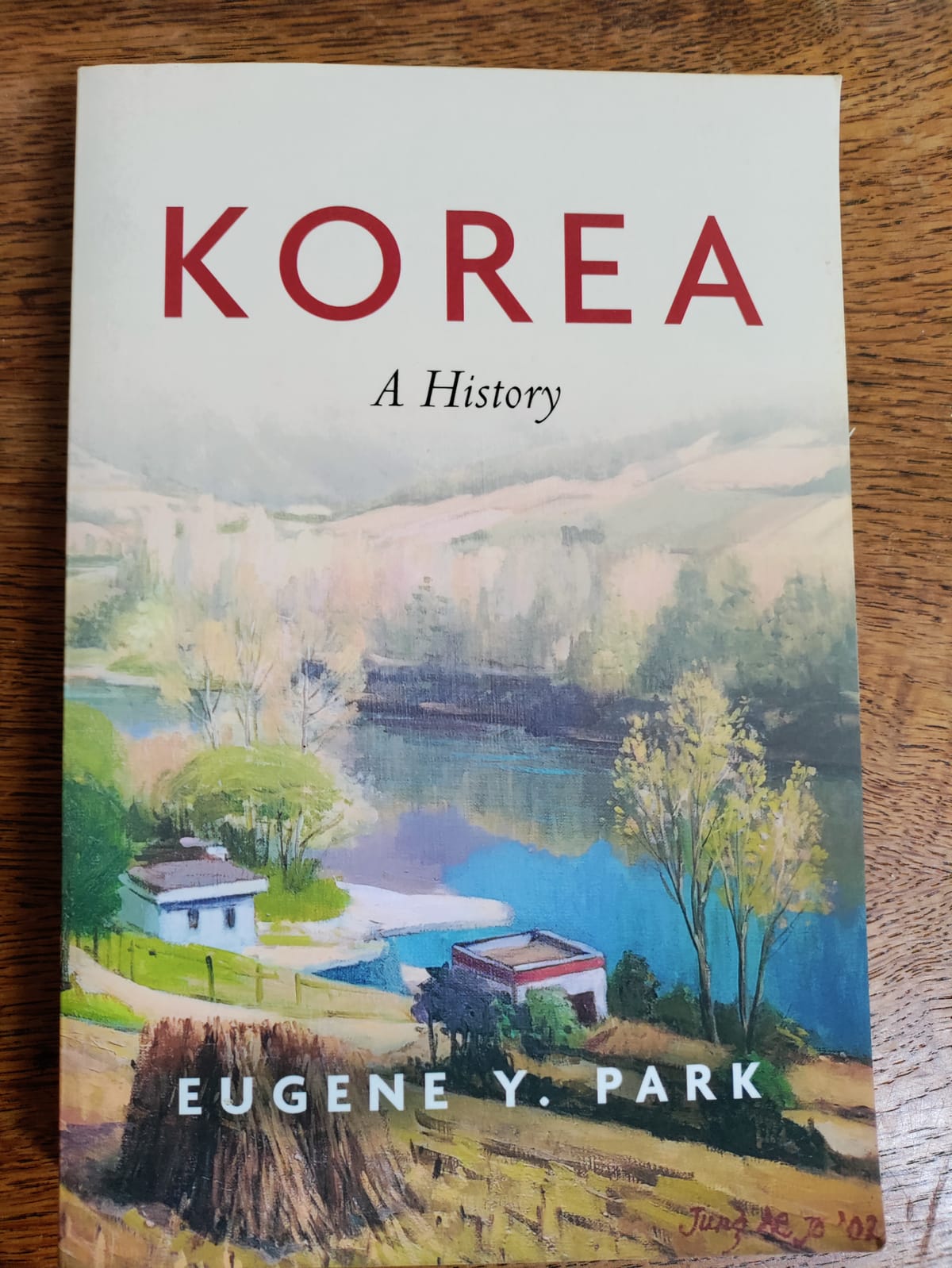
Eugene Y Park’s Korea, A History is an attempt to map out the narrative of the currently divided peninsula. In doing so he shows us the ebb and flow of the civilization of Korea from disorder, to varying unity, through to the present schism.
From the outset it is clear that Park’s position mirrors that of the narrative presented to us: in the south there is freedom, whilst in the north there is only a prison. He writes that “since the devastating Korean War, North Korea has become an isolated totalitarian state. By contrast, South Korea has emerged as a vibrant democracy.” As Park outlines the recent history of these two entities, however, there are questions to be made over both these assertions.
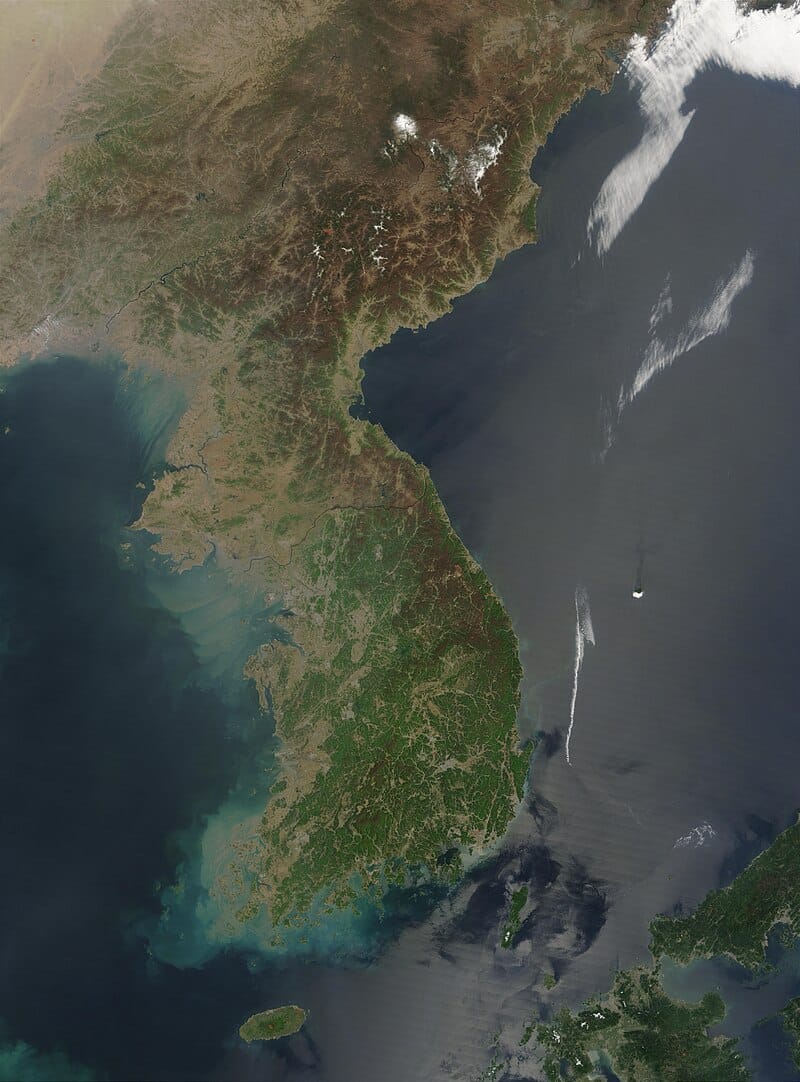
The two Koreas of the moder age show the South as a place of freedom, westernised and modernised, able to co-host a World Cup and provide high-quality consumer goods to the world, whilst the North is an antagonistic state where the system of control is so total that their citizens, starving and dejected, are more likely to be believe that they have won a World Cup. As ever, the faces are not entirely what they seem, and the wider geopolitical and social contexts demand further enquiry.
Park begins his history with commentary on the nature of Confucian Historiography, inherited from the Chinese civilization. This approach, writes Park, “regards history as a mirror for reflecting the past to draw lessons for the future.” For any history teacher who has been asked by a Year 8 child what's the point in studying history if it’s in the past? we can cite this response. Park further notes that respect for history in East Asia arises from a long tradition of diligent record keeping, another positive inheritance from China.
Importantly, we can interpret the cyclical nature of history as displaying patterns: an early phase of a new dynasty (or period of rule) is characterised by effective governance, social harmony and so on, but eventually there is moral decay in the leadership, inviting disasters and invasions as well as rebellion, which in turn leads to dynastic change (or what we may refer to as a change of the "Mandate of Heaven"). There is some attraction with this framework for a historian (or observer) to work with, as it is a way of identifying rises, declines and falls (though not in the Gibbonian sense), and it could also be argued to give the new dynasties a way of presenting their case for change (or of legitimising their ascendancy).
Park commences 750,000 years before the present (YBP), with Homo erectus making their way to eastern Eurasia. By about 50,000 YBP, anatomically modern humans arrived in East Asia, both replacing and "interbreeding". By 10,000 YBP (that is, 8,000 BCE), Korea entered the Neolithic (new stone age) era, otherwise referred to as Chulmun (or Jeulmun) Period – that is, “raised pattern” of pottery. Agriculture began around 3,500 BCE “when the amount of asteroid debris entering the earth’s atmosphere increased”, one result of which is said to have bee a further motivation for food production and more complex religious activities.
Having established this broad scene, Park spends some time on the genetic background of the Korean people, which feels like very fragile ground. He does note, however, that all humans originate from a Y-chromosome Adam and a mitochondrial Eve (160,000 YBP in Africa), but Park considers genetic mutations which distinct “haplographs”. The dangers of this line of reasoning are robustly presented (and countered) in Angela Saini’s Superior.
Park notes that in the Bronze Age there was a more intensive agricultural production and a full shift to a sedentary life, with increased social complexity. So far, aside from the style of pottery, there is nothing that we can say particularly distinguishes the peoples on the peninsula from other early human societies. Neolithic abodes moved towards rivers or farming villages rather than the shoreline, which is perhaps a distinguishing move that groups living far from the shorelines could not make.
At this time, various types of Chinese currency reflected “economic exchanges with China and local movements of goods and humans.” Social stratification accelerated. “Dolmens, in particular, reflect the power of elites.” Then, as tribes “merged through war and alliances, larger polities arose, first in Liaoning and north-western Korea.”
An interesting feature of Park’s approach is that each chapter, focusing as it does on a specific timeframe or era, has a set pattern: he opens with a narrative summary before moving on to the political scene, the economic environment, literature and the arts, and so on, including housing and even food. This makes it handy for referring back to the text if there was a specific topic to study/examine.
The first polity to arise within Korea was Kojoson (or Gojoseon). Documents on this period are sparse. The oldest extant historical work, History of the Three Kingdoms, does not discuss the founding of Kojoson. The Legend of this era is based on the Tan’gun legend, which “retains traces of ancient Indian cosmology.” Another legend recognises a Chinese prince, Kija, as the founder.
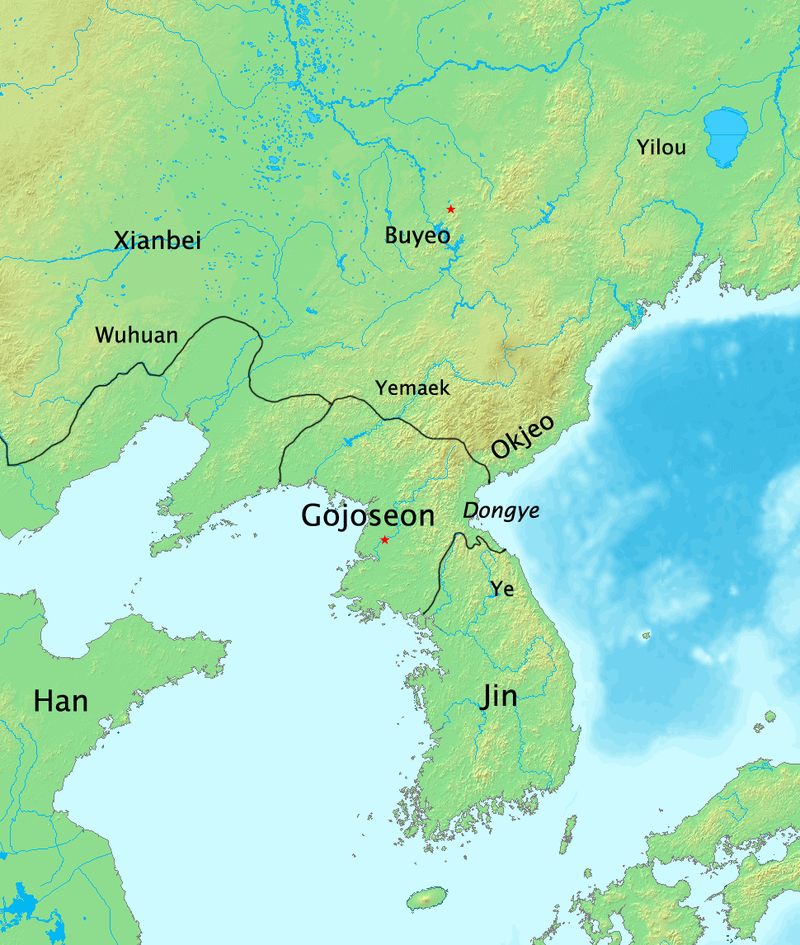
By the 4th Century BCE, historical records in China begin to mention Kojoson. The entity shared a border with Yan, a “warring state.” The Yan conquered Liaoning. Once the dynasty in China changed from Qin to Han, a number of refugees made their way from China to Korea. As we shall see, the Han made their way into the Korean peninsula, specifically the northern area attributed to Kojoson, establishing military garrisons (“The Four Commanderies of Han”).
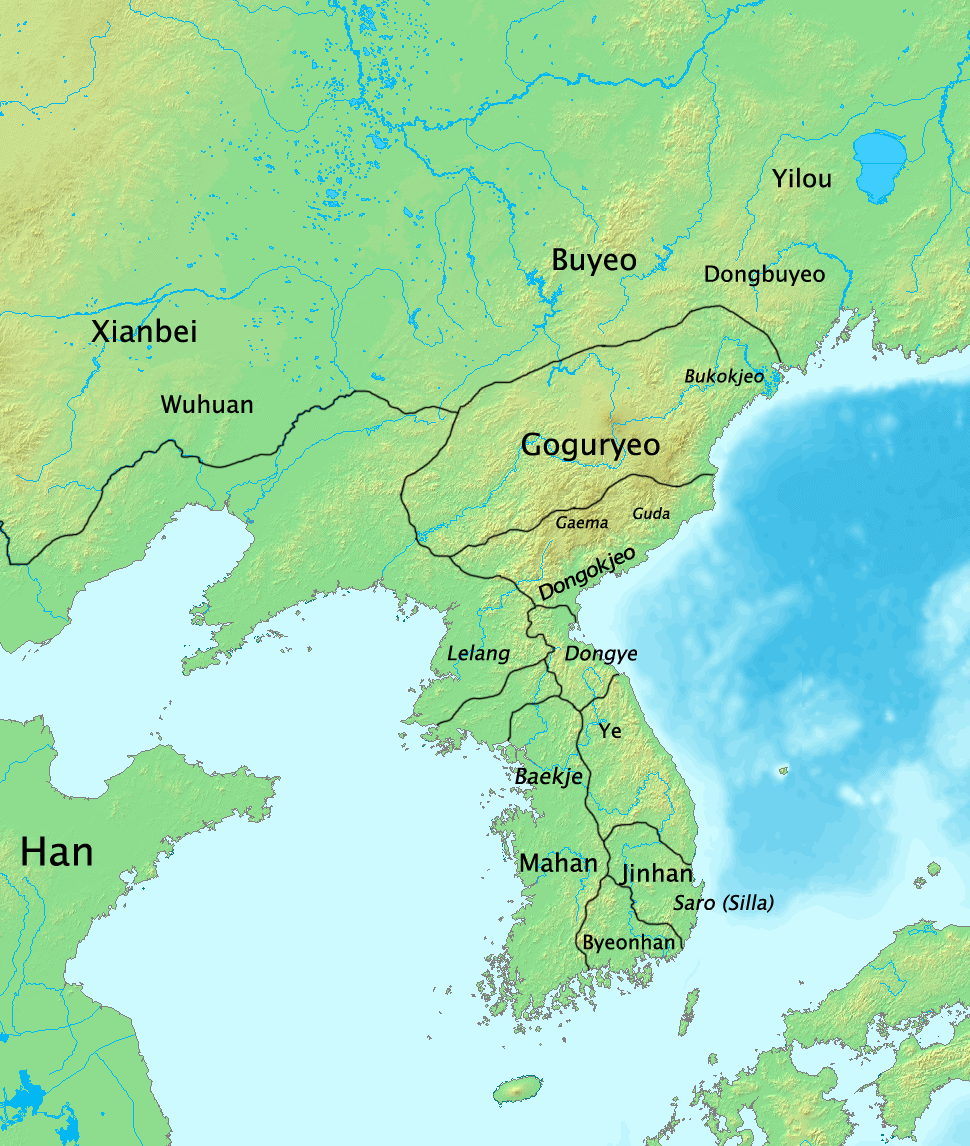
Kogoryo (or Goguryeo), came into existence since at least the second century BCE. The elite were mounted warriors who raided Puyo (or Buyeo), in northern Manchuria. The name ‘Korea’ derives from Koryo, which is an abbreviation of Kogoryo.
Reading through this time period is terribly confusing due to the amount of entities, not least Puyo, Okcho (or Okjeo), Tongye (or Dongye), Chin, Samhan (that is, the collective of Byeonhan, Jinhan, and Mahan confederacies, each of these groupings of tribes – unsure how important the suffix ‘han’ is in these instances), Pyonhan (that is, Byeohan), Chinhan (Jinhan), T’amna (that is Jeju Island), Paekche (Baekje), Kaya (or Geumgwan Gaya), Silla. The shifting and blurring is difficult to follow.
Kogoryo, however, is attributed to be the first of the so-called Three Kingdoms to move to a centralised aristocratic kingdom. King T’aejo is noted by Park to be the first ruler (first verified ruler, perhaps?). The state went to war with the Wei of China (242-59 CE), which led to expansion, and King Mich’on positioned for a clash with Paekche.
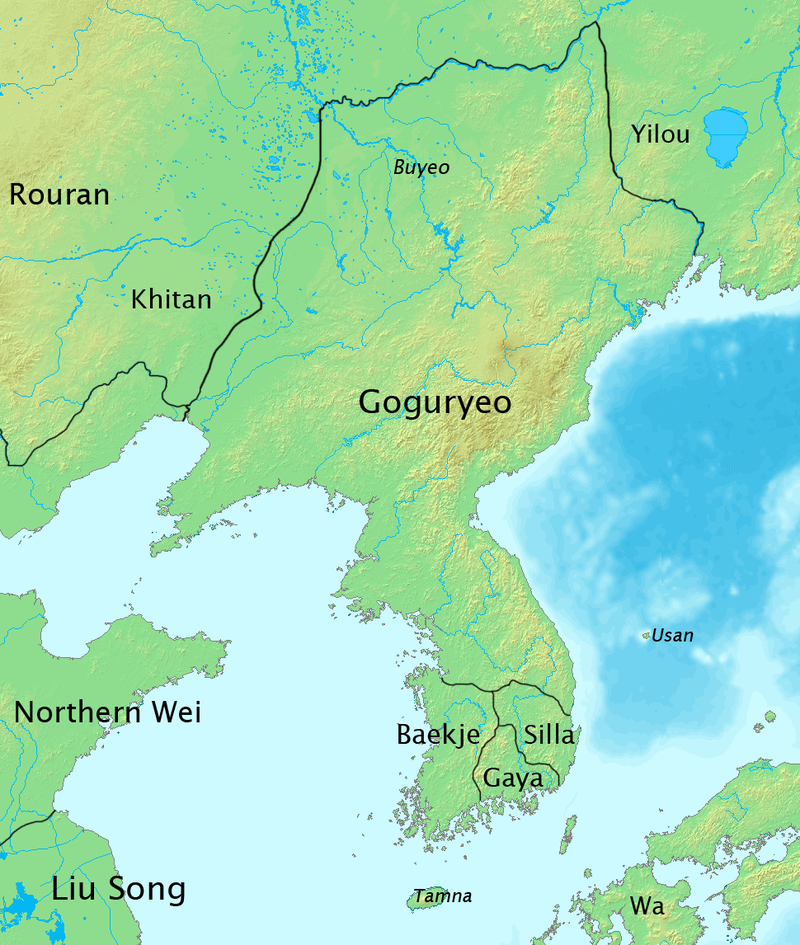
Paekche’s founder was Onjo, who is reported to have come from Kogoryo and who left to found his own kingdom. The Paekche gained control of the Han river valley, an important agricultural and strategic position which will be a key area as we move through the states. Paekche are also reported to have adopted various Chinese customs and ideas. The third kingdom was Silla, which began as an alliance of “indigenous forces” and migrants from the north. As we shall see, this area was most resistant to ideas from China.
King Kunch’ogo (ruled 346-75 CE) defeated Kogoryo and extended Paekche power. The kingdom soon adopted Buddhism, which was in turn adopted by Kogoryo in 372. In turn, a state Confucian Academy was established. The Confucian code of practice would remain present in Korean state affairs for some time, and the Confucian classics “played a central role in moral education of the youth and in the training of government administrators.” Silla, though, in resisting Chinese ideas, is said to have “lagged behind” Kogoryo and Silla.
The first historical ruler of Silla, Naemal (r. 356-402), led a state more resistant to Chinese culture. His direct descendants, the Kims, would come to monopolise the throne for five centuries. They suffered from frequent raids from Japan.
Park notes how Kogoryo’s martial culture had a special place for women, and that they practised “uxorilocal marriage,” whereby the man moved in with the bride's family. The tribal nature of the kingdoms turned more administrative, but “the relative autonomy of the indigenous strongmen who controlled fortresses or villages persisted for centuries.” In this sense, as we can say with many states across the world, power bases looked to extract resources outwards.
Park writes that the period of 391-676 saw each of the three kingdoms adopt Chinese “governing institutions to enhance royal power,” which seems to suggest that the Confucian framework was as much about consolidating social hierarchies and power structures, though the actual history both of China and Korea shows how rebellions and uprisings were part of the cycle of dynastic change.
Each of the three kingdoms improved their economic productivity by strengthening their methods of tax collection. This seems to be a key part of learning for states to this day, and there is undoubtedly an ongoing battle between the state being able to balance fair taxation as well as honing in on evasion. Some would argue that in the west today, and perhaps in particular the UK, tax evasion and avoidance (through off-shore practices) is a fundamental contribution to social inequalities, or in the very least that it prevents the state from funding improvements to essential services.
The three kingdoms also instituted strict laws to “buttress a caste-like aristocracy system […] while promoting Buddhism for social harmony and order.”
King Kwanggaet’o (or Gwanggaeto the Great, ruling from 391-412) of Kogoryo expanded into Manchuria against the Khitans (who would play an important role in Chinese history), as well as defeating Paekche and securing Silla as a protectorate, leading a golden age for the state. His son and successor King Changsu (Jangsu) gained control of the central Manchurian plain, and moved the capital city from Kungnae (Gungnae) to P’yongyang. In defence, Paekche and Silla allied, so Changsu took the Paekche capital Hansong and killed their kin. Paekche retreated south.
King Song (ruling Paekche from 523-54), promoted royal power and social cohesion with Buddhism. He collaborated with Silla to retake the Han River Valley, but Silla betrayed him. Song was subsequently ambushed, captured, and beheaded: “Silla was now Paekche’s mortal enemy.”
Silla’s transformation occurred under King Chijung (Jijeung), with movement to more centralised rule and royal power. His son and successor, King Pophung (Beopheung) completed the “bone rank” system, a caste-system which strictly arranged society, recognising an aristocracy of “sacred bones”, “true bones” and six “head ranks”.
The short-lived Sui Dynasty (581-618) in China began to extend its control and influence. Kogoryo made an alliance with Paekche, Wa and the Eastern Turkic Khaganate of Mongolia. The Sui were defeated. Kogoryo also mobilised Malgal warriors, who were ancestors of the Jurchens and Manchus who, like the Khitans, would come to have a significant impact on Chinese civilization. Kogoryo repelled two additional Sui invasions (613, 614). The Tang succeeded the Sui, and also commenced war (645-70) led by the Tang Emperor. The invasions were once more repelled due to “Kogoryo’s determined, well-organised resistance and the logistical challenges for a sedentary state based in China proper of conducting an extended campaign in Korea.”
Silla King T’aejong (r. 645-661) was the “architect” of a Silla-Tang alliance which defeated Paekche (who had joined forces with Japan). Paekche also sought alliances against Kogoryo. When we look at history in such a broad way, with centuries spanning sentences, it seems strange to see the movements of alliances. As we experience history, it is perhaps easy to forget how quickly alliances and agreements can change, where once deadly foes can forge a bond, or where clasps turn to fists.
Eventually Silla and the Tang went to war against one another, from 670-676. Park refers to this as a “Sino-Korean war” as Silla “drew support from populations of both vanquished states”. In 676, Silla won a “resounding naval victory” and the Tang withdrew to Liaodong.
“Now in control of roughly the southern two-thirds of the Korean peninsula, Silla faced the formidable challenge of integrating its gains and governing an expanded realm.”
The Silla throne itself was reserved for sacred-bone Kims until 654, when they “became extinct with two female monarchs.” They were in turn replaced by true-bones Kims. By this point, true-bones also included the Paks, who were descendants of Silla’s earlier royal house, as well as descendants of the last king of Kumgwan Kaya, and descendants of Kogoryo prince, Ansung.
Park explains that society in the three kingdoms was a place where the aristocrats enjoyed a luxurious life, whereas the rest of the population were commoners (mostly free cultivators) and slaves (owned by aristocrats as well as government agencies). Commoners struggled to survive – they owed their labour and taxes to the state. In times of war, they were drafted, and they had to obey strict laws.
The three kingdoms, however, are said to have promoted education as well as Buddhism (which in turn was introduced to Japan). Silla adopted Buddhism later than either Kogoryo and Paekche.
“The mature Buddhism of Silla stressed karma, a concept according to which intents and actions of a sentient being influenced its future, including reincarnation.”
There were two key figures: Wonhyo (617-686), and Uisang (625-702), the “two pillars of classical Korean Buddhism.” They popularised worship of Avalokitesvara, who had deliberately postponed nirvana to help suffering sentient beings. Uisang and many others are reported to have travelled to Tang China where they honed their theories.
The three kingdoms also received Daoism, which is said to have “complimented indigenous shamanistic beliefs.” This period is said to have seen a high level of mathematical knowledge, especially in relation to construction (such as the building of fortresses). Metallurgy was also highly developed. Silla crowns, for instance, show “no sign of Chinese influence”, and are said by Park to suggest the influence of Scytho-Iranians, a link which is quite incredible, and begs the question as to how closely the peoples of the vast Eurasian plateau are linked. We sometimes think of our present age as being the most connected (in terms of communication between lands and peoples being available within seconds), but in the recent past it is clear that humanity found a way to have dialogue, perhaps particularly so across the Eurasian plateau.
Silla and Parhae (from 698 to 926) are said to have “perfected classical Korean civilization”. Parhae arose as a multiethnic state in the north with a distinct Buddho-Confucian culture. “In its final decades, the Silla state’s increased extractions from farmers sparked rebellions.”
Parhae was formed from the restless populations of Kogoryo and Malgal (who were Khitans descended from Xianbei. Tae Choyong (King Ko, ruled 698-719) led the population to eastern Manchuria. His successor and son, King Mu (ruled 719-37) expanded Parhae and ended the military threat of the Tang and Silla “once and for all” following the Parhae-Tang War of 732-33. Parhae also reached out to the Second Turkic Khaganate (682-744), a nomadic confederacy in Mongolia.
Park notes that:
“subsequently, no China proper-based state would ever attempt to invade Korea, settling instead of a symbolic acknowledgement of the Chinese emperor as the universal ruler by a Korean state as China’s tributary.”
At the same time as Mu’s son and successor, King Mun (ruled 737-93), was focusing on internal consolidation, Silla experienced political instability. True bones grew in power as they monopolised key positions as well as expanding their economic bases to fund private armies. The monarchy suffered as a result, and the aristocracy was put in check: “in the early ninth century in Silla, royal succession politics turned into a bloody free-for-all among the true bones, and royal power plummeted.”
By the end of the ninth century, Parhae had become militarily weak. Khitans to the west had become stronger before forming the Liao Dynasty in China. When Queen Chinsong (the “third and last female monarch in Korean history”) abdicated in 897, warring rebel leaders established independent states: Later Paekche and Later Kogoryo.
Silla and Parhae were also affected by late harvests, the state’s harsh exactions, and epidemic diseases: “In both states’ final decades [there was] widespread vagrancy among commoners and chronic warfare.”
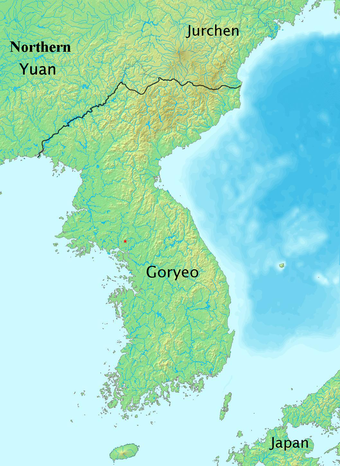
In the aftermath, King T’aejo, born in Kogoryo, rose to unite the Later Three Kingdoms and establish Koryo. He was “keenly aware of his place in history”, embracing an exodus of refugees from Parhae whilst courting Silla. He awarded key positions to “foundation merit subjects” who had helped him ascend to the throne, as well as to local cooperative strongmen. He also married women from local prominent strongmen families (having six queens and 23 royal concubines).
King T’aejo’s fourth son, and Koryo’s fourth ruler, King Kwangjang (ruled 949-75) enhanced the royal power by purging the strongmen and the merit subjects. He introduced the Slave Review Law (956), freeing those who had been “wrongly enslaved” as well as returning slaves to their “rightful owners.”
The early Koryo recruitment system struck a compromise between meritocracy and aristocratic privilege with the examination system (almost certainly informed by the Chinese Confucian tradition). These exams included policy-based essays on literary talent, though like the system in China these were not accessible to all citizens.
From 993-1019 the Koryo state went to war against the Khitans (whilst at the same time the Liao was at war with Song China). Following an initial attack of some 60,000 Khitans (also attributed o be a force of 800,000, though this is disputed), there were attempts at negotiation between Koryo and the Khitans. A military strongman Kang Cho (946-1010) deposed King Mokchong (ruled 997-1009), following which the Liao attacked with 400,000. Their rear supply line was “insecure”, a key flaw in wars to the present day, and they withdrew. When they next attacked, military commander Kang Kamch’an (948-1031) led 208,000 troops and “annihilated 100,000 Liao troops in the Battle of Kwiju.” They then constructed a long wall on the northern border. In the end, there was a peaceful trilateral agreement between the Liao, Koryo, and the Song.
This peace was disrupted by the ascendant Jurchens, who occasionally raided the border. By 1104, they had gained control of the Tumen River basin. When the Jurchens founded the Jin Dynasty in China (1115-1234), Koryo became their vassal. Indeed Korea’s status as vassal to China, and then later in a sense to Japan and for a small time the Soviet Union (and perhaps to this day the USA), is an interesting point of reference for their history. They seemed to differ somewhat from other Chinese vassal states, however, in the sense that they did not become a prey to colonial powers during the Qing Dynasty (though fell prey to the Japanese imperial machine – but more on this later).
Park writes that early Koryo reformed tax collection, with King T’aejo prohibiting strongmen from overtaxing the population. He also fixed a land tax at 1/10th of the harvest. During this time, Park notes the very distinct and ordered social hierarchy.
- Aristocrats: their primary income sources and assets came through inherited landholdings and slaves, as well as a government stipend for holding office. They increased their landholdings through land reclamation, buying commoners’ plots at a low price, or “using political clout or high interest rates, outright taking over such land.” We may legitimately ask, with regards to land ownership, what measure on the scale we are in the UK today? The UK is a place which seems to fetishise home ownership (or mortgage debt, that is), and there is a great deal of revenue made through property development and a landlord class with their bricks and mortar investments.
- Commoners: somewhat aided by the state such as with rent subsidies or temporary tax exemptions for cultivating wasteland or weed-grown fallow land. They also received emergency reliefs during famines.
- Slaves: not free, but “enjoyed minimal economic security”. Some were resident slaves (such as those who lived with their owner, performing domestic work), and some were out-resident slaves, living separately (owned by an aristocrat or a Buddhist monastery).
Elites enjoyed a life of luxury. Many “used their political influence to take over private and government-owned lands illegally.” At the bottom of society were the lowborn, “the vast majority of whom were chattel slaves who could be bought, sold, inherited, and transferred between owners.”
Koryo’s monarchs “upheld Confucianism as the guiding ideology for governance,” but we can certainly see some distinct difference between how Korean states practised Confucianism, and how China practiced it. There doesn’t appear to be as heavy an emphasis on slavery in Chinese history, though to be sure the treatment of what we might regard as the common people was at times harsh.
Confucianism, like in China, influenced education and historiography. Compilation of “reign-by-reign” accounts and “veritable records” began immediately after T’aejo’s reign.
Buddhism also enjoyed state sponsorship “and appealed to all social groups.” Daoism and Shamanism also continued to flourish. Belief structures and narratives to give meaning to the order of the world (and of existence) is always important, it seems, regardless of the social stratification around us.
Park also notes that during this time “advances in print culture facilitated knowledge production and dissemination in astronomy, medicine, shipbuilding, and architecture.” The level of astronomy is even compared to the Islamic world of the time, where astronomy was most advanced. With regards shipbuilding, Park notes that the state was constructing vessels larger even than Columbus’s crew, three centuries later. As a result, there was increased maritime trade with the Song Dynasty.
Moving into the Late Koryo stage (1146-1392), Park notes a prolonged decline before a collapse. Monarchs remained as figureheads until a century-long military rule (1170-1270) followed by war against the Mongols (1231-59) and then Mongol domination (1259-1356). After this they broke free, but raids from Wako and demands from the Ming weakened them, leading to a host of private armies from military men, resulting in the ascendency of Yi Songgye (1335-1408), also known as Taejo and the founder of the Joseon (or Choson) dynasty of Korea which would last through to what we might regard as the modern age.
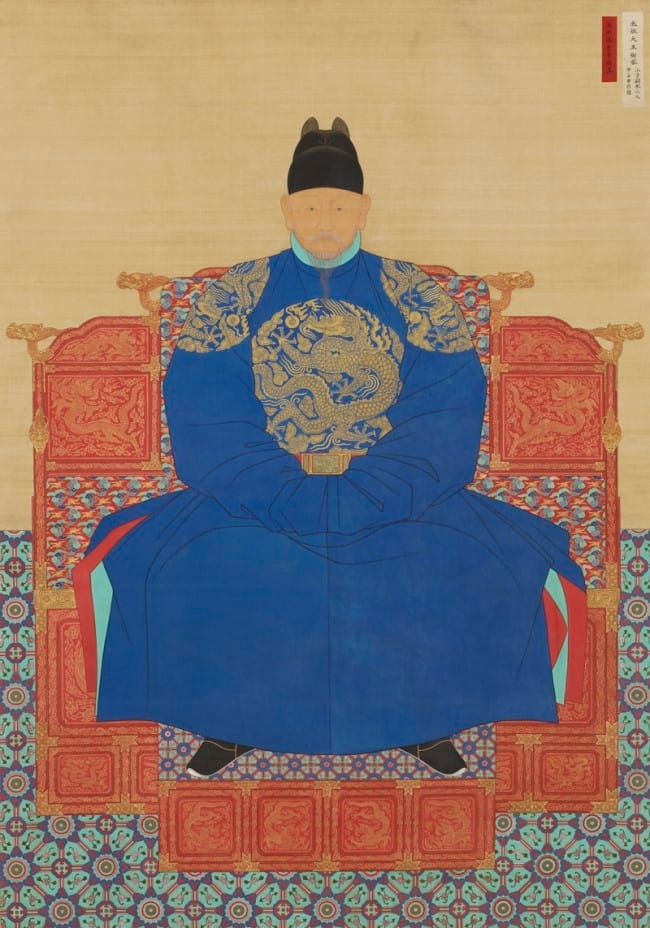
In the Late Koryo age there was great conflict between competing factions of ruling elites before a violent coup of King Uijong led by solider and military dictator Chong Chung-bu (1106-79) with the support of Yi Uibang, another military dictator. They slaughtered aristocrats, eunuchs, and court favourites, but soon after turned on one another. Ch’oe Ch’unghon (1149-1219) gained control and supreme power. His son, Ch’oe U (1166-1249) focused on “wielding supreme power” and therefore “neglected the overall wellbeing of he country and the people while a catastrophic military threat loomed in the heartland of Asia.”
This threat was, of course, the Mongols, who conquered China from the Jin. In turn they attacked Koryo, who repelled them. Some of the power structure wanted to come to terms, with King Kojung (1213-59) agreeing to submit. The Mongols adopted the Chinese position, tentatively submitting Koryo as a vassal state rather than destroying it. The subsequent Yuan Dynasty “imposed itself”, and “meddled in Koryo’s internal affairs”. They made huge demands, such as imposing that every Koryo heir apparent marry a Yuan princess.
When Yuan power declined rapidly in the mid-fourteenth century, King Kongmin (ruled 1351-74) “took bold steps”, including a prohibition on Mongol customs and a purging of pro-Yuan figures. He was assassinated, however, and there followed a to and fro for succession until Yi Songgye ended the near five-century rule of the Wang royal house.
During this period, the state nearly went bankrupt. This was due in part to the aristocracy monopolising land ownership, so taxable land decreased. There were also exactions from the raids of both the Yuan and Wako.
“Unable to stand increasingly harsh exactions, some suffering commoners and slaves rebelled.”
Intellectual fervour was motivated by the invention of the world’s first movable type printing technology. It is also asserted that gunpowder was invented in Koryo by Ch’oe Muson, a military official, who had kept this a closely guarded secret. As a result, the technology of cannons greatly increased, assisting the defeat of the Wako in 1380.
We then move into the Early Choson period (1392-1567), when “the state promoted farming while regulating commerce, but as agricultural productivity increased, the surplus stimulated private manufacturing and trade, giving rise to rural markets.”
The aristocracy continued to overburden the commoners, “who relied on mutual aid organisations for survival.” In addition, Neo-Confucianism triumphed as the official ideology of the state.
The Choson (or Joseon) founder, as previously noted, was Yi Songgye, known as King T’aejo. He was supported by the high officials who had elevated him. His fifth son, and the third ruler of Choson, King T’aejong (ruled 1400-18), abolished all private armies and placed the troops under royal command. There was also a pushback against Buddhism, with the confiscation of their monastic lands (1406).
Now secure, T’aejong’s son and successor, King Sejong (ruled 1418-50) “completed all Confucian statecraft’s primary institutions.” He also “sought to propagate Confucian morality as the social norm.” After his reign, however, royal power “declined sharply.”
There were some moves to “prevent corruption, nepotism, or oligarchy” with the system of “mutual avoidance” prohibiting the appointment of close relations to the same government agency of posting a magistrate in his home locale. Nevertheless, the detail of this is not examined, and this may have simply been a power struggle within the ruling elite based on the fact of continued social stratification:
“In early Choson, an aristocratic landlord typically owned anywhere between 10 and 700 or more slaves.”
There was also a rise of an aristocratic class more committed to Neo-Confucianism, They in turn became a new political force, the Sarim (or, Rusticated Literati). They gradually expanded their presence in officialdom whilst Choson Korea interacted with Ming China within the framework of “serving the great” and acknowledging a “China-centred world order.”
Jurchen raids continued despite various carrot/stick policies, though Choson Korea took a more “neighbourly relations” approach with the islands to the east and south. They also took on military campaigns against Tsushima and Wako. In the 16th Century, relations with Japan deteriorated. The Japanese “increasingly resented the continuing Choson and Ming restrictions on East Asia’s expanding international trade.”
There were four occupational categories: scholars (at the top), farmers, artisans, and merchants.
“Both the throne and the ruling elite generally believed that unregulated commerce would produce extravagance and waste, hurt agriculture, and widen the gap between rich and poor”.
This is an interesting position to contrast to the past century in which there is often talk of removing regulations (that is: deregulation) from commerce, the promotion of private industry, and the worship of the so-called free market. Regulations are seen as barriers, of creating bureaucracy which in turn impacts upon economic growth and efficiency; but those who are opposed to this view argue that regulations are a protection for those involved in a transaction (that is: seller and buyer, as well as supporting entities involved in a transaction).
The Choson instituted a social hierarchy that divided the population into four status groups:
- Yangban – the hereditary aristocracy.
- Chungin – the “middle people”, government-employed technical specialists, capital government office and local functionaries, non-commissioned military officers, and illegitimate children of aristocratic men and commoner concubines.
- Commoners – mostly farmers. They formed the majority of the population, and they were legally entitled to take civil service exams but were unlikely to do so. In addition, Park noted that “most commoners struggled with hardship, and government aids were insufficient.”
- Lowborn and unfree – they were regarded as little more than commodities.
We then move into the Mid-Choson “crisis and recovery” from 1567-1724. During this period the ruling elite formed political parties (pungdang), and more ideas from the western world entered the land.
The Sarim triumphed when King Sonjo (or Seonjo, 1552-1608) ascended the throne, but the “political establishment soon became divided”, with the Sarim splitting into those who were more conservative-minded and those who advocated for reform. They became the Easterners and the Westerners, but to add confusion to this we then get the Southerners and Northerners. Everywhere we turn, it seems, there is fragmentation and grouping.
These difficulties meant that the leadership were unprepared for the “devastating” East Asian War (1592-98). Japan had been reunited by Toyotomi Hideyoshi and in 1592 led an invasion force of roughly 200,00 to Korea.
The navy and “righteous armies” were able to effectively deploy their knowledge of local terrain and use guerilla tactics, and they were further supported by the arrival of some 50,000 Ming troops. By the end of the war the Northerners had replaced the Southerners as the ruling party. The population was drastically reduced by warfare, famine, and epidemics. A decade after the war the two countries normalised relations, but this would not be the last time the two clashed.
Meanwhile the Jurchen (who we come to know as the Manchus) grew rapidly in power in China, proclaiming a Later Jin Dynasty (1616), which would later become the Qing Dynasty and last through to 1912. The Ming requested support from Choson, and King Kwanghaegun (or Gwanghaegun, 1575-1641) reluctantly accepted. A Combined Ming-Choson force (some 103,000 to 133,000) suffered a crushing defeat. The king refused to send more troops.
In turn, the Westerners staged a coup, deposed the king, and purged the Northerners. They advocated a pro-Ming and anti-Jin policy but this “soon invited disasters.” The Later Jin attacked (Chongmyo War, 1627) but were repelled and withdrew. As the Jin morphed into the Qing Dynasty, they demanded that Choson transfer its allegiance as a tributary from the Ming, but Choson refused, sparking the Pyongja War (1636-37), resulting in defeat for Choson. This only led to further anti-Manchu sentiment, with the Manchus regarded as “barbarians.”
During King Sukchong’s reign (1674-1720), Choson came to terms with the Qing despite some leading scholar-officials seeking to revive the Northern Expedition Policy (repairing fortifications preparing to invade the Qing). During this time, Park notes that Choson maintained peaceful relations with Tokugawa Japan, and ports became commercial centres which would have a bearing as we move into what we might term the colonial age.
For the Korean peninsula, however, what followed was the period of Late Choson Renovation and Decline (1724-1864). There was prosperity, notes Park, during the reigns of Yongjo (ruled 1724-76) and Chongjo (ruled 1776-1800). Yongjo is noted for implementing the Policy of Impartiality “and its rationale of putting the public good over partisan interests,” which seems like a good idea for the state on the whole. Royal power increased, however, as a result of the governing ideology.
As for Chongjo, he “judiciously yet decisively weighed in on partisan issues and sought to curb the influence that the royal in-laws and eunuchs had gained.” He also instituted a system of recommended civil officials and fostered kyujanggak, a “royal library”, and an archive as well as a political organ. In addition, the “concentration of power around the throne that Chongjo effected ultimately paved the way for an oligarchy of consort families upon his death (1800)”. This oligarchy (the Andong Kim and P’ungyang Cho in-laws) “failed to govern the county effectively.”
Bribes became “rampant” at county level, as “rapacious officials filled their pockets by imposing unjust taxes and surcharges on the population.” Furthermore, famine and epidemics came as a result of natural disaster. The tax burden increased. Discontent and uprising followed.
At the same time, private merchants grew in power, amassing wealth, with a network of more than 1,000 local markets. Commoners were more able to make a profit themselves through handicrafts and mining. The position on slavery is said to have improved, and the “unfree population began to decrease rapidly.” Park argues that this may have been in part motivated by the desire to increase the tax-paying commoner population.
Catholicism and Maitreya Buddhism became popular, as well as Tonghak, an indigenous religion. The founder of this was Ch’oe Cheu (1824-64), who created a syncretic proposal which combined Confucianism, Buddhism, worship of immortals, and aspects of folk religion. The main elements of the religion were:
- Worship god by serving humanity
- The people are heaven
- Equality for all, abolish slavery, respect women and children
The Government saw this as a threat and Ch’oe was executed.
Banditry became rampant in most regions, and women’s freedom became more restricted then ever, especially among elites.
Th 18th century also saw the rise of Practical Learning and Yangmingism (School of the Heart), with various schools of thought. Park notes Yi Ik (1681-1763), who advocated for land reform geared towards stabilising the farming village society. His proposed system would guarantee each household an amount of land minimally necessary for supporting its livelihood. He opposed buying and selling such land. He had many disciples, some of whom drew inspiration from Qing China.
In addition, Choson intellectuals moved away from presenting their relations to their neighbours in a civilization vs barbarian framework to a “pragmatism geared to betterment of their country and people.”
Yu Suwon (1694-1755), for example, emphasised promoting commerce, industry, and technological innovation, as well as occupational equality. In turn, Hong Taeyong (1731-83) advocated for technological innovation, abolishing the yangban privileges, and overcoming Neo-Confucianism all as “the fundamental requisites for a wealthy state and a powerful army.” He also criticised the notion that China was the centre of the world. This would have been quite controversial, particularly with Choson still a vassal state of Qing China.
Two centuries of this Practical Learning scholarship “culminated” with the polymath Chong Yagyong (or Tasan, 1762-1836) who has some 500 works. Park outlines the progress and key points of scholarship on medicine and history, cartography and astronomy.
We then move into the era of Reform, Imperialism, and Nationalism, from 1864-1910, in which Korea is said to have “struggled to reinvent itself as a modern nation-state.” The Tonghak Uprising (1864) was fuelled by “spreading government corruption, foreign economic infiltration, and popular discontent” which in turn gave a pretext for China and Japan to intervene. This set off the first Sino-Japanese War (1894-95). For so long Korea had been a tributary state of China but we see in this epoch the move towards occupation by Imperial Japan.
At the time of Hungson Taewon’gun (1821-98), a regent of Emperor Gojong (or Kojong), western powers and Japan began to “pressure Korea for relations and trade.” Korea, unlike Qing China, did not succumb to signing unequal treaties. Taewon’gun, in turn, made two political enemies within Korea: conservative Confucian literati (he closed private academies), as well as King Kojong (whose rule commenced in 1873) and Queen Myongsong, who increasingly believed that the country should engage with the west and Meiji Japan.
Japan, however, ignored Kojong’s gestures. They “dispatched a fleet that provoked Korea’s coastal artillery into firing, used the incident as a pretext to stage a more threatening display of force, a tactic it had learned earlier from the United States, and pressured Korea into signing the Treaty of Kanghwado, which allowed Japan to export goods without paying tariff and to buy Korea’s grain without limit.” Further treaties with the west followed.
At the same time, he pursued an “Eastern Ways – Western Implements Reform” in which he sent official learning missions to Japan, China, and the United States of America. Qing China became more heavy-handed and “exercised tight control of Korea as a tributary”, whilst “Kojong sought to check Chinese interference by strengthening ties to Russia”. Britain, alarmed by this (as they were also alarmed by other Russian moves such as towards Persia and the Gulf south of Persia which ran towards the British Raj) began to jockey for power and influence.
The Tonghak (or Donghak) movement was a Neo-Confucian reaction against western learning. The movement promoted equality and social reform, and gained a large following. “A corrupt magistrate was the initial spark” for the uprising. Local farmers rose up, shouting “protect the country, preserve the people,” and “eliminate tyranny, save the people.” Both the Japanese and Chinese sent in troops. In July of 1894, the Japanese stormed the Kyongbok Palace and installed a pro-Japanese government. It is very interesting to track large-scale changes within society and how often these culminate with uprisings and general rebellion, almost as if the chaos is a neccessity for transfers of power.
Kojong remained as the king, and would become the first emperor when he inaugurated the Empire of Korea in 1897. In 1899, he promulgated a new constitution “which featured a powerful emperor unrestrained by any branch of government.”
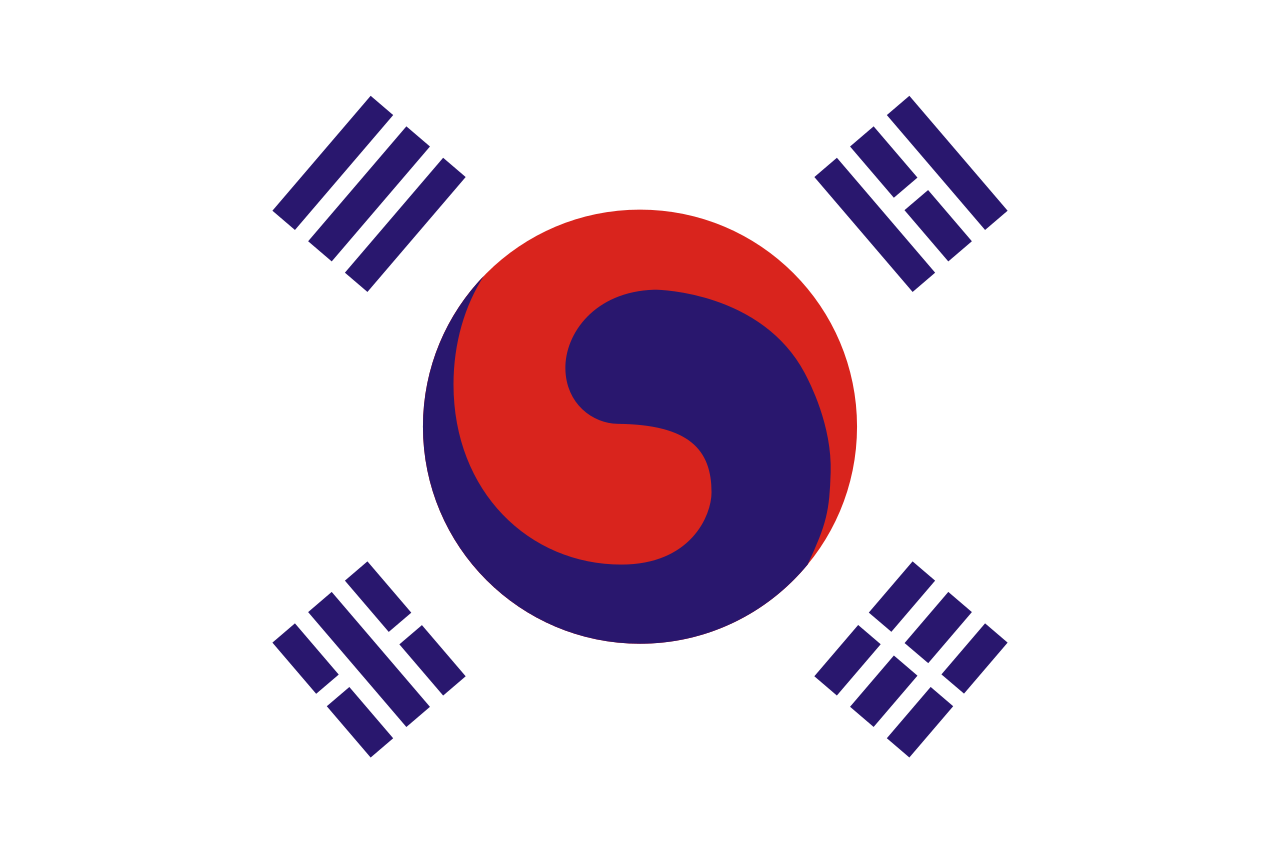
Anticipating the Russian-Japanese War, Korea declared neutrality in January 1904, but the Japanese won this war and then secured for their troops a “free pass throughout the country.” Japan made further gains, including recognition from the USA and Britain regarding Japanese consolidation in Korea. Kojong resisted, and was subsequently replaced by his eldest son and heir, Emperor Sunjong (r. 1907-10). He was, however, simply a figurehead. The subsequent Japan-Korea Treaty of 1907 stipulated the abolishment of the Imperial Korean Army. Korea was effectively a Japanese colony from 1910.
Resistance bands formed, some of whom relocated to Manchuria or the Russian Maritime Province (as did many Koreans who “lacked means of livelihood” and fled to these areas). Prior to this, Japan had been concentrating and constructing railways to extend their influence into mainland north-east Asia, whilst “other great powers scrabbled”. The USA won rights to mine gold, and Britain, France and Germany all secured concessions in a similar way to them grabbing concessions in Qing China.
Social reform movements led to a challenge to the hereditary status system. Part of this was a push to appoint officials based on merits and to advocate for the equality of people. This led to the Kubo Reform which banned things such as slavery, human trafficking, and torture during interrogations. “Traditional status distinctions, however, also persisted and remained widespread.”
Western ideas, such as Social Darwinism, began to arrive in more urban areas, This “provided a justifying logic for the control of weaker nations by imperialist powers.” At the same time, there was a major drive for education, including the opening of primary schools.
The next stage of history defined by Park for the Korean peninsula/peoples was the Japanese Occupation from 1910-1945. There were, he argues, three phases to this:
1: Military rule and coercive measures (1910-19).
2: An “enlightened administration” (1919-31).
3: Mobilization of Korea for Japan’s extended war efforts.
Japan replaced the Residency-General of Korea with a Government-General of Korea. They then stationed more than 20,000 gendarmes. Ethnic Koreans were without “freedom of speech, assembly, the press, or association.” All formal Korean organisations were banned. The authorities then “fabricated a conspiracy to assassinate the first Governor-General” and arrested over 600 nationalist leaders.
“Encouraged by the principle of national self-determination” as articulated by President Woodrow Wilson at the end of the First World War, Korean students in Tokyo “publicly proclaimed Korea’s independence.” Subsequent protests in Korea were, at first, peaceful, with at least 1 million taking part. But these were then suppressed. 7,500 were killed, with some 17,000 arrested.
Japan installed a provisional government in Shanghai in 1919, with Syngman Rhee (1875-1965) elected as president. In Manchuria, however, nationalists organised into armies to counter the Japanese with guerilla warfare. In addition to the nationalist movement, there were also socialist and anarchist movements. Anarchists groups, such as the Heroic Corps, were labelled as terrorists.
In the 1930s, Japan “intensified its exploitation of Korea to support an expanding war effort.” They occupied Manchuria in 1931, and invaded China in 1937. Japan’s National Mobilization Law “subjected Koreans to work in factories, mines, and labour camps.” They also sent young Korean women to military camps as sex slaves or “comfort women.”
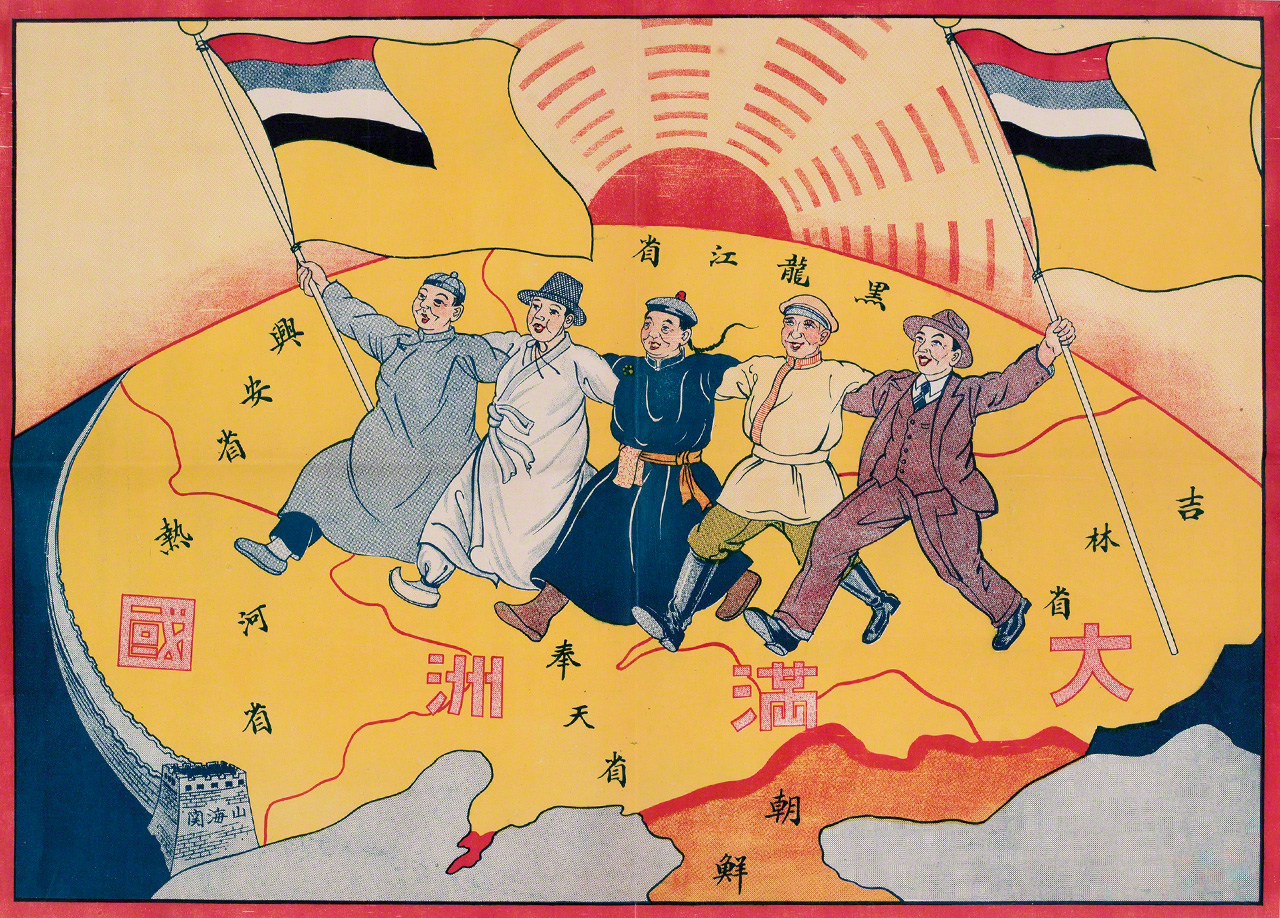
When Japan created the puppet state of Manchukuo, Kim Il-Sung retreated to the Soviet Union. Anti-Japanese movements, therefore, continued to gather outside of Korea, which would be important following the end of the Second World War when there was a dizzying return and departure from the land. Japan promoted Manchukuo as a state of “five races”, that is: Chinese, Japanese, Koreans, Manchus, and Mongols. As of 1934, with a population of 30,880,000, the Chinese (including Manchus) accounted for 95.6%.
The Japanese also formed Korean military units, and this included some members (Park cites a number of 300) of the notorious Unit 731. It is documented that this unit conducted bacteriological weapons experiments on humans. The acts and atrocities of this particular Unit is extremely disturbing, even in the context of the horrors of the world wars.
Japan exercised tight control of the press and the education system:
“an overarching goal of the colonial education system was to phase out Korean cultural identity and to assimilate Koreans into the Japanese mainstream whilst withholding equal rights until the colonials became worthy – whatever that might mean.”
In addition, there was an attack through academia:
“Trained in modern methodologies in historical research, as acquired from the west, Japanese academical historians published seemingly well-researched, empirical studies that ostensibly demonstrated how Koreans had failed to keep up with the West’s and Japan’s regular progress.”
The Japanese also tried to phase out Korean language instruction in primary and secondary schools. Finally, there was a further tightening of Korean Buddhism, with an order to all Koreans to participate in Shinto rituals, the “central part of which was to venerate Hirohito as a living god.”
In summary, Japan’s colonial imperial actions undertaken in Korea (and into China) utilised military and industrial tools, with some tacit agreement with the great powers of the day, with the attack extending into culture through academia and education and religion.
In 1943, President Roosevelt, Winston Churchill, and Chiang Kai-Shek “agreed that Japan should relinquish all the territories it had conquered by force and that in due course Korea should become independent.”
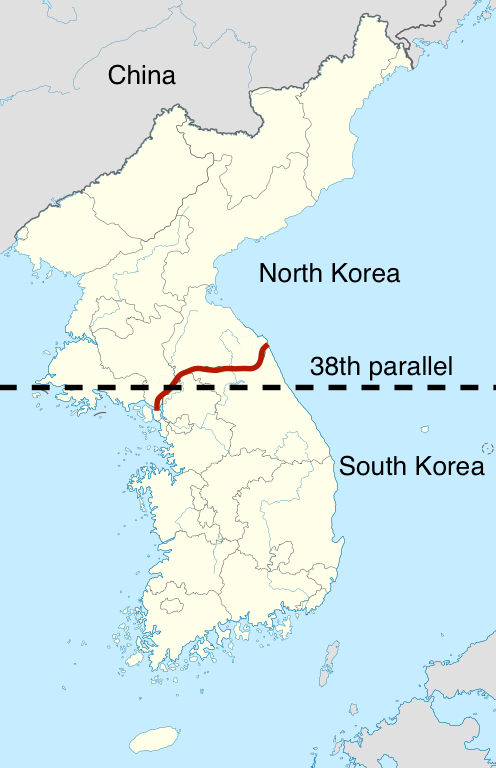
Stalin replaced Chiang as an Allied leader when invited to conference in 1945. President Truman, who had succeeded Roosevelt, was “alarmed over the establishment of Communist governments by the Soviet Red Army in Eastern Europe” and he “feared the same outcome in Korea and elsewhere in Northeast Asia.” Two American officers were assigned the task of defining an America occupation zone in Korea, infamously using the 38th parallel, which Stalin in turn accepted.
Korea’s population at the time (1945) was some 25 million. There was a huge migration to Japan (419,000 in 1930) due to physical jobs requiring labour. After the war, many Koreans remained in Japan and would come to be known as Zaini chi (“Japan resident”). As of 2019, there were some 474,460 residents in Japan.
The next period of Korean history, from 1945-1960, is the period in which the two states we know of today were formed. This was in part a result of the Cold War, which polarized both global and Korean politics. This led to the establishment of the “pro-American Syngman Rhee in the south and the Soviet-supported Kim Il-Sung regime in the north.” It is at this point that we start to note the subtle choice of wording deployed by Park, such as “regime”. But the south, he writes, was also “authoritarian”. Rhee’s rule collapsed in 1960.
America aided the south’s capitalist economy, whereas the Sino-Soviet fallout “spurred North Korean to pursue a self-sufficient, nationalized economy guided by the concept of Juche (Chuch’e, or “self-reliance”) that upheld Kim as the subject of a leadership cult. This idea of self-sufficiency is something we hear of today at a smaller level for individuals and families who wish to live “off the grid” or away from a modern culture which is viewed as destructive and toxic. It also brings to thought a distrust of power, of the state, and of the framework of government. Applied to North Korea, it may be that we can read a little of how they viewed the global order.
The Soviets administered the north through Kim Il-Sung and his former anti-Japanese guerilla comrades, the Partisans. America implemented “direct control” through US military in the south from 1945-1948 through the United States Army Military Government in Korea (USAMGIK). US-Soviet relations deteriorated and this schism would be harshly felt in a Korea still recovering from the Japanese occupation. At this time, unity was still a key aim and hope, not least an expectation.
“Devising a strategic plan for unifying Korea through communizing the south, the northern leadership began to despatch trained guerillas to the south.”
The assassination of Lyuh Woon-hyung is said by Park to have been “a critical blow to the centrist cause.” The group behind the killing is unknown: it could have been the ultra-right, domestic communists, or supporters of Kim. Lyuh had proclaimed a People’s Republic of Korea on the 6th September 1945, acting as Chairman of the National People’s Representatives. When the United States arrived, they did not recognise the government.
In November 1947, the UN General Assembly passed a resolution mandating a UN-supervised general election for all of Korea, proportionate to population. The Soviet Union and the north opposed this as the population in the north was half that of the south. There was also, Park notes, opposition in the south.
The US withdrew in 1949 and the Soviets in 1948, with a Republic of Korea formed in May 1948 with Syngman Rhee elected president. The Democratic People’s Republic of Korea (DPRK) was established by Kim Il-Sung in September 1948. Each denied the others’ legitimacy.
The north stabilised quickly: “the regime was relatively well grounded, with the general population as its political base.” Ki and Pak Honyong (1900-56), who had fled to P’yongyang, merged their parties to form the Workers’ Party of Korea (WPK). They introduced a sweeping land reform which resulted in tenant farmers becoming landed supporters. Around 600,000 to 1.39 milliong landlords fled. “North Korea, then, had virtually disposed of its malcontents.” In addition, Mao Zedong’s China released 50,000 Korean Volunteer Army troops who were immediately incorporated into the Korean People’s Army (KPA).
In the south, there was internal turmoil, with widespread unemployment, high inflation, and leftist guerillas. It is interesting, as we consider today, how each nation has “developed” within the last few decades, which in relative terms is a very brief moment when we consider what has come before but which can sometimes seem overwhelming (in terms of the amount of events taking place, not to mention the trauma of the people).
There were continual skirmishes along the 38th parallel which eventually boiled into a war in 1950 when North Korea launched an all-out invasion. The USA and 15 other UN member nations contributed troops to a UN command force. General Douglas MacArthur was in command, and the majority of the troops were Americans. 26,000 Soviets fought for the North “unofficially.” The KPA occupied Seoul within 3 days.
“In the following seven months, the tide of war shifted three times before reaching a stalemate.”
Park notes key events such as an amphibious landing of US and Republic forces at Inch’on following which the KPA retreated. UN forces retook Seoul “after bitter street fighting,” and “as the UN and South Korean troops approached the Sino-North Korean border, in late October, waves of a million Chinese troops began to push them back; in a little over two months, the Communists retook Seoul.”
The UN and the South pushed back, and by early summer 1951 “the battlefront had stabilized along the present Demilitarized Zone (DMZ).” Representatives from the UN, North Korea, and China began negotiations. Rhee was opposed to a truce, “insisting on conquering the north”, but neither the USA or the Soviets wanted to continue.
In terms of casualties, Park notes that some 1,000,000 South Koreans, 510,000 North Koreans, 500,000 Chinese, 40,000 Americans, and 30,000 UN forces died, with a further 1,000,000 South Korean and 600,000 North Koreans civilians.
The war “deepened the North-South divide with mutual antagonism” and this was especially true in rural areas, where “grievances were deep-rooted.”
“To this day, in the absence of a signed peace treaty between its two nations, the Korean peninsula remains in a state of war.”
Park writes that the Syngman Rhee “regime became increasingly unscrupulous in its efforts to hold on to power.” There were demonstrations against rigged elections which in turn sparked the April 19 Revolution (1960). Protests erupted in Seoul, Pusan, Taegun, and Masan. These were student protests, which is something we shall see occurring again and again. The police fired live rounds, and the US “pressed Rhee to resign”. He went into exile in Hawaii.
Kim Il-Sung, on the other hand, pressed ahead with pursuit of a dictatorship. There were purges, including of Pak Honyong. At this time the concept of Juche was first expressed, which began to “evolve into the bedrock of North Korea’s guiding ideology, stressing the nation’s self-rule, self-sufficiency, and self-defence.” He also purged both the Yan’an and Soviet groups.
“Since Japan had built much of its colonial industry in the north, the division of Korea and the loss of electrical power from the north devastated the southern economy.”
Postwar South Korea is said by Park to have been one of the “poorest countries in the world.” The USA provided some 3.1 billion dollars of aid, half of which went to the military. North Korea’s socialist economic policy, however, “produced some positive results.”
As noted previously, there was land reform, with the confiscation of private land, which was in turn redistributed among landless farmers for free. They also nationalised major industries.
The Rhee regime expanded Korea’s 4-H program (Head, Heart, Hands, Health), with public school education through practical and hand’s-on learning. There was, in fact, a significant focus on education, Park notes: “Those who obtained a university-level education, including the brightest with financial means who pursued higher education in the United States, began to form an elite group of technocrats and business leaders who would spearhead South Korean economic growth in the following decade.”
The South saw feminism and nationalism clash. Park notes the inferior legal status of women, whereas in the North there were steps such as a Gender Equality Law which included suffrage for women and rights for inheritance, marriage, education, divorce, and child support. This also included social care reforms such as maternity leave.
“The state advocated the ideals of an educated, modern mother.”
In both states Park notes the “demise of the more traditional culture shaped by Confucianism”, with the North having an increase in Nativism.
In both states we can also track the ways in which the ruling elite exercised state control. In the South, Park writes that “understanding media’s power, the increasingly authoritarian Rhee regime limited press freedom through such time-honoured methods as censorship, if not outright intimidation threats, applied through the police and even hired mobsters.”
The next period, from 1960-1980, is headed by Park as “Growth and Divergence”, as we move towards what the modern perception of Korea is. In the South, Park Chung-hee overthrew the government with a military coup in 1961. He was in turn assassinated, with Chun Doo-hwan taking power.
In the North, there were continued purges of rivals, whilst Kim’s son, Kim Jong-il, was groomed for succession. Upward mobility became much more limited.
The coup in the South was motivated by several factors, including the inability of the government to maintain law and order, as well as a need to revive the economy. Park and his colleagues set up a “junta” which “prosecuted droves of politicians, progressive intellectuals, and student activists.” The measures taken were “well-received” by the people.
He also sought to normalise relations with Japan, as advised by the USA. Japan rejected South Korea’s demand for compensation for their colonial enterprises. Activist university students and other protested Japan’s “unwillingness to acknowledge responsibility for colonial rule” leading to martial law being declared (which becomes a theme in South Korean modern history, such as in 1971 when students demonstrated to “overthrow dictatorship!”).
South Korea secured loans and aid from Japan, as well as from the USA for contributing troops to the Vietnam War. This war is noted by Park to have been important in the fact that it led to Korean firms (such as Hyundai) gaining lucrative business contracts. War, it seems, often goes hand-in-hand with business and commercial interests.
The North, writes Park, almost dismissively, was more or less a “totalitarian regime.” But both Kim and Park entered into dialogue at the start of the 1970s. This included agreements to reunite separated families.
A joint statement in 1972 articulated 7 key points:
1 – Collective pursuit of the unity of the Korean people and peaceful reunification without foreign interference.
2 – Easing tensions or armed provocations.
3 – Inter-Korean exchange.
4 – Co-operating on Red Cross meetings.
5 – A Pyongyang-Seoul hotline for communication.
6 – North-South Coordinating committee.
7 – iImplementation of all terms of the agreement.
Park imposed a further emergency martial law with the national assembly passing the Yusin Constitution. Park’s presidency became a “de facto dictatorship.” Anti-Yusin resistance gained strength, and the KCIA (the South Korean version of the CIA) abducted the opposition leader. The North withdrew from inter-Korean talks. Park “ruled South Korea with an iron fist.” Incredibly, with mounting pressure of Park and his regime, the KCIA Director, Kim Jae-gyu, killed Park. In the trial, “Kim would assert that he had acted to restore democracy.”
Park (the author) notes that “the Park regime effected South Korea’s economic takeoff”, and notes such measures as construction of hydroelectric power stations in the early 1960s. This was in part achieved through foreign loans, but also with a “relatively young, disciplined population willing to work hard to get ahead in life and for national glory.” They also had access to key markets such as Japan and the USA, which of course the North was denied.
In the 1960s, South Korea also saw a rising concern with nationalism which grew strong among intellectuals and university students who “pursued a twin mission of overcoming the colonial legacies and effecting national reunification.” The Park regime issued the National Education Charter, a 130-word text which all primary and secondary school textbooks included through to 1994 – children had to memorise and recite this.
Rhee and Park both understood the power of the media. Park:
“used his increasingly authoritarian rule to limit the press’s freedom through censorship, if not outright intimidation and threats.”
With Park removed, the military filled the power vacuum. More student demonstrations occurred in 1980 with the “Spring of Seoul.” As you can guess, martial law was declared. Chun Doo-hwan, seizing power in a coup, “sparked the Kwangju Uprising” led by local university student demonstrations which were violently suppressed. Chun “established a de facto junta.”
In the North, Kim had responded to the Yusin system with the Juche Constitution in 1972, concentrating all power in the president’s office. They prioritised heavy industry and the military: “the lack of incentives for competitive productivity, the limited inflow of foreign capital and advanced technology, and disproportionately heavy military spending all slowed overall economic growth.”
There was in addition large demographic shifts in the population, with a shift from a female majority to a male one, and a large emigration of Chinese out of Korea to Hong Kong, the USA, and Taiwan.
Gender progress continued to see “faster progress” in the North, including paid maternity leave before and after birth, though patriarchy “remained strong as a sociopolitical ideal.” The analogy took hold of Kim as the father and the people being his children.
In the period 1980-2000, inter-Korean relations were established. In the South, the June Struggle (1987) ended authoritarian rule and “heralded a vibrant democracy”, whereas in the North there was further isolation following the collapse of the Eastern Bloc (1991) which led Kim to pursue nuclear weapons and ballistic missile programmes “for strategic leverage.” Under Kim Jong-il, the “stagnant economy collapsed.”
Chun Doo-hwan had succeeded Park and he was elected in 1981, inaugurating the Fifth Republic. He implemented a “mixture of repressive policies and concessions.” This included repealing the anti-Communist Law. The government still deployed police on university campuses to “forestall student demonstrations.”
There was during this time a high profile terrorism incident which Park attributes to the North. During a visit of Chun to Myanmar in 1983, bombs were exploded. There was also a targeted explosion of a Korean Air passenger plane in 1987 reportedly staged by “hawks” with the younger Kim’s “tacit approval.”
Tension rose in South Korean relations with Japan when the Japanese government sanctioned textbooks which justified colonialism and downplayed war crimes. Park hints that this had some connection to further student protests, including ordinary citizens, with an estimated one million participating in what became known as the June Struggle. Concessions were made, leading to the stipulation of direct election of Roh Tae-woo, leader of the Democratic Justice Party, Chun’s designated successor.
In 1988, Seoul hosted the Summer Olympic Games. This led to subsequent diplomatic relations being established with the Soviet Union, China, and other socialist countries. Roh extended his “conciliatory gestures” to the North. There was even discussion of fielding a joint team for the 1990 Beijing Asian Games. Both nations simultaneously joined the UN in 1991.
“Subsequent high-level talks resulted in adapting a basic agreement on mutual non-aggression, reconciliation, exchanges, and cooperation.”
There was also a joint statement around keeping the peninsula free of nuclear weapons.
Kim Young-sam was elected president of the South in 1992, meaning he was the first leader with a civilian background since 1960. He required all government officials of the fourth rank or higher (out of 9 ranks, which brings to mind the bone rank system) to report their assets: those found guilty of corruption had to resign or face prosecution. Roh Tae-woo was subsequently arrested for accumulating a slush fund. Chun Doo-hwan was also arrested for his role in the coup in 1979 and for the suppressing of the Kwangju Uprising. He was sentenced to death, though both were eventually pardoned.
Kim Dae-jung was elected in 1997, with the South Korean economy “reeling from the Asian Financial Crisis”. Financial reforms were mandated by the IMF “as a condition for its bailout loan”. South Korea paid the loan off by 2001 to the tune of 20 billion US dollars.
In June of 1994 there was an unprecedented inter-Korean summit, but Kim died suddenly. This was restarted in 2000, with the two Kims meeting at Pyongyang. They articulated five main points:
1 – Achieving reunification through both Korea’s efforts.
2 – Recognition of the common ground between models (of governance).
3 – Reunion of separated families.
4 – More balanced economic development for the peninsula.
5 – Hold working-level talks to implement the terms of the agreement.
During this time, Park notes that the numbers of “escapees” from the North to the South increased. Most “crossed the Sino-North Korean border into the Yanbian Korean Autonomous Prefecture of China by evading or bribing border patrol troops.” Many were sent back, but “many female escapees were sold and resold as farm-hands, restaurant workers, servants of elderly Chinese, brides of bachelor farmers, or even sex workers.” Escapees who were sent back to the North are reported to have undertaken “rigorous re-education” and some were executed.
Park states that during this time that there was a reversal in women’s rights in both the North and the South. In the South, although there was an increased workforce presence and education level, many South Korean women “continued to believe that they should be good housewives and mothers.” While in the North, official announcements started to emphasise the traditional role of women.
It should be noted that Park spends much more time addressing the politics and movements of the South, though this may in part be due to the access to information in each state.
In 2002, Kim Jong-il visited Shanghai and is reported to have been impressed by the economic development. At the same time, the US labelled the North as part of an “axis of evil”. Also during this year, South Korea and Japan co-hosted the Fifa World Cup.
There was an ongoing ebb and flow between North and South. During the World Cup, for example, there was a clash in the Yellow Sea. But there was also participation in the Asian Games, and a ceremony to connect the Seoul-Uiju Railway. South Korea, however, was increasingly supportive of the hard stance taken by the USA.
In 2003, the North announced that it was in possession of nuclear weapons. Six Party Talks were held with both Koreas, China, Japan, Russia, and the USA. Breakthrough came in 2007:
“on the condition that North Korea dismantle its nuclear facilities and register all aspects of its program, both America and Japan promised to improve relations with the country.”
All nations agreed to supply fuel as an emergency assistance. America wanted the North to dispose of its weapons first, but the North wanted delivery of aid first. North Korea has been mentioned during the recent Israeli-American attacks on Iran as an example of the protection nuclear weapons can afford a nation - that is, the idea of deterrence.
In 2007, Roh Moo-hyun became the first South Korean president to walk across the DMZ. There followed a further joint statement and articulation of key aims. But with an upcoming election, many saw this as a campaign ploy. There was reported starvation in the North with many fleeing to the South.
More recently, Park notes that the South fell back into “authoritarian tendencies” from 2008-2017 before more mass protests, impeachments, and conviction ousted the leader. In the North, Kim Jong-un, taking over from his father in 2011, further expanded the nuclear weapons and ballistic missile programmes. US-led sanctions against the North have “prevented South Korea from full engagement as an economic powerhouse.” Internally Kim raised his sister, Kim Yo-jong to second-in-command.
North Korea became “more confrontational” over time, which included a second nuclear bomb test in 2009. All 15 members of the UN Security Council voted unanimously to impose economic sanctions.
Park Geun-hye was inaugurated as president in the South in 2013 (she was the daughter of Park Chun-hee, who was president from 1963-1979). Tensions continued to run high between South and North, and the North “increasingly upset the new Chinese government, headed by President Xi Jinping.” In the South, “various issued and incidents fuelled political turmoil”, including with key appointments, “manipulation of public opinion”, and scaling back on promises made around social welfare policy. She was subsequently impeached in 2016 on charges related to “influence peddling” by her top aide. She was convicted and removed from office.
Moon Jae-in succeeded her. He was “determined to secure an irreversible framework for inter-Korean relations, and his efforts paid off in 2018, ushering in detente and brokering a dialogue between North Korea and the USA.”
“Seeking to achieve his regime’s long-term security by officially ending the Korean War, Kim decided to rebuild the economy by improving relations with the United States and South Korea.”
The US was intent on denuclearization first, whereas North Korea demanded an end to sactions first.
South Korea paid off its IMF loan in 2001, and exports became “booming”, with the country boasting a world leader in Samsung, as well as notable companies such as Hyundai, Daewoo, and LG. In 2004, the government decreased the workweek from 6 to 5 days. They secured a number of FTAs (Free Trade Agreements).
The contrast between South and North, in the economic sphere particularly, is rather stark. On the one hand, we see a South which benefits greatly from the support of western nations, a kind of sponsoring, whilst at the same time a fierce determination from the citizens even in light of harsh rule and oppression. The North, however, in part self-inflicted (if we are being harsh), has been denied the same opportunities as the South, and the approach taken is presented as belligerent and antagonistic.
“As of December 2020, South Korea enjoys a secure standing as a significant player in the global economy.”
They are, reportedly, the 14th largest economy in the world. Importantly, however, their total exports and imports of goods and service account for around 83% of their GDP, so they are heavily reliant (read: vulnerable) on trade.
By contrast, “North Korea’s ruined economy has shown little sign of recovery in the past two decades.” We can say, in the very least, that the sanctions placed on the nation have contributed significantly to this position. Of course, this is attributed to the North’s goal of developing nuclear weapons, though Park notes that the North has also taken steps to grow their economy through foreign investment through the creation of “special economic zones” (or SEZs, which also bring to mind the special economic zones of China, areas such as Shenzen, which were initially established under Deng Xiaoping). These were set up in the South also. Park notes that the North currently has 75 of these zones.
As noted by The National Committee on North Korea, a “non-governmental, non-partisan” organisation based in Washington, “the development of SEZs in North Korea has largely stalled.” The report also asserts that sanctions are a constraint on the North’s efforts to develop SEZs. This inhibits the financial infrastructure needed to develop the zones, as well as impacting on any potential exports. The report identifies that the North has been designated by the USA as a place of “primary money laundering concern”.
Park goes further, stating that the US sanctions “choke” the DPRK economy. Compounding this, China, the North’s biggest trading partner, ceased purchases of coal, which was the North’s biggest export revenue stream. China does, however, provide “extensive energy and food subsidies.” As of 2020, the economy remains “repressed and stagnant.” As a result, local markets (“jangmadang”), including black markets, continue to grow despite ongoing crackdowns.
The violations of human rights receive “much attention”. This is reported to include internment camps for political prisoners. It is alleged that atrocities such as rape, torture, and forced labour happen at these sites, which makes them similar in a sense to the US with their Guantanamo Bay site, or the practice of Israel against Palestinians in Gaza. Park notes that “children have suffered from abuses rare elsewhere in the world," though he was writing before the more recent phase of the Israeli genocide against the Palestinians.
And on this depressing note we can summarise by seeing just how problematic the recent history is for the people of Korea, a state which is now divided, but for a long while had been a united tributary state of China practising a distinct form of Confucianism, with a significant cultural and scientific treasury. Much like China, and perhaps in less well-documented areas of the world, the united state arose from a time in which there was a chaos and ebb and flow of a ‘warring states’ period.
We can also see the depth of the ripples of trauma arising from the age of Japanese imperialism on the peninsula, as well as the schism imposed by the United States of America and the Soviet Union. In some ways there is a measure of control, perhaps, being exerted in the split, though the North’s approach of self-determination and so on seems to have made the approach taken by powers such as the USA even firmer. The North is spoken about in voyeuristic terms as a place which closely resembles Orwell’s 1984 dystopia. But although the South is praised and presented in highly glowing terms, with economic as well as cultural influence extending across the world, there is also a concerning undercurrent, with much talk since its founding of authoritarian approaches, mass repression of demonstrations, and martial law.