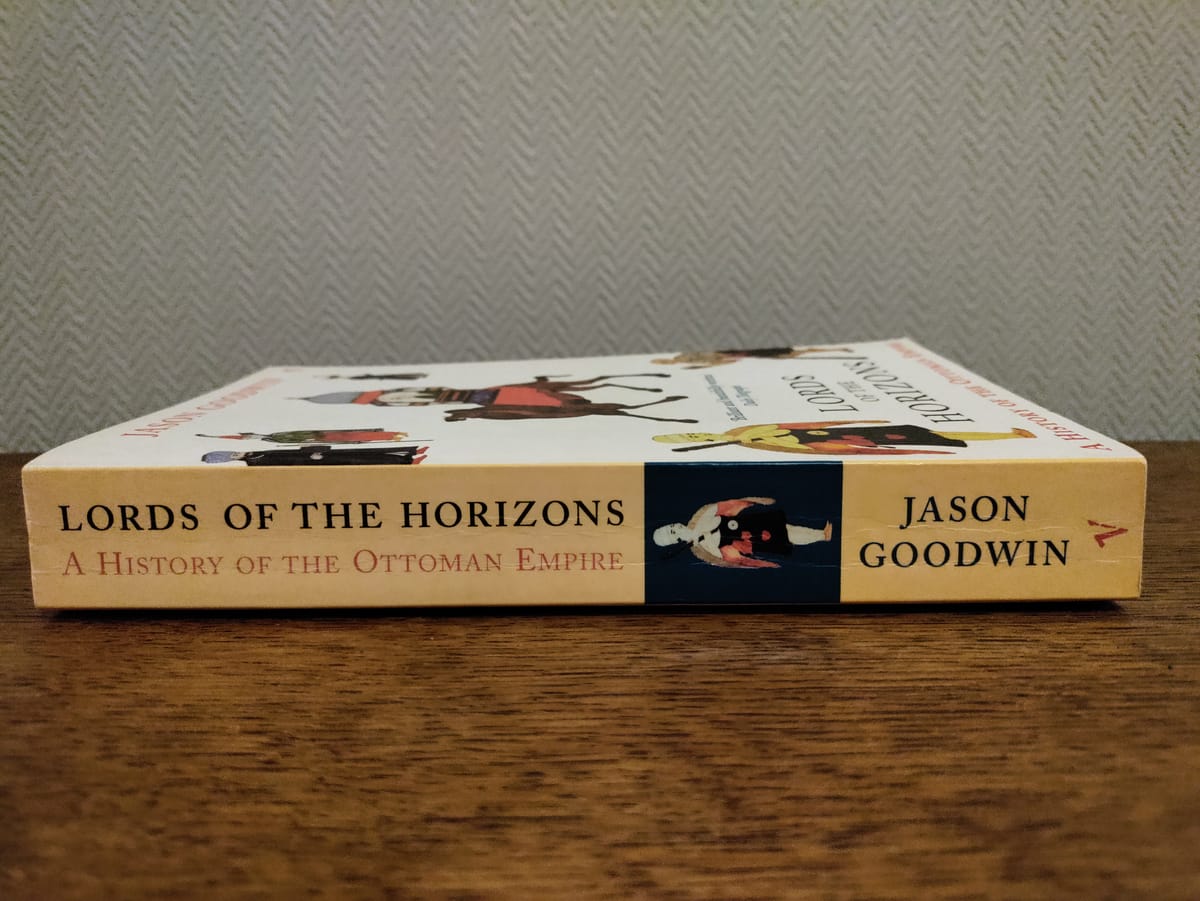
Lords of the Horizons (Jason Goodwin)
Short reflection on 'Lords of the Horizons - A History of the Ottoman Empire', which approaches the narrative with a thematic rather than linear recounting.
In my primary school years we played football on the field. This was before the school grounds were penned in by metal fences painted green. The open field gave way onto a road and the lands beyond. Anyone could enter; anyone could depart. Every spring and summer the field would be filled with the caravans and vehicles of a traveller community, and we would be ushered to the concrete playground where the surface was much less forgiving on our knees. I always recall seeing children my age or a little older driving around on quad bikes. Why weren’t they in school? I thought.
At this time, and into secondary school, the main empires I had been (made) aware of were the Roman and the British empires. I had some general awareness and learning about other great ancient civilizations such as ancient Egypt, Persia, as well as the Aztecs and Incas, mythological onces such as Atlantis, and of course the clashing imperial empires of Europe, but the Ottoman Empire was barely mentioned, and only then as a kind of minor character in the First World War theatre. A closer look at the vast lands covered and conquered by this empire deserves a closer look.
Jason Goodwin’s Lords of the Horizons: A History of the Ottoman Empire avoids a linear route examination of the Ottomans, instead taking a thematic approach to considering this vast and sprawling empire. He writes in his overview that “for six hundred years the Ottoman Empire swelled and declined. It advanced from a dusty beylik in the foothills of Anatolia […] to conquer […] Byzantium, including the entire Balkan peninsula”. The submission of the Crimean Tartars and the capture of Constantinople “completed its control of the Black Sea.” In 1517, it “swept up the heartlands of Islam.” The key learning is undoubtedly the connection between Ottoman and Europe, and how over time as the concept of Europe is established the Ottomans (and the subject peoples) became an Other for the Europeans.
The Empire was, Goodwin writes, “Islamic, martial, civilized and tolerant.” It was “an Islamic empire, though many of its subjects were not Muslim, and it made no effort to convert them.” It was also a Turkish empire, but its dignitaries, officers and shock troops were Balkan Slavs. Its dignity was Persian, its wealth Egyptian, its letters Arabic. At the start of the 17th Century it faltered, until disintegrating at the end of the First World War, its pieces divided between the victorious imperial powers of the day.
The origins of the empire were with the Turkmen of the Eurasian steppe, who tamed horses in the third millennium BCE. They were nomads of the steppe, armies of slaves who had been recruited in the “internecine wars” of the Sunni-Shiite dispute. “When they quit the steppe in the ninth Century, the Turkmen had taken service with the Abbasid caliphs of Baghdad, who had taught them Islam. From the Persians they learned statecraft.”
Between 1320-1390s the Ottomans “moved like a ripple through the shallows of Byzantine power” - beyond Anatolia and across the Dardanelles. Between 1300 and 1375 the rank of Ottoman leader rose from bey to emir, from emir to sultan. Ottoman power at this time was a “family affair”, with sovereignty shared (to a degree) by brothers, uncles, cousins, and even female relatives. The family was extended by Murad I in 1365 when he founded the janissaries (or “new troop”), taking captives and training them to be the personal army of the sultan.
Bayezit, or Yilderim (“Thunderbolt”) is one of the most famous of the Ottoman leaders. His mother was a Byzantine princess. He gobbled huge tracts of Anatolia and made enemies among the old ruling families. He confronted Tamerlane.
The young Ottoman Empire could have collapsed early on: “the empire had outgrown the ability of a single man to govern it personally.” Yet their enemies remained fragmented. “The idea of Ottoman dominion had taken root […] by 1430 the sultans had restored the empire Bayezit had gambled away thirty years before.”
Mehmet II seized Constantinople from the Greeks in 1453. Following this, the local Mediterranean powers (Venetians, Genoese, Ragusans), offered their congratulations and agreed to raise their tribute. The city “remained the finest city in the world,” regarded by the Byzantines as the naval of the world. Mehmet’s troops laboured in the city to “repair the ravages of centuries of neglect.” The city is also described as a “turnstyle of the continents, seal of empires, geomantic paradise, Constantinople was a place of absolutes.”
Following this, from Trebizond to the Peloponnese, Mehmet “wound up all the Byzantine despots, rivals and dependents,” subjecting the whole of the Greek-speaking world. In 1456 he stormed up the Danube to take Belgrade, but was defeated.
Mehmet introduced the fratricidal law to ensure that only one man could ever rule the empire at a time. This led to executions of brothers and nephews to prevent power struggles (primogeniture was unknown). This difficulty with succession was also problematic for the ancient Persian Empire of the Achaemenids.
But how did hierarchy work in the empire? “Most sovereign states”, writes Goodwin, “discovered ways to devolve power, without giving it all away. The Romans and Persians used eunuchs, the kings of Europe unmarried clergy, and the Chinese used their famous exam system to enrol humble but eager scholars into the ranks of the ruling class.” Murad II introduced the tribute system in 1432, and Mehmet “carried it to a logical conclusion”. Every three years or so, a tribute officer went to the villages of Greece and the Balkans and selected “the finest Christian youths for the sultan’s service.” Every aspect of their lives was constantly watched and assessed – they were the sultan’s slave, though not in the traditional sense. These youths and their predecessors formed a commonwealth of slaves. They were sent out to fill positions of responsibility in the provinces: “none know so well how to govern as those who have learned to obey.” Others joined the Noble Guard, or the regular cavalry.
The Jannisaries were from the same stock, but were less cultivated, who, in addition to becoming the personal army of the sultan, took up roles such as gardeners, gate keepers, sculleries and wood cutters. The kul system, Goodwin notes, was a “ruthless meritocracy.” In 1638 the boy tribute was formally abandoned, and the way was clear for the establishment of dynasties.
As noted, the term “slave” is reported to be an inexact term. It never resembled plantation slavery in America: “they could not be bought or sold and nor, for all their power, did they resemble an aristocracy.”
The Ottoman Empire, writes Goodwin, “lived for war […] while western rulers would be cajoling and threatening their vassals, pleading with over-mighty magnates, perhaps, or the citizens of free towns, or frantically raising loans to raise troops, the Ottoman armies would be assembling like clockwork, paid up and signed in.” In addition, they “carefully analysed the problems of war” - no source of intelligence was overlooked, they held vast spy networks, and held reflections on each campaign. This voracious focus on reflection and improving upon each iteration (of the entity or machine of empire) seems to wane and bloat as time passes.
“By the end of the 15th Century the Ottomans had brought their dominion to a comfortable point: their borders lapping against Hungary on the middle Danube, against the steppes in the north, against Iran and the Arab states in the Middle East. It was this latter region which held out the fattest promise: take Arabia, even Egypt, and the Ottoman monopoly over trade routes from the East into the Mediterranean world would be complete.”
Sultan Selim (or Selim the Grim, 1470-1520) led the conquests of modern-day Iran, Iraq, and Egypt. The sherif of Mecca “handed him the keys to the holiest city of Islam.” He was succeeded by Suleyman (“The Magnificent”, rulin rom 1520-1566), who oversaw the “most detailed codification of sultanic and Koranic law that had ever been known in an Islamic state,” such as establishing the relationship between Muslims and non-Muslims, though for all their tolerance towards the habits and beliefs of people of the book (those Abrahamic faiths), they “loathed the Shias with an anxious passion.”
With Luther being condemned as a heretic, and with the Holy Roman Empire about to fall apart, Suleyman took Belgrade, and then Rhodes, sending the Knights of the Order of St John away. They established themselves at Malta. The eastern Mediterranean now belonged to the Ottomans.
Suleyman ruled for 47 years, 30 of which were spent campaigning. In 1570, Suleyman’s grand vizier, Sokullu Mehmet, took Cyprus, prompting the formation of a Holy League against the Ottomans consisting of Spain, Venice, and the Knights of Malta. The “discovery” of a trade route around Africa, however, lessened the importance of the Mediterranean for trade.
Goodwin notes that at this point the rulers of the Ottoman Empire went from the field (that is: campaigning directly), to the court and the household. He writes that “for all its glitter and martial energy, for all the riches […] the empire was pastoral at bottom.”
“The Ottomans,” he continues, “were always interested in effective forms of self-government,” expecting every subject to belong to the retinue of some great man, or a guild, or a regiment. Whilst Islamic law prevailed, Jews and Christians were expected to have their own laws, too. Everyone was organised into millets, “and as long as the millet did not come into conflict with Islamic organisation and society, provided it stumped up its taxes and kept the peace, its leaders were left to run their own affairs.”
When the Jews were expelled from Spain in 1492, Sultan Bayezit II ordered his governors to receive them with kindness and assistance. Goodwin notes that wherever the Ottomans “met talent they gave it scope.”
Ottoman cities, where crime was reportedly rare, “tended to reflect the demands of private, not public, life.” They lacked, for example, “the architectural establishment of the piazza.” Markets were patrolled by kadi with summary powers: “profit was generally limited to 10%” though this limit was harder to gauge on goods brought from afar. Interestingly, Goodwin notes that “the people had to be protected from overcharging and scarcity”. The Ottomans did not engage directly in much trade, but they did tax it.
Goodwin writes that the Ottomans “did not burden the world with monuments to their own magnificence, and it is this, perhaps, which makes them seem so distant, as if their empire had flourished many centuries ago, on other continents.”
The first ten rulers of the empire were given names such as Grim, Magnificent, and Conqueror, whilst the next 26 had names such as Sot, Mad, and Damned: “many of them seemed to be mentally unstable,” though not in the same way as the inbred European royalty. This was more to do with the environment of their upbringing as opposed to inherited characteristics. Ahmet I, in 1603, broke with fratricidal law. From that point on, princes were no longer killed as a matter of routine, but were instead kept in the harem, confined to the inner sanctum, the so-called cage (or kafes). High office was increasingly dangerous; the court was a cauldron of conspiracy.
In 1606 a long war with Austria ended in stalemate. This differed to previous campaigns in that the Emperor of Austria was admitted as an equal, which was “tantamount to defeat.” The empire, Goodwin notes, had reached its geographical limit. Perhaps we can argue in its assertive limit also. The wage bill of the army swelled “when the rewards of constant warfare were beginning to dry up.” This led to money inflation and brigandage. In 1683 there was a reverse at Vienna. The next sixteen years of war were “full of military disasters,” with the Austrians expelling Ottoman armies from Hungary, Venetian troops securing the Peloponnesse, Belgrade surrendering to the Austrians, the Habsburg Emperor recognising the sovereignty of Transylvania, and the Russians seizing the “Sea of Azov behind the ear of Crimea, and lands north.”
Goodwin explains that “some say that the causes of Ottoman decline are to be sought on the periphery, which no longer provided the empire with fresh blood; others blame it on the palace.” He notes some additional factors:
- The warrior blood of the early sultans was diluted. We might read this as the retreat from campaign field to harem or the court.
- A perpetual struggle with Shiite Persia.
- “Foreign historians tend to blame the international forces of capitalism – their capital, their force – and suggest that the west reduced the empire to a peripheral producer of raw materials.”
- Military experts point to 1683, suggesting that “Austria and Russia were beginning to learn the lessons that the Ottomans themselves had already started to forget.”
Goodwin also considers the polarities that had long governed the Ottoman world: peace and war, public and harem, two seas, two continents, in addition to their “early genius for lightness and speed” and its later reputation as a “lumbering sloth.”
The Thirty Years’ War is described by Goodwin as a “proving ground” for the “superiority of massive infantry divisions backed by mobile field artillery over medieval cavalry charges and heavy bronze siege cannon.” The western and central European powers also developed a very efficient tax system which was necessary for training, wages, and supplies.
Russia proved to be particularly good at this and used its army as a “palisade” behind which “people could be settled for taxes and cultivation.” The Ottomans never considered this expansion and settler mentality/approach as they are described by Goodwin to have been “predatory horsemen and hired guns” or “privileged jannisaries.”
In addition, “unlike the aristocracies of the west, who ultimately moved into trade, finance and production, the Ottomans still saw wealth as plunder, to pile up in glittering heaps.” This suggests that the evolution of the ruling elite (in Western Europe) was to use their wealth to work for them in creating more wealth rather than wealth as display – that is, that wealth was seen to have utility in that it could be used to consolidate and increase power. Goodwin also notes that the Ottoman regarded the economy as serving war, whereas in the west (we seem at this point to have moved into this delineation) the opposite was true.
Goodwin notes, wistfully, that “the gap between theory and reality grew wilder with every passing year. Too many people owed their living, not to the real world, but to the sham of it, from the sultan down.” Some would argue that today there is a shallowness to the reality that slips in our grip, something tangible, when we reflect upon the “American Century”. It was always slightly tongue-in-cheek, a laugh and a sahke of the head when watching a film in which we hear a chorus of “US-A! US-A! US-A!” But that is certainly an emblem of the sham and charade of the modern-day superpower.
Goodwin notes that “by the end of the eighteenth century the empire’s military prowess had dried up. Her existence was to be prolonged only by the reluctance of the Great Powers to see her carved up and delivered to their own enemies.” We are not quite there yet with America, but the carving of the turkey is unlikely to be as clear - America has established spheres of influence and control that are sometimes opaque, with less presence “on the ground.”
In addition to the meritocratic elements of the Ottoman Empire, Goodwin also notes that “the most impressive feature of Ottoman rule was its opposition to the thin inadequacies of national identification.” In this sense, “race was meaningless” and “every man could be made.”
Mehmet Ali, described as a “cunning Albanian”, had taken charge of Egypt which, by the 1820s, was the “most progressive and efficient state in the entire region.” He began to modernise and westernise. The army he inherited, however, refused to conform, and in 1823 he turned to peasant conscripts, the Egyptian fellahin, who were drilled by the French officers who had stayed behind after Napolean’s “adventure”. This group became a national army, a concept that was “wholly new” to the Ottoman Empire. Within the empire smaller factions began to organise within the fragmentation. The destruction of the Janissaries (the so-called Auspicious Event) led to Greek independence.
Ali’s successes gave Mahmut a “powerful model to follow” with the two seemingly in a race to westrnise. Mahmut began to “reorganise his government along bureaucratic lines” but died in 1839 to be succeeded by 16 year-old Abdul Mecit. “The army eventually put an end to the pretension of the sultan’s caliph. The army, of course, contained a very high proportion of ‘advanced’ types: scientists, linguists, mechanics.”
By the time of the fall of the Ottomans, “belief in the empire had long since leached away when the First World War swept out Europe and ushered in our own century of dictators and massacres.” The actions taken by the imperial powers following the fall of the Empire in the region known colloquially as the middle-east would come to have long-lasting effects, including the dispossession, ethnic cleansing, and attempted genocide of the Palestinian people.
By no means should we advocate for a similar entity to the Ottoman Empire to be established in the region. Despite some attractive elements the the history of the empire, such as the emphasis on merit rather than background, the empire belongs to a rapacious time of human history. Or is that the history of Humanity is rapacious? I reamin on the fence about this.
There are many distractions in the alleyways of society, on the many plinths in the piazza, and everything presented us seems to be with an intent to sell and capture. Is there anything to be said for a mutual aid, for a global community, something to unify without hatred, to surge within us?