Medicine - Lu Xun
A reflection on Lu Xun's short story 'Medicine' and what it says about the connection of people within a society.
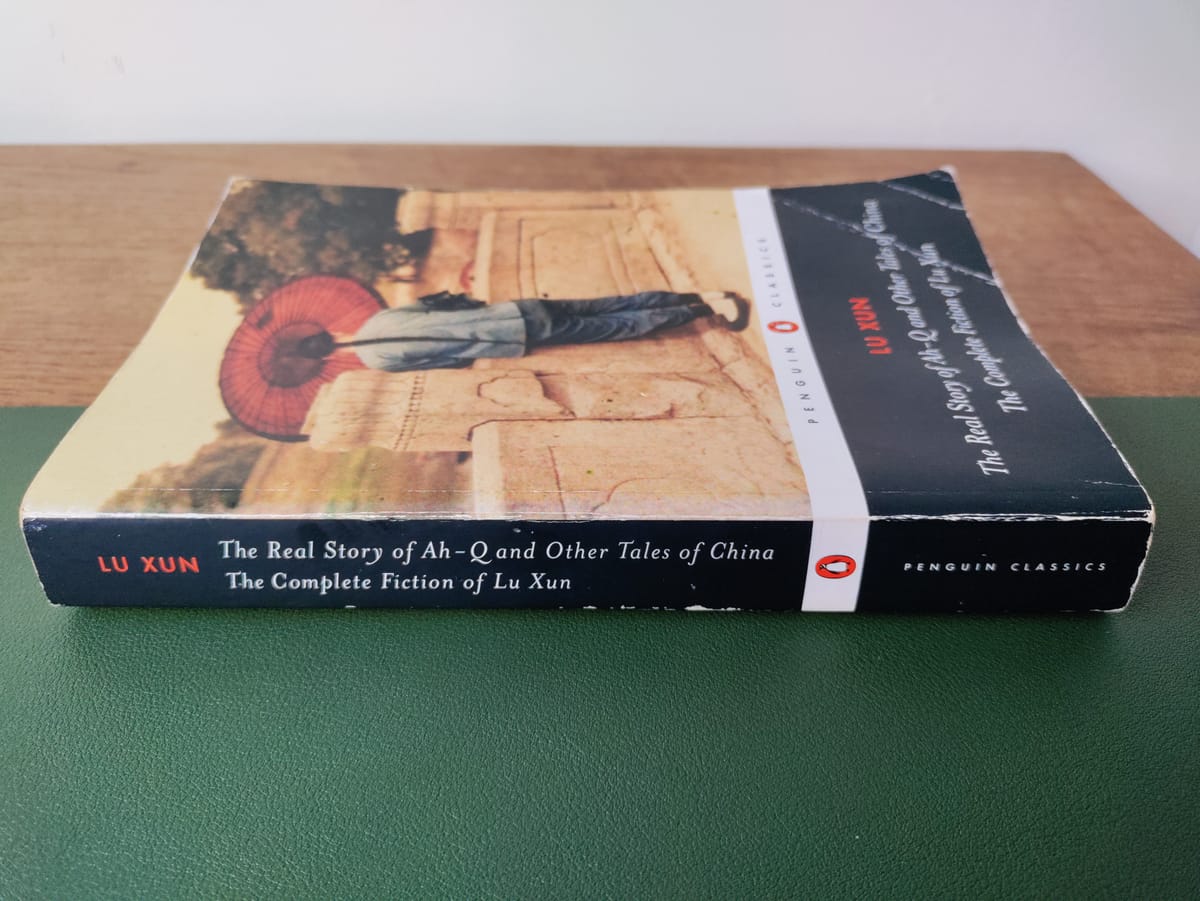
Having abandoned his study of medicine to pursue literature, Lu Xun is reported by Julia Lovell to have been a “self-appointed literary physician of China’s spiritual ills”. His stories are diagnoses of social issues, and there is a high degree of didacticism in them due to his intention to propose cures. As these often relate to the ways in which people should behave, or to think, there are times when his suggestions and messages lack finesse.
In ‘Medicine’, he identifies the connectedness between those striving for one aim (in this instance we can say specifically the ideals of the New Culture Movement), and those going about their daily lives, who in turn can be said to be presented as being unaware or apathetic to the more important matters at hand.
Lu Xun consistently deploys the imagery of contrasts between light and dark to emphasise the trope of progression and modernity from what we might regard as the general slumber and lethargy of the late-Qing Dynasty as well as what is colloquially known as the Century of Humiliation (1839-1945). He was focused on a new direction and a new pathway for the new Republic, and this story was written in the aftermath of the new Republic of China (1912-1949) which, as Lovell notes, had “regressed into authoritarianism”, with imperial Japan gaining further control of Manchuria and Mongolia and the leading world powers of Britain, France and America ceding Chinese territory to the Japanese in the Treaty of Versailles (1919).
The opening to the story is set in the dark hours before an autumn dawn, a nod to historical context of the social revolution taking place in China which had not yet been fully realised. We learn of a man, Hua Shuan, who is awake at this early hour, and we hear the coughing fit of his son. Hua tucks a packet of silver into his jacket “with trembling hands”, and we can assume both from this opening and the title of the story that he is embarking upon a journey to seek something to help his boy.
As he leaves the house, his lantern “cast its light over his feet, illuminating their progress.” As well as deploying the imagery of the light of nature in his stories, Lu Xun frequently uses lamps and lanterns to signify modernity and progress, or the hope of progress, against the perceived backwardness and social ills of his day. In turn, Hua is invigorated on his walk as the day gets lighter. He purchases a crimson steamed bun which is dripping red:
“His only thought was to place this elixir inside his son, and enjoy its blessings.”
Lu Xun hints at the macabre nature of the bun, with the mention of soldiers, but the revelation that this is dripped in the blood of a dead soldier (or revolutionary, or prisoner) is held off until later in the story.
Hua returns to his wife, Hua Dama, and they prepare the medicinal bun for their ailing son, with Lu Xun offering an initial signal that the people of a society, whether revolutionary soldier or teahouse proprietor, are all closely connected, though perhaps not in the traditional Confucian sense, using a wide definition, of the state as a family:
“The boy picked it up and studied it. The strangest thing: as if it were his own life he were holding.”
We can also read this as representing the sacrifice of the revolutionary who had, whether it is acknowledged or not, died for the people.
Customers gradually arrive at the teahouse. One of them, a Mr Kang, exclaims “He’ll be better before you know it! Guaranteed! […] A miracle cure! Right? Get it hot, eat it hot.” We then learn that Mr Kang is an executioner, and in turn we learn that the dead man whose blood had blessed the bun is named the Xia boy. Lovell notes that Lu Xun uses the words Hua and Xia for the surnames of two of the characters in this story, both of which can also mean China, “infusing the story with an intense historical symbolism." We can say further that the names also strengthen the idea that all the citizens of a state are connected, and that all should contribute as they stepped along the pathway for progress.
The gossipers of the tea-house label Xia as “a rascal” and as “the idiot”, especially when discussing that he had “even tried to get his jailer to turn against the government.” The Xia boy had displayed strength and courage even in the face of death, not looking for some miracle cure, but instead pursuing his ideals through action.
After we hear of this, we learn that “life – and the power of speech – returned to the other customers. As the teahouse bounced with noise once more, the Shuan boy began coughing desperately.” The Xia boy’s sacrifice, like all sacrifice for revolution, pulsates with energy outwards, though the customers regard him as “crazy.” Mr Kang goes over the Shuan boy and thumps him on the back: “No need to cough like that, Shuan my boy. Guaranteed!” whilst another customer remarks: “Crazy.” For the reader, we can take this to mean that the people of the teahouse are crazy with their foolish superstitions, rather than the Xia boy himself, especially when we consider how seemingly cataclysmic events in the world and in society (such as a genocide, or political corruption) are often received indifferently.
The story itself is arranged into four parts, each of which can be regarded as an outline of a social revolution, that is: part one is concerned with a proposition, that being the journey to secure the medicine; part two is the action, in the sense of the preparation and taking of the medicine; part three is the reaction, both in terms of the Xia boy and the Shuan boy; whilst part four represents the aftermath (and/or the new proposition). As we shall see, the aftermath or new proposition does not always arrive neatly or with a sense of resolution.
The final part opens as follows:
“For as long as anyone could remember, the land beyond the western gate in the town wall had been common ground, bisected by a narrow, meandering path tramped out by the shoes of short-cutters. To the left of this natural boundary line were buried the bodies of the executed and those who had died in prison; to the right lay the mass graves into which the town’s poor were sunk. Both sides bulged with grave mounds, like the tiered crowns of steamed bread with which wealthy families celebrated their birthdays.”
It is no great leap to assume that the Shuan boy has died. The guarantee of the medicine, of the miracle cure, was false. There is no easy path or short-cut to progress, no miracle cure to cultivating culture, no simple medicine to reform society. There are only harsh truths and a need for action from all people.
In the village graveyard we see a delineation in the burials, with a movement from those executed and those who had been prisoners, the assumption being that they had committed (or had been convicted of having committed) a crime, to the mass of the poor, the general population of people. Over the mounds of both groups – convict and citizen alike – is the image of a golden extravagance of the wealthy, the crowning bread a kind of claim to ownership of life which also suggests the excess and waste of the ruling elite. This is the inequality and injustice that the Xia boy was standing against; this is the apex of the corruption within society that needed to be challenged.
We learn that the weather that April was unusually cold. “Not long after daybreak”, writes Lu Xun, again using the dawning of day to frame the movement and his proposition, “a weeping Hua Dama set four dishes of food and a bowl of rice in front of a new grave.”
Another woman arrives, “her hair also grey, her clothes ragged”, and again it is no great leap to wonder if this may be the mother of the Xia boy: the two are bonded, after all. The Xia boy’s grave is “directly across from the Shuan boy’s, the two plots separated only by the narrow path.” The use of the word narrow implies not only that the life of a person is fragile, but that our deeds can go one way or another, with much left to chance. As we shall see, the Xia and Shuan boys, connected as they are, make different ripples after their passing.
Noticing that the new woman seems uneasy, Hua Dama goes over to her. At first she regards the grave as “unkempt”, until looking closer, seeing that “across the grave’s rounded peak lay a wreath of red and white flowers, clearly visible even to eyes long cloudy with old age.” Xia’s sacrifice and life is honoured by nature (and by a mysterious mourner, or group of mourners), giving new life to the unkempt land. The mention of eyes cloudy with old age can be regarded as a reference to history itself, the assertion by Lu Xun being that the life of a revolutionary, given for the revolution, cuts through time and is clear for all to see. Xia is honoured in death, whilst Shuan’s grave, and those of others, are “scattered only with hardy little bluish-white flowers”. At this, Hua Dama feels “unaccountably troubled by a sense of dissatisfaction, or inadequacy”. Could it be said that her dissatisfaction is a feeling that her son's life carried little meaning? The Xia boy, we know, died standing for his ideals, whilst the Shuan boy we can only assume died from his chesty illness. Both are tragic, but only one of these is raised as a standard by Lu Xun.
This is not to render the Shuan boy’s death as meaningless. We know that the title of the story can be said to relate not only to the medicine that Chinese society needed in terms of their social sickness and recovery, but also in a very literal sense to the modernisation needed in society, including the approach to medicine and healthcare. As we shall see in further stories, Lu Xun rails against the waste of human life in his society.
The mother of the Xia boy lets loose the grief within her:
“Yu’er,’ she suddenly cried out, her face streaming with tears, ‘They murdered you! And you can’t forget."
She continues, now with an audience of a “lone black crow on the bare branch of a tree:
“I know […] they’ll be sorry, Yu’er […] If you’re here, and can hear me, send me a sign – make that crow fly on to your grave.”
The two women watch, expectantly:
“Time passed. Other mourners, of various ages, appeared, weaving in and out between the graves.”
The crow doesn't move, for now. Hua Dama is described as feeling relieved, “as if a heavy burden had been lifted from her shoulders”, and she suggests that they leave. It could be said that her relief is a result that the Xia boy’s mother was not granted any further supernatural blessings. It would be simple for Lu Xun to have the crow land on the grave, to give the story a sense of resolution, but he chooses a different pathway:
“After a couple of dozen paces, a lone caw broke the silence behind them. They looked back, their skin prickling: its wings spread, the crow crouched for take-off, then flew off, straight as an arrow, towards the horizon.”
In one sense this ending, with the crow not landing on the grave as per the mother’s plea but instead heading towards the horizon, represents the fact that in revolution an individual sacrifice, though honoured and important, is still subordinate to the greater purpose. For Lu Xun, this was about the progress of society, and each individual had a duty of sacrifice, which we may say was something he learned by osmosis from his brief time in Japan, though can also be said to be a response to all the lives lost in the various conflicts in his lifetime up to this point.
This would undoubtedly be a difficult position to accept, or a difficult pill to swallow. We could say that Lu Xun's instruction is that a person's life is important and has value and is enhanced when made part of a wider movement, which is partly reflected in the way a person lives their life and the ideals they stand for. Furthermore, it can be said that there are no miracle cures for the ills of society, but instead of responding to this challenge with apathy (or subordination), the time for action is right at this moment.