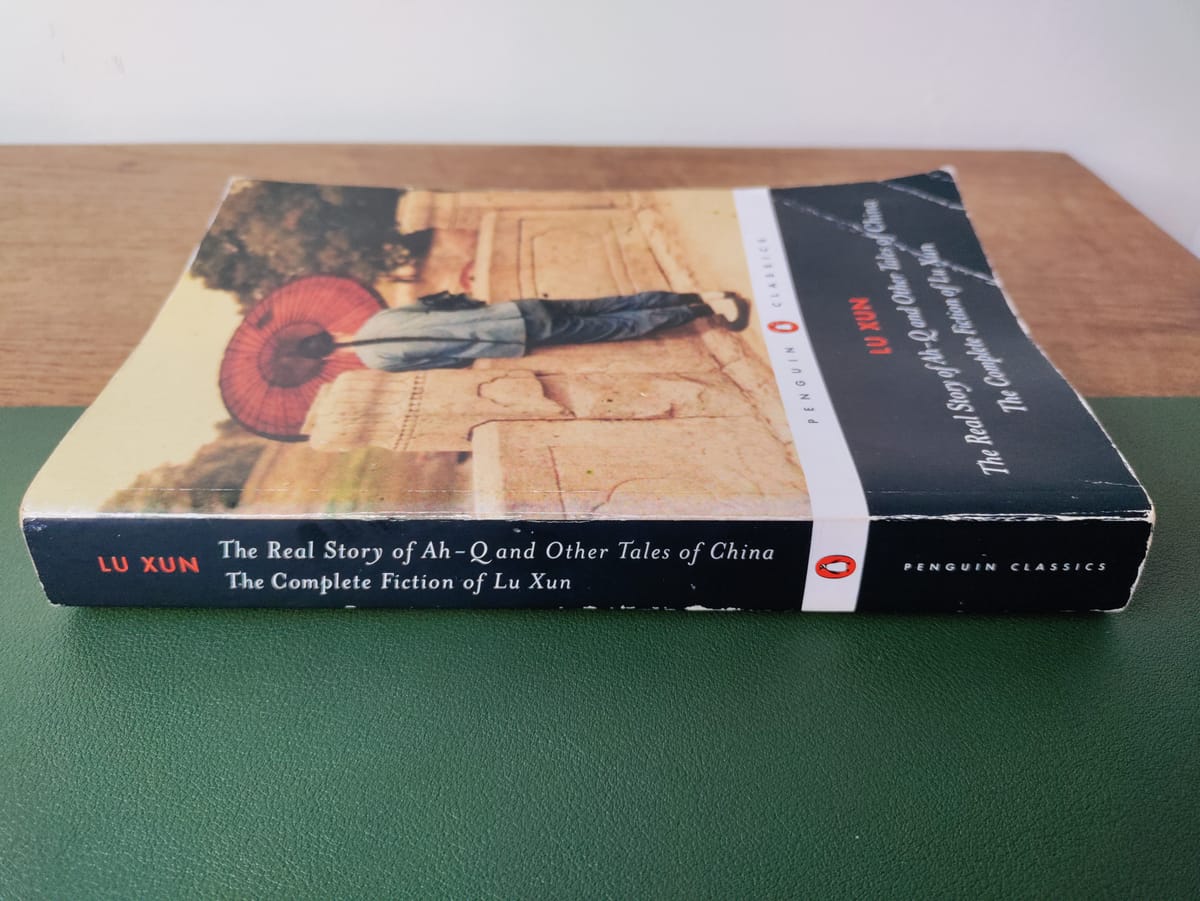
Nostalgia - Lu Xun
A reflection on Lu Xun's short story, 'Nostaligia' and what it says about how ordinary folk are impacted by the cycles of revolution and uprising.
Rebellion and uprising shakes the land. People flee, sheltering, evading, being consripted, ordered here and there under banners torn and burned as the great cataclysmic shiftings streak the skies with sulfur. The Mandate of Heaven is taken from a bony and weary hand and placed into a bloodied and mud stained hand. The rumbling and shuddering of the land pauses.
In Lu Xun’s ‘Nostalgia’, we learn about the effect of war and rebellion on the ordinary folk of the land. In the cycles of revolution and regime change, with much focus on the main characters on the political stage, it is easy to forget that nations and empires and civilizations consist of masses of people who are often voiceless.
The story opens describing the narrator’s difficulty with his teacher’s approach and the topic of learning, that of “suffering another lecture on The Analects” and other Confucian classics, which is interrupted by rumours of an approaching rebel army which in turn prompts the family’s gatekeeper, Wang, to recall the arrival of the Taipings (who are referred to as the Long Hairs as a result of them choosing not to shave their heads in the style of the Manchu Qing rulers) some years before.
Upon hearing this rumour, the teacher, Mr Bald, with his “bottomless education”, a man who “could have survived, unscarred, through any time, in any place,” is visibly worried as he gathers his belongings to make a departure. Lu Xun leaves no room for misinterpretation for his reader: the days are numbered for the Confucian class as we pass from antiquity to modernity.
Wang, however, has seen (and experienced) this all before. He serves as a point of reference for the narrator, contrasting to Mr Bald, and for Lu Xun he could be seen to represent true knowledge and learning, an “unschooled intelligence”, that which is rooted in experience and praxis rather than the bureaucratic and removed learning of the scholarly elite. The narrator decribes himself as “badgering” Wang “for stories of the mountain people," and he is clearly much more interested in the learning from these stories that the stagnant books of his teacher.
Wang is described as swapping stories with the narrator’s amah, Li: “and there they would sit, deep into the night, the darkness interrupted only by sparks from his pipe.” Lu Xun often deploys the imagery of light to represent progress and/or truth, such as here with the sparks from the pipe.
The rumour of the approaching rebel army is brought to them by the neighbour Yaozong, a hoarder of money, whom Mr Bald treats with “peculiar deference,” which the narrator believes to be due to his filial virtue, but may just as well be a kind of hypocrisy in the deference of the scholarly elite to wealth. Yaozong, his lack of intelligence described in the most scathing of ways, is said to have one quality: that of the “art of welcoming invading armies with food and drink” which he had learned from his parents. Yaozong, too, is contrasted to Wang, with Lu Xun presenting the scholarly and wealthy class against what we might term the serving class, or the mass of commoners, who would come to represent the vanguard of the Red Revolution in China. It is clear where Lu Xun's admiration lies.
The tension for the characters in the story stem principally from the recent events of the Taiping Rebellion (1850-1864), though can be read by extension to stem from the cycles of revolution in China. Wang is reported to have been 29 when the Long-Hairs came to “these parts”, suggesting how rural areas in China – or those a step removed from the various and ever-shifting capitals – were often secondary settings, or places where armies and generals passed through and recruited (sometimes with the promise of land, at other times with the threat of death). As noted, Chinese history is one of cycles, the ebb and flow of revolution and uprisings, the passing of the Mandate of Heaven from here to there, with frequent challenges to authority. More than any other civilization, Chinese history is one which clearly illustrates the cliff edge upon which the ruling elite stand. 'Nostalgia' addresses, in part, what it must feel like to be one of the ordinary folk on the edges of these momentous transitions.
Evidently there is concern amongst the villagers, though this concern is less apparent in Wang (even when recounting the potential for murder and pillaging). The narrator considers the “ant-like swarms of humanity” who gather their belongings and make their way to Hexu, whilst others make their way to Wushi, with no-one particularly knowing the best way to respond to the implied terror. For the ordinary folk, then, with their designated place in the hierarchy of society and the cycles of dynasty, times of uprising and rebellion are the periods which punctuate stability and peace, and the impact of this is a movement, a kind of uprooting. As Lu Xun has it:
“Since the great creator Pangu cleaved heaven and earth in two, unleashing tireless cycles of bloody chaos and orderly peace, dynasties have waxed and have waned.”
Compared to the Abrahamic faiths, the act of creation here contains no sensitive breath of life, but instead has an aggressive action, like a butcher with a carcass, and can be read in some ways to be an error, which does bring to mind the Abrahamic Fall.
In the shifts and movement that the rumours bring, we see Mr Bald, “my teacher,” hurrying off with his clothes but leaving the “multivolume crammers on writing eight-legged civil service examination essays.” When survival is the key matter at hand, the possessions one reaches for are far more instructive than those possessions piled-up in times of peace and prosperity. Lu Xun suggests that the Confucian order of ethics, for so long the guiding framework of Chinese society, had become useless in light of the changing world. This would come to pass in the coming revolution and short-lived civil war, with Confucianism suffering the most in the rising Red China.
While others, including Mr Bald, begin to panic, Wang and Li remain calmer in the narrator’s eyes. Wisdom and knowledge, and the fight-flight-freeze response to perceived threats, clearly have roots beyond textbooks and examinations. As the day passes, a “great crowd” gathers around Wang, “open-mouthed […] as if transfixed by some demonic creature.” Compared to the stale lessons of Mr Bald, Wang breathes life into his teaching (which is of course not presented as teaching, but as a kind of folk retelling): “back then” he opens, explaining his memories of the Long Hairs’ last visit.
He is interrupted by the return of Mr Bald, whom Wang dismisses respectfully, continuing his story, until Yaozong returns to the compound bringing news from his servants: the Long Hairs are actually refugees, he states. The panic is over, though there is no consideration as to what or where they are fleeing from, which implies that displacement and movement was a fairly frequent occurrence. Quiet returns to the compound and around the parasol tree, “leaving only Wang and a handful of others.” These are the members of Chinese society that represent permanence and deep rootedness.
For the narrator, the contrast between Mr Bald and Wang leads to another possibility:
“When the Long Hairs were about to descend on us, my teacher had left; the Long Hairs, I therefore reasoned, were a force for good. And since Wang was always kind to me, I further deduced, he must have been a Long Hair himself.”
Could it be that the rebels were actually a force for good? Wang dispels this quickly, explaining what had happened when he had fled to Mount Huang:
“My neighbour Niusi and two of my cousins weren’t so lucky. They got dragged out on to the Taiping Bridge, had their throats slit, then were pushed into the water and left to drown.”
The narrator is reminded that the threat was real, and that the reactions of fright and terror were understandable.
Wang’s recounting is interrupted for “bedtime”, but the boy wakes in his sleep, seemingly more disturbed by his formal education (“ow! I’ll work harder, I promise”) than the violence and unease of the rumoured rebels.
Mrs Li is beside him, also with bad dreams, though hers are linked to the disruption and violence of rebellion, illustrating that experience of the world does not necessarily lead to peace of mind, particularly where change and upheaval is concerned.