
Palestine - a Four Thousand Year History (Nur Masalha)
Nur Masalha outlines key evidence to refute the assertion that Palestine did not exist before the creation of Israel, or that it was a land without a people for a people without a land. In doing so, he examines what it means to be able to name something, and the implications of this privilege.
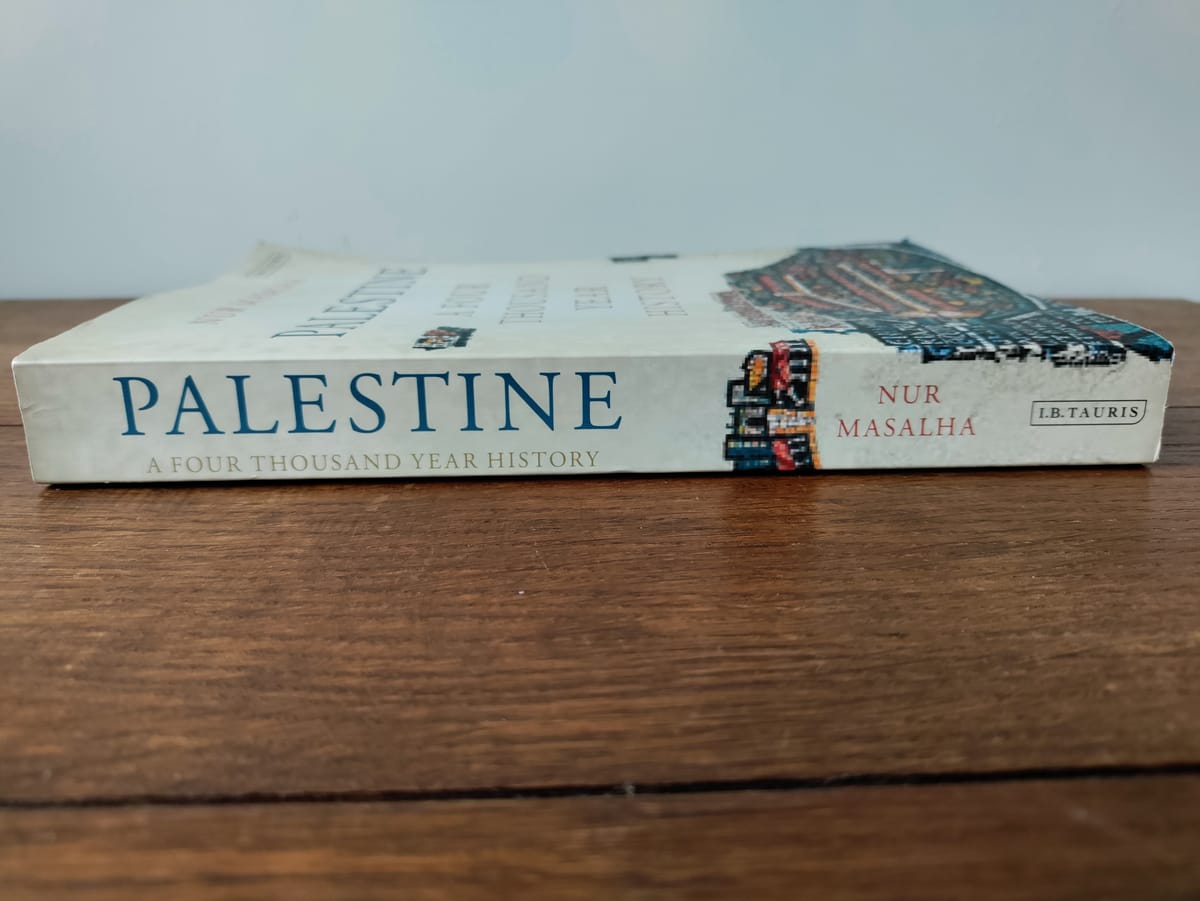
Nur Masalha’s Palestine: A Four Thousand Year History is a celebration of the land and its inhabitants over the stretch of recent human history. It is also a counter to the Zionist claim that Palestine was a kind of terra nullius, a “land without people, for a people without a land”. By extension, Masalha argues that “the legend of the Israelites’ conquest of Cana’an and other master narratives of the Old Testament (or Hebrew Bible) – a library of books built up across several centuries – are myth-based narratives designed to underpin false consciousness, not evidence-based history which promotes truth and understanding.” The view that Palestine was an empty or disused or neglected land, or that there was no such thing as a Palestinian people or organised polity or society, is still asserted by apologists for Israel. Masalha’s text contains key information to refute this line of argument.
Masalha outlines the history of the peoples of Palestine from the Late Bronze Age through to the Mandatory Palestine period (post-First World War). He evidences that the name of Palestine is found throughout the last 3,300 years, being referred to by ancient Egyptians, Assyrians, classical Greek writers, Romans, Christian Byzantines, and medieval Arabs. It is also asserted that:
“until the advent of anachronistic European political Zionism at the turn of the 20th century the people of Palestine included Arab Muslims, Arab Christians, and Arab Jews […] the binary of Arab versus Jew is deeply misleading.”
This dual framing – that of a land with a vast history of culture, literature, commerce, and geopolitics, as well as a land of diversity, of many faiths and polytheism – is important in the context of the dialogue over the ongoing conflict because it addresses a key assertion of apologists for Zionism: namely that Palestine was a disused land sparsely inhabited by backwards Arabs.
Masalha makes frequent reference to the fragility of the Zionist claim on the land of Palestine in terms of it being based on scripture, or myth-based narrative. Furthermore: “in this Orientalist-biblical discourse the local cultures of Palestine and Palestinians were presented as incapable of united action or collective memory […] the history of ancient Palestine has been ignored and silenced by the discourse of biblical studies, which has its own agenda: western scholarship has invented ancient Israel and silenced Palestinian history.”
This is a bold attack because it strikes at the heart of the Zionist project, going further, even, than the Zionism as a colonial-settler project arrow. The biblical narratives are, he writes, “literary imagination, adaptation, theology and officially sanctioned memory – not history.” He examines how, for example, there is no “empirical or archaeological evidence to substantiate or validate the Old Testament story” of the so-called Israelites in Egypt, as well as for the Kingdom of David.
Masalha proposes that there should be a recognition of evidence-based history rather than “officially sanctioned memory”. It is interesting to note just how many accounts and discourses on the conflict base the Zionist/Israeli claim on the Bible, and there is often a quick movement on from this point, without a pause for thought on whether the events of the Bible actually happened. There must be a reason for this. Perhaps there is an apprehension in stating that the historical claims made by the Bible are flawed, because if this detail is flawed then it calls into question the “word” of God and, in addition, the claims made by the leadership structures of the book.
Masalha also takes issue with another key claim of Zionism: that the Jewish people are distinct nation. Masalha references Maimonides (1138-1204), an important rabbi, philosopher, and scientist, who regarded the ancient “Israelites” not as a race or an ethnicity, but as a community of faith: the Jewish faith. We should ask, however, at what point (and with what other factors) does a community become a nation?
It is always interesting to note the social context of Europe at the time that Zionism was invented in terms of racial theories becoming popular, as well as ideas about Social Darwinism. Masalha writes that, “in contrast with the European Zionist settler-colonial project, which is based on old legends and new Social Darwinism – of Iron Walls and ‘survival of the fittest,’ the appropriation and erasure of indigenous heritage of the country, Palestine [has] survived across more than three millennia through adaptation, fluidity and transformation.” The settler-coloniser, he writes, “invades the space and appropriates the heritage of the locals.”
The focus of the text, however, is Palestine. Masalha is gracious enough not to overstate the flaws he sees in Zionism, which speak for themselves (increasingly so), and he moves quickly on. He notes that, unlike the six regional and neighbouring countries – Egypt, Syria, Arabia, Turkey and Iran – “throughout its history Palestine never produced empires or mighty imperial cities”. It was a key transit country from north to south, west to east. Palestine was “strategically located [and] managed to flourish culturally and economically and achieve a great degree of autonomy by relying largely on its soft power.”
This was a particularly interesting point of reflection for me as it is interesting to note that Palestine is placed in a position of geographic importance both in the present day but also in antiquity if we consider trade routes and the meeting of the “near East” to the “far East”, with the great empires and civilizations of Egypt, Greece, Rome and so on. It would be almost laughable (if the events of the past 100 years weren’t so abhorrent) to assert that the land of Palestine is lacking in history or culture when we consider the vastness and importance of the events taking place in the surrounding lands, with it proximity to the cradle of civilization.
Masalha spends some time considering the importance of naming a place; indeed a large portion of the text is spent on examining how the land of Palestine has undergone an intense renaming. This, he notes, is about staking claims, supporting the tactic of land grabbing, where “erasure” is enacted in order to construct identity (in this case, the national identity of Israel). There is also some time spent on considering memory, and “collective memory”, with some discussion on Maurice Halbwachs and Emile Durkheim in terms of evolving social memory in light of actual history. This is certainly a key issue, because as time progresses there is clash between more recent memories (or narratives) and more historic memories/recollections (and narratives). In addition, “an individual’s memories and understanding of the past are closely related to group memberships, ‘collective memory’ and group consciousness.”
At the present time there does appear to be – or there does feel to be – a pushing of narrative (from each direction, but also from the centre) in terms of what this conflict is. From my own perspective this appears to be a case of a nation state being implanted within an already inhabited land, supported by the great colonial (and imperial) powers of the day, with a steady cleansing/transfer of the indigenous population which, at its reaches its end goal, has only served to remove the mask from the great powers or supposedly advanced nations in terms of the rules within global politics. There appears to be a significant shift in the power balance of the world, with many citizens in the supposedly advanced nations coming to a realisation (or having further confirmed their belief) that they are the negative and abusive force within the world.
Herodotus (484-425 BCE) was the first historian to denote a geographical region of Palestine, and Masalha contrasts this to the myth narrative of the Bible. The historical reference to the land of Palestine goes much further back, however: “a cognate of the name Palestine, ‘Peleset,’ is found on five inscriptions as referring to the settlement of a seafaring people along the southern Palestinian coast from the mid-12th Century BCE during the reign of Rameses II and III.” It is also established that international trade between Palestine and Egypt dates back to the Chalcolithic Period (4,000-3,200 BCE).
Masalha notes how the Biblical Canaanites were not a specific people, but instead could be regarded as an ‘Other’ for the myth writers of the Bible, with the creation of an Other as literary or political device. For the Nation of Israel it is the Philistines who “have personified the intrinsically evil Other in the burgeoning narrative myth.” In addition: “the militant myth narratives of the Books of Joshua, Deuteronomy and Samuel have provided modern Zionist settler-nationalism with the muscular, militaristic and violent dimensions of the conquest of the land of Cana’an and elimination of its indigenous people.”
The classical Greek historians, Herodotus and Thucydides (460-440 BCE), in contrast to the authors of the Old Testament, “sought to separate myth from reality based on reasoned argument (logos)”. Herodotus, we know, travelled widely in the region, but he doesn’t mention Judea, or Cana’an or the Canaanites, or the Israelites. Masalha also makes reference to Aristotle and Ptolemy (and his world map) and the widespread use of the term Peleset as a geopolitical unit throughout antiquity. Then, during Roman rule of the region, and more specifically between 135 CE and 390 CE, Palestine became one of the provinces of the empire. The official Roman designation of the province as Syria-Palaestina existed long before the Jewish revolt of 66-69 CE, with Judea a part within this province.
Masalha then moves into the Christian era of Byzantine Palestine (early 4th to early 7th Century). The country consisted then of a mixture of Greek and Aramaic-speaking population, minorities of Samaritans, Christian Arabs, Jews and Nabataean Arabs. During this period, particularly from the 4th Century onwards, the “Holy Land – a nebulous, abstract and semi-mythical location – was transformed into a real country called Palaestina, with thriving cities, ports” and so on. The multifaith nature of Palestine is clearly a feature of the land, even during the centuries in which the Zionists claim that the Jews had been expelled.
Masalha makes reference to the Madaba Map, a floor mosaic contained in an early Byzantine church in modern-day Jordan, estimated to be made between 542 CE and 570 CE, which references the border of Egypt and Palestine, but makes no mention of Cana’an or Israel.
Masalha also spends some time considering Gaza, which was established more than 5,000 years ago and which is placed in an important strategic location, with an ancient port, and which was, for a time, ancient Egypt’s administrative capital in the region of Palestine.
From an Islamic perspective, Masalha notes that Palestine inherited the cultural, material, administrative and intellectual heritage of Byzantine Palestine. But, he writes, the “Arabisation processes in Greater Palestine […] long preceded the Islamisation processes in the country, although the establishment of Arabic as the lingue franca of Palestine went hand in hand with the Islamisation of the country.”
Under the Umayyad Caliphs, “the centrality and importance of Palestine and Syria […] remained paramount”. There was, Masalha writes, “a period of prosperity and religious toleration and religious and cultural autonomy.”
In more recent history, Masalha considers the emergence of the British Empire in trying to penetrate the Ottoman Empire (the sick man of Europe). This included various agencies and organisations committed to exploring the Holy Land. The main motive for “mapping the country as a whole was its strategic and geo-political important for the British Empire, which was then engaged in international struggles over the Middle East.” Masalha also explores how British figures aimed to “present European colonialism as a continuation of an ancient Jewish ownership of the land” and that this meant that “place names were […] fiercely contested.” Masalha spends a good deal of time exploring how place names within Palestine have changed and been renamed. This act of naming a place is vital – to name a place is to bring it into existence, and this is then reinforced through repetition, collective memory, and ritual, and once again we see the colonial hand at play at this time.
Masalha writes that: “until the advent of European Zionism in the late 19th Century relations among the Palestinians (Arabic-speaking Muslims, Christian and Jews) were peaceful and stable, forged by centuries of coexistence shared history and shared country.”
Often the most basic view of this conflict, or the most basic prism through which it is presented, is as some kind of Jew vs Muslim battle, which is quite simply flawed. It is interesting, however, to consider the role and perspectives of Christians who, for the most part, we would expect to agree with the Zionist claim that the Jewish people were the original inhabitants of the Holy Land, because they would necessarily need to believe, or assert, that the events recounted in the Old Testament are historical fact. There is also a specific strain of Christianity which believe that the Jewish return to the Holy Land, including the reconstruction of a holy temple, is a necessary prerequisite to the second coming of Christ, of Armageddon. These religo-political roots of British pro-zionism are explored by Masalha. We hear of Lord Shaftesbury, a crusading Protestant Christian Zionist who believed in the “End of Times” line of thought. It was he, interestingly, who coined the phrase “A country without a nation for a nation without a country”, which was to morph into “a land without people for a people without a land.”
We have seen in other readings how the Zionists were quicker to organise and make political moves, whereas Palestinian nationalism arose more in face of the apparent danger from the Zionist-settler activities, which commenced prior to the First World War.
Masalha establishes the links between Zionist settler-colonialism and European colonialism, noting how both regarded large parts of the Earth as terra nullius, and how they acquired lands through occupation and settler colonisation. This is also a key line of enquiry in Rashid Khalidi’s The Hundred Years’ War on Palestine. Masalha notes how “the creation of ‘political facts on the ground’ together with the instrumentalisation of cultural heritage is key to all modern settler-colonial projects.” We can view this as the process by which the colonial settler project changes the narrative over time, or, in a sense, inverts the narrative. For example, the indigenous peoples are attacked, and they respond in self-defence, but over time their self-defence is inverted and presented as an attack, and as the settler-colonial project (now established) reacts, this is presented as “self-defence”, the act of which in turn continues to subjugate the oppressed peoples, cleanse the land, or shape the discourses.
Masalha spends further time considering some of the British actions around this time, making note that Lord Balfour, as Prime Minister, passed the 1905 Aliens Act, the main object of which, Masalha states, “was to restrict entry into Britain of Jews from Eastern Europe.” There is an interesting parallel over the past century since Palestinians became displaced, with many/most becoming refugees in neighbouring Arab lands (such as Jordan and Syria), and how we often hear people asking why the neighbouring Arab nations don’t take the Palestinians in, or do more to support refugees? If it were only so simple, both from the perspective of the displaced, but also the “host countries”. It would a pleasant solution for the establishment of Greater Israel (and its colonial/imperialist chums), but we would be forgiven for thinking hat the issue would remain unresolved.
We can view Masalha’s text as an attempt to reclaim a space for the Palestinian voice in the historical sphere, attacking the very cornerstones of the Zionist ideology, namely the ancestral right or claim by the nation state of Israel to Palestine, as well as the idea that the land was uninhabited or being used inefficiently. It is also to claim a voice for the Other within the western discourse.
Masalha makes reference to Edward Said in terms of the representation of Islam in the west which, he notes, is “an important part of the question of Palestine because they are used to silence the Palestinians, the majority of whom are Muslim.” We can certainly see how, in the west, the perception of Muslims and Islam in the public sphere (which is impacted by the representations of Muslims and Islam in the media), is often negative. It appears that the demonisation of Muslims/Islam is an important reference point for many politicians also, and it would be interesting to see if there are any studies on the links between how Jewish people have been historically mistreated and demonised in Europe, and how Islam is currently being portrayed in the west. Whilst there doesn’t appear to be the same level of violence committed against Muslims in the west (on western soil, that is, because we could argue that Muslims living in Iraq, Afghanistan, Iraq, Syria, and other nations have had violence committed against them by the west) than we have seen being perpetrated upon Jewish people in the west, but we might wonder if this is building up to more violent outbursts towards Muslims/Islam in the west (on western soil), or whether we are missing a key element in the sense of the violence brought to Muslims/Islam by the western powers in other lands?
Masalha continues to explore the idea of renaming and of creating. Many important Zionist figures and early Israeli figures renamed themselves, such as David Ben-Gurion (originally David Grün, 1886-1973). Perhaps the most amazing aspect, or even the most praiseworthy aspect of the Zionist project, was the creation of a language by Eliezer Ben-Yehuda (1858-1922), who believed that “there are two things without which the Jews will not become a people: the country (Palestine) and the language.” He created a new, secular language. This seems to me to be quite an achievement, and I largely admire this undertaking, particularly if we consider the experiences of the Jewish people at that time (and at other times in European history) – taken at face value this seems admirable and brave. It becomes less so for me when we consider the literal implications of the taking of land and actions against the indigenous people, but creating a language as a way of unifying is a superb move, a Tolkienesque undertaking. Masalha notes that this is both self-invention and self-indigenisation, and this went hand-in-hand with the renaming of places. “Zionism reinvented Judaism and translated Jewish themes into political action.”
An interesting path to take following this is to consider how much Zionism aligns to the true beliefs and aspects of Judaism? We are sometimes/often told that Israel is a Jewish state, and without some background context this seems straightforward, one of those pills that passes down the gullet without a second thought. If it is indeed a Jewish state, why are many Jewish people opposed to their practices, and why do many Jewish people reject the shackling of their faith to the Israeli nation-state? But this is murky territory for me to comment on, and I think more reading on the Jewish perspective (and indeed dialogue with Jewish people) is needed to consider this in clearer detail.
Masalha makes reference to the Book of Joshua as being of extreme importance to modern-day Israel, so much so that it is required reading in schools. To be fair, there are required readings in the British curriculum, but this doesn’t necessarily mean that children in British schools are being indoctrinated in extremist views (though there are certainly some who may take this position). There is a big emphasis, for example, on British war poetry, which someone might argue is meant to romanticise conflict and the past “glory” of the British Empire; we could just as reasonably argue the opposite, however. The delivery of the curriculum is important to consider: do children in Israeli schools (in the occupied land of Palestine) have an opportunity to subjectively analyse and critique the Book of Joshua, or is is delivered as straight-up fact without any passing thought?
Masalha notes that the Book of Joshua sets a “narrative of conquest as a precedent for the establishment of Israel as a nation.” We once again return to the fragile basis of Bible as historical fact. Masalha writes that “although the account of the Israelites’ enslavement in ancient Egypt as described in the Book of Exodus is generally recognised as a myth, in Israeli schools and universities this is treated as actual history.” At which point this become rather more sinister: we are forced to consider how a leadership group sculpts its system in order to indoctrinate its citizens. I speak as someone raised in the UK, which for a brief time was considered the pre-eminent world power, so here is a great deal of indoctrination and myth in the society around me, including glorification of the past (despite what we might refer to as misdemeanours), and with any criticism of the gloried past seen as suspicious.
But perhaps each nation has this? Perhaps the idea of each and every nation is held together by a belief in the mythology that holds the invented borders (and the myriad peoples within it) together? We can state the same to be true of both Palestinians and Israel. What strikes me is the context of belief for both Israel and Palestine, and how the One was created in spite of, and to the great great detriment of, the Other, and how each identity is shaped and continually forged in the ongoing events. Their existence is partially dependent on the other, at least for the moment; if one falls, or is transported elsewhere, or is voiceless, does the other suffer in turn? What we can say, however, is that there appears to be a very real prospect of one of the parties being permanently displaced, abandoned, transported elsewhere, exiled, perpetually disaffected.
But these are just reflections, and these reflections shift. What is most striking about Masalha’s text is the assertion of the “limitations of the Bible tradition” in terms of historical fact (which, in turn, weakens the Zionist claim of ancestral rights). Masalha writes that “more and more archaeologists and Biblical scholars are convinced that the ancestors of the Israelites had never been in Egypt and that the biblical paradigm of a military conquest of Cana’an as completely fictional.” In our current age we are often able to access information direct from source rather than it being filtered through traditional news outlets and their methods of programming (though we could say any every source of information may be compromised in some way). With this in mind, we could say that more and more citizens around the world, both in the so-called developed world and in the so-called Global South, are becoming aware of the lie that is the state of Israel (if we were being a little cheeky we could refer to it as “the abomination which causes desolation”), not to mention its lurching benefactors and suppliers of arms.
In the UK, we (my generation as well as my parents’) were raised to consider the First and Second World Wars to be a great stand of the objectively Good (the Allied Powers) versus the objectively Evil (in terms of the Axis Powers and Fascism). This assertion was closed as a debate when punctuated by the horror of the Holocaust. Who could possibly take the position that the Second World War, in particular, was anything other than a moral battle? Who could argue that some of the British (and Allied) actions were unjustified, even though there were uncomfortable actions too, such as mass bombings of civilians, and atomic bombs being deployed? Now, however, the UK, the USA, Israel, and other states and entities aligned to them, are being discussed as malignant and destructive forces in the world. All the propaganda that is inherent in their systems has lost its allure and programming power, though it must be said that there are still plenty who stray away from the topic of Palestine, or who dismiss it as a Non-White problem, or who continue to largely be sated by the bread and circus (both of which take an ever greater slice of the wage pie).