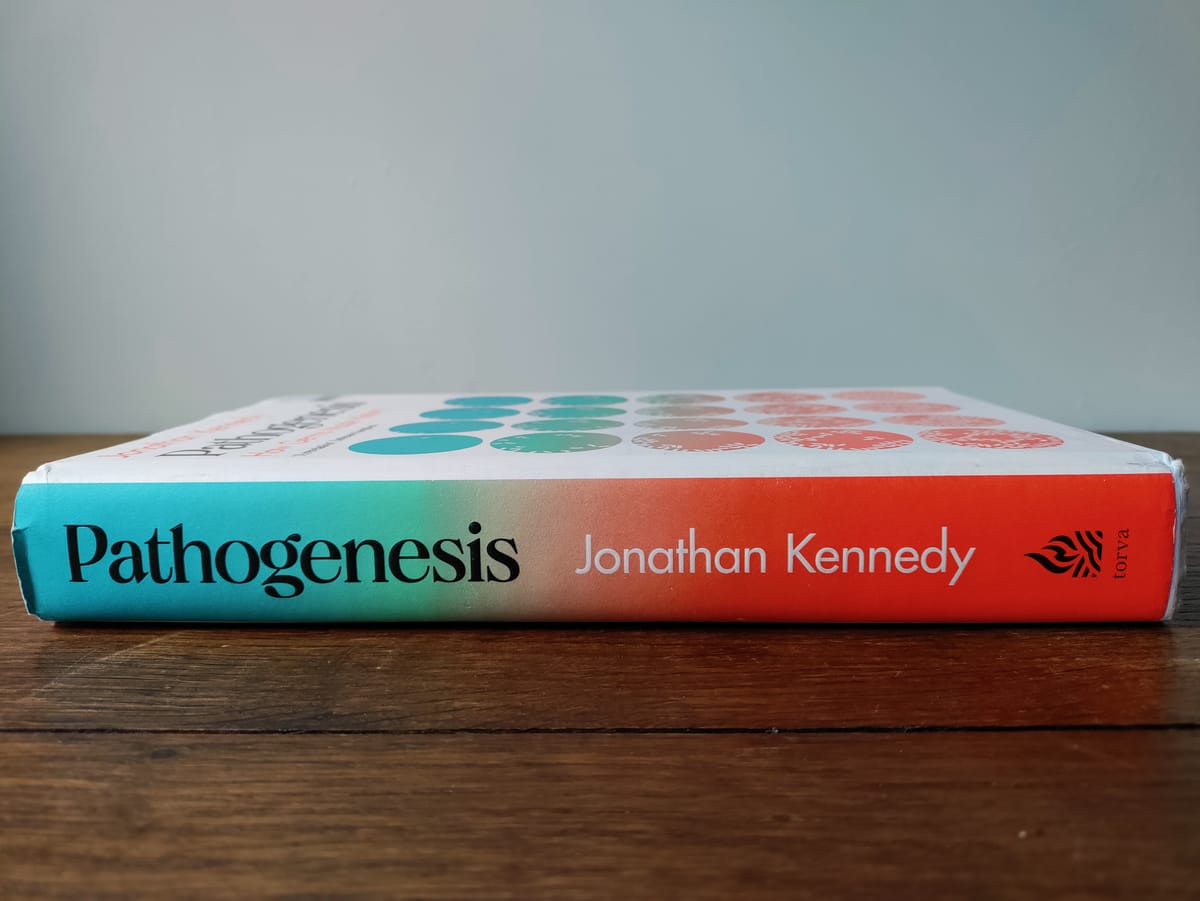
Pathogenesis (Jonathan Kennedy)
Jonathan Kennedy explores the impact of bacteria, germs and disease upon the histpry of Humanity.
I recall that in the days leading up to the birth of our first child, and indeed in the years after the birth of that beautiful Dodo child, we received a wide range of advice on, and recommendations around, the raising and rearing of children. This came from family, from friends/acquaintances, and even from complete strangers. Some of the advice was contentious, such as the so-called “cry it out” method in the topic of sleep-training, whilst other advice could be regarded as pretty well-established and reasonable, such as having skin-to-skin contact to develop attachment, or plenty of eye-contact and welcoming facial expressions and smiles. One piece of advice which sat somewhere in the middle of the spectrum was around germs, specifically around not being overly cautious of the baby/infant being exposed to or coming into contact with germs.
It must be said that within the advice there is a spectrum. Who could argue that it would be foolish to allow a baby to crawl around, or handle, dogshit? But we can concede that our immune system may be made stronger at times by exposure to germs, and this was about the range of my understanding around germs prior to reading Pathogenesis, with my main practice being to avoid directly touching handles in public toilets. (Whilst I have habitually used a tissue to create a barrier between my hand and public toilet handles for two decades or so, I do acknowledge that any public handle or surface could have a virus on it which may cause harm.) The dodo child was born two or three weeks prior to the Covid pandemic taking flight, which led further to an ultra-focus on germs and fear and change within society.
The spread of viruses, and their impact upon human history (including at significant turning points) is the focus of Pathogenesis, which Jonathan Kennedy approaches from the macro- to the micro-level, both in terms of our own perspectives (that is: from considering the cosmic above to the quarks within), and the history of Earth, archaic humans and Homo sapiens, civilizations to nation-states.
There are three main domains of life on this planet: Archaea, Bacteria, and Eukarya, which all share a Last Universal Common Ancestor (LUCA). All animals, plants and fungi are part of the Eukarya branch (these are organisms whose cells have a nucleus in which DNA is stored, and which are powered by mitochondria), whilst Archaea and Bacteria are single-celled (prokaryotic) and lacking a nucleus. In terms of the main inhabitant of our planet, incredibly Eukarya amounts for less than 0.001% of species (though Eukarya has a collective global biomass larger than prokaryotes, with plants contributing a significant amount to this). Taken another way, despite the seeming abundance of animals and plants, Bacteria and Archaea are overwhelmingly the dominant life form on Earth.
A virus is an organism/agent which consists of genetic material (DNA or RNA) coated in protein. They enter/infect the cell of a living thing (that is, all life forms, from animals and plants to bacteria and archaea) and then produce copies of itself. When they are outside of an infected living cell they exist as viral particles (and can reside on, amongst other things, toilet door handles).
Kennedy notes that our telescopes have turned from aiming above to aiming below (and within) through microscopes to the micro-world, which we are continuing to learn about and which, as he outlines, have a significant impact on our personal existence (such as bacteria within the gut, which impacts on brain functions), as well as our collective existence, such as with the rise and fall of civilizations. This latter part of his argument is quite the leap, but at times he argues it convincingly, approaching this study through a multi-discipline lens that draws on the major sciences as well as sociology, history, anthropology, literature, philosophy and ethics, and psychology.
Broad strokes of prehistory position our understanding of existence and the formation of life, such as The Great Oxidation Event, when cynobacteria (blue-green algae) used the sun’s rays to power photosynthesis, which in turn pumped oxygen into the oceans and the planet’s atmosphere, which in turn cooled the planet so that sea levels fell and land emerged.
Kennedy addresses controversial areas and topics, such as the idea that the cognitive revolution of Homo sapiens took place in western-Europe, which is labelled as ‘Euro-centric’ for placing France and Germany as prominent sites of our development. In addition to this, we also have discussion on our distant cousins (or archaic humans), such as Neanderthals and Denisovans which, we now know, Homo sapiens came into contact with over periods of time across the globe, including mating, which in turn meant the exchange of DNA. This DNA was crucial in helping Homo sapiens to adapt to new pathogens that they encountered following the migration(s) out of Africa – though as Kennedy notes this was less a migration out of Africa but a constant coming-and-going over a long period of time, which is also a riposte to the idea that Homo sapiens continued to evolve (or improve) in stages as they spread across the globe.
Following this we have an interesting take on the first agricultural revolution. This is generally accepted as giving rise to civilizations in the sense of (broadly speaking) settled agricultural communities benefiting from food surplus and storage which allowed for division and specialisation of labour (and therefore social hierarchy). Kennedy considers whether this can be considered a mistake, as this also led to despotism, inequality, poverty, and work. The neolithic (new stone-age) hunter-gatherer-forager diet, which, although less assured, was highly varied, and is contrasted to the settled agriculturalist, which was vulnerable to bad harvests and famine, which in turn led to malnourishment and weakened immune systems. In addition, in settled communities and societies people were more closely populated, living closer to domesticated animals and parasites, and were therefore more exposed to pathogens. This is an interesting take on what we view to be progress and advancement, and today there are plenty of recommendations around the benefits of certain diets or approaches to sustenance that draw less upon an agriculturalist approach and more upon a foraging, variation approach (including fasting).
Alongside Pathogenesis I read Superior, by Angela Saini, and it was interesting to note how the two authors address the issue of ‘race science’. The evidence presented here, for example, proposes that people of European ancestry are a mixture of three genetically distinct groups: western hunger-gatherers, such as The Cheddar Man (more on this in Superior); Neolithic European farmers, such as Otzi the Iceman; and steppe herders. This feels to be fairly sticky territory in terms of whether we start to consider human-beings (and “races”) as being considered genetically distinct, though each of these would be classed as Homo sapiens. As we learn from Superior, there is troublesome faction of populist politics and academia focused around race science and difference which is rooted in the study of genetics (and Eugenics, which was forced to retreat and sanitise its edifice following the second world war).
Kennedy’s text is accomplished and ambitious in terms of its breadth, with many periods of history and civilization covered. For example, the historical lens moves from our species’ prehistory to Ancient Greece on to the Roman Empire, to feudal/medieval Europe and through to the age of colonialism. Kennedy explores the Eurasian landmass through the Mongol Empire (and the Mongoal Yuan Dynasty of China) which facilitated trade along the continent which also aided the spread of plagues, with a series of epidemics in China from 1331-4 and 144-6, reducing the population from about 125 million at the beginning of the fourth century to 65 million at the end (with the additional impacts of wars and floods also). Kennedy considers the progress made more recently by China in terms of approach to tackling infectious diseases, going as far to state that there are “policy lessons” for the rest of the world, both low-income and rich ones.
Following the decline of the Roman Empire, a feudal society emerged in western Europe in which Lords and knights ruled over the countryside from their castles – this in turn discouraged technological innovation, with the Catholic Church brutally suppressing dissent in order to enforce social hierarchy and privileges. The so-called Black Death, for Kennedy, is a trigger for social change, as people (all people, from castles to countryside) suffered and died. About 60% of the European population died in the time between 1346-1353, and the pestilence returned every few years for much of the 14th and 15th centuries. This in turn ground the economies, or the feudal system itself, to a halt. (An important detour is taken by Kennedy to outline how Jewish communities were scapegoated, blamed and persecuted; a sad theme that we see throughout European history.) The Lords’ economic situation was considerably worsened as there were fewer serfs to provide and produce labour.
Following this, the expansion of the Ottoman Empire disrupted the established trade routes between the far East and Europe which in turn compelled Spanish and Portuguese “adventurers” (a jaunty term for pirates and privateers) to seek new ways to reach the Indies. This led us to the age of colonialism, and what a wonderful age that proved to be.
I found the approach taken to examining this age, which includes the transatlantic slave trade and the movement against colonialism, and specifically the amount of time dedicated to the Haitian Revolution, encouraging. We have the perspectives of both colonisers and colonised as well as those of the enslaved (and those who are freed and who free themselves). Kennedy argues that the European (Conquistador) conquest over the Americas was the result of the introduction of Eurasian pathogens to the New World rather than the perceived advancement of the conquerors (or of them having been ordained by a higher power). Kennedy engages with and challenges a well-established argument that the New World was conquered as the result of Guns, Germs, and Steel. The Old World pathogens, Kennedy asserts, did far more damage to the indigenous population than animals or weapons or ideas or social organisation. Astoundingly, the indigenous population of Mesoamerica was around 20 million when Hernan Cortes arrived in Santo Domingo (modern-day Dominican Republic), capital of Hispaniola, in 1504. A century later this had reduced to 1.5 million.
The Spanish crown were in a unique position to reap the proceeds of this so-called New World but, according to Kennedy, they spent this on a series of ill-advised wars within Europe. Whilst this was going on, England had turned its “stagnant feudalism” into a “dynamic capitalism”, and they in turn became the main power of colonialism.
The impact of Old World onto New World (in terms of pathogens) is contrasted with the question about why the colonisers (such as Portugal) were not able to conquer and subdue western Africa and into the “interior” of Africa. This was unsuccessful, Kennedy argues, for reasons similar to the Spanish “success” in the New World: trade routes between Eurasia and Africa were long and well-established, hence pathogens were less impactful. In turn, however, diseases such as yellow fever and malaria prevented European advancement in Africa – this led to the idea that tropical/interior Africa was all but unconquerable, as well as giving it the name “the white man’s grave”.
And so we move to the age of slavery. As Kennedy has it, slavery is an extension or “progression” of the domestication of animals to unfortunates within society. The uniqueness of the transatlantic slave trade, however, was that this appears to be the first time a racial element was given to enslavement. As we learn in Superior, the path here leads to the necessity of the idea/creation of race: that is, race as we know it is a social construct used in order to justify X, Y, and Z (insert your own definitions); that race in itself is an attempt to classify and order into a hierarchy, and we could even take this further (just to be a little controversial) and say that the Abrahamic faiths (or certainly Western Christianity) welcomed and encouraged this classification and ordering because being chosen and set apart is fundamental to their systems of thought/indoctrination. At the time of writing the ongoing feud in the so-called Holy Land has intensified, alarmingly so in our current age of (dis/mis)information, entrenched positions, and dulled critical thinking.
Nevertheless, Kennedy notes that there was a key element motivating the slave trade: west African people were regarded as ideal workers in the New World as they displayed a resilience to disease. There is an interesting contrast between North America and the other parts of the New World in terms of the success of the colonies (and the success following their independence) – this is actually sometimes framed in terms of race, with the United States of America’s success indicative of the power structure (and racial type of their leadership and majority), as opposed to states such as Haiti and others. Kennedy outlines that this can explained by northern America being more settled in terms of colonial plots, with Europeans moving with their families to settle, whereas in Haiti, for example, the aim was short-term stay for maximum profit – this in turn was reflected in the sickening brutality and violence (even considering the brutality of the north American system and approach). For the horrors of Haiti, Kennedy notes later, we can also see the Belgians’ approach to the Congo in the 19th Century.
Importantly, the Haitian Revolution is seen as the main driving force behind the abolishment of the slave trade, rather than the glossy, pre-packaged, ultra-processed explanation we are given in terms of an act of love of brave European abolitionists. This is an overlooked area of learning in the mainstream education curriculum because the Haitian Revolution is important not only in terms of the impact upon European powers (and the impact of the French Revolution upon the leaders of the revolution, not to mention the United States of America), but also how this leads into the latter age of colonialism within the context of the colonial powers (the British, for example, greatly benefiting from a weakened France), industrialisation, and then into the world wars and postcolonialism.
CRL James’s The Black Jacobins will be a future area of study, so we will leave the summary of the text at this point, but it is important to note a link Kennedy establishes between the Victorian industrialised society to the feudal society in terms of the relationship of rulers to masses in that the economic growth, in the absence of strong state intervention, enriched only a small elite but resulted in disruption, destitution, diseases and death for the masses.
There is plenty to admire about Kennedy’s text, and I am very pleased that Mrs Dodo took a chance and bought this hardback edition from a charity shop for £1.50. I will more than likely re-read this in the next year or so because there is much to learn from it.
Things to pass on:
- The events of of history, and indeed of our own lives, are the flicker of a candle flame amidst the thick midnight of a long-forgotten grove. There is much outside of our control, and one of the main tools at our disposable is our process of reflection.
- Empires, civilizations, and world powers are impacted by randomness as much as internal/external individuals, groups, and events. There is only so much planning and geopolitical strategy one can do. The same might be said about our own personal lives (in terms of planning) - there are times when you simply must live for the moment.
- Life on Earth is all connected, despite our ongoing attempts and need to compartmentalise and label and classify. Perhaps most importantly, human-beings are one species, not a collection of races, and we live within systems and hierarchies where creating and enforcing difference and oppositions is a means to subjugation (chains which are both physical and mental) and control. Divide in order to rule, as it goes.