Persia (Lloyd Llewellyn-Jones)
Lloyd Llewellyn-Jones, lamenting the corrupted Greek lens of history, aims to give a Persian version of accounts in order to present the empire with a more stable hand.
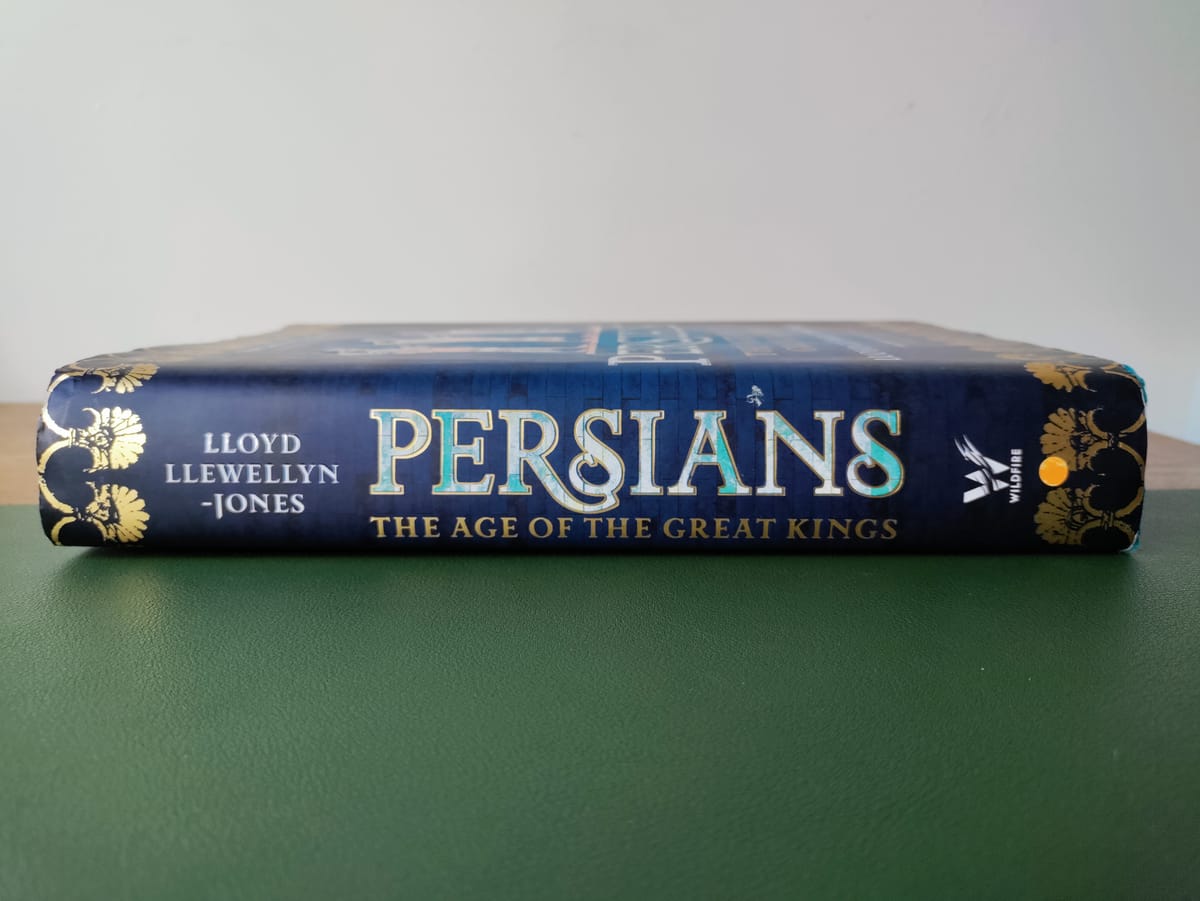
Depending on where you live in the world, modern-day Iran is sometimes viewed as an antagonistic pariah state which harbours and aids “terrorist groups” and enforces social oppression upon its people. It is also the land of the Persian Empire (also known as the Acheamenid Empire) which, for Lloyd Llewellyn-Jones, has been miscast as a barbaric empire. This is in part due to the empire being seen in the so-called west through ancient Greek accounts, as well as through the lenses of modern-day and 19th century imperialism and orientalism. He seeks to redress this by focusing on genuine, indigenous, ancient Persian sources with a specific focus on 1,000 BCE to 330 BCE, the point at which Alexander of Macedon arrives.
From the outset he maintains that the Persians were not barbarians. They made possible the first East/West continuous contact, an international dialogue on the vast Eurasian plateau. They were “enlightened despots,” and their empire was multicultural, with Darius the Great using the term vispazananam (or, King of the Countries). They ascended from a “miniscule tribal territory" in Fars or, in old Persian, Pars, or Parsa, which was heard by the ancient Greeks as Persis. It was in 1935 when Reza Shah, first ruler of the short-lived Pahlavi Dynasty (1922-1979), opted for the name Iran.
Llewellyn-Jones notes that Western imperialist discourse has represented the ‘colonies’ and cultures of the Middle Eastern world in a way that would justify and support the west’s colonial enterprise (and he draws upon the term Orientalism to support this). In this framework, “the Orient” is an invention, and can be shaped to suit the discourse and decisions/actions of the western imperial powers. The narrative(s) and fiction(s) of history are one of the key threads in this account, and this is an important reminder that all historical accounts are an interpretation, and we must be wary of bias and intent when considering historical sources.
We had no access to genuine Achaemenid-period textual sources until 1837, when Henry Rawlinson of the East India Company finished a copy of the Bisitun Inscription. The Persians up to this point had mainly entered the discourse through the Old Testament and classical Greek and Roman sources. The Greeks, Llewellyn-Jones writes, were “obsessed with their powerful neighbours”. In a sense, he notes, the opposition helped to mould Greek self-identity, and he argues that there was a lot of denigration towards the Persians, using the images and messages presented on the Eurymedon Vase to support his argument.

During the European Enlightenment, “intellectuals began to theorise as to why the West had become so dominant in the world order and had been so successful in the spread of white civilization.” This led to a radical theory: they were the inheritors of the ancient Greek tradition which had in turn been passed down from Rome. Charles-Louis de Montesquieu, speaking in the terms of his circles and in his day, stated that liberty was intended for the genius of European races, and slavery for that of the Asiatics.
Lord Curzon, seeking to impose empire across the world, felt bewildered that “the normal Asiatic would sooner be misgoverned by Asiatics than well governed by Europeans.” He was a “successful product of the locus classicus of a distinctly British form of philhellenism: the English elite public-school system,” which were “factories of privilege” where Ancient Greece was considered a cornerstone and blueprint. This has led, Llewellyn-Jones argues, to a “series of damaging premises and a harmful conclusion – that classical Greece was an exceptional moment in world history and that the West had unquestionably benefited from being heir to Greek culture.” He further argues that “this perverse understanding of a hierarchy of cultural competence” is “still propounded".
The presentation of the Persians, then, also draws to mind the “Yellow Peril”, not to mention how migrants and refugees are presented as dark brutes and invading hordes, whereby the Other is positioned as intruder and enemy, the antithesis of what the West is supposed to mean and to stand for. But the Persians, writes Llewellyn-Jones, were never out to “destroy democracy”. For example, many Ionian Greek city states continued to practice their so-called democracy under Persian rule, and the “most oppressive freedom-denying slave state of antiquity,” Sparta, was not defeated by the Persians. This is an important reminder that when we hear the word ‘democracy’ in dialogues today we need to consider whether it is being applied in the correct way.
“Since the end of the Greco-Persian Wars,” Llewellyn-Jones argues, “the Persians themselves have been at the receiving end of a historiographic smear campaign in which they have been cast as the tyrannical oppressors of the free world.” This is certainly true today in some western theatres, including the theatre of the Middle-East, where both The United States of America and Israel, as well as their ally Saudi Arabia, are said to be direct opponents of Iran.
Returning to the way we access a more accurate account of the past, Llewellyn-Jones notes that Persian history was mostly transmitted through songs, fables, and legends. This was a “performed history”. He concedes, fairly enough, that the “Persian Version” of history projects its own variety of historical spin. Darius the Great, for example, ran a “well organised and effective propaganda campaign and commissioned inscriptions and images less to inform than to persuade.” This invites us to consider to what extent we can trust any historical source, which is one of the foundational skills or considerations of the historians’ discipline. Even today, with the amount of information circulating around the obelisks of our mind and the thousands of plinths in the piazzas of society, a key skill is around discernment (or discernment as much as is possible). We can ask: what can we really say about ancient history? in the same way that some people ask: what can we really say about the moon landings, the assassination of JFK, or 9/11? Whilst some degree of scepticism is appropriate, one discussion point is at what point do we draw a line when considering a particualr event (or set of events)? Which narratives do we need to engage with, to unpick, to scrutinise, and which (if any) can be taken at face-value?
Llewellyn-Jones does not look to present the Persian Empire as a faultless and equal society. He concedes, for example, that the Persians were at time merciless, especially when “crossed or challenged”. We can say that this describes not only empires and civilizations, but also Humanity in its entirety.
For the Persian Empire, there was no slow process of decline and fall; it was instead swift and totally unexpected following the conquests of Alexander of Macedon in the late 300 BCE. Their longevity was in part due to the fact that the Achaemenid family never lost its exclusive hold on kingship, with no opposing dynasts, though as we shall see they were never able to solve smooth succession which led to a great deal of trouble for them.
Having taken up the weeds and cleared the path of stones, Llewellyn-Jones begins the narrative outline outline in 5,000 BCE with the nomadic tribal peoples of Central Eurasia, where we could find pastoral migrants whose life was their cattle and whose enemy were cattle raiders. They were known as Aryans, which is also the etymological source of ‘Iran’. Arya originally meant “hospitable,” “noble,” “household,” or “lord”. These proto-Iranians spoke Old Avestan, a sub-branch of the Indo-European family of languages and a sister of Sanskrit. These Eurasian horse nomads and their Persian descendants were masters at shooting with bows and arrows from horseback, a theme also noticed in the history of the Turks of the Ottoman Empire and the Mongols of Chengghiz Khan.
For this group of people, horses were the symbol of status and wealth, connected to the tribal ideology and the model warrior image. Some of them became Bactrians, others Sogdians, and their terrain extended south to the Iran/Afghanistan border as Arachosians, Areians, and Drangians, whilst further into the Iranian plateau we also had the Parthians, and Medes. Within the western Zagros mountains we find the Persians. Peoples had settled in the Iranian plateau long before, perhaps as long as 10,000 BCE, including the Elamites. They had fought fiercely for autonomy, especially against the Assyrians and the Babylonians.
A pastoral life of herding, then. And ther seemed to be quite a separation of gender roles. Until they were 6, for example, Persian boys were raised around the women and girls. They barely saw their fathers or other adult males who, it is inferred, were out hunting or scrapping. As a result, boys had many aunties, and many nurses.
The main protagonist and founder of the dynasty was Cyrus the Great, who emerged around 600/590 BCE. At this time, the dominant power of this region was the Median kingdom, centred in Ecbatana and led by Astyages. They began encroaching on the Persian land, so Cyrus gathered the support of Pharnaspes and married his daughter, Cassandane, of the venerable old house of the Achaemenids. At the Battle of Pasargadae, Cyrus was victorious. He marched on to Ecbatana. Despite his victory over Medes, he chose to put them on an equal footing, routinely appointing them to high office throughout the Achaemenid period.
One brother-in-law of Astyages, the wealthy Croesus of Lydia, who had funded the construction of the Temple of Artemis, attacked Persia after consulting the prophetess of Apollo: “If Croesus goes to war” she declared, “he will destroy a great empire.” The irony here of course being that it was his own empire that was destroyed. He was defeated in 547 BCE and then, when Sardis fell, the Ionian coastal cities fell too. They accepted Persian hegemony and offered tribute. In turn, they were allowed a form of self-government.
In 539 BCE, Cyrus took Babylon, “antiquities only metropolis,” which was “unrivalled in the ancient world for its splendour.” In turn, the Babylonian exile “transformed the Judeans into Jews,” writes Llewellyn-Jones. “From being just one of many captive peoples, they emerged as People of the Book. From one of many nations doomed for destruction, they transformed into histories perpetual survivor.”
For Cyrus’s generosity towards the Jews he received the accolade meschiah, that is: messiah, or anointed one. “While Yahweh acknowledged that Cyrus did not recognise His divine authority, He was still moved enough by the Persian king’s virtue to make him a messiah for the Hebrews.”
Cyrus’s empire was “founded on bloodshed, as all empires invariably are,” and the “expansion of the Persian empire was a military exercise.” Llewellyn-Jones notes the Cyrus Cylinder (currently held by the British Museum), which he describes as “the greatest PR document from antiquity […] a masterpiece of propaganda”, which Shah Mohammed Reza Pahlavi dubbed the “first charter of human rights.” This is contested, including by Llewellyn-Jones, though the text of the Cylinder does appear to frame Cyrus as tolerant of cultural and religious diversity.

In 530 BCE Cyrus named his son Cambyses as his formal successor. Cambyses undertook a series of marriages, including to full- and half-sisters. Llewellyn-Jones notes the “first attestation of the importance the dynasty laid on endogamy – the notion of marrying within a specific social group or caste.”
It is here that Llewellyn-Jones returns to take issue with how the Persians are presented, noting Herodotus’s account of Cyrus’s death which Llewellyn-Jones regards as a form of composing an “elegant logos” of the “overreaching imperial ambitions of the kings of Persia.” In addition, Cambyses, who conquered Egypt, is presented by Herodotus as a crazed despot.
In 526 BCE, the Greek mercenary soldier Phanes of Halicarnassus was brought in to advise on the Persians' mission into Egypt. He recommended going through the Sinai Desert, enlisting support from local Arab tribes for safe passage. Cambyses augmented his troops from across the empire, and in 525 BCE their navy made a rendezvous at Akko on the Palestinian coast and made their way along the shore to the Nile Delta. The army simultaneously marched across the Sinai Desert, and by the summer the whole of Egypt, from the Nile to the cataracts of Aswan, had been brought under Persian rule.
Like Cyrus, Cambyses appealed to the local population through pageantry, religious ceremonies, and “ostentatious propaganda”. He permitted freedom of worship, freedom to trade and barter. He then went south into Kush, “a place long exploited by the colonising Egyptians for its rich resources of gold.”
Reports of treason and conspiracy back home led him to return to Persia, where his brother Bardiya was aiming to usurp him. Bardiya proclaimed himself king in 522 BCE. On Cambyses’ journey back he died (reported to have stabbed himself in the thigh, by accident), leaving no heirs.
Bardiya moved his court north to Ecbatana, then made his “first foolish move”, confiscating the pastures, herds, and properties of the khans in a “bid to limit their power.” This led to him being overturned by a group of nobles, including Darius (who would become Darius the Great). There is a fine line, or a slim margin of success, when a new ruler antagonises the established elite in exercising new authority.
The next great ruler of Persia was Darius, who was not a "self-made man". His father was Hystaspes (by this point a governor of Parthia), and Darius himself “benefited from the nepotistic ambitions of his family elders.” He was, in addition, claims Llewellyn-Jones, “antiquity’s most confident, bold, and successful propagandist.”
Llewellyn-Jones returns time and again to the theme of propaganda – indeed, it looms over the text. This may in part be due to the assertion that Greek propaganda (or their record/version of history) is denigrating towards the Persians, so as to re-frame our viewing (or assumptions). It may also be due to the limits Llewellyn-Jones places on Persian historical accounts of the day. There is furthermore a difficulty in assessing the legitimacy of narratives when accounts are sparse and the source of narratives is from people(s) with clear biases. But we can certainly say that every historical source must contain bias of some kind, and that writers have always had an element of trying to perpetuate, or establish, a narrative.
Even today, and perhaps especially today, propaganda (the term here deployed in a broad sense, for a loaded intent) is everywhere, and is more subtle now than the classical posters and cartoons of the early 20th Century. For example, we can look back on material related to the Yellow Peril, perhaps, and see it for what it was. The front pages of organisations such as The Daily Mail, or The Sun, The Independent, The Economist and so on, not to mention so-called news entertainment organisations such as Fox and the BBC, all have clear biases and narratives being established in the viewers’ mind. We also have to contend with social media, where the attempts at misleading and shaping can either be subtle or blunt. The difficulty for us is when the facade of the institution or organisation that is presenting a narrative or position to a viewer appears to be clean, trustworthy, objective, such as a graph in The Economist or the Financial Times, for example.
Returning to Darius, Llewellyn-Jones notes how he married all the available royal women of the house of Cyrus. He proclaimed the favour of Ahuramazda (or Ahuru Mazda), lord of wisdom and the great deity of Zoroastrianism. Civil war erupted, the fullest account of which is found in Darius’s Bisitun Inscription. This includes the character of Niduntu-Bel, who proclaimed himself Nebuchadnezzar III, and who was defeated in 522 BCE and impaled at Babylon City main gate where “he suffered a protracted, agonising death that lasted for many days.”

There are many accounts of the violence of this age. When speaking to an acquaintance regarding the genocide in Palestine recently (at the start of October, 2024), he held a position that human-beings are cruel and unkind, noting in particular the British bombing of Dresden during the Second World War. He told me that people are horrible, regardless of race, creed or ethnicity. We're all as bad as each other, he said. Whilst this may in some ways be a valid statement, it is still hard to accept that many people today are using this line of reasoning to wash their hands (or minds) with what is currently occurring in Palestine. I wondered, however, whether this is the reaction or approach someone takes when they feel compromised by the events? I also wondered, give what we know about events in Palestine over the past 100 years, but specifically within the last year or so, whether this is humanity’s final chance at redemption, to draw a line in the earth and reach some common understanding?
I’m not hopeful, and this surely means a descent into more and more atrocities. Israel’s actions (and the position taken by its backers, including governments in the USA-aligned nations), for me appears to be a threat to everyone. As every parent knows, children continually test boundaries to understand limits and consequences. Whilst there should be a certain degree of autonomy and choice for children, which in turn increases as they get older, there must always be clear rules and boundaries regarding choices and actions. There will come a time when my daughter can choose whether eating an ice-cream whilst she has a cold is a good choice, but until then this choice will be made by myself and Mrs Dodo. All being well, I’m happy for her to have an ice-cream, and she is welcome to choose any flavour, a type of cone and so on. I wouldn’t allow her to trip another child and take their ice-cream, and I would certainly be intervening if she began to slam that child’s head against the pavement.
Darius’s Bisitun Inscription recounts the quelling of nine kings who revolted against him. It was translated and quickly disseminated throughout the empire - the transmission of narrative was recognised as important for the fabric of the Empire. The message here seems clear: bend the knee or be destroyed. This is another common theme occuring throughout world history. Darius then launched a campaign to extend his borders, adding north west India, as well as consolidating the western frontiers (up to the Aegean Sea).
In 598 BCE there was the Ionian Revolt, an “inopportune and costly border skirmish” on the periphery of the empire. This meant that Darius had to abort plans for a more extensive campaign into India. He then ordered infrastructure projects such as the completion of a canal in 500 BCE which connected the Nile to the Red Sea, thereby opening a lucrative shipping and trade route around the Arabian Gulf to India.
The infrastructure of the Empire itself was excellent: “the most sophisticated of any ancient civilization”. Llewellyn-Jones cites the Royal Road, which ran for 2,400 km. All the roads were guarded and policed. This is one example (in both ancient history and modern history) of how an empire (or dynasty and so on) creates a kind of neural network across physical space connecting (or creating connections) between people.
The Royal Road in particualr allowed for a fast and efficient postal relay system. Herodotus noted: “there is nothing that is faster than the system that the Persians have devised for sending messages.” This infrastructure also allowed the Great King and his court to traverse the empire, with a Persian phenomenon Llewellyn-Jones labels as “Royal Nomadism.” Indeed, nomadism was a “deep-set instinct in the Persian psyche.” The court followed the cycles of seasons, for example. An element of nomadism may also be noted in the Mongol Empire (including entities such as the Khitans), the early Ottoman Empire, and perhaps even in the horseback peoples of the Xiongnu - all of whom we can regards as nomadic people of the Euraisan steppes. This seems like an interesting distinction between civilizations: those where there is a sedentary element, and those where there is a constant movement and relocation. Or is it that all human-beings are nomadic in nature, only choosing to settle when comfortable?
For the Persians, the “peripatetic royal court was, to all intents and purposes, a moveable city.” There were the king’s personal staff, scribes, record-keepers, treasurers, artists, dancers, livestock, priests, astrologers, armed forces, and the harem: “like a swarm of locusts, the court could easily strip bare the surrounding countryside of its produce.” This is a lovely was of describing the elite of a civilization – a force which decimates the land and extracts resource from the people.
On the other hand, the Persians are decrsibed as “enthusiastic builders”. Under Darius, a palace was constructed at Susa, which Llewellyn-Jones describes as a “masterpiece of multinational design and international manufacture.” This description can be taken in much the same way as the football stadiums built for the Qatar Fifa World Cup can be. The best known of the grand structures is Persepolis. This was chiefly built under Darius around 518 BCE but was expanded under Xerxes, Artaxerxes I, and was still being expanded up to 330 BCE with the arrival of Alexander, whose army destroyed it.
The empire by this time was highly bureaucratic. Everything was recorded, which is helpful for learning about its history. For example we have administrative documents from Aswan to Bactria, all methodically filed away, such as the Persepolis Tablets. Overseeing sections of this vast empire were satraps (“protector of the province”, or “guardian of the kingdom”). Although they enjoyed great privileges, this was a “hazardous business […] for he was dependent on the king’s favour.” Each satrapy covered an extensive area. The number itself was “in constant flux”, each with a regional capital (such as Memphis in Egypt). The satraps themselves relied on “healthy interactions with local elites,” and this often took the form of marriage between Persians and locals, with the satraps also taking local women as concubines. An important obligation was to send the best produce of their provinces to the Great King.

In addition, Darius was interested in the legal codes across Mesopotamia, such as Hammurabi and Egypt, in “the olden days,” as he referred to it. Darius and the Achaemenid kings “decided legal cases mostly in accordance with local circumstances on a case-by-case basis.” Ordinary judges were appointed from Persian nobility. Under the Achaemenids the world experienced the first use of coinage, Llewellyn-Jones claims.
Despite the bureaucracy, or perhaps in addition to this, the Persians operated their empire through the use of slaves and captured people. “As a result of far-flung conquests of the Great Kings […] soon after the consolidation of imperial power under Cyrus and Cambyses, Achaemenid nobles became the owners of very large numbers of slaves,” and “for many enslaved war captives, brutality and cruelty were part of life.” In addition, the “policy of deportation of conquered populations was commonplace in the ancient near east.” In modern day terms, there were a whole number of war crimes being committed.
Llewellyn-Jones gives us a sense of the lives of the masses during this period using information from tablets found at Persepolis which gives detail on agricultural labourers, artisans and cultivation workers. There is evidence concerning the rationing of food and drink, as well as a breakdown of the mix of population with many “foreigners – Ionians, Sardians, Egyptians, Carians, Elamites, Bayblonians.” The workers were given rewards for successful reproduction through post-partum feeding rations which in turn incentivised reproduction, which would not be out of place in a dystopian novel. In addition, the Persian administration actively broke the families apart and forbid their creation (such as through marriage). The bond between mother and child was temporary – they were close for the first few years and then were taken elsewhere.
The information we receive on this time makes it difficult to draw a conclusion on whether the masses had enjoyable lives despite these constrictions. We can assume it was quite a brutal and unforgiving time. We don’t hear from them directly: the dominant voices are those at the top of society.
Llewellyn-Jones investigates the role of the harem in ancient Persia. He notes that our viewpoint may be one of a sensual, sexual adventure, or of Persian rulers being ruled by their harem. “From a historical perspective” the harem was “a physical space”, or it “could also simply refer to women and their blood kin when grouped together.” At its core, however, it represented a “taboo” and “by implication it means a group into which general access was prohibited or limited, and in which certain individuals or certain types of behaviour are forbidden.” In royal practice, according to Llewellyn-Jones, the harem in ancient Persia were the people who made up the inner court of the king, and this included children, in-laws, and slaves.
The royal women of Persia, writes Llewellyn-Jones, were not enclosed behind walls: “they rode horses on hunting expeditions, they attended banquets, and they engaged in sports, including archery and javelin.” He also challenges the assumption that being hidden or away from the public eye was a shameful thing, something which is interesting to consider in our modern-age when many people thirst for recognition or to be in the light. We can ask whether this is in part engineered: as Llewellyn-Jones notes, “there was no honour in being visible”. We may note how damaging celebrity culture can be for those in the light and those who worship/follow those put into the light.
Nevertheless, the harem, the inner court, gave opportunity for accessing power, so this was by no means a protected or content space. There were frequent antagonisms and competition. Achaemenid kings were polygynous, having sexual access to many women (referred to as “concubines”). This led to a hierarchy in the harem complex, which was in a state of constant flux. Llewellyn-Jones notes that there is a Darwinian perspective on the issues of reproduction and imperialism which “reveals that the human desire to amass females for reproductive purposes has been a feature of many societies throughout history.” The most fertile Egyptian pharaoh, for example, Ramses II, was said to have fathered 99 sons and 120 daughters”, even taking some of those daughters as wives and fathering children on them too. We also have the example of Solomon and his 700 wives (assuming this is factually accurate).
There were many wives, but only one mother. Indeed, “the king’s mother held the highest place of authority” over “all the women of the realm.” In addition, the Achaemenids created a “complex pyramid-like court structure with the Great King at its narrow apex and slaves, the kurtash, at its base.” There is no mention, for example, of the meritocratic aspect of social mobility which would be a defining trait of the Ottoman Empire. Nevertheless, we can say that in the harem, in the inner court, there were opportunities for movement. In a corollary to other empires mentioned by Llewellyn-Jones so far (such as the Ottomans and the Ming), eunuchs and castrated males increased in prominence, specifically from 204 BCE.
Llewellyn-Jones brings into the discussion the Biblical Book of Esther which, he notes, is “closer to fairy tale than it is to history”, which a cheeky person might also say could be true of the rest of The Bible. With regards to the narrative in the Book of Esther, there is a genuine basis in the royal practice of sending scouts across the empire to bring back to court pretty girls to be trained in the arts of music, poetry, and beauty. For this we may also see the Ottomans, as well as the Ming and Qing dynasties. Llewellyn-Jones has it that this practice was a way of restocking (the phrase seems appropriate in this instance) the harem and bringing new DNA into the imperial bloodline. Primogeniture was not practised, therefore there was always a large choice of successors when the Great King died, meaning that consorts and concubines were potential king-makers. Despite this, and unsurprisingly, concubinage was not a satisfying state of existence.
As noted previously, the Persian Empire is sometimes linked to Zoroastrianism, with Ahuramazda as the father of all things. The worship of this god also greatly influenced Jewish scribes and priests. This was a precursor to the creation of a binary opposition between good and evil (Angra Mainyu). One key proponent of this faith was Zoroaster, or Zarathustra, whom scholars date to 1,000 or 1,200 BCE. Zoroastrians maintain a personal commitment to three principal tenets:
- To have good thoughts
- To speak good things
- To perform good deeds
Of course the battleground here is in what constitutes “good”, but we can approach this another time. Zoroastrianism was made famous, writes Llewellyn-Jones, by Friedrich Nietzsche. He argued that the history of humanity consisted in his metaphysical interpretation of morality, especially his idea that the fight between ‘good’ and ‘evil’ was the real force in the order of the universe. He is furthermore noteworthy for arguing that religion was doomed to fail, proclaiming that ‘god is dead’.
Ahuramazda had a priesthood who were known as magi, a sort of elite caste of religious observers. From the reign of Darius I, they were the official priests of Achaemenid monarchs, performing important services at the royal court, holding influence, guarding tombs, performing rituals, and they were also custodians of history. A few roles of society rolled into one, then. Llewellyn-Jones notes, however, that we cannot label the Achaemenids as Zoroastrians due to the difficulty in (or absence of) a set of criteria for determining what constituted a Zoroastrian at that time.
Other gods are mentioned in various inscriptions, such as Mithra (or Mithras) and Anahita. Llewellyn-Jones writes that “the mix of deities is best defined as a Persian pantheon, and the combination of blended Indo-European and Mesopotamian gods and goddesses supports the notion that the Achaemenids had a proclivity to merge ancient Iranian and ancient Elamite concepts of the divine and the rituals of their worship.”
Llewellyn-Jones continues to flag that the Greeks and, following them, the West, viewed Persia through the filter of ‘decadence’, which is also a filter used for the Ottomans and certain dynasties of China. “The familiar story’, he writes, “goes that the Persian Great Kings (like the emperors of Rome) let slip their imperial duties, downed arms, and gave themselves over to the hedonism of good living.” This is certainly something noted of the Ottomans also, who descended from horseback, retreated from their nomadic courts and constant campaigns to a walled and sedentary luxury.
Xerxes succeeded Darius in 486 BCE. He “dominates the popular western perception of ancient Persia,” one example of this being the film 300. He invaded Greece in 480 BCE, and is portrayed negatively by Herodotus who, Llewellyn-Jones writes, misrepresents him (see also the Book of Esther). It was Darius’s failure in Greece that lay behind Xerxes’ ambition to conquer the region. Persian sources, however, state nothing about this war, so we are left to Herodotus. He calculates, for example, some 5,283,220 fighting men, which is refuted by modern-day military specialists. He also lists the ethnicities of the fighting force, a way to imply that the whole world was against Greece. The danger of an invading horde becomes a common trope in western society, although it can be said that we see the same fear of raiding barbarians in China, prompting the building and enhancement of great walls and other barriers.
With regards to the Greek War, Llewellyn-Jones notes that many Greek poleis sided with or supported the Persians (such as Thebes, Argos, and Delphi). This was not simply a clash of civilizations, or of a fight for “freedom” or “democracy”. Thirty Greek states (including Athens and Sparta) created a defensive league. The prominent battle was as Thermopylae, which Llewellyn-Jones asserts “can only be regarded as a great Persian victory.”
In 480 BCE, Xerxes entered Athens – most citizens had fled to Salamis. The Persians torched the city: “and yet the war dragged on,” leading to the Battle of Salamis where the backbone of Xerxes’ army was broken. “Exhausted and demoralised, the Persians were forced to retreat.” The Greeks followed on the offensive, including landing a force in Mycole in Ionia (as the Persians retreated). The fighting continued for decades, and Persia never invaded Greece again.
Following the war in Greece, Xerxes' inscriptions began to emphasise loyalty and the consequences of insurrection against the throne. Around 470 BCE, Xerxes became increasingly influenced by a eunuch (and commander of the royal guard), Artabanus. A severe famine struck the land, with food in short supply and storehouses running empty. Xerxes was assassinated in his sleep. “At least seven of the twelve Achaemenid Great Kings met their deaths at the hands of an assassin of some sort.” For Xerxes, this was likely a regicide by one of his sons.
Artaxerxes I ascended by 464 BCE and was forced into conflict with his brother, Hystaspes, the satrap of Bactria, who eventually withdrew. There was also a major revolt in Egypt, led by Inarus (ruled 460-454 BCE), which lasted for six years. Athenians were pursuing empire-building of their own, establishing the Delian League. “In some respects […] the rise of the Athenian empire resembled that of Persia itself” in the sense of systematically grabbing land and then demanding tribute.
In 431 BCE, the Peloponnesian War erupted between Athens and Sparta in a “life and death struggle for the military supremacy of Greece.” Artexerxes I was succeeded by Xerxes II in 423 BCE, but after just 45 days into his reign he was murdered. Sogdianus (son of a concubine), seized the throne, but he failed to win over the army. Another of Artaxerxes’ sons, Ochus, serving as satrap of Hycarnia (which included modern-day Turkmenistan) hastened back to the captial and was hailed as Darius II. He claimed his half-sister, Parysatis, as his wife. She would prove to be “one of the greatest politicians the Achaemenid dynasty ever encountered.” Darius II persuaded Sogdianus to relent the throne. He was subsequently held captive and condemned to death. It is reported to have been a particularly cruel death in which he suffocated to death in cold ashes.
Darius awarded governance of Lyida, Cappadocia and Phyrgia to Cyrus the Younger, who was favoured by Parysatis. But Darius named his elder son, Arsicus, as the crown prince. Following this, Llewellyn-Jones describes Parysatis as “cantankerous” and “peevish”, working to cause strife. “As a result, Cyrus grew up prone to sociopathic behaviour.”
When Darius II died in 404 BCE, Arsicus ascended the throne as Artaxerxes II. He immediately made orders for Cyrus to be arrested, believing him to be plotting a coup, though he ended up pardoning him due to the pleading of Parysatis. Returning to Asia Minor, Cyrus started to build a mercenary army,and this included Greeks such as Xenophon who was “destined to become one of the superstars of ancient historiography. His Cyropaedia, or ‘The Education of Cyrus’, is one of the most remarkable works of literature to survive from antiquity.”
In the spring of 402 BCE, Cyrus and his army began to march east. The king was forewarned, and he began preparing his own forces. They met in 401 BCE. Cyrus attacked first, knocking Artaxerxes II from his horse. But Cyrus carried on into the midst of the enemy and was killed. “The great failing” writes Llewellyn-Jones “of the Achaemenids was their terminal inability to deal with royal succession and to prepare for the orderly transfer of power from one ruler to another.”
After years of plotting and eliminating rivals, Ochus was appointed as Artaxerxes II’s heir. He became Artaxerxes III and commanded the execution of all his nearest kin to prevent any further complications. Plutarch states that Artaxerxes II “outstripped all in cruelty and bloodlust.” His rule lasted for 21 years.
In 349 BCE, Phoenician cities revolted, supported by the Egyptians. Insurgency spread into “Judah and Syria and on to the island of Cyprus.” In 348 BCE Artaxerxes II marched on to Sidon and made an example of the city. He then marched to Egypt for revenge and is said to have “continued his reign of terror in Egypt with acts of sacrilege” such as slaughtering the apis bull and feasting on its roasted flesh, whilst executing priests. Llewellyn-Jones writes that this is likely anti-Persian propaganda.
But “not even a strongman like Artaxerxes II could avoid the snares and traps of the court.” A eunuch by the name of Bagoas, “a veritable creature of the court”, murdered the king and installed Prince Arshu as king, ruling through him. When Arshu began to marginalise Bagoas, he was in turn assassinated. Bagoas welcomed Artashiyata, a champion warrior who became Darius III, and whose “reign was set to be glorious.”
With all this murder and bloodshed, Llewellyn-Jones writes that “court societies of all periods and all places have suffered from the strain of imposing and then maintaining power […] nothing is reported of Xerxes, Artaxerxes III, Bagoas, and Parysatis which we do not find reading parallels in well-attested information about Henry VIII, Ivan IV (the “Terrible”), or Wu Zetian.”
Llewellyn-Jones then introduces us to Macedon, a “land rich in natural resources: its mountains were dense with forests and timber was plentiful”. King Amyntas I of Macedonia had surrendered to Darius the Great about 512-511 BCE. The Greeks for their part regarded Macedon as a “dangerous, lawless place.” Over this time it had become increasingly Persianised, particularly the royal court, which came to be a safe haven for “disgruntled Persians who had turned their backs on the Great King.”
Philip II, expanding the land, defeated Athens and Thebes in 338 BCE at the Battle of Chaeronea. With this, the “balance of power in Greece and the Balkans changed overnight.” He established the League of Corinth, a unification of many Greek poleis under the hegemony of Macedon, “with the ultimate purpose of making war on the Persian empire.” This was around the time of Artaxerxes II death and the chaos of Bagoas’s plots. In 336 BCE, Philip II was murdered by a bodyguard, and Alexander II ascended to the throne.
In 333 BCE, at Issus, the Persian and Macedonian armies met. The so-called “Alexander historians” offer “wildly divergent accounts” of the battle. Darius escaped, with Alexander capturing the royal harem: a symbolic ownership. The writing was on the wall, as we often hear people say. Darius returned to Babylon to replenish his troops and to train new recruits.
Alexander in the meantime had captured Joppa and Gaza (the “Phoenician city states”) and entered Egypt as “a liberator and as a living god-king.” In 331 BCE he marched north to Tyre, then east towards the Euphrates, via Damascus and Allepo. Anyone paying even the tiniest bit of attention to the news over the past decade will be familiar with the names of these historic places. Alexander then marched towards Babylonia, not far from the ancient Assyrian city of Ninevah.
Darius fled once more, this time to Ecabatana. Alexander entered Babylon, then Susa (which fell without resistance), settling troops around Persepolis, “the jewel of the Persian empire.” Llewellyn-Jones notes that the “violence unleashed on Persepolis was vicious, prolonged, indiscriminate, and completely abandoned.” In 330 BCE, Alexander torched Persepolis, which he is reported to later have come to regret, for, amongst other reasons, “the arson had deprived him of a seat of power in the Achaemenid ancestral homeland.”
Darius planned to move east, towards the mountains of Bactria, burning fields and farms (deploying a scorched-earth strategy). Alexander knew that he would never be regarded as the Great King until Darius was defeated and dead, which he soon was, the details of which involve more double-crossing and general unpleasantness.
Alexander’s forays into the region went on a while longer until he too was dead. His direct successors were the Seleucids, who turned their backs on the Iranian plateau until the Parthians, to some extent, revived and revitalised Persian power. They were from the eastern steppes of the Caspian Sea, and they slowly infiltrated the plateau. By 140 BCE, they had moved across south-western Iran and into much of Mesopotamia too, as well as edging to the borders of Syria and the Levant. They defeated the Romans in 53 BCE, but had no empire-building aims.
In 226 CE, a Sassanian dynasty was established and ruled by the House of Sasan. They ruled the plateau, central Asia, the Caucasus, Mesopotamia and (at times) pieces of Syria and Anatolia for some 400 years, promoting their connection to the Achaemenids and to Zoroastrianism. In 651 CE the Sassanians fell to Arabs in the south, and Iran became an Islamic state.
Llewellyn-Jones skips the years in which Persia was an Islamic entity, returning to the modern age to note that “the 1979 revolution replaced a 2,500 year-old tradition of secular monarchy with a theocracy which regards the glorification of that imperial tradition as hostile to the fundamental teachings of the Islamic Revolution.” He further writes that “for a theocracy, Iran has an overwhelmingly secular population” and also has the “youngest demographic on Earth, with around 70% below the age of 40.” With this in mind, the “pre-Islamic Persian past has been awakened in contemporary Iranian consciousness and its effect is galvanising Iranians to criticise the ruling regime.” In some ways we can hear him licking his drooling lips as he considers whether the current Islamic version of Persia may be another temporary blip.
He returns to offer his assessment on the idea of a “Persian Version” in a more broader sense, noting that the Persians allowed conquered areas to continue to practice traditional rule, imposing nothing of themselves onto conquered people. This second part of this assertion seems blatantly untrue given what we know about the Persians enslaving captured people, not to mention to recruitment of girls for the harem, both of which we can reasonably state are impositions.
He further asserts that the Persians were “placid masters”, unlike the later civilizations of the west, “chiefly the Romans, the British, and the other imperial powers of the industrialised world”, which included a “white-supremacist ideology that was brought to bear on the conquered peoples of Africa, India, the Middle East, and South Asia by powerful industrialist European imperialists”. He states tht this was the “antithesis of the Persian empire.”
Ultimately, he believes that the Persian Empire, so short-lived, was weakened by internal family strife which was exposed further and further with each monarch’s death. The traditional “rise and fall” scenario of empire does not fit with Persia, though neither does it fit with many other civilizations either.
In closing, and with particular importance for today, Llewellyn-Jones notes that “numerous world powers, on their own journeys of empire-building, have attempted to control Iran; they have attempted to crush its culture and destroy its identity.” And yet, he writes, the Arabs, the Mongols and the Turks “eventually ended-up being conquered by the culture they aimed to destroy.” Although this tastes reasonably sound, with the right amount of seasoning, it is an opaque claim. Perhaps if we had a definition of Persian/Iranian culture, we may be able to measure the effect on the empires who had laid claim to the land. This isn’t examined in the text, so it is difficult to make an observation on this.