Superior (Angela Saini)
Growing-up as a "mixed-race" boy in a southern coastal town of England, with frequent visits to the outer edges of south London, I always felt that I had a special kind of power in the sense of recognising that people were largely the same regardless of the shading of their skin, the religion they followed, the food they enjoyed, the music they listened to, or even the language they spoke. As I grew older it became apparent that this wasn’t really a power (such as the power, or intuition, to sense when someone you’re speaking with is considering your ethnicity or has some prejudice beneath the surface) – it was more a perspective on life and society, something which it could be argued we are all born with.
On the various forms that I’ve needed to complete over the years there is often a section on ethnicity, and I always found these challenging to complete as the boxes never quite captured what I believed I was. For a while I ticked ‘mixed’, until a new option, ‘dual-heritage’, arrived, and when asked to define this mixture, I began with ‘White-Black African’ (as Mauritius is within the African continent), though this felt inaccurate, so I would tick ‘White-Indian’, and then, if given the choice, I would select ‘Other’ and define this is as English + Mauritian. I have since followed the example of Christopher Hitchens by defining ‘Other’ as ‘Human-Being’.
This is a long way of stating that race and ethnicity have always felt to me very challenging to box or define though I have, at the same time, been proud to defend my mixed status whilst emphasising that first and foremost I am a human-being.
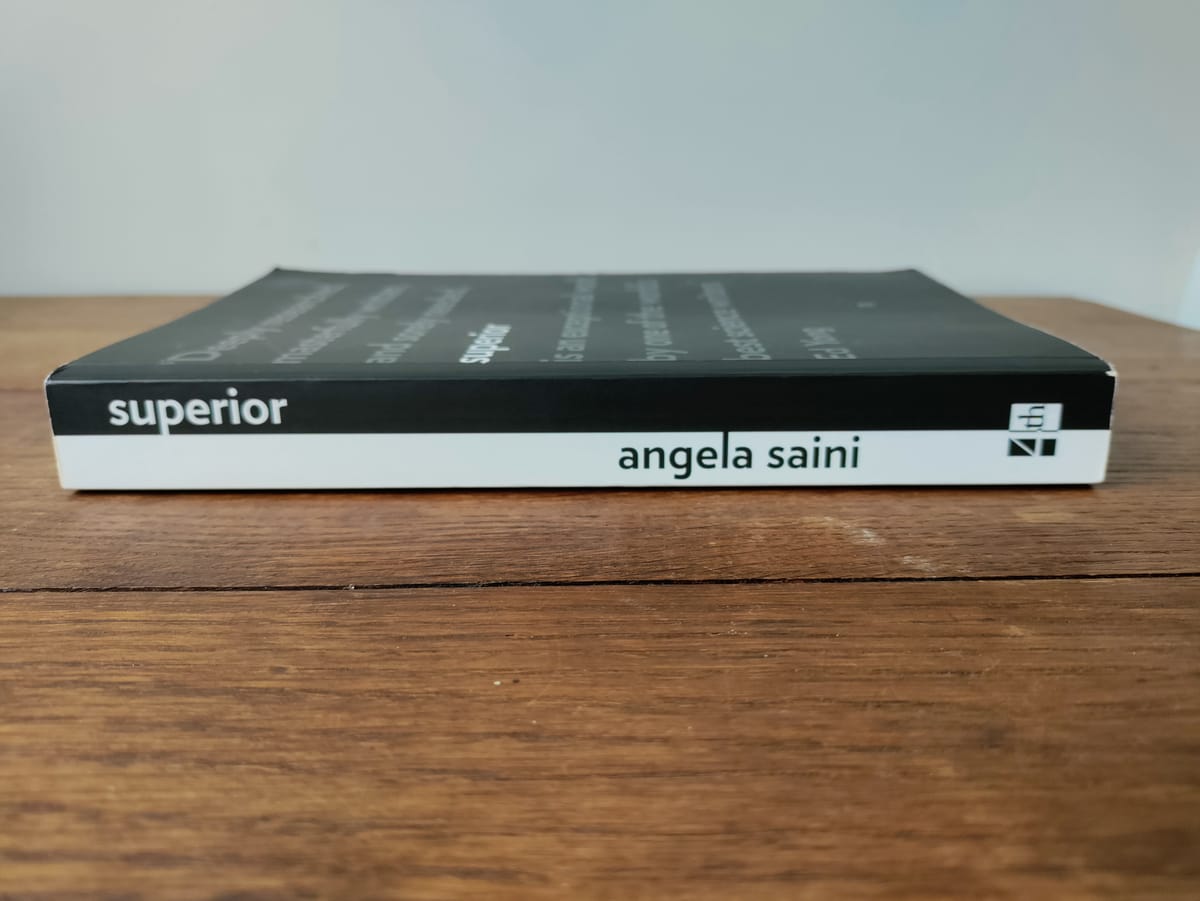
Growing-up mixed-race (to use the outdated term) has an additional challenge in the sense of not feeling as if you fully belong to one “thing” or group, especially when society insists on definitions and groupings. How much easier would it be if the first classification was our humanity, with the other detail much less emphasised? This question is addressed in Angela Saini’s text. The key assertion of the text is that race is a social construct: there is no scientific or genetic basis to the claim that we as a species can be further subdivided into races who have quantifiable genetic differences or who may be a separate branch of the same species. The range of interviews, evidence and examples also considers those who take the position that there are races who have fundamental differences between them.
Our dating of Homo sapiens is regarded as problematic, though we have fossils of people who share our facial features from around 300,000 BCE to 100,000 BCE, with evidence of art (or use of ochre), from 100,000 BCE. Homo sapiens existed alongside other archaic humans such as Neanderthals and Denisovans, and interbreeding took place between each, which had an impact upon our genetic material and our resistance to some pathogens. In the deep past we all shared the planet and co-existed.
The scientific debate about what makes a “modern” human is, Saini writes, “as contentious as it has ever been”. The contentions, and the undercurrents, are perhaps the most disturbing revelation of this text as Saini explores, through a range of direct interviews, how scientists can approach their discipline with distorted views and aims. In a way, this shouldn’t be particularly surprising given that any human-being, regardless of profession or position in society, can be motivated by personal biases and ill gains. As Saini puts it, mainstream and prominent scientists can be racists, murderers, and abusers. We imagine that science is above politics, is noble, rational and objective, but science is influenced and shaped by the context of the age. In an age of unprecedented information, with a bombardment of opinion and ideas, it can be challenging for a citizen to discern trustworthy sources of information, and it is therefore reassuring that Saini presents a range of views and arguments.
Race as a construct, Saini outlines, has clear roots to the colonial age, when Others (those conquered, subjected and enslaved) were portrayed and labelled (and contrasted) as “savage, miserable, trapped in a cultural stasis”. The lands were regarded and defined (by the colonialists) as terra nullius, territories without a master, nobody’s land, uncultivated: they didn’t belong to anyone, and could therefore be claimed (and “improved”). The conquerors noted (Saini specifically focuses on Australia in the opening) that these “savages” hadn’t built houses or developed intensive agriculture, and therefore considered them to be primitive, at a “fossilised stage in human evolution”. In a sense, this idea persists today, with nation-states sometimes being referred to in terms of their development, or places being referred to as being “lands without people for people without lands”. This is also key to our understanding of how we impact the environment of the planet, as there is an implicit idea that our mastery over nature equates to progress and advancement. If a community or nation state (or supposed race) evidences control and mastery of the environment, whereas another appears to be subject to the environment, then the masters make claim.
With the age of colonialism also came the age of Enlightenment which was Euro-centric in both a literal sense (taking place in Europe), but also in a sense of perspective as this in turn impacted upon the thinkers who began to organise and classify the natural world. This ordering included human-beings, with the European thinkers mostly putting themselves at the top of the pyramid. As we progressed into the 19th Century, “whiteness” (that is, western Europe and the recently-established United States of America) became the “visible measure of human modernity” despite modern evidence showing that human migration to Europe happened later than anywhere else.
The migration of human-beings is further examined as Saini carefully explores the ‘multiregional hypothesis’, which is idea that human beings continued to evolve after they made the journey/migration(s) out of Africa, the implication of which would mean that the “racial groups” that we see today are distinct and different branches of the evolutionary tree. This is worth noting because the theory has the kind of proposal that appeals to some minds and is likely to return time and again in different packaging. This view has been used to enforce the idea that races are real, and it appears to be in part motivated by rejecting any notion of direct African heritage. It also implies that some people or races are more highly (as well as less) evolved than others. In short, it fragments human-beings, allowing for a degree of Otherness, which in turn can be used to dehumanise, which in turn can lead to atrocities.
This is dangerous ground, but it is easy to see how it could be accepted, especially considering that we have established that Homo sapiens had crossed paths (and shared beds, so to speak) with Neanderthals and Denisovans. Genetic studies, however, have shown that all modern humans share a common ancestor who lived in Africa around 200,000 BCE, known as Mitochondrial Eve. Interestingly, alongside this reading I also listened to some podcasts such as The Ancients, and there was a professor on one of the episodes who stated that he prefers the term ‘Recent African Origin’, in other words that we came and went and returned and migrated in and out of Africa over time, including in terms of our the contact with archaic humans.
There is a wide range of voices in Superior. This gives the text an intimate feeling such as a good documentary. It is certainly preferable to texts in which we hear one voice with little referencing, and certainly more trustworthy than a podcast in which a man in a basement growls and spits hatred into a microphone (whilst trying to sell various snake oils and gain subscription fees), or hearing the ramblings of some unblinking man wearing a polo-shirt and a [brand name redacted] gilet, who has been financed by some organisation connected to [redacted]. The Great Replacement! Culture Wars! Wokeness! Beaker Folk! coming over here and… etc etc.
This does lead to an interesting question, however: where does culture end and ethnicity begin? “Even up to the 18th Century” Saini writes, “race (that is, physical difference) was seen as permeable and shifting.” It was Enlightenment science that led to race being hard and fixed. In the need to define and categorise, a hierarchy was created which in turn helped to justify practices within the realm of politics and culture. This is one of the key learnings: race and science, the idea of race itself as well as science as a discipline, can be shackled to the politics of the age, which in turn impacts upon culture and society.
The idea that there are races and that there are genetic differences (and more, or less, development/progress) leads to the justification for atrocities: that is, if we can argue that one person is more human than another, the other is dehumanised, and we are more likely to relate to those who we regard as belonging to the same group so that, it follows, we are less likely to relate to those we view as Other and are therefore more likely to commit acts against them which we may not ordinarily consider appropriate (an oppressive force referring to people as vermin, for example, or “children or darkness”). Jonathan Marks, Professor of Anthropology at the University of North Carolina, outlines this by extension: “If you could say that the slavers were naturally distinct from the slaves, then you have essentially a moral argument in favour of slavery.”
There are plenty of examples of atrocities in our history. Aside from the Transatlantic slave trade and colonialism in general, the Holocaust is also shown to represent Humanity at its worst, with race science and populism wedded. Saini also notes the horrific Yugoslav Wars and the ethnic cleansing and displacement: “reputable historians and archaeologists found themselves fighting an intellectual war against nationalist ideologues who wanted to justify their actions by promoting false versions of the past that suited their cause.” The ideas of the regime were favoured and bolstered, and no doubt had these wars taken place now there is likely to have been more apologists and defenders of those committing the atrocities. We need only look at the ongoing events in Palestine to see what seem to be clearly horrific acts being justified and defended.
The myth of racial purity and superiority, as well as the creed of white supremacy, can be seen to be taken from Count Arthur de Gobineau (1816-1882), who developed the theory of the Aryan master race. Alongside this chap we have Francis Galton (1822-1911), who is described as the father of Eugenics. He drew upon the ideas of his cousin, Charles Darwin (1809-1882), to assert that a race of people could be more quickly improved if the intelligent were encouraged to reproduce. This is explored in detail by Saini, who takes in discussions on how some people regard ‘races’ as more or less intelligent as another, showing that what is often ignored (or overlooked) are key considerations such as economic disparity, social conditions and so on. But this is the problem with ‘race’ in general and particularly with the Eugenics movement (which was established and accepted science for some time but, having gotten a bad reputation following the second world war, shifted its identity and facade somewhat): humans are reduced to parts of a whole, and it assumes that almost all we are is decided before birth. Again, what is being ignored (whether purposefully or innocently), is that our environment and conditions shape us. Saini references Alfred Russell Wallace (1823-1913) who states: “give the people good conditions, improve their environment, and all will tend towards the highest type”.
Unfortunately, as Saini points out, again and again over the course of the last century race science was substantially funded and promoted, and was often closely tied to fringe politics, which has increasingly become mainstream (or is it that there is an ebb and flow of extreme views, shifting to the shadows and caves, resting, gathering, only to stumble back to the plinths of society in full view?). For example, Madison Grant (1865-1937), another jolly Eugenicist, revived the legacy of de Gobineau in order to propose a Nordic master race (counting, amongst other favourable historical examples, one Jesus of Nazareth...), and he raised concerns about this master race being outbred and replaced (for more on this, we can refer to the modern-day “great replacement” conspiracy theory). Adolf Hitler referred to Grant’s text as “my Bible”.
After the war, intellectual racists moved to forge new networks which were often more covert and, as noted above, given a new facade. They continued to try and identify and enforce difference at a time when the world of legitimate science continued to progress the understanding of our species: “anthropologists and geneticists were learning that individual variation within population groups, overlapping with other population groups, turned out to be so enormous that the boundaries of race made less and less sense.” This is perhaps best evidenced in those ethnicity questions on forms in that the “types” of race that are listed are simply too broad to mean anything. Even a box such as ‘White – British’ doesn’t particularly mean anything, and it could of course change depending on the course of history if Britain, to create a wild example, were to be subsumed within a newly-created Nordic Fisheries and Antarctic Sea Exploration Confederation, and the “whiteness” of the people within the new alliance were to be defined by skin pigmentation with codes such as would be seen in a Dulux Paint catalogue.
In the 1950s, UNESCO stated that mankind is one, and in 1972 a landmark paper by Richard Lewontin investigated genetic diversity, concluding that 90% of variation lies roughly within the old racial categories. Saini explains: “statistically this means that, although I look nothing like the white British woman who lives next door to me in my apartment building, it’s perfectly possible for me to have more in common genetically with her than with my Indian-born neighbour who lives downstairs.”
Although science has evidenced our oneness, showing that the differences in human-beings are cultural (constructed by human-beings) rather than racial (pre-determined, intrinsic), race remains a battleground, and is used time and again to emphasise difference in order to fragment the populace, divide in order to rule (or in some cases simply for financial gain). This can be seen in issues such as Brexit, and with populist and dog-whistle politics.
Saini writes that “scientific racism is now out of the shadows. Over the past 30 years a culture has emerged that rails against ‘political correctness’ and calls for greater diversity of political opinion and freedom of speech as a disguise for the propagation of extreme right-wing views.” There is also now a pushback and distrust against so-called mainstream media, who are often seen to be shaping the narrative of society to suit the interests of … well, take your pick. Almost anyone can have a concern with the so-called mainstream media, with the internet and social media providing “simpler ways to access and grow networks” for any individual with a view. This is a positive thing overall, as it allows connection and ensures that anyone can have a voice (as well as giving space to relaying events as they happen that bypasses the traditional, and sometimes biased, “news reporting media”, which we can also view as a branch of the entertainment industry), but it also makes for difficulties for a range of reasons, not least that people (and perhaps, though not necessarily so, children) can be more easily manipulated.
Race science continues because it is an important political issue which powerful forces fund, from slavery and colonialism, to immigration and segregation, to the right-wing agenda of the current age. Does this sound paranoid? There is plenty of evidence in the text to support this, including an exploration of some key thinkers in race science, academic journals, and their various links and potential motivations. Saini notes that some of these race scientists “when they look for human variation, however objective they claim to be, they can’t help but ask what the differences they think they see mean for society […] often speculation as to causes of economic and social inequality”. In this way, historical context and injustice is ignored, with race and difference being emphasised, one example being Haiti.
“The need to separate, to treat people as different”, writes Saini, “is how race was invented”. The indication of our difference is how we look, with skin pigmentation being the most popular catchment. Saini shows how at the time of Brexit “the tractors that eventually pulled through for a marginal victory had a very unsettling smell coming from them”. Brexit was about more than the failings of the political establishment, because that was in part too complex to digest; instead, it was clearly the fault of immigrants, and the true British people needed to reclaim their land and their values.
Shortly after Brexit, we learned that the Cheddar Man looked nothing like what some imagined a modern (or true) British indigenous person would look like – this is in part because the notion of what makes someone “indigenous” is completely outdated given that we know human-beings have always migrated and shifted and moved around. Sarah Tishkoff, Geneticist at the University of Pennsylvania, has it that “skin colour is a terrible racial classifier. There really are no good biological classifiers for race”. Mark Thomas, Professor of Evolutionary Genetics at the University College, London, states: “If we could see each other by looking at our genomes then, without a big computer, you would be hard pushed to work out whether somebody was from India or from Poland”. David Reich, a Geneticist at Harvard University, has it that “big large-scale mixture, migration, however you want to call it, is common and recurrent”. For him, however, this can mean that there are genetic differences between populations – in other words that there could be some genetic basis for the claim that there is variation in Homo sapiens: “There are real ancestry differences across populations that correlate to the social constructions we have” though Reich “adds, judiciously, that he doesn’t think these differences will be large”.
Saini examines the importance of origin stories for human-beings, nation-states and groups. Although we all have a connection, this is sometimes regarded as something which, at best, is in the deep past. Throughout history, and certainly today, people relish difference. As we have seen, this can be a method for enforcing social hierarchy (divide in order to rule), but it can also be something which isn’t nefarious, something very personal and well-intentioned. It is important for people to consider their origins. Narrative is, it seems, hard-wired into us, and is something that we all share: to understand who we are, our place in the world, how we came to be.
Saini also spends time examining cognition and intellect, enquiring whether these areas (like skin colour or height) have a genetic basis. This discussion is, she writes, “one of the most controversial in human biology”. In the UK, we are told that the cohort of children who perform worst academically are white working-class boys. But perhaps the key indicator here is social class rather than ethnicity. As difficult as intellect is to define and measure, Saini proposes that “there are social influences where class, ethnicity and gender intersect, and they all affect achievement.” In the UK, the class-based structure of our education system is a key foundation stone of our education system and, ultimately, our political system. But even though the system is rigged, so to speak, there are always spaces to navigate. We are to some extent free some social determinism.
This is investigated further through the example of the caste system in Indian, which biologist Rama Shankar Singh notes is “the perfect example of social determinism” and is defined as “a set of barriers maintained by society for so long that it felt as if they were in the blood”.
Saini writes that the power of race “is the power to twist science to its own ends.” The relationship between science and politics (that is, of hierarchy and rule) is a close one. Intellectual racism has always existed – it is “still the toxic little seed at the heart of academia.” Perhaps this is because it remains a toxic seed within society, with academia a microcosm of this in the same way that we can consider a school to be analogous to society.
With some trepidation, after reading this book and trying to grapple with some of the key ideas whilst reflecting on my own views and biases, I asked Mrs Dodo in bed one night how she would define ‘race.’ I was apprehensive, in part because she usually shrugs away my questions when she’s trying to sleep (regardless of whether the question is about dinner the following day or race). What would her answer be? Would she emphasise difference, would it stir up some of my childhood experiences, would her response have some echoes of the Eugenics clan? Without hesitation she replied to say that it was an invention, something used to create division.
Ultimately this is the key thing for me: unity and recognition of our onesness rather than fragmentation and hostility; celebration (and acknowledgement) of our eclectic tastes and approaches, learning from one another, rather than assigning values and placing within hierarchy. The challenge for me now is raising little Dodo and addressing these issues as she encounters them.
Things to pass on:
- We are all connected, whether in the deep past or with modern means. Today, and perhaps for much of recent past, difference is used to fragment. Celebrate cultural differences and approaches, respect and recognise, but be careful of assigning value or of making assumptions.
- How do we encourage re-connection, particularly amongst people who relish the fragmentation? Are there ways to encourage the dialogue with people who, for example, find it easier to blame X, Y, or Z for the ills of society?