
The Destruction of Palestine is the Destruction of the Earth (Andreas Malm)
Malm links the genocide against the Palestinians to the ecocide, drawing in historical context of Britain's coal-powered steamships.
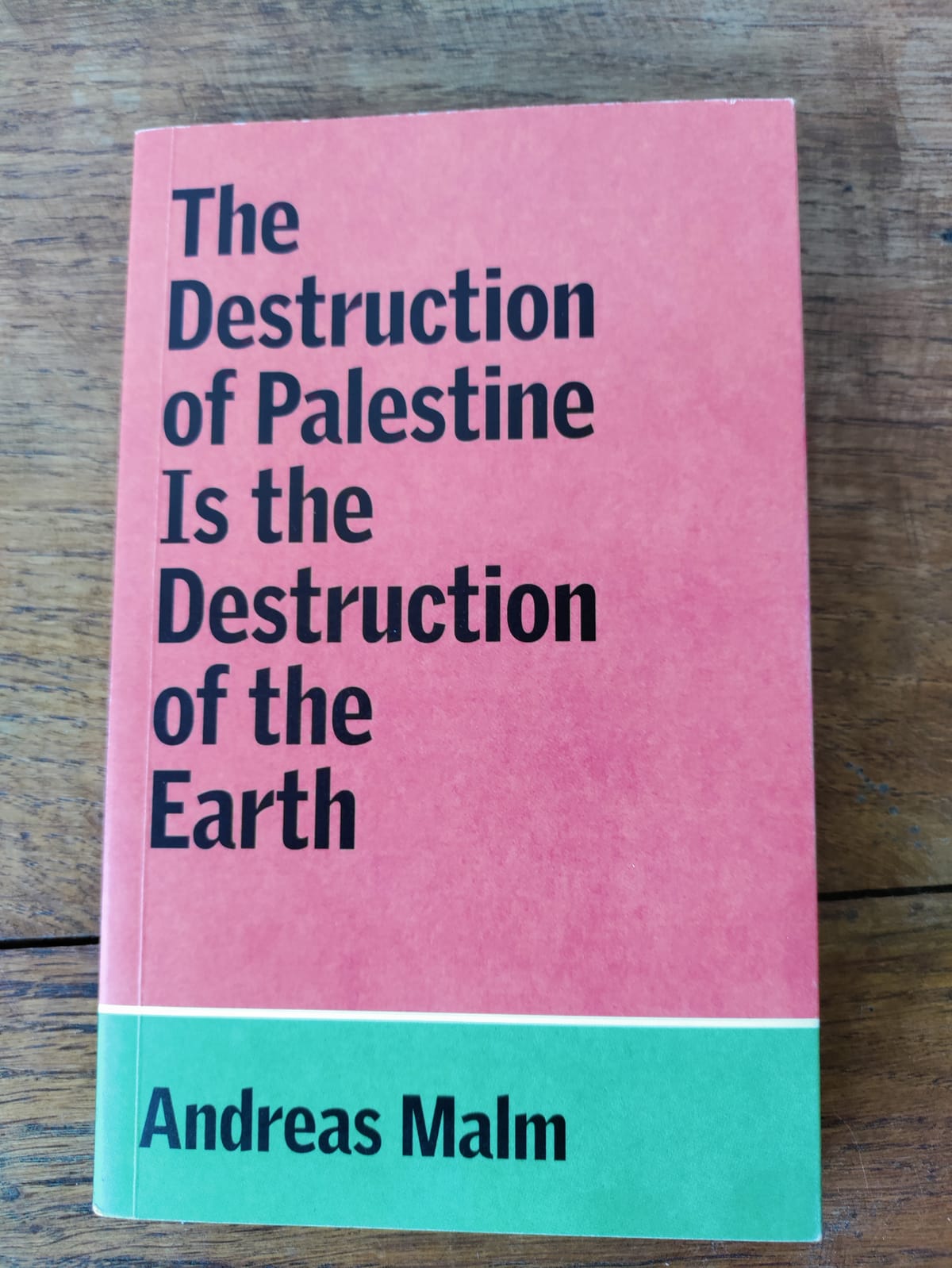
I have long held the position that the genocide against the Palestinian people is the single most important issue facing the world, and that the outcome of this will determine the future state of Humanity. As I write today, in April 2025, my fear is that Israel and its allies will complete their aim of completely annexing Palestine, with the Palestinians either wholly displaced or murdered. This in turn will usher in a new era of geopolitics, with states even more antagonistic and brazen in their actions against others. The states themselves, perhaps in pretty much every case, led by a ruling class who have no regard for the people of the states except in the sense of maintaining their lives just enough to maintain the state and their ruling privilege.
A more positive outcome sees Israel and its allies fail. This would be mostly down the indomitable resilience of the Palestinian people, but undoubtedly would require an intervention from another state or party. The implosion of one of Israel’s key allies, such as the United States of America, may be another event which leads to an Israeli fall.
There is much talk of a multipolar world, with America stepping down (or tripping up) from its plinth. For some, the multipolar world is one which is led by autocratic states, the picture for Humanity no better. For others, a multipolar world is an opportunity for more cohesion across Humanity, with shared goals. In the middle of these two positions, we may take the view that all states and entities act in their own interests, and that the fragmentation of Humanity is an unsolvable problem. Can any world power be classed as broadly altruistic, or sage-like? Some might argue in favour of the Tang or Ming Dynasties of China, but this is difficult terrain to navigate.
Andreas Malm puts forward the case that the genocide against the Palestinian people is the “first advanced late capitalist genocide” as well as a “technogenocide” which shares a terrible affinity with ecological breakdown. The text is based upon a manuscript Malm used for a lecture on 4th April 2024, with this text written in July 2024. At the time of writing (April 2025), we might argue that the genocide continues undeterred, and the figures that Malm references (in terms of those killed) is now almost beyond comprehension. In Gaza, ecocide is “fused with genocide in a manner never seen before.”
As we have learned in other readings (Palestine), the actions of the Israeli state since its creation have been similar to a child pushing boundaries, a child who in turn becomes a psychopath or sociopath, an abuser, demented. For Malm, “there are no limits to what the state of Israel can get away with.” To compare Israel to a child, however, is to do a disservice to children, and the analogy only stretches so far.
Some key questions, then, before we begin, would be around what Malm means by the ‘destruction of Palestine,’ and how he links this to the ‘destruction of the Earth?’
He sets the scene in this way: in addition to some of the common themes of war, the horrific loss of life, including citizens, a generation of children made orphans, sexual abuse, starvation, famine, outbreaks of disease, and trauma, Israel has committed acts unheard of, such as bombing hospitals, massacring patients, massacring citizens waiting for aid, bombing refugee camps, and has in fact repeated these acts over and over and over again. For Malm, “no one can impose any limits on what they do to the Palestinians.”
He references the great Franz Fanon with regards to Israel’s unashamed acts:
The colonist is an exhibitionist. His safety concerns lead him to remind the colonised out loud, “Here I am the master”.
Each line that we can assume to be a line which wouldn’t be crossed when the eyes of the world are on the place has in fact been crossed. In Spring 2024, it appeared as if the United States of America had set limits, a “red line”, when it openly warned against any military operations (terrorism and so on) being taken against the refugee camp in Rafah. But Israel contiued anyway. Shortly after this, Israeli president Benjamin Netanyahu addressed the American congress, stating that: “It’s a clash between barbarian and civilization.” He was right, of course, but he had his sides confused.
Nevertheless, these terms are not new terms. It is a stain on Humanity that we have always created an Us/Them framing in order to create division and to legitimise terrible acts. We continue to do so. It is a tactic as old as script and temples.
Malm proceeds to correlate Israel’s action to the actions Humanity has taken against the Earth itself. For example, he notes that there are currently no limits to the fuel we extract from the Earth; he notes the “frenzy” of exploitation which is “led by Anglo-America with its settler-colonial petrostates: the UK, Australia, Canada – but above all the US – plus Norway"; and he notes a “compulsive limitlessness” and a “drive to destruction” in the ways in which we are living.
Palestine, then, for Malm, is a “microcosm” of the larger processes which are underway. He writes for many of us when he observes:
“one can go insane with despair watching this from a distance. If one feels that way, then one should try to imagine how the survivors in Gaza feel.”
Some people still contest referring to Israel’s actions as genocide. Some people move swiftly on, holding on to the tenuous thread regarding supposed events on October 7th, when Hamas broke free of the border patrol of Gaza and kidnapped Israeli citizens. For some people, there is a barely described, if not outward, show of contempt and hatred for anything which might be associated with Islam or Arabism. And for some actors (and they are certainly paid actors), actors who have their little plinths in society upon which they display their sleights of hand and techniques of persuasion, actors and agents of the Israeli state, this is all part of an ongoing battle for the discourse.
But if we consider the views/assessments of objective and impartial observers, we can refer to this as a genocide without ay sense of hyperbole. In addition there are, Malm writes, some unique characteristics of this genocide, one of which being the “transnational efforts” in terms of the participation of the UK and other states. “One could be forgiven,” he writes “for thinking that they want the Palestinians to die.”
He cites the genocide committed against Bosnian Muslims: “with an arms embargo, the west denied that people the right to defend themselves […] in the four years of the war, the so-called international community stood by as Bosnian Muslims were decimated.”
In the case of Palestine, however, the West supplies and provides the armaments being used to kill. It also sits by as Israel denies aid agencies to support the Palestinians. We might ask, as Malm does, what ties Israel and the West so closely? And what explains the willingness of the west to contribute and participate? One answer often mentioned is the enigmatic and shadowy "Zionist lobby", though as we shall see, Malm feels that their influence is overstated.
There are still people complaining about whether we can refer to this a genocide. Malm considers the definition of genocide, one component of which is the “physical destruction in whole or in part” of the targeted group of people. Gaza, we can say, has been destroyed. This time there is no doubt. Whilst we have some first-hand reporting from within Gaza, this has severely reduced over the past year due to Israel’s targeting of journalists and the restrictions on free movement within Gaza.
Malm dates this process to the 1948 Plan Dalet, where Zionist forces were “instructed in the art of destroying villages”. During the Nakba, these forces invaded Palestinian land at night and “systematically” destroyed houses with dynamite, families still inside. It is not a new thing for Israel to target families in their homes.
As Malm notes:
“fresh rubble is always poured over Palestinians. Destruction is the constitutive experience of Palestinian life because the essence of the Zionist project is the destruction of Palestine.”
With this in mind, and if we consider the accounts give to date, it is worth asking again whether any human-being in their right mind wouldn’t respond to such violence in sometimes violent ways? How can someone sit at a table to discuss an issue when they have been treated with such barbarity?
Having established that the Palestinian people are victim to a genocide, and that their homeland has been destroyed (and occupied and stolen and misappropriated), Malm moves to consider climate breakdown, in which ecosystems are being physically destroyed, such as the Amazon Rainforest, standing tall for 65 million years and which may become a treeless savannah in the coming decades.
Malm asserts that fossil fuel companies are complicit in the destruction of the Earth and the murder of people. He writes: “when fossil fuel companies extract their goods and put them up for combustion, they do not intend to kill anyone in particular. They know, however, that these commodities will, as a matter of certainty, kill people.”
But we have climate change deniers, of course, so people may challenge Malm’s line of reasoning. Many people point to the fact that the Earth has undergone frequent changes in its climate and the ecosystems. Although I have much more reading on this subject to do, as I understand it the difference now is that the change in the Earth’s climate and ecosystems is a result of the actions of Humanity, and these actions (including the burning of fossil fuels), are predicted to bring chaos and death.
Malm continues: “as a corollary of the basic insights of climate change, the knowledge is now more or less universally spread: fossil fuels kill people, randomly, blindly, indiscriminately, with a heavy concentration on poor people in the Global South.”
We might consider in this the importance of intentionality when considering acts, in the same way as karma/kama. In order to catch a murderer, or an accused murderer, would it be at all permissible to bomb a school or a hospital or a refugee camp, regardless of whether the accused murderer is hiding there?
Malm’s study happens to hinge on the year 1840, a “pivotal” year for the middle east and the climate system, for this was the year that the British first deployed steamboats in a major war. These vessels depended on coal, and the “diffusion through the industries of Britain […] turned this into the first fossil fuel economy.” As the British were at this time the pre-eminent global power, this use of coal was then exported to the rest of the world, a kind of “globalisation of steam.”
The Royal Navy had first begun to use steam propulsion in the 1820s. Prior to this, of course, wind was the primary mover of ships, but this had many limitations, putting much adventure at the mercy of the gods. Steam allowed intentionality to navigation and movement, and with it more refined military tactics utilising the sea.
Admiral Charles Napier practised the technology when Britain went to war with Muhammad Ali, pasha of Egypt. He had been expanding from Egypt, threatening the seat of the Ottoman Empire, “whose stability and integrity Britain, at this point in time, regarded as a strategic counterbalance to Russia.”
At this time, cotton had been Britain leading export, and the British had secured a free trade deal with the Ottomans in 1838. But Ali was building his own cotton factories, which angered Lord Palmerston, foreign secretary and “chief architect of the British Empire in the middle of the nineteenth century.” Free trade, he argued, “had to be forced onto Ali and all the Arab lands he ruled.”
He wrote, furthermore:
“For my own part, I hate Mehmet Ali, whom I consider as nothing but an arrogant barbarian.”
On the 9th September, the British deployed their new technology, with Admiral Napier commanding the Gorgon. Beirut was bombarded from the sea. Malm notes a local general’s letter to the British fleet:
For the sake of killing five of my soldiers, you have ruined and brought families into desolation; you have killed women, a tender infant and its mother, an old man, two unfortunate peasants, and doubtless, many others whose names have not yet reached me [...] Your fire, I say, became more vigorous and destructive for the unfortunate peasants rather than for my soldiers. You appear decided to make yourselves masters of the town.
The steamers chased Ibrahim Pasha’s troops along the coast. Palmerston then ordered the attack on Akka, which had famously held out against Napoleon in 1799, and again in 1831 when Ibrahim Pasha had laid siege to it. This time, however, the town was “turned into a mass of rubble.” This particular imagery of a place of life being turned to rubble by an invading army with superior technology is of course a recurring theme in Palestine from this moment onwards. For his part, Admiral Napier is reported to have shown some “unease and perhaps a pang of guilt.”
This attack is given attention so as to make the connection between the indiscriminate approach being taken from Israeli forces against the Palestinian people in Gaza. In a detailed reconstruction of the attack on Akka, four Israeli researchers wrote in 2014:
“The bombardment was rather aimed at the town itself […] In fact, the object of the bombardment was to compel the garrison to surrender, not by the injury which it might have sustained, but by the killing and misery which it inflicted upon non-combatants.”
This focus on non-combatants also seems to be a perverse fixation of Israeli forces against Palestinians for the past century. In fact, there prevailing idea is that all Palestinians are combatants, even children and babies.
The British continued up the coast and round to the Egyptian port of Alexandria, where Ali conceded. “Thus did Britain destroy the Arab proto-empire by means of steam.”
As The Observer noted, with reference to Palestine:
“Steam, even now, almost realises the idea of military omnipotence and military omnipresence; it is everywhere, and there is no withstanding it.”
Ali’s cotton industry “crumbled virtually overnight.” The Egyptian economy, Malm notes, didn’t have any “prime movers” - that is, water power, or steam. The Nile, for example, is a very steady and still river system. Ali desired steam power, then, but steam demanded fuel and Ali did not possess any coal reserves. His “quest for coal drove the imperial expansion”. As we have seen, Ali’s expansion down the Red Sea was most definitely an imperialist venture, and his adventure in Yemen is regarded as “Egypt’s Vietnam.” After 1840, however, Egypt “underwent the most extreme deindustrialisation experienced anywhere in the nineteenth century.”
The year 1840, Malm also notes, first saw the British proposition of “colonisation by Jews.” As Palmerston wrote to Ponsonby (page 32):
Pray try to do what you can about these Jews; you have no idea to what extent the interest felt about them goes; it would be extremely politic [if we could make] the Sultan give them every encouragement and facility for returning and buying lands in Palestine; and if they were allowed to make use of our consuls & ambassador as the channel of complaint, that is to say, place themselves virtually under our protection, they would come back in considerable numbers, and bring with them much wealth.
Malm writes, as we have seen in previous reflections, that Britain in the 1830s “saw a wave of Christian Zionism, the doctrine that Jews must be gathered and ‘restored’ to Palestine, where they will convert to Christianity and precipitate the second coming of Christ and usher in the Last Judgement.” One key figure in this was the Earl of Shaftesbury (related to Palmerston through marriage).
Indeed, this was the moment of “conception” for two key principles:
- That no people existed in Palestine (“it now became a persistent theme of British commentary on Palestine that no people lived there”).
- The land must be taken by the force of technology running on fossil fuels.
We can also add to this the idea that the colonisers would be making the land civilized and productive, and we may also note the British as a kind of political protection. So we can see that before even the articulations of Herzl, the British had prepared the way. As Malm puts it, “when the Zionist movement was eventually assembled, it was a wagon that could be placed on ready-made tracks, laid out by the British after 1840.” He notes further that “before Zionism as Jewish, it was imperial”.
At this time, the British also subjected antagonisms towards Yemen and Iraq, and this continues to this day. Malm argues that the British shared and then passed on this power to the US, whilst also remaining to be an active participation in the imperial system (the ongoing bombardment of Yemen evidence of this).
We then move to more modern-day events, following the initial Zionist moves towards the end of the nineteenth century. Malm references Francesca Albanese when stating that “genocidal extermination is the climax of settler colonialism”, and for Palestine, from the moment of 1948, “displacing and erasing the Indigenous Arab presence has been an inevitable part of the forming of Israel as a Jewish state.”
At this time, however, the dominant fossil fuel had moved on from coal: now it was all about oil. It is at this point that the US becomes more of a feature and prime mover. When they were first deciding whether to “throw their lot in with the Zionists during the Nakba”, the Americans were swayed by the argument that a Palestinian victory would “increase Arab self-reliance, demands and bargaining power.” In other words, perhaps, Palestine was the example set to the other middle-eastern nations, and it becomes that much clearer that Israel as a state is an outpost for the western imperial powers. Without it, some might argue, their hand would be much weakened when it comes to oil. Indeed, as Malm notes, “American oil companies seem to have converged on the view that control over deposits would be indirectly reinforced by having Israel as an ally in the region.”
The primary resources of the age, then, and the location of these resources, also come to inform the primary wars and conflicts and where these take place. The machines of the genocide, for example, all the military vehicles and Boeing planes which run supply flights and “ferry the missiles over the permanent airbridge”, run on petroleum.
In the modern day, we have an expansion of fossil fuel production, including oil and gas extraction in the Levant Basin along the coast from Beirut via Akka to Gaza. As Malm cites, “two of the major gas fields located here, called Karish and Leviathan, are located in waters claimed by Lebanon,” which perhaps gives another reason for Israel’s antagonism towards Lebanon.
Other conflicts then impact on other conflicts, as Malm notes that the war in Ukraine caused a “crisis” on the gas market in 2022, meaning that Israel was “for the first time elevated into a fossil fuel exporter of note.” The Tufan al-Aqsa, however, “posed a direct threat to the Tamar gas platform” as it was within range of rocket fire.
Returning the question of why nations such as Britain and the US seem so powerless or frail (notwithstanding their own established motivations to support Israel), Malm engages with the often-cited Lobby Theory, that “the Zionist lobby in the US has amassed so much financial, electoral and media power as to hold American politics in an iron grip.” In this framing, the American national interest is subordinated to the forces working on Israel’s behalf. For him, the Israel lobby is a “surface phenomena.” We must acknowledge that there is an unsettling undercurrent of anti-Jewish sentiment in the US from groups/figures who have used the genocide as a way of bringing up the old narrative about Jewish control over America – in other words, they take issue with supposed Jewish control rather than the atrocities of the genocide which, you get the feeling, they don’t really care too much about.
But Malm argues that not all actions in the middle-east are the result of Israeli influence. He shows that the other position take is that of Israel as a tool, which is the position taken by the Arab Left, and he references Sayyed Hassan Nasrallah:
“There is a misconception prevalent in the Arab world regarding Israeli-US relations. We keep hearing this lie about the Zionist lobby – that the Jews rule America and are the real decision-makers, and so on. No. America itself it the decision-maker. In America, you have the major corporations. You have a trinity of the oil companies, the weapons industry, and the so-called ‘Christian Zionism’. The decision-making is in the hands of this alliance. Israel used to be tool at the hands of the British, and now it is a tool in the hands of the America.”
Malm makes further reference to the Strategy for the Liberation of Palestine (1969) when noting that the entity (that is, Israel), is a “base on our land and is being used to stem the tide of revolution, to ensure our continued subjection and to maintain the process of pillage and exploitation.” This document further notes that Zionism is an “aggressive racial movement connected with imperialism, which has exploited the sufferings of the Jews as a stepping stone for the promotion of its interests […] in this part of the world that possesses rich resources and provides a bridgehead into the countries of Africa and Asia.”
Malm then proceeds to ask: Where is the US empire going? What is it doing in the Middle East? How does the state of Israel fit in?
All of these are pertinent questions for our current age, as they will inform the next stage of humanity, for better or worse. Part of the answers lie in the other texts we have studied.
Malm’s hypothesis is as follows: “the share value of Israel as an investment rises proportionately to the challenge from Russia and China. When inter-imperialist rivalry intensifies again, in the 2020s as much as in the 1830s or 1910s, the entity becomes a valuable asset.”
And perhaps this is best way of addressing the question as to why there has been such deflection and denial regarding the genocide in the west. It is simply (and it is a simple but uncontroversial proposition) that Israel is an outpost of the so-called West, vital to the strategic interests of this bloc. It does follow, however, that the backers of Israel are also committing the genocide against the Palestinians. This much should not be forgotten in the recounting of this age.
What is certain is that the modern age sees an abundance of knowledge about the destruction of the Earth and of Palestine. For the most part, nothing is done about this. This may in part be down to who is most affected. As Malm writes:
“In the climate catastrophe, the lives of non-white multitudes in the Global South do not count. They are expendable, of no value.”
He references Storm Daniel striking Libya in 2023 where, in Derna, 11,000 people were killed in one night. There was no media coverage regarding this. But what if, Malm rightly asks, those affected were Brits or Swedes? It wouldn’t be long until this question was to be answered, of course, because in October 2024 there was flooding in Spain. The media coverage was significant for this.
The death toll for Palestinians in Gaza as of 2nd May 2025 is at least 52,000 with over 100,000 wounded. This genocide is notable for the Israeli focus on women and children, though this is not a new (that is, following October 7th 2023) tactic. As of April 2025, the UN reported that at least 100 children had been killed or injured every day since Israeli strikes on Gaza resumed on the 18th March. On the 5th April, the Palestinian Education Ministry reported that over 17,000 children had been killed in Gaza since October 2023.
The Palestinians have no value, and their deaths are regarded by many as their own fault.
- If only they hadn’t committed the attacks on October 7th (as if the whole people are responsible for the actions of a few).
- If only the “terrorists” didn’t hide in residential buildings or hospitals or schools or refugee camps then we wouldn’t need to bomb them (as if this in any way justifies the bombing or residential buildings or hospitals or schools or refugee camps).
- But there is historical precedent for this, look at Dresden, eh? Or how about Hiroshima and Nagasaki? some argue, without mention of the historical context. But God promised us this land – it’s all here in the Torah/Bible! Very well, then everything you do is justified, congratulations. They would do it to us! Look at what is happening to the West – you’re being taken over and replaced!
Malm takes up the point of the US as leader in this genocide when he notes that al-Aqsa challeged the perception of Israeli (and the US's) military and technological superiority. In turn, they “shared the imperative of restored deterrence.” We have already studied Israel’s Iron Wall approach, which proposes that Israel meets their neighbours (and the indigenous people of the land of Palestine) with brute force and unyielding brutality. Here is it in full effect, mask off. As Malm writes, the US voice is heard in the Israel response:
“If you dare to pierce our armour like the Palestinian resistance did on 7th October, we will obliterate you and your people.”
This in part explains the “performative element” of the Israeli/US response, where despite the lack of access to Gaza, and despite the muzzling of major media outlets, the horror and brutality is clear for all to see. The Israeli “killing machine” is just that: it has been shaped for a long while, where mass killing is mechanised and automated with the use of AI which bear names such as ‘the Gospel’ - it is petroleum and algorithms, and of course the energy needs of vast AI data centres is another major climate question today.
At the end of the text, Malm takes some time to address some critiques. On the subject of Hamas’s so-called terrorism, he notes that “if ever armed struggle has been imposed on anyone, this is it.” And this is supported by what we have learned so far, and is a counter to the Zionist claims that the Palestinians could have had peace if only they had wanted it (or, more recently, if they had returned the hostages). This is, Malm states, “the greatest anti-colonial revolt of the 21st century.”
Furthermore, where Hamas is labelled as being guilty of “messianism, authoritarianism, and sectarian manipulations,” Malm counters that “messianism is not a thing among Hamas or any other part of the Palestinian resistence,” subtly nodding to the other Abrahamic faiths, perhaps. He notes that the trajectory of Hamas is towards secularisation, breaking with anti-semitism, loss of interest in gender segregation and hijab imposition.
He then asks what is meant by ‘authoritarianism’ when we compare this to other states in the region or, indeed, a prison? “Gaza under the rule of Hamas,” he writes, “was the most complete instantiation of […] democracy anywhere between Beirut and Tunis.” And this is the thread running through the piece, that the colonial powers (the US and Britain, through Israel) control the region through the regional powers, and the Palestinian people (not least Hamas) represent a threat to their control.
Perhaps the key idea in the piece, aside from the connection made between the climate crisis/catastrophe and the genocide against the Palestinians, is that Israel is a tool of the US and British, rather than some puppet master. If Israel is the puppet-master, then the attention is deflected away from the ruling powers/individuals of the western nations and the public are misdirected to considering some mass shadow play, or the classic conspiracy about Jewish bankers running the world.
But the entity of Israel is simply (horrifically) a colonial endeavour, and like all other colonial endeavours the indigenous people suffer for the benefit of the colonists (and the benefits of course extend to ordinary citizens living within the colonial nations, so that we may be said to be in some ways complicit)...