The First Emperor (Sima Qian)
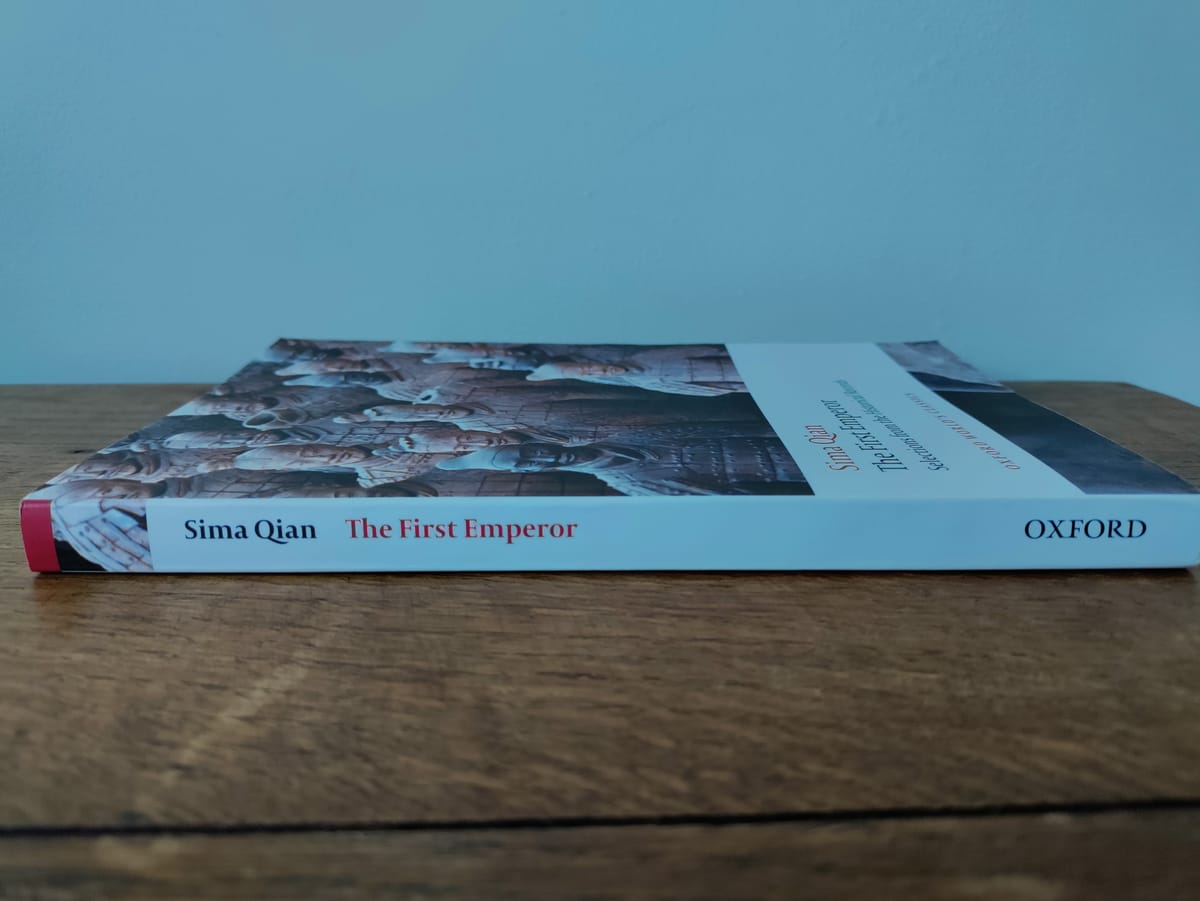
Key points from the Oxford abridged version of Sima Qian's grand history.
Chinese civilization can make claim to be the longest-running continuous civilization known to Humanity. From early on it emphasised the power of writing and diligent record-keeping, and in addition it placed great value on learning and literature, which in turn lends itself to rewarding study.
It was under the Han Dynasty, immediately following the short-lived Qin Dynasty, in which historical records became a kind of genre in its own right, though there were important historical narratives preceding this, including the Shujing. Sima Qian, who is affectionately known as the Grand Historian (or the Grand Historiographer), and his legendary work, Records of the Grand Historian, is “meant to contain a history of the Chinese world from the beginning down to about 100 BCE”.
The idea for these records can be attributed to Sima Qian’s father, Sima Tian, who “looked upon it as the hereditary task of the family to produce such a compilation since they had been Grand Astrologers even in ancient times.” We can say that Sima Qian displayed great filial piety, and respect for his family lineage, in completing this project.
K. E Brashier has it in his preface to this Oxford abridged edition that this is the most famous Chinese historical work, known for its “complexity of construction.” It is not merely a narrative history, as it includes key detail on the organisation and acts of the dynasty and the principal characters. There are, however, many complications (as with all history) in terms of considering accuracy, omission, and bias. The Qin preceded the Han, and as such as the characters of the Qin may be presented inaccurately in order to justify the new ruling party/dynasty.
For the most part, although the Qin are regarded as the first dynasty to have unified China, “the Chinese people have not looked back on this age with pride.” This is attributed to some of the Qin practices and acts which “made them synonymous with tyranny in the eyes of their successors.” The perception of the Qin, however, is informed by how they are presented, and Sima Qian appears to be a primary source (with his history constructed, it seems, with a range of sources, and not many of them primary, to use a modern term).
One example of the terrible Qin acts was in 213 BCE, with the ‘burning of the books,’ an act intended to “monopolize learning for the benefit of the court by causing sensitive material to be available only to the seventy court academics.” This included suppression of Confucian classics, which were revitalised under the Han.
The “Qin darkness and barbarism” therefore, “came to be directly contrasted with Confucian light and civilization.” Brashier has it that “sources assume that the evil of Qin was very much due to its being a Legalist state.” In addition, however, the Qin can be regarded in much the same was as the short-lived Sui Dynasty, in the sense of bringing order from chaos, or setting the foundations for a stable age (the Sui preceded the golden age of the Tang).
The Historical Records have “much to do with the outline of politics and military events and the deeds of great men, and little to do with grand modern concepts like causation.” We can say, however, that there is a specific intent at play with regards the histories, certainly in terms of justifying (or giving reasons for) the Mandate of Heaven passing from the Qin to the Han.
In terms of the approach taken, Raymond Dawson writes in his introduction that Sima Qian “took an exuberant interest in good stories and would certainly not have felt the need to submit his material to the kind of scrutiny that would have worried the conscience of the modern historian.” It is interesting that Dawson implies that modern historians may be less inclined to bias, or of using questionable sources to support a line of reasoning (or narrative), or even that modern historians have any more of a conscience than a historian in a past age.
It is also telling that Dawson notes the “artificiality of the speeches” that Sima Qian recounts. This is a recorded history, but not to the extent in which we have their voices captured on an audio recording or film. The same can be said, of course, for much of human history aside from a brief slice of recent time, and now we have the advent of artificial technology which may call into question audio and video presented to us.
Firstly, then, we have the narrative of the state, of the ruling elite, and the capturing of a narrative to give grounds for rule (and the Mandate). In addition, Dawson notes that Sima Qian saw himself as a “preserver of tradition about great men.” His histories are part biography, capturing the words (through Sima Qian) and deeds of important people in the story of the Middle Kingdom.
The text on display here focuses on a few small sections of his Records, most notably the story of the First Emperor of China, as well as his Chief Minister, Li Si, and one of the rebels who would topple the Qin, Xiang Yu.
The Birth of the First Emperor
According to Sima Qian, Lu Buwei (the first emperor’s father) was an important merchant from Yangdi. As he travelled about, he bought cheap and sold dear, and as a result his household amassed a fortune. At this time, King Zhaoxiang was the ruler of Qin, a periphery state. Lord Anguo, his son, was the crown prince. He had a concubine and chief consort, Lady Huayang.
Lu took a liking (or “felt pity”) for another of the King’s sons, Zichu. With his merchant mind, Lu thought: “this rare commodity should be invested in.” Lu advocated for him to Lady Huayang, who in turn convinced Lord Anguo to name him as his successor.
Zichu in turn took a liking to one of Lu’s courtesans (whom was actually pregnant by Lu). Lu “makes a present” of the concubine to Zichu, further portraying this chap as someone who views people as goods and services. In doing so, he concealed the pregnancy, which gives an air of scandal to the legitimacy of the Qin empire.
When King Zhaoxiang died, he was succeeded by Lord Anguo, but he in turn died only one year later. Zichu became the king (King Zhuangxian), but died three years later. He was in turn succeeded by his son (but who was actually, as reported by Sima Qian, the son of Lu). He “honoured Lu Buwei by making him chief minister.”
Sima Qian refers to Confucius when he states: “What Master Kong meant by ‘the man of reputation’ surely refers to Master Lu." The full quote is: “The man of reputation assumes an air of humaneness but his conduct belies it.” In this sense we see that the approach and character of Lu is called into question, and by extension the Qin Dynasty itself.
The Qin Dynasty, however, is regarded as the first to unite “all under heaven”, and is noted to have been viewed negatively by the Chinese despite this. Sima Qian refers to the Crown Prince of Yan, who described Qin as follows:
“Now Qin has a heart that is greedy for profit, and its desires are insatiable. If it does not absorb all the land under Heaven, and make all the kings within the seas its subjects, its ambitions will not be satisfied.”
It is interesting how much the language and ideas encountered so far (commodity, present, merchant, profit, greed, desires, ambitions, reputation) are all terms which some would regard in a positive light in modern society, particularly in a neo-capitalist way. For Sima Qian, and perhaps for his contemporaries, these terms are being deployed in a pejorative way.
Sima Qian relays the assassination attempt of the first emperor of China (The August Emperor), which differs to that as portrayed in the film Hero, though contains some similar logistics in the sense of presenting a gift (the head of a general) to the king:
“The king of Qin is bound to be pleased and grant me an audience, and I will grab his sleeve with my left hand and stab him in the chest with my right hand.”
In this, the assassin, Jing Ke, nearly succeeds, “but before it [the blade] reached his body the king of Qin drew back in alarm.” Jing Ke pursues, but the king manages to strike him down, though not without some clumsy luck.
Gao Jianli, a skilled lute-player, was a friend and co-conspirator of Jing:
“The August Emperor of Qin was so moved by his excellent lute-playing that he gave him a special pardon and merely put out his eyes.”
Gao persisted in his mission, and he bides his time before attempted to kill the emperor with his lute. Failing, he was subsequently put to death.
The Biography of the Chief Minster of Qin
We next learn the shady moves by the August Emperor’s Chief Minister, Li Si, and with it perhaps a message from Sima Qian and the ruling body about staying in one’s place and not getting above one’s station.
Li was a minor clerk in Chun before becoming a follower of Xun Qing. He “studied the techniques of emperorhood and kingship” before moving to Qin, feeling that the rest of the 6 warring states were weak.
Lu Buwei (purported father of the First Emperor) regarded Li Si as a man of quality and he appointed him as a palace gentleman. Some of Li Si’s thoughts and advice are captured by Sima Qian:
“The ordinary person misses his chances. The completion of great enterprises consists of taking advantage of weaknesses and ruthlessly exploiting them.”
Li Si, despite the positive biographical details, is still put forward as an antagonistic character to the reader. In this sense, we can regard the ambition, and the methods taken to achieve supposedly great enterprises, as negative characteristics, but this would be to oversimplify the Chinese conceptual framework (in the Confucian sense), which doesn’t hold the cosmos to a binary account (such as Good/Evil, Light/Dark).
Li Si goes further:
“If one stays in a humble position and decides not to take action, this is to behave like an animal, whose only concern is food. Only if one has a human countenance is one capable of taking vigorous action. Hence there is no greater disgrace than lowliness and no deeper sorrow than poverty. To stay in a humble position for a long time or live in an area which suffers distress, to reject the age and show a hatred of profit, and to commit oneself to a lack of purposive activity (wu wei) – that is not the nature of a man of action.”
There’s a whole lot to examine in this passage, with a deep concern again shown for position in society, in trying to escape from poverty, which is regarded as a disgrace. It is possible that Sima Qian is building the picture of a man who is discontented with his lot in the hierarchy of society, which leads him to undertake abhorrent actions.
Sima Qian recognises, in some ways, the man’s qualities, even so far as suggesting that it was Li who saw the opportunity in uniting the land, to make “all under Heaven into a unity.” He also notes that Li Si argued against migrant workers (referred to as “aliens”) being expelled.
But Li Si was not to be admired. His proposals were gradually adopted in the state, which we will come to learn was a harsh and punitive state before being superseded by the Han. This included banishment and censorship of literature such as The Book of Songs and other Confucian and historical classics. For the reader of the time, then, this chap was bad news. The reasoning for this, Sima Qian states, was “in order to make the people stupid.” As noted in oher studies, the power of the written word was always key to the ruling class maintaining and legitimising power, and this was extended first by the Qin and then by the Han with the civil service bureaucracy. This was later expanded by the short-lived Sui, and then the following Tang.
Other implementations proposed by Li Si were the standardization of bureaucratic documents, and this respect for the written word and for administration runs throughout Chinese history, which is to be admired.
Following the death of the August Emperor, there arose some succession difficulties which Li Si would inevitably become embroiled in. Zhao Gao, an Iago-like schemer, seeks out Li Si, who is holding a letter with the Emperor’s succession wishes. He has a successor in mind, favouring Prince Huhai:
“So determining a crown prince simply depends on what Your Excellency and myself have to say. What shall we do about the matter?”
He goes further, trying to worry Li that the eldest son (Fusu) will employ Meng Tian as his Chief Minister: “and it has become clear that you will definitely not be returning to your village cherishing your seal as marquis of the highest rank.” All of Li Si’s ambition, his rise through the social order, is threatened.
Li Si is not easily swayed, however:
“You should go back to your place, sir […] I have received our sovereign’s mandate and I pay heed to the decrees of Heaven. What doubts are there to be resolved?”
Gao persists: “Surely one hears that sages shift their ground and avoid constancy […] readily accepting change, they accord with the seasons […] the authority and destiny of the Empire depend upon Huhai, and I can get what I want out of him.”
Once again we meet a man (technically a eunuch - I'm unsure of the classification in this regard) who views people as vehicles for their own use. Sima Qian notes that both Li and Gao are from humble backgrounds who worked their way up to the hallways of power. It may have been that Sima was issuing a warning (or reminder) to his peers that the ruling elite needed to have strict entry requirements, with a value placed on the aristocracy. Rulers are cultivated, and must come from the ruling class.
Gao wins Li over eventually:
“If you, sir, listen to your servant’s plans, then you will long retain your fief, and the title will continue for generation after generation […] Now if you let this opportunity slip and do not join in, disasters will befall your sons and grandsons, sufficient to make your heart turn cold.”
The audience know it will all fail miserably for Li and Gao, so the dramatic irony is clear: the selfish ambition, and the jump above station, not following official decrees and commands for private gain, is foolish. But this perspective in part conflicts with the overthrow of the Qin, which we will come to later, and which Sima Qian would be well aware of. What he would not realise, however, was the degree to which peasant uprisings would become a common theme in Chinese history.
It is worth bearing in mind that this conversation, and many others reported by Sima Qian, are completely invented – that is, there is no way of knowing how accurate the content is, though we can assume very little resembles the truth of the matters.
The eldest son, Fusu, fell for the deception and killed himself. His advisor, Meng Tian, remained suspicious, but he was apprehended.
Gao, now Director of Palace Gentlemen, advised the king to “make the law severe and the punishments harsh […] wipe out the important officials and keep your own flesh and blood at a distance; enrich the poor and honour the lowly.” We see here a mixture of things we might regard as positive and things we might regard as negative.
“The laws and punishments day by day became increasingly harsh, and each one of his ministers felt himself to be in danger, and there were many who wished to rebel.”
Gao eventually became fearful of all the enemies he had made, and he took an antagonistic approach to Li Si. He turned the new emperor (whom Sima Qian refers to as "Second Generation") against Li, who in turn submitted a letter to the emperor outlining Gao's shortcomings.
The emperor refutes the assertions:
“Lord Zhao is a man who is strong and incorruptible in spirit.”
“It is not true, said Li Si, this Gao was originally a man of lowly birth.”
Once again we have the emphasis on the hierarchy of society, and how rulers would do themselves no favours to be swayed by such people.
Li Si was brought to trial, where he lamented: “Alas, how tragic, how can an unprincipled ruler be planned for?” Gao tries the offence, and Li Si is flogged and makes a “false confession.” When in gaol, he wrote a letter listing his crimes (which are really to be read as contributions and successes, such as annexing the Six States, the implication being the unity of the Middle Kingdom), driving back aggressors, repairing ancestral temples, standardizing measures and documents, building roads, relaxing punishments and reducing taxes.
Gao, who became Chief Minister, dupes the emperor into believing he is mad: “he presented a deer, but called it a horse”, and by tricking him into retreating to fast, he eventually leads him into killing himself. But Gao, aware that heaven would not grant him the throne, confers the imperial seal onto the First Emperor’s younger brother, Ziying. This ruler enlisted the support of the eunuch Han Tan, and Gao was killed:
“His kindred were exterminated to the third degree.”
Ziying, for his part, did not last long, and would be executed by the Governor of Pei, whom we shall come to later on.
Sima Qian, the Grand Historiographer, summarises as follows:
“From the village lanes Li Si went through the feudal states before entering the service of Qin, and consequently exploited their defects to support the First Emperor, and ultimately brought to completion the imperial heritage.”
At the same time, however, or following his contributions to the kingdom, “he gave his assent to reckless associations.” For Sima Qian’s readers, that of the rulers of the state itself, including the aristocracy, the message here is clear: great tragedy and disgrace can result from disobedience and selfish ambition.
For the modern reader to compare to the historical precedent of some western traditions (or can we say the Abrahamic faith traditions), there isn’t such a binary distinction between choices and actions in Sima Qian’s account. Li Si has admirable qualities, though we can certainly say that Zhao Gao is presented in a negative way to an almost comical degree. Sima Qian’s narrative recounting, then, may appear at first glance to be a kind of folk retelling, but there are layers to the narrative that he is juggling, and this includes referencing the Confucian tradition as well as, we can assume, consideration to historical accuracy in terms of the alliances and movements of states.
The Builder of the Great Wall
He next examines Meng Tian, who was chief advisor to Prince Fusu, the son who was supposed to inherit the throne following the death of the August Emperor.
Meng was originally a general of Qin “on account of his long-term service given by his family” which included his paternal grandfather Meng Ao, who came from Qi to serve King Zhaoxing. He was given 300,000 troops to go north “and drive out the Rong and Di barbarians,” and he “filled the Xiongnu with terror.”
Upon the usurpation of Prince Fusu, with Gao and Li putting Huhai (Second Generation) on the throne, Meng was imprisoned. Gao, “fearing that the Meng family would again be treated with honour and be employed on affairs, felt resentful.” He became intent to “wipe out the Meng family.”
Meng’s younger brother, Meng Yi, was killed whilst imprisoned. When Meng himself was targeted, he self-advocated, sighing, to the Emperor’s messengers, who dared not recount it to the Emperor (or Gao):
“There is a crime for which I certainly ought to die. I built a wall stretching more than 10,000 li from Lintao as far as Liaodong, and so in the course of this I surely could no avoid curing through the earth’s arteries. This then is my crime.”
He swallows poison and dies. It would be an interesting study in the area of climate literature to map out and analyse how classical and historical literature across cultures reflects attitudes towards to human impact on the earth and nature.
For now, we have Sima Qian to summarise. He says that he has visited the northern border and observed the ramparts of the Great Wall. He states that Meng:
“showed little concern for the efforts of the people […] although he had become a famous general, [he] did not use this occasion to remonstrate strongly and remedy the distress of the people, minister to the old and enable the orphans to survive, and strive to cultivate harmony among the masses. Instead he embarked on great enterprises to pander to imperial ambition, so was it not therefore reasonable that both he and his brother should suffer the death penalty?”
This is very intriguing, for Sima Qian establishes a connection between a person’s acts across the span of their lives (and in terms of how they use their power and status for the greater good) to a specific charge brought against them, and even the punishment itself. In this way, we can see the contrast between western traditions, which we can broadly say emphasises the rights of the individual regardless of the whole, and the Chinese tradition which, although containing those natural human characteristics and flaws, such as selfish ambition and vain conceit, tends to emphasise the individual as part of the whole. This may too broad a reading, however.
What we can additionally take from this in our brief study is the role of the historian in this specific time of Chinese history, where Sima Qian acts almost like a judge and arbiter of events, with a measure of objective analysis. But we know that bias is a yeast in the loaves of literature, so caution is always advisable in taking a position without wider reading.
The Annals of Qin
The next portion of this abridged text is The Annals of Qin, which is a kind of year by year outline of some of the key events. It includes matters of rule, of initial edicts and decrees.
For example, the First Emperor said:
“It is because of the existence of marquises and kings that all under Heaven has shared in suffering from unceasing hostilities.”
The empire, now united, was subdivided into 36 provinces, with a governor, an army commander, and an inspector for each. The emperor himself toured the land, setting up various stone tablets along the way in a kind of Ashokan pilgrimage. Indeed, there are also similarities as explored in Persian history in terms of the message of the state to the (now ruled) people, a kind of mass propaganda or establishing of narrative.
Inscriptions include rhetoric such as:
“With sagacity, wisdom, humaneness, and righteousness, he has made manifest all principles.”
We also learn about the standardization of weights, scripts, measures, and documents (which is previously attributed to Li Si):
“Removing doubt he fixes he laws, so that all understand what they are forbidden to do.”
This is certainly handy, we can say. For the most part, a modern observer or citizen would welcome a land in which the law was clear to all and that punishments and expectation of punishment would be equitable for all. In reality, we know that rules may not always apply to all equally. It is, perhaps, this innate injustice which lies at the heart of all systems of justice, though it is certainly an admirable aim.
We also hear that:
“Relations care for each other, and there are absolutely no bandits or robbers.”
This one feels like a stretch. On the one hand we have the admirable social care aspect which we find present in much of Chinese history, but the second part is clearly a kind of sales pitch to the people from the new regime. It reads almost like a tweet from the Trump administration.
The year by year accounts continue, which include details on the commissioning of Xu Shi to send several thousand young boys and girls out by sea to seek immortals, as the Chinese civilization spreads outwards.
We also revisit Li Si, who recommends the burning of historical records and harsh punishments for those who even mention them: “Those who, using the old, reject the new will be wiped out together with their clans.” The repeated refrain about how one’s actions can lead to punishment for relatives is a kind of deterrent for stepping out of line, as well as a social bind which we may see leads to great endeavours as well as complete chaos.
There are details of the famous burial at Xianyang, which included the burial of all concubines who had not produced a son, as well as workers and craftsmen who helped construct the site.
Sima Qian also revisits the plots of Zhao Gao, who notes to Second Generation the difficulties of dealing with the famous and noble families, with a further emphasis on social status:
“Now I am obscene and lowly by origin.”
The Treatises
The next section of this text deals with various treatises. We learn how the August Emperor, having gathered seventy Confucian masters and scholars of broad learning together, “heard the counsels of these people, but each suggestion was bizarre and difficult to adopt, and as a result he got rid of the Confucian masters.” This rejection of Confucianism can be read to be another of the emperor’s mistakes, and the Han dynasty of Sima Qian’s time would greatly resurrect Confucianism as a cornerstone of the state apparatus.
Indeed, Sima Qian notes further that the emperor made “enemies” of the Confucian scholars, who hated Qin for burning classical texts and “putting to death men of letters”. In turn, the “people resented its laws.”
At this point we can revisit the important question of who the intended reader would be for Sima Qian? As we have seen, he was from a fairly illustrious family, firmly entrenched in the aristocracy. It wasn’t until the Tang, however, and then in later dynasties such as the Ming and Qing, when widespread literacy would become the norm. We can take a position, then, that Sima Qian’s intended audience was the nobility, aristocracy, and the scholar official class, rather than the common people. In some ways this makes it more admirable when Sima Qian notes how important it is to consider the people, but it also calls into question the amount of flags that he raises with regards hierarchy and class. As we shall see, from the Han onwards, peasant and rebel uprisings would become a common cycle in Chinese history, and would bring down many a dynasty.
The Story of the Rebel Xiang Yu
Xiang Yu was 24 years old when he rose up in rebellion. His family had been generals of Chu for generations. He gave up on both writing and swordsmanship, saying:
“Writing is useful only for recording names. With the sword one opposes a single individual […] I will study to oppose 10,000 men.”
There is some irony, of course, in the fact that Sima Qian, in his grand historical narrative, shows that writing is more than a tool of recording. Nevertheless, there are different roles in society, including in the aristocratic realm. Xian Yu’s uncle, Xiang Liang, took on the role of teaching him military tactics.
Yu was tall and strong: “His talent and spirit were both exceptional, and even the young men of Wuzhang had all become terrified of Yu.” With his uncle, they staged an uprising, with his uncle becoming governor of Kuaiji, with Yu an assistant-general.
Sima Qian outlines the various movements and alliances and battles, showing the shifting scene, from chaos to unity. Song Yi, an important Chu general, warns Xiang Liang:
“If a general becomes arrogant and his troops become idle because of a victory in battle, then they will de defeated. Now the troops have become a little idle, and the Qin soldiers increase in numbers day by day, and I am fearful for your sake.”
Xiang Liang subsequently died in battle, and Song Yi is made Minister at the Head of Armies for Chu. He advises against joining forces with Zhao to attack Qin, instead recommending caution. Xiang Yu, however, disagrees:
“That morning, when Xiang Yu paid a formal visit to the supreme general, Song Yi, he cut off Song’s Yi’s head within his tent.”
Xiang Yu then became the supreme general, and he “inspired awe in the state of Chu and became famous throughout the feudal states.” In turn, the feudal states subordinated to him.
They continued on their way, which included the annihilation of “more than 200,000 Qin troops south of the city of Xi’an.”
Sima Qian introduces Xiang Yu's conflict with the Governor of Pei (also known as Liu Bang, founder of the Han Dynasty), who had secured Xianyang and the important Hangu Pass. A rumour made its way to Xiang Yu that the Governor intended to rule as king. This led to a great tension when they met to dine, with the Governor sensing some trouble and managing to step away. “After a few days Xiang Yu led his soldiers forth and they went westwards and butchered Xiangyang.”
Later, Xiang Yu established the Governor of Pei as the King of the Han, establishing a capital at Nanzhong. King Xiang, as Sima Qian recounts, was from this time an “antagonist” against the Han. The King of Han gathered a force of 560,000 and attacked Chu. They entered Pengchang and “removed all valuables and beautiful women from it.” Xiang attacked, felling 100,000 Han troops.
“The King of Han was encircled by a body of three men deep. Thereupon a great wind arose from the northwest. It felled trees, demolished houses, and raised a sandstorm. It was so gloomy that the day was like night. When this hit the Chu army, it was thrown into great confusion.”
With this sign from the heavens and the natural world, the King of Han was able to escape.
Xiang Yu subsequently laid siege to Xingyang, where the food stores were used up. Once again, however, the King of Han made an escape. At this time, as if to emphasise who the baddie is in this retelling, Sima Qian notes that Xiang Yu was burning people to death and boiling people alive.
The King of Han made a further escape, this time from Chenggao. Xiang Yu, now battling against Peng Yue, an ally of the King of Han, tried to force the King of Han’s hand:
“he constructed a high sacrificial stand and placed the Supreme Duke on it and announced […] If you do not submit quickly, I shall boil the Supreme Duke.”
The Kind of Han responds:
“When you, Xiang Yu, and I together faced north to receive our commands from King Huai, we said that we made a pact to become brothers, so my father is your father. If you insist on boiling your own father, then do me the honour of allotting me a cup of soup.”
This Chu-Han contention went on, with each holding the other “in check for a long time.” Xiang Yu then challenged the King of Han to single combat, but to no avail. Once the Chu were weary and their food was depleted, a compromise was reached. But following this the Han pursued Xiang, promising territory to others in order to gain their support.
King Xiang and his army were surrounded. In his tent, at night, he sung sadly of “his regrets.” Sima Qian’s retelling once again is given a stage:
“King Xiang’s tears streamed down, and those about him all wept, and none could raise their eyes and look up.”
He returned to fight the Han, decapitating generals on horseback: “several hundred men of the Han army were killed by Xiang Yu alone.” Eventually cornered, he cut his own throat. Following this, Chu fell to the Han, ushering in the age of the Han Dynasty.
Sima Qian once more summaries: “How sudden was his rise,” he notes, “but when he turned his back on the passes and cherished Chu, drove out the Righteous Emperor, and set himself up, the resentful kings and marquises revolted against him.”
Once we have the warning against rises to power and how that power is used. Perhaps Yu's most telling error, at least for Sima Qian, was that:
“when he died […] he still did not wake up and lay the responsibility for his mistakes on himself.”
To summarise, Sima Qian's approach to history is starkly different to the accepted practice and discipline in the west today, particularly with regards sourcing material, referencing, and the general structure of a narrative, but this does not make it any less relevant or accurate. There are many flourishes and fireworks, and certainly strong biases and intentions in mind. It is certainly a more didactic approach, which may be grating for a moder reader despite the wonderful prose.
In addition, there are questions to be asked about whether the narrative presented to us, including the biographies of historical figures, are accurate or fair, though the same can be said for much of our historical records.