The New Silk Roads (Peter Frankopan)
How is China's Belt and Road Initiative impacting upon the world and the relationships between nations? And what are some of the potential repercussions of China's global network strategy?
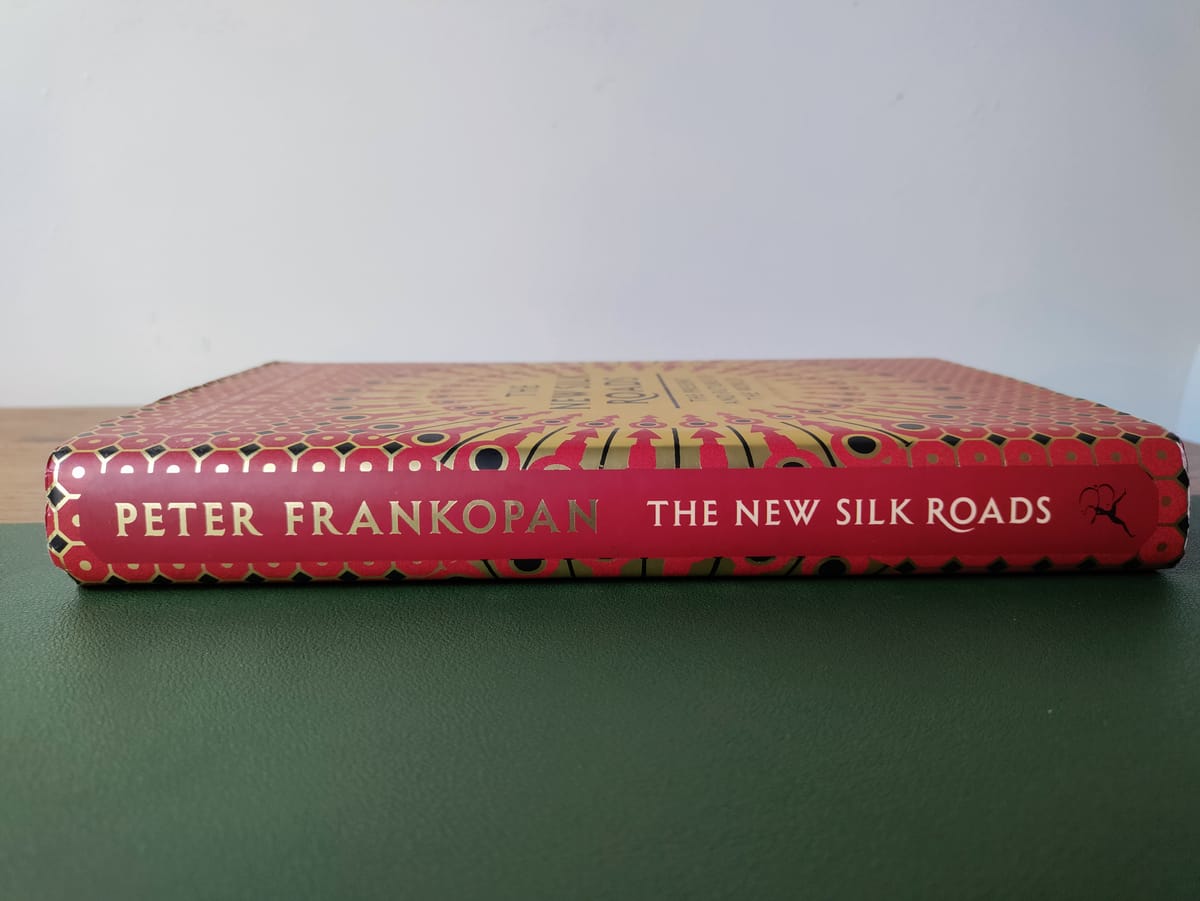
Peter Frankopan’s The Silk Roads examined the ancient Eurasian plateau, considering the ways in which trade connected continents and peoples. In The New Silk Roads he revisits the region once more with a particular focus on China’s actions and extensions across not only the Eurasian plateau but also across the globe – for in this age the Silk Road is more than a physical space and network as well as a framework and approach for the multipolar world order.
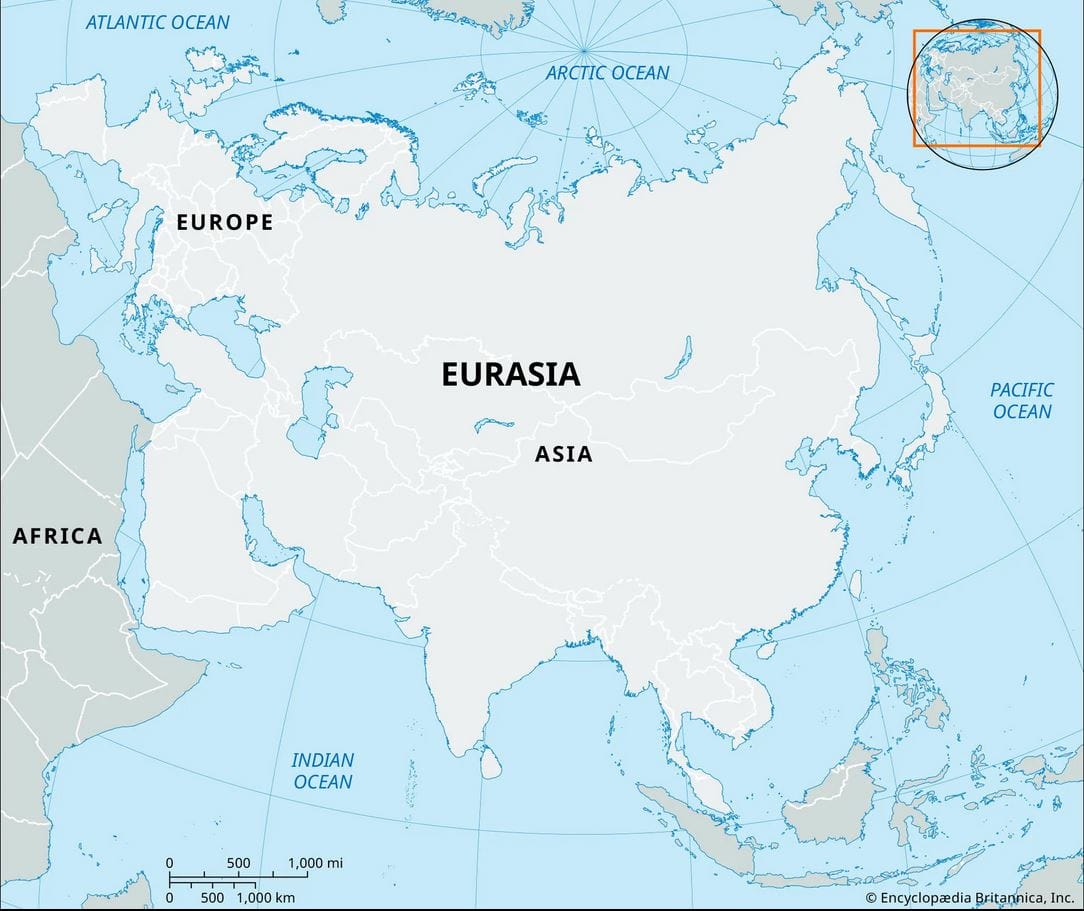
The term Silk Roads is attributed to a German geographer Ferdinand von Richthofen who was referring to the networks of exchange linking Han-dynasty China with the world beyond. It is a term “that describes the ways in which people, cultures and continents were woven together.” It is also a term which spoke of a time in which the rhythms of history were of a “bigger, more inclusive global past.” We think of our modern world as being the most connected age, with information transmitted within seconds across the globe, but the speed of connection does not necessarily mean closeness or inclusivity.
Frankopan expends great energy at the outset of the text in contrasting the optimism in Asia with the many current uncertainties in the West (such as the first inauguration of President Trump, the war in Ukraine, and Brexit), in addition to the “tensions” elsewhere in the world (such as in Syria, Iran, Iraq, and with India-Pakistan). Published in 2019, this is essentially a pre-Covid, pre-Palestine Genocide formulation, though we might say that both those events have only served to strengthen China’s standing in the world as well as throw further fuel onto the bonfire of an America World Order. Other areas which have been called into question as a result of Covid and the Genocide include the idea of fair and functioning democracies in western nations, the idea of an international rules-based order, and of course an examination of the meaning of the term human rights.
For Frankopan:
“we are living in the Asian century already, a time when the movement of global gross domestic product (GDP) from the developed economies of the west to those of the east is taking place on an astonishing scale – and at an astonishing speed.”
With this in mind, he makes reference to Rudyard Kipling and the “Great Game” held between the British Empire and Russia, where the two empires “competed politically, diplomatically, and militarily for position and dominance in the heart of Asia.” In some ways the centre of the game progressed towards the Middle-East upon the discovery of vast oil reserves, and this has been the main stage for much of the past 100 years. Today, though, Frankopan outlines a series of other Great Games, namely for:
- Influence
- Energy and natural resources
- Food, water, and clean air
- Strategic position
- Data
One example given is in the ownership of brands and institutions (such as football clubs) within western nations by people or organisations elsewhere. The English Premier League is a good example, where a club such as Chelsea were pumped full of questionable cash from a Russian oligarch in the early 2000s, leading to success on the field before his control was suspended by the British government and then bought by an investment fund which pumped further cash into the club. Another example would be public services and utilities, such as water companies, which are now owned by overseas entities. In a sense, the vulture capitalism which allowed for this (and which smiles at it all), has further shifted the power balance towards the so-called developing economies, to the detriment of the citizens within the western nations. A great mass of people, however, still seem unable to identify the main culprits of the vast transfer of wealth and resource away from them.
It may be easy to forget for a modern audience, but China was once regarded as a developing nation in the 20th Century and into the current century. Frankopan notes that in 2001, China’s GDP was 39% of the USA, which rose to 62% by 2008 and by 2016 was 114%. As we write (January 2025), the USA has suspended/blocked/banned TikTok, leading to a huge amount of people visiting other Chinese social media apps where they have seen evidence of potential disparity in the living conditions between the two nations, surprising many Americans and making them question the idea of their social superiority. There is an argument that this could prove to be a significant tipping point in a large portion of the American populace awakening from their slumber. I doubt this to be the case, however. There is always a super bowl or some other such circus.
The Chinese middle-class is huge, notes Frankopan, and their standard of living can be said to be much more favourable to those in western nations who regards themselves as middle-class (but whom we can now perhaps put down a few tiers). This includes a new kind of entrepreneur, one of whom has purchased 3,000 hectares of land in France with the aim of providing flour for a chain of more than 1,000 boulangeries in China. Another entrepreneur has purchased (and re-named) some famous French vineyards. By 2017, Chinese tourists accounted for 250 billion USD per year to the global tourism industry. Skyscanner was acquired by Chinese company Ctrip in 2016 for 1.7 billion USD. Chinese customers account for almost one third of buyers of luxury goods.
“We are living,” he writes “through a transformation and shift that is epochal in its scale and character, similar to what happened in the decades that followed the crossing of the Atlantic of Colombus and Vasco de Gama, who opened-up maritime routes between Europe, the Indian Ocean, South Asia and beyond.” This is a shift in the world’s “centre of economic and political gravity” away from western Europe. In 2019, this may have seemed a bold statement, but in 2025 it may be clearer than ever that western Europe is a kind of rotting carcass which, though salvageable (the metaphor only extends so far), is being picked at by various vultures who choose to feed the process through discord and hatred. The carcass can be reanimated (all nations are a kind of Frankenstein’s Monster), but the external influence at this time seems too sharp and acidic.
The concern in the west has led naturally to some doom-mongering. Frankopan argues that this need not be the case: that the rise and success of other areas of the globe may not mean doom for the other. Unfortunately, Frankopan also notes that “across many parts of the developed world in the west, politicians, voters and governments are taking steps to diminish cooperation with each other, to disengage with agreements that were made in the past”. There is fragmentation within these nations and in terms of their relations to one another. We could ask how this differs from any other time in known/interpreted history? Nations and empires have always clashed, made treaties and agreements, clashed again, with alliances forming and being broken.
It seems that Frankopan does distinguish between a kind of developed, western group of nations who are now threatened by what others have termed the Global South. The increased isolation and fragmentation of the west is contrasted (at least initially) to the Silk Road since 2015, where, on the surface, there appears to be great cooperation and grand optimism for collaboration. Frankopan notes defusing tensions and the building of alliances. In other words we have instances of decoupling (such as Brexit and Trump), versus deepening ties (as we shall see with the New Silk Roads).
Such examples include the agreement between Turkmenistan and Uzbekistan to inaugurate a new railway bridge in 2017, or the increased trade between central Asian states such as Tajikistan, Uzbekistan, and Kazakhstan, or the Trans-Anatolian Pipeline in 2018 which linked gas fields in Azerbaijan with south-eastern Europe, or the Central Asia and South Asia Power Project (CASA-1000) where surplus energy from plants in Tajikistan and Kyrgyzstan is transmitted to Pakistan and Afghanistan. A 2017 conference in Samarkand was attended by senior officials from the Central Asian Republics and included representatives from Afghanistan, Russia, China, Turkey, Iran, India, and Pakistan. Frankopan argues that this is more than surface level: there has been continued progress with “the thorny issue of border disputes.” This included agreement over the legal status of the Caspian Sea, which has taken decades and impacts upon Russia, Iran, Turkmenistan, Kazakhstan and Azerbaijan (some argue, however, that much is left unresolved).
Despite some closer ties, Frankopan notes some of the key difficulties and issues which may arise in this vast area. Most notable is water. There are three major rivers: the Syr Darya, Amu Darya, and Irtysh, each of which are “transboundary waterways” which mean they run through different states. This means that decisions in one country can inevitably impact those downstream (see also the River Nile – Egypt and Somalia).
The regions of the New Silk Road are resource rich. One example includes “war-torn” Afghanistan, where a US geological survey noted that the nation “may hold nearly 60 million metric tonnes of copper, 2,200 million tonnes of iron deposits, 32,000 tonnes of mercury, millions of tonnes of potash as well as huge reserves of rare earths such as lithium, beryllium, niobium, and ceasium.”
In these nations, however, Frankopan also notes there are “structural problems, petty rivalries, personal animosities and difficulties that could equally be said to characterise the region.” He notes that “a new world is emerging in Asia, but it is not a free one” and he cites issues such as freedom of the press, as well as the treatment of dissent and various financial mismanagement (he goes into some detail on Turkmenistan).
Frankopan notes that the Trump administration is committed to regime change in Iran. Relations between Iran and Saudi Arabia are strained, where the ruler MBS refers to Ayatollah Ali Khamenei as making Hitler look good, whilst also claiming that Iran’s leader is looking to take over the world. There are “warming relations between the Saudis and Israel” to the extent that the Grand Mufti of Saudi Arabia had labelled Hamas a “terror organisation”. Israeli officials are said to have admitted to have contacts, “partly secret,” with the “moderate Arab world.”
Moving on to China, Frankopan brings the One Belt, One Road policy/initiative to the table. “The belt,” he writes, “representing overland connections to China’s neighbours and beyond, and the road a ‘maritime sea road’” linking the Indian Ocean to the Gulf and the Red Sea. But this is not simply building physical roads: it is a huge investment across the regions and into countries themselves. By the middle of 2015, the China Development Bank “declared that it had reserved 890 billion USD to spend on some 900 projects mainly focusing on transportation, infrastructure and energy.” President Xi emphasised “win-win cooperation” for international relations, which is contrasted to the approach taken by the USA.
“China has learned from its own experiences that building roads, train lines, energy plants and creating the ecosystem to enable cities to grow does more than just accelerate commercial exchange; it helps life people out of poverty.”
This is particularly noteworthy at a time where poverty and destitution, or even the simple cost of living, continues to rise in the so-called developed west.
One example of China’s work is in Pakistan, with the China-Pakistan Economic Corridor, where there are multiple investments into roads, energy plants, and a deep water port at Gwadar, on the coast of Balochistan in southern Pakistan. As we shall see, when these projects are mentioned, critics raise suspicion regarding the real/true motivation behind these projects: are these altruistic projects or projects with defence and attack in mind, with soft and/or hard power in mind, or even a kind of project in extortion?
Further examples of the huge projects of construction include high-speed and freight-train lines across South East Asia, including in Malaysia and Laos, as well as motorways, bridges, power plants and deep-water ports in Bangladesh, Cambodia, Myanmar, and Sri Lanka. There is also an 8.7 billion US railway from Mombasa to the Ugandan border. There is support to Nepal, including construction of new police-training centres, hospitals and a metro system, including a tunnel under the Himalayas to link Kathmandu with Tibet and beyond.
Critics raise suspicion regarding all this. It seems to go against the behaviour of nation-states who, whilst acting in collaborative ways, tend to err on the side of self-preservation which often includes conflict and exploitation, at least when considering the recent colonial age.
Frankopan argues that China has three main aims:
- Long-term planning for domestic needs, such as energy, as well as food and water security. Any good organisation makes long-term plans, and we would expect that nations do the same, though there are many who distrust the ruling powers to act in the interests of the society and the citizens.
- Transition of their economy from manufacturing to services. In other words, having now industrialised and modernised, China is looking to “outsource” certain industries and practices whilst there is a shift in the utility of their population. I guess this is a kind of evolution of whatever we may say is their current class system of hierarchy in society.
- Security – this is in terms of strategic depth, of the lines of communication and transport that exist during times of physical conflicts, of building alliances and allies.
All this has not gone unnoticed by the world’s modern-day superpower, the USA. The primary focus (and discussion point, as evidenced by recurring news headlines and articles), is the South China Sea, where China is undergoing continuous development. In 2014, the US Secretary of Defence, Chuck Hagel, labelled this as “the beating heart of Asia-Pacific and a crossroads of the global economy.” This, Frankopan notes, is an “understatement”. The South China Sea sees 40% of China’s trade, a third of India’s trade by goods value, a quarter of Brazil’s, and 10% of the UK, Italy and Germany, and “China is acutely aware of the strategic vulnerability that stems from its heavy dependence on maritime shipping in general and the pinch points that control access to the South China Sea.” This is particularly why Taiwan is presented to us as a central issue (and is the likeliest flashpoint for direct conflict) – Taiwan (although nominally a part of China) represents open access to the Pacific, which for the USA is said to be red line.
Returning to the potential motivations for China’s New Silk Roads, Frankopan notes that some have labelled the projection as a form of “colonialism that results in assets ending-up in China’s hands.” For example, in Africa, “China’s loans are building the continent”, though it is also noted that unlike the colonial enterprises of the past, China follows a “Five No” approach:
- No interference in internal affairs;
- No imposition of Chinese will;
- No attachment of political strings to assistance;
- No seeking of selfish political gain in investment;
- and financing co-operation with Africa.
The Chinese approach differs to the approach taken by the Americans and the preceding colonial powers, a least on paper. There is a similar story of investment without strings in the Caribbean and South America, where nations such as Venezuela have turned to China for financial support.
Other concerns raised about the One Belt, One Road Initiative include environmental concerns, as well as the potential for corruption with such vast sums of money, where local elites line their own pockets (perhaps as a form of tribute). Frankopan cites Jonathan Hillman, a senior fellow at the Council on Foreign Relations and author of a book on digital silk road (which, amongst other things, warns against the CCP’s ownership of personal data, which is clearly much more dangerous than the USA accessing our personal data...), and who is a “leading scholar on the subject” who honks that the project is “breathtakingly ambiguous”.
Frankopan also cites Harvard’s Joseph Nye (he has a long list of accreditations, and the phrase “soft power” is attributed to him), who asks whether the scheme is more “public relations smoke than investment fire”. Also cited is an unnamed EU official (unnamed for a reason, perhaps), who claims “it’s about selling their stuff.” These all feel like tenuous criticisms, and at best a little hypocritical coming from western commentators. If there is a motivation around financial profit, is this bad? Should infrastructure projects be given for free? That would be a major update to the system imposed upon developing nations over the past century, including loans with interesting terms and conditions.
Frankopan goes some way to addressing this by considering the “aid” given by states such as the USA, which, “rather than being an expression of ‘altruistic charity’, is a mask for the exploitation of the local populations – and a way of passing subsidies to US corporations.” With this in mind, and with China seemingly setting a different pattern and framework for international relations, Frankopan notes the “rising criticisms of the rules-based international order, considered in the west as the corner-stone of global stability.” This has been brought into sharper focus with the genocide in Palestine, not to mention Israel’s attacks against Lebanon, and Israel’s terrorism in other nations, in which the leaders of the western world froze and erred, or perhaps could be argued to be themselves complicit in the genocide. Where the majority of the world called for a ceasefire, condemning the actions and approach taken by Israel, and where rulings were issued from the International Criminal Court, Israel and its supporters (their western gimps), remained in opposition. The USA and the UK in particular were clearly supportive of Israel’s actions, as they supplied weapons and surveillance. The world, it is argued, has (once more) seen the true face of the western ruling elite.
For the developing world, then, China represents more clearly than ever a different pathway and option. Frankopan notes that the arrangements made between China and other nations need not be simply one-way, citing Kenya’s president, Kenyatta, who feels Africa should open up to China to allow for goods from Africa to flow to China (as well as the other way around).
The question remains, however, about the funding implications. The levels of debt (such as in Pakistan, Kyrgyzstan, Tajikistan, Loas and Mongolia) are high: what happens if debt repayments cannot be met? In 2011, Tajikistan “ceded several hundred square kilometres of land to China in exchange for forgiveness of debts that it could not service.” It is easy to see how usury and lending can lead to enslavement and exploitation on a social level, and this goes for relations between nation to nation also. As Frankopan summarises:
“borrowing money from a lender who may have an interest in utilising the asset on which the loan is secured inevitably brings risks that need to be assessed carefully.”
He also notes, however, that in 2018 China announced that loans that it had given to Africa’s “least developed countries” would be exempted and forgiven.
Not all nations are open to China’s proposals. Frankopan notes the “tetchy relationship” between China and India, which is in part informed by their military clash in 1962. There have been references to China’s “colonial enterprise”, which China in turn refutes. Also, “underpinning India’s reticence is the amount of investment into Pakistan,” who have purchased attack submarines from China. We can also note Kashmir and the Himalayas, the Doklam Plateua, which lies close to the Siliguri Corridor, known as the ‘Chicken’s Neck,’ or a “terrifying vulnerable artery in India’s geography. There are potential flashpoints all around, particularly as India seems closely aligned to the USA (and, along with some western nations, took perhaps the most supportive stance of Israel’s genocide against the Palestinians). Frankopan also notes the Indian Ocean as a contested space.
Frankopan then turns to the small east-African state of Djibouti to illustrate the many moves being undertaken by nations across the world for influence and presence: “where one of the many modern versions of the Great Game is being played out.”
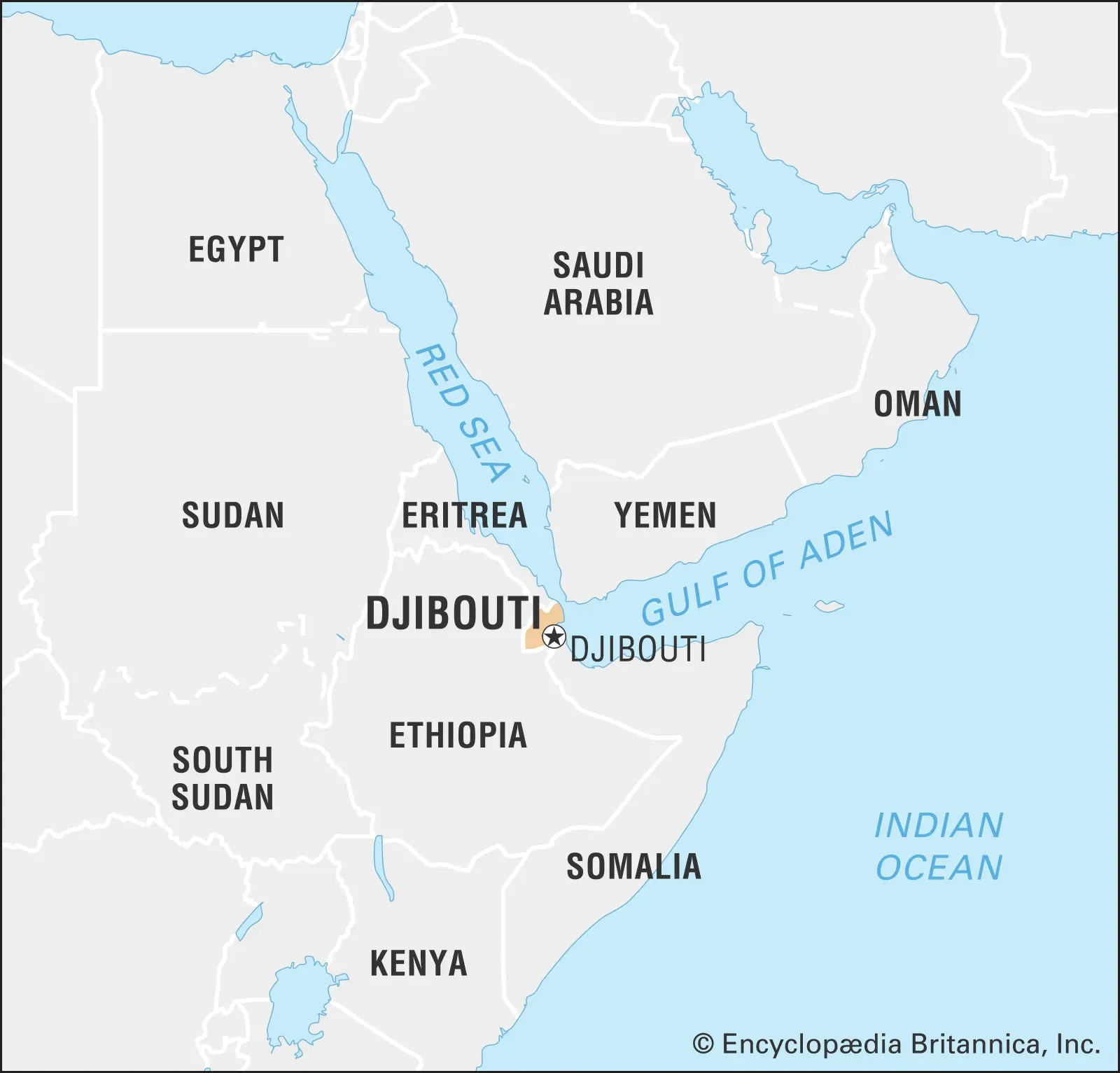
Djibouti is at the vital chokepoint between the Gulf of Aden and the Red Sea (which connects to the Suez Canal). 30% of global shipping passes through each year. More recently we saw how Yemen, displaying more opposition to the Israeli genocide of the Palestinians than perhaps any other nation, was able to greatly reduce traffic through the Red Sea, though we should also note that some ships were allowed passage (including those linked to China). Djibouti has been home to a French military base since 1977 after gaining independence from France. The region itself has become a “honey-pot” for states such as Saudi Arabia and Turkey. Japan also has a military installation there, whilst the UAE has a reinforced facility in neighbouring Eritrea, and Qatar has funded a seaport in Sudan. Russia is reported to be in discussion to establish a military base in Somaliland. China constructed a naval base in the area in 2016, and Frankopan notes how for the US, the area is of “pivotal importance.” It is easy to see how such a clogged area could become a place for quickening conflict.
Some commentators may argue that the moves made by the nations are sensible, though we can ask what the human and environmental cost is? For Frankopan, “as history shows, expanding economic and political interests go hand in hand with taking steps to protect them.”
Also of note is west Africa, where in the tiny state of Sao Tome e Principe there is major Chinese investment, with a deep water port under construction at an estimated cost of 800 million USD. In central America, Frankopan notes that both Panama and the Dominican Republic have benefited from funds to upgrade port facilities. With the inauguration of Trump for a second term, it was noteworthy to hear of the USA’s ruling elite speak through him regarding the Panama Canal, suggesting shifty Chinese interference and a desire to claim the territory.
Frankopan’s text is an exercise in presenting a building-up of tension towards a clash between the USA and China. There are references to James Mattis, US Secretary of Defence, and Lieutenant General Kenneth F McKenzie Jr, and Admiral Philip D Davidson, all of whom issue warnings around China’s power projection and capabilities with regards the South China Sea and beyond.
Frankopan gives some room for the Chinese voice, with Jiany Shigong, a prominent Chinese intellectual quoted:
“Western civilization is built on a philosophical-theological tradition of binary antagonisms”.
By this we can take to mean the inheritance of the Abrahamic faiths and the clear distinction (or battle) between good/evil, light/dark, which can be argued to extend to other binaries such as coloniser/colonised, master/slave, Us/Them, West/East, civilized/barbarian. To be sure, we could make a case for these existing in other civilizations. The Chinese, for example, had a few ‘alien dynasties’, including the Manchus, the Mongols, and other nomadic steppe peoples who were regarded as barbarian. The difference (as noted by Patricia Buckley Ebrey), appears to be that when a civilization or peoples come into contact with Chinese civilization and culture, they are subsumed by it (or won over), with those barbarians becoming Chinese through Chinese culture. For the West, power is imposed, and as we can see in places such as the USA and the UK, those conquered and colonised remain, at times, rejected and mistreated.
For Frankopan, “the question of China is a very existential question to the United States.” This is a bold position, but with the recent genocide against the Palestinians this takes on even greater implications. As noted, the whole world has had a clear view of the events taking place and the responses given by each nation, each set of rulers, each form of government, each culture, each group within society. It could be argued that at no other time before has something been so clear to the entire world, and the responses so recorded.
Frankopan notes that key figures in the USA make the assumption that China is seeking global dominance, but perhaps this is another error being made by the USA in that they assume the world will necessarily follow in the bloodied and burnt footsteps it has walked. It is the US, he writes, “that is increasingly perceived as bending rules to its own will or breaking them altogether.” Again, without wanting to labour the point, the recent genocide has in a sense removed the mask from the existing world order. The United State of America and Israel (as well as its gimp followers) made very clear that, when the time came, they would choose what rules they would follow, what they wanted to respond or answer to, and they walked the path they chose without care or consideration to the voices of the rest of the world. Indeed, Frankopan states that there is a wider pattern (this book was first published in 2018, remember) of the US choosing to act unilaterally, such as withdrawing from the World Trade Organisation, or from the UN Human Rights Council:
“this chorus about America’s unreliability is becoming more and more common.”
Although Frankopan goes into some detail on the Trump administration and approach (or “doctrine”), including the aim of permanent destabilisation, as well as “attacks” on supposed friends, where the chaos is a smokescreen, alarmingly, this trend of US bullying cannot be argued to have started with Trump: the preceding years of Obama, Bush and so on evidence a clear trail of destruction, but also with what followed with the Biden administration.
Frankopan’s contribution to this dialogue is to propose that the USA has decided to “bet the house” on India. We can see this shaping of alliances take place today, where even Zionist-funded figures in the UK voice more reasoned views, at times, concerning India. But Frankopan notes one difficulty is that India has been supported by Moscow for generations, with Prime Minister Modi referring to Russia as an “old friend of India,” though this can be taken another way to mean that alliances and agreements have shifted.
Some commentators believe/argue that the United State of America and Israel have achieved some goals in securing larger parts of Syria, and that their absolute aim is for regime change in Iran. There are a number of reasons for this, and Frankopan notes a key one in that “Iran has always been the ‘back door’ to Russia.” He goes on to reference Gordon Duff, writing in the New Eastern Outlook, as saying that “war with Iran might well be the end of America as a ‘world power’”, that it would result in Saudi oil supplies being stopped “for all time” and “lead to the ruin of Israel for good measure.” Frankopan notes that efforts to weaken Iran have had a negative effect on states such as Turkey and India. The obvious beneficiary, of course, is China, who continues to trade with Iran regardless of threats and sanctions from the USA. And this brings us back to the physical space of the Eurasian plateau, where we see the land connections between these states.
Ultimately, Frankopan notes that “it is striking to see just how few true allies the US has around the world, and how even long-term partners questions is basic reliability.” Perhaps this is why the USA took such a stand with Israel’s genocide against the Palestinians. In one sense, they displayed to the world that if a nation is an ally, then they will be supported all the way, and that the USA would find ways to circumvent or disregard any opposition. The cost, of course, is that genocide now has a benchmark in the modern world.
Let us imagine that the Cornish began an uprising for independence which was suppressed by a New Mercian brigade, or an English Defence Legation, and this brigade murdered children (labelling them as “terrorist infrastructure”), systematically raped women, and destroyed their towns, hospitals, universities and so on, and Westminster argued that their actions were justified in protecting the territorial integrity of the United Kingdom, and despite international condemnation the monarchy and Westminster simply ignored UN Resolutions or warrants for arrest. This could explicitly be liked to the genocide against the Palestinians. A strange example, perhaps, but the terms can be interchanged to make it relevant to any member of humanity. Today we can say that the genocide of the Palestinians is a result of the years they had been ignored, and the ongoing actions of Israel which were overlooked or ignored. In other words:
“whoever spares the rod hates their children, but the one who loves their children is careful to discipline them.”
Alongside Israel and India (not to mention to a certain, cretinous extent, the UK, France and Germany), the other key ally for the USA is Saudi Arabia, noted by Frankopan to be a “pillar of US policy in the Middle East.” During the Obama years, the Saudis spent 112 billion USD on US armaments over the course of 8 years. Where does all this money go, a citizen of the USA may well ask? Riyadh, however, also has some good connections with Russia. Upon his recent second inauguration, Trump mentioned how nice/good the USA has been to the Saudis.
In addition, Turkey is regarded as a “cornerstone of NATO’s cold war strategy […] thanks to its position relative to Russia, the Middle East and Central Asia.” The old seat of the Ottoman Empire, regarded as a meeting point between east and west, has a delicate position which makes it both extremely vulnerable and extremely influential.
As we can see, Frankopan’s text moves from hopeful discussions of the productive and cooperative relations between nations (i.e regarding China) to the potential flashpoints and difficulties to the world (i.e the USA). And what of Washington’s old foe, Russia? Frankopan notes that there is a wider pattern of Moscow “trying to present itself as a reliable and calming force, as well as an independent international arbiter.” This is perhaps made more challenging given its actions in the Ukraine, however Russian apologists point towards this being a precautionary exercise of territorial and defensive integrity against NATO expansion, with the Ukraine being a red line that was crossed.
Whatever position taken on this, there are notable differences in the ways that Russia approached their aggressions against the Ukraine and how the United States of America and Israel attacked the Palestinian people. There is also notable differences in the ways in which the actions of Russia and the actions of Israel are reported in the western media, not to mention the ways in which the Ukrainian people and the Palestinian people are discussed.
Frankopan spends some time considering some of the potential rifts between China and Russia, before estimating that 85% of Belt and Road initiatives have proceeded without difficulty, despite negative headlines. He also notes the risks to the global economy in the event of a “slowdown, correction or crash in China” given how deeply embedded their economy is across the globe. Although there may be some benefits to places such as the UK (Frankopan cites a potential drop in oil prices), he also notes how the Bank of England has reported that the UK would be hit particularly hard by a financial crisis in China.