
The Shortest History of England
James Hawes's Shortest History lays bare the fragility of the English identity.
England is a nation comprising of English people. And there are some Welsh and Scots living there also, not to mention some Danes, some Indians, some Cornish, some Protestants and Catholics, some Arsenal supporters and some Bristol City supporters and some doctors and nurses and teachers and farmers. There's a lot of different people, to be fair, and this seems to be the same in any nation across the world, where in some places there appears to be some cultural elements or practices which are more widespread.
But what is a Englishman or an Englishwoman or an Englishperson? Is is a person who is born within the current borders of the state? Is there a threshold of past generations within a person's family tree that need to meet the birth within borders requirement, and if so what is the limit? Is there a formula to determine this (birthplace + parent birthplace / last generation born outside 'England)? Is there some set of cultural values that we can define as English, and how do these factor into whether we can determine if someone is English? In what ways does the 'English' identity clash and become submerged within the 'British' or 'United Kingdom' identities?
We are living in an age of great fragmentation, where people are led to believe that the causes of their problems or concerns are people such as seekers of aslyum or immigrants from other lands, rather than the architects and primary beneficiaries of social inequality.
James Hawes has great freedom in choosing when to begin his 'Shortest History', and he chooses to do so in 55 BCE with the Roman Empire vaguely aware of a land famous as a source of tin, a vital metal that could transmute copper into brass or bronze. At this time it must be said that the British Isles consisted (as they do now) of variously defined peoples, none of whom would yet be labelled as English.
Caesar’s fleet crossed the channel in a single night but their landing failed; they tried again the following year, successful up to the Thames Valley. By 43 CE, Emperor Claudius decided that the colony (can we refer to it in this way?) had developed well enough to be worth properly invading and taxing. By 100 CE, the south-east was a peaceful and prosperous colony (ah, we can now). Its people, Hawes writes, were related to the Gauls, whilst in the north the people were Germanic in origin. Hawes emphasises this supposed north/south divide throughout his history.
In 286, the Saxons “infested” the channel, and by 367 they had conspired with the Picts, Scots and Franks against the Romans, who eventually left in 383-4. The term Anglo-Saxon, which many people today make claim to, was a term invented by Alfred the Great. Hawes, in fact, deploys the term “English” as shorthand for all Germanic settlers, and there are many today who would welcome the link between English and German. Does this in some way mean that the modern-day nation-state of Germany can lay some claim to England itself? Is there a future where a political entity comprising of England, Germany, and some of the Nordic countries is established?
The Anglo-Saxons, nevertheless, are said to have replaced the Roman culture, rather than assimilating with them. This is said to have been so complete, in fact, that the Romano-British language died. The Celtic languages, as we shall see, would also have to battle to survive.
In 601, Ethelbert of Kent (Bretwalda, or ‘paramount king’) was married to Bertha, a Frank, and he converted to Christianity. Everyday language was English, rather than Latin. By 655, the last pagan king, Penda of Merica, was dead.
By the end of the 8th century, the borders between England and its neighbours was established, and remain much the same as today.
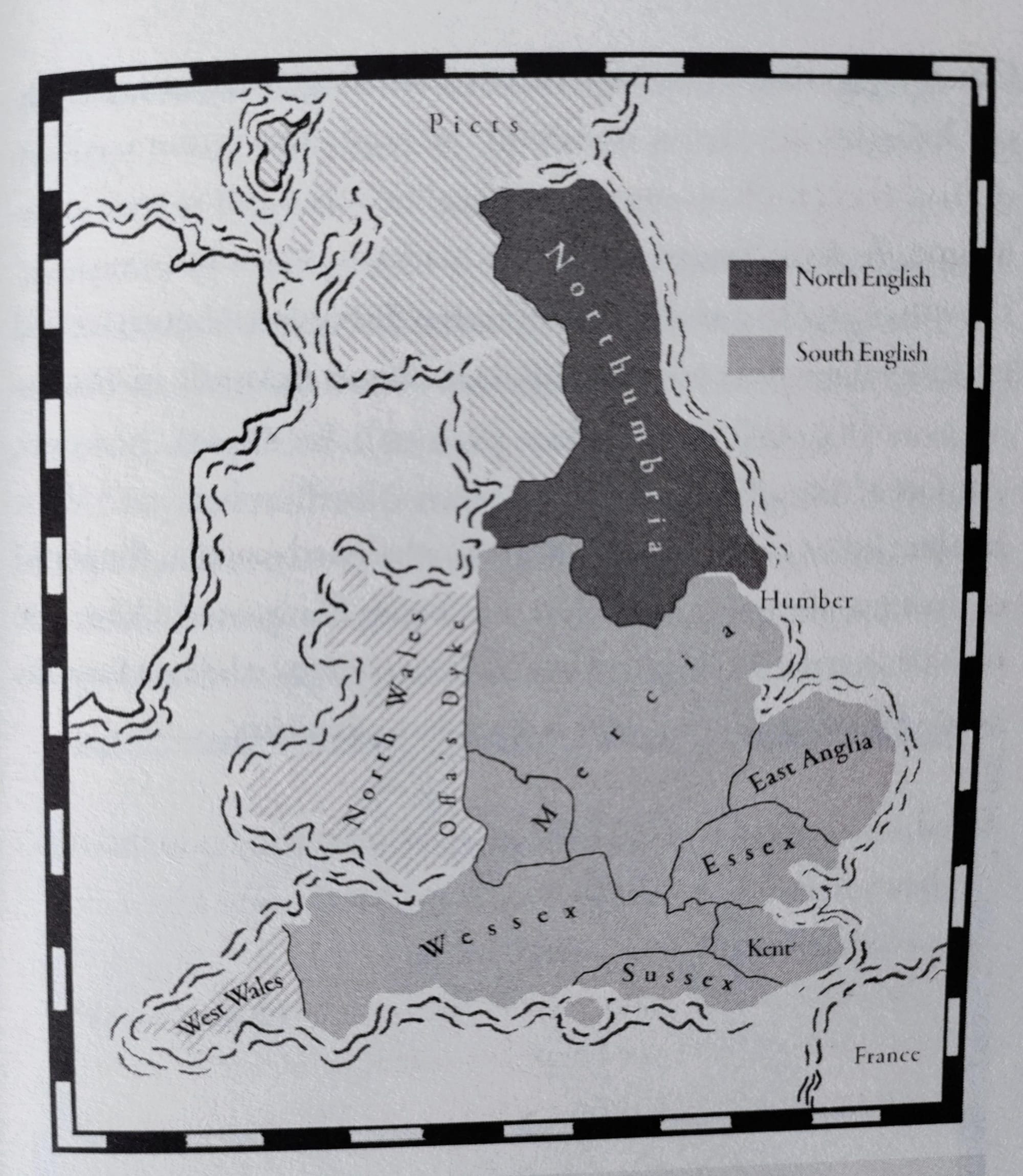
Viking raids commenced, including the sackings of Southampton (840) and London (842). In 865 they smashed into Northumbria and partly took Mercia. Alfred of Wessex, a fugitive king, was able to regroup, rally, and defeat the Danes at the Battle of Edington, 878. He then sought to unite England – Saxons, Angles and all. He imported the Frankish hierarchy, including the idea that kings were approved by the church (read: God). In 886 he retook London from the Danes. His successors united glorious England, including the Danes.
“Modern England was born.”
The Vikings, or Danes, however, retook York and Northumbria following Athelstan’s death. England was re-divided between Eadwig in the south and Edgar in the north, who ceded Lothian to the Scots.
Edgar’s laws only applied to the English, with the Danes having their own law, handily titled Danelaw. Vikings continued to raid, and appeasement (a phrase deployed when we get to the Second World War) didn’t work. Aethelred the Unready tried to bring Normans onside by marrying the Duke of Normandy’s sister, Emma, in 1002. Then he ordered the massacre of “all the Danish men who were among the English race.” The Danes, under Sweyn, King of Denmark, invaded, and Aethelred fled, exiled in Normandy.
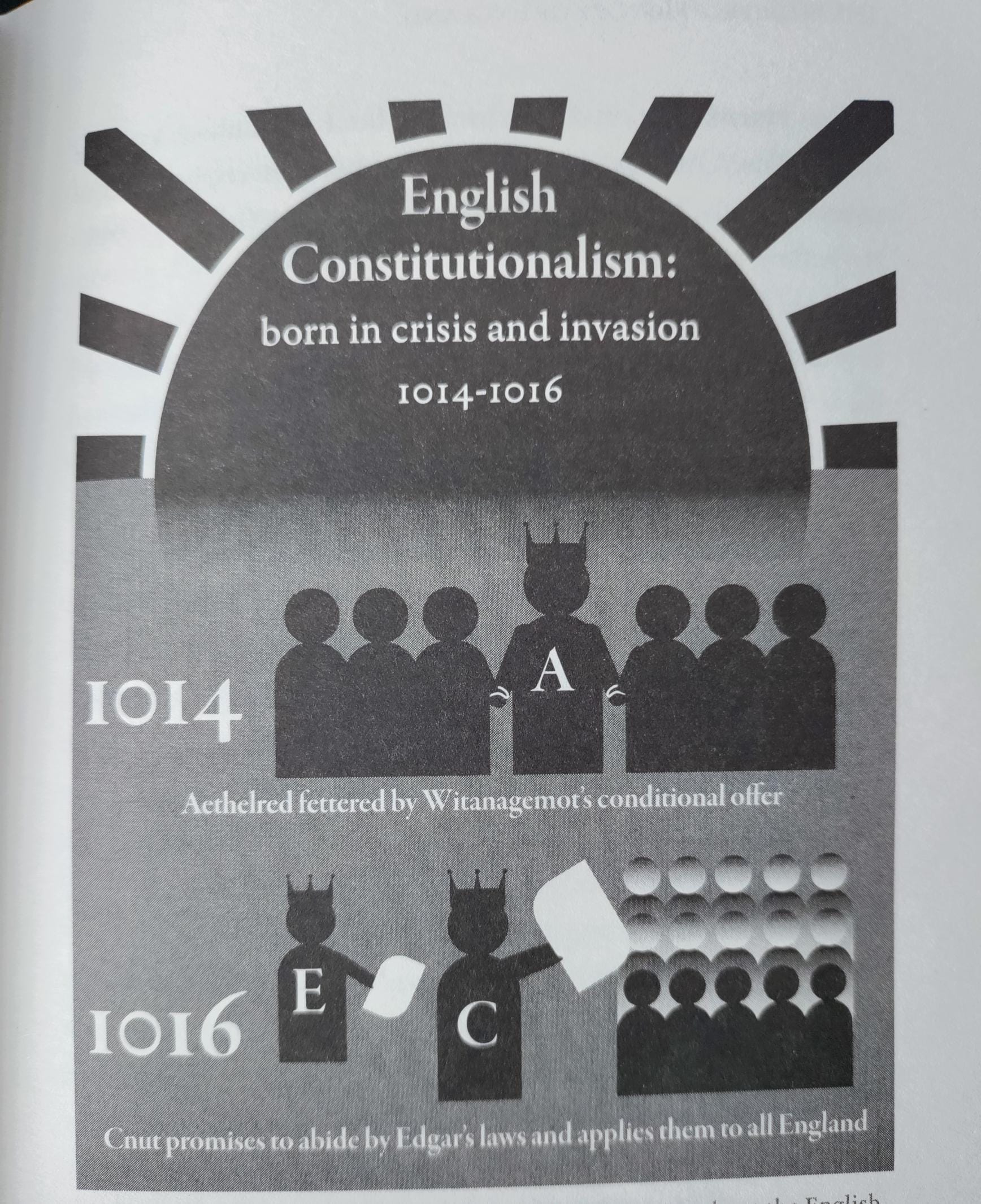
He returned, however, invited back to “rule righter than he did”, and he invited King Olaf or Norway to oust Cnut, who in turn fled back to Denmark. He also returned, however, and England was divided with Cnut in the north and Edward Ironside in the south until Edward died that same year and Cnut inherited all. So far so English, or Danish. One of the two, at least.
Cnut married Emma of Normandy, and the aristocracy was purged, replaced by Danish or Norwegian earls. Cnut called the land ‘England,’ and so we may say that England was founded by a Dane.
Following this William or Normandy (backed by Pope Alexander II) invaded, defeating the chosen king, Harold, at Hastings in 1066 using the new European warfare tactic: a heavy cavalry charge with a lance. The English warrior elite fled the country en masse, founding a New England in the Crimea.
An Anglo-Norman realm followed with Rufus, William’s second son. He used England as a “tax pump” for his endless attempts to conquer Normandy. In 1100 he was killed in the New Forest and his younger brother Henry declared himself king.
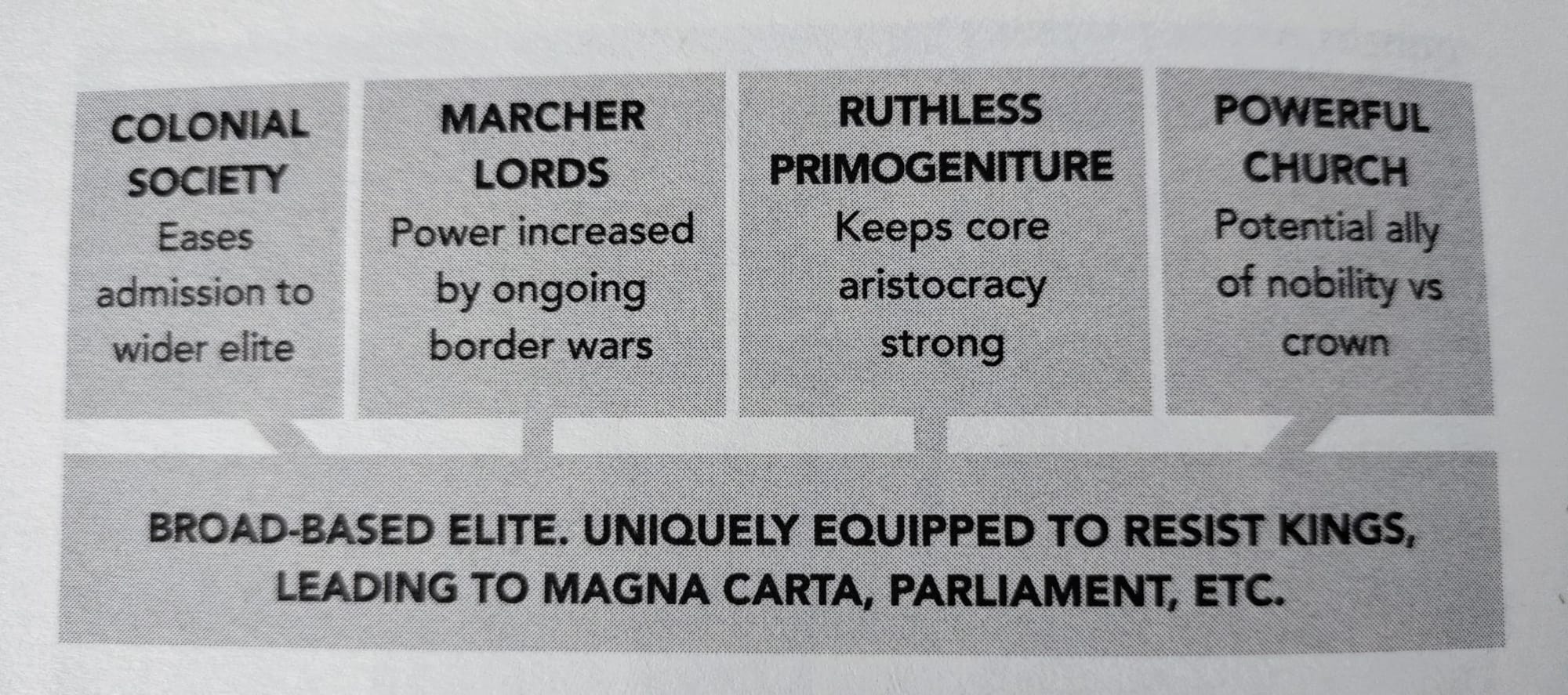
The Anglo-Normans attempted to conquer Wales and Scotland, but failed. This was the “start of centuries of warfare […] that reinforced the ancient differences between the wealthy, pacified South-East and the rest.” This led to the creation of a “super-aristocracy” known as the Marcher Lords, who were entrusted by English kings to hold and extend the frontiers.
In 1152, Eleanor of Aquitaine divorced the King of France and married Henry Plantagenet. He inherited the throne from Stephen of Blois (Henry I’s nephew), though he was more French than Norman.
Hawe writes that the Conqueror and his successors treated the colony (England) as a “legal blank slate” whereby all noble land was a loan from the king, so the nobles in turn developed primogeniture, meaning all estates and titles “cascaded” only to the first-born male, unlike elsewhere in which all children inherited. This created a “tight, rich aristocracy.”
The next key character in this sweeping history is Thomas Becket, a humble-born Anglo-Norman who was made Archbishop of Canterbury. In 1170, Henry had him slain in his own church, and the king was then forced to perform a public penance. This left England with a “powerful and confident church, wary of monarchical power.”
Henry’s eldest son, Richard, rebelled and was named as heir when Henry died in 1189. He was made prisoner of the Holy Roman Emperor when shipwrecked as he crusaded. John, his fourth son, succeeded him (or usurped the crown) in 1199. He promptly lost a key battle in France. The barons subdued him in 1215 and forced him to sign what would become the Magna Carter. This contained the “germ” or parliament, and the idea of a law which would be above the king. John died and his nine-year-old son Henry was crowned in 1217. He re-confirmed the Magan Carter. Under Henry II, England “became still more French.”
Hawe notes the origin of the St George’s cross, which is now being painted on roundabouts by valiant and brave souls whose only wish is for society to improve! It was the good chap Prince Edward who used the cross to mark out his own men at the Battle of Evesham in 1265. As Edward I, he pursued a “vast, methodical and ruthless campaign” from 1282-83. He also expelled the Jews in 1290, declaring debts owed to them were now owed to him. He also turned against the Scots, but was defeated by Robert the Bruce.
“His wars hardened all three nationalities in Britain.”
The Great Death of 1349-50 killed 30-45% of all people in England. A new rural middle-class arose in the peasantry, and with fewer peasants, wages soared. Perhaps this is what the Farages and the gammon-flavoured vape smokers beating their drums against anyone considered brown are really after? They just want higher wages; and who can argue with their arguing?
Richard II was crowned at the age of 10 in 1376, supported by his uncle, John of Gaunt. The common people now had English leaders, such as John Wycliffe an John Ball. Richard surrendered to his cousin Henry Bolingbroke, who became Henry IV in 1399. He made a “populist appeal to ordinary English folk” and became the first king since Edward the Confessor to accept the crown in English.
In 1403, the Mortimers (Richard II’s legitimate heirs), united with the rulers of Northumberland, the Percys, and with Owain Glyndwr of Wales, to rebel against Henry. Henry succeeded, however, the price a “serious transfer of power to parliament.” The descendants of the Mortimers and Percys would become deadly rivals in the War of the Roses, where Richard of York and his allies lined-up against the king (Henry VI, aided by the Percys.
It was the warlords of the north and wales against the warlords of the south. Eventually, Edward of York crowned Edward IV in 1471. He appointed his brother, Richard of Gloucester, to run the north. He built a powerhouse in York, then staged a coup when Edward died in 1483. The princes in the tower were never seen again, their tomb a multistorey carpark. Edward was to become the most “reviled” king in English history.
Henry VII, part-Welsh, succeeded Edward. Hawe notes that this ushered in a new style of state-building, with a three-pronged leader ship of crown, church, and “tamed aristocracy.” Hawe makes some interesting choices at this point, including references to Enoch Powell and phrases such as John Cabot having “discovered” North America.
Henry VIII, a peer of Charles V of the Holy Roman Empire, and of Francis I of France, next ascended to the throne. He began by asserting that he had a rightful claim to France. This chap is mainly known for having various wives and for the impact this had on church and state in England.
The entire “Old World” was disrupted by a little ice age which hit food supplies. A particular flashpoint in England was “enclosures”. Previously, farmland had been held in an “open field system” so that everyone had a share of good land, poor land and fallow land. There was also “common land” where everyone could jeep a few geese or goats or pigs. Common land was now divided up. Landowners, as is often the case, became richer, but in turn created “the most destabilising” thing for any society:
“A class of poor folk with no hope of bettering themselves.”
This is surely what we have in the UK, Britain, England (whatever) today. Social inequality, hording of wealth, avoidance of tax by the wealthy, and the selling off of public industries and utilities has created the conditions for widespread disaffection. The people who are most disaffected, with their communities drained, are the ones most susceptible to being misled by snakeoil salesmen such as Farage or actors such as Tommy/Stephen Robinson/Yaxley-Lennon. The populace remains fragmented, and the engineers of the inequality wipe their brows in relief. Are we in an age of another Grand Disruption?
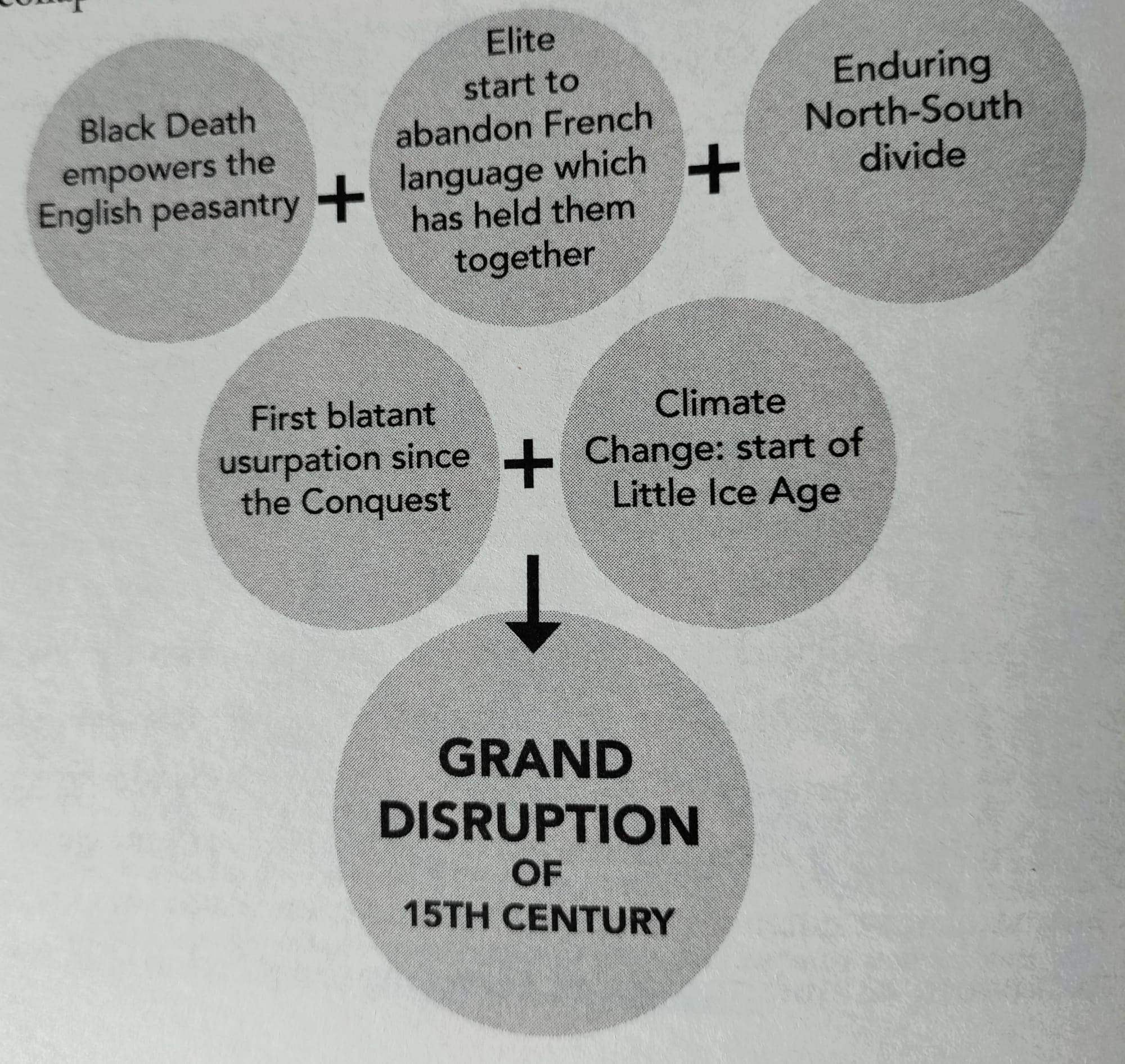
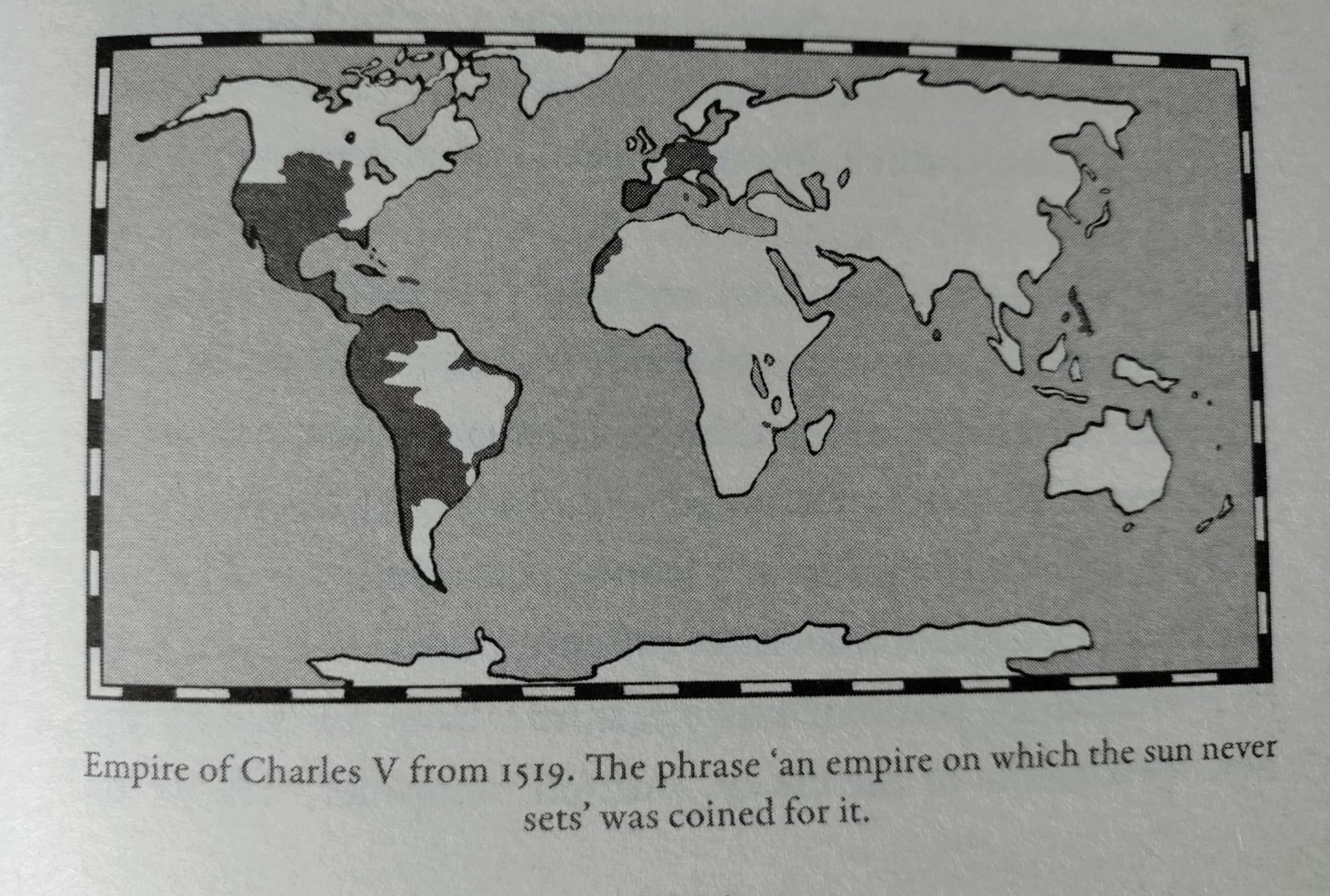
People fled from rural areas to towns and cities. This coincided with an expanded understanding of the world, with Charles V’s new world empire in 1519 with the defeat of France in 1525. Henry VIII demanded a full-scale invasion, and a special tax was announced, but parliament resisted and peasants revolted. Henry tried to divorce his marriage to Catherine of Aragon, but this led to a divorce with the church (the Pope version, that is). The Act of Supremacy (1534) made England an empire governed by the king, who was completely sovereign.
Hawe notes that the “elite never cared about nationalism”, which we could also apply for our age. Nationalism is the packaging, or the vehicle (powered by the people they herd together) which the ruling powers (in contest with one another, at times) present to certain segments of the populace.
Henry and his elites overcame and seized Wales, Scotland, and Ireland, funded by a vast royal asset-grab. They also nationalised the church, and brought in a new scholarly elite at Oxbridge.
The Duke of Somerset enacted the Poor Law: anyone unemployed for three days had to do any work that was offered to them, in exchange for food. They could be enslaved for years. Peasant rebellions were crushed.
Edward died in 1553, with Mary becoming the first queen to rule in her own right. She ignored parliament and chose to marry Philip of Spain (son of Charles V). Protestants were targeted and burned. England lost Calais to the French. Upon Mary’s death (1558), Elizabeth (Henry VIII’s daughter by Anne Boleyn) succeeded. Parliament was strengthened.
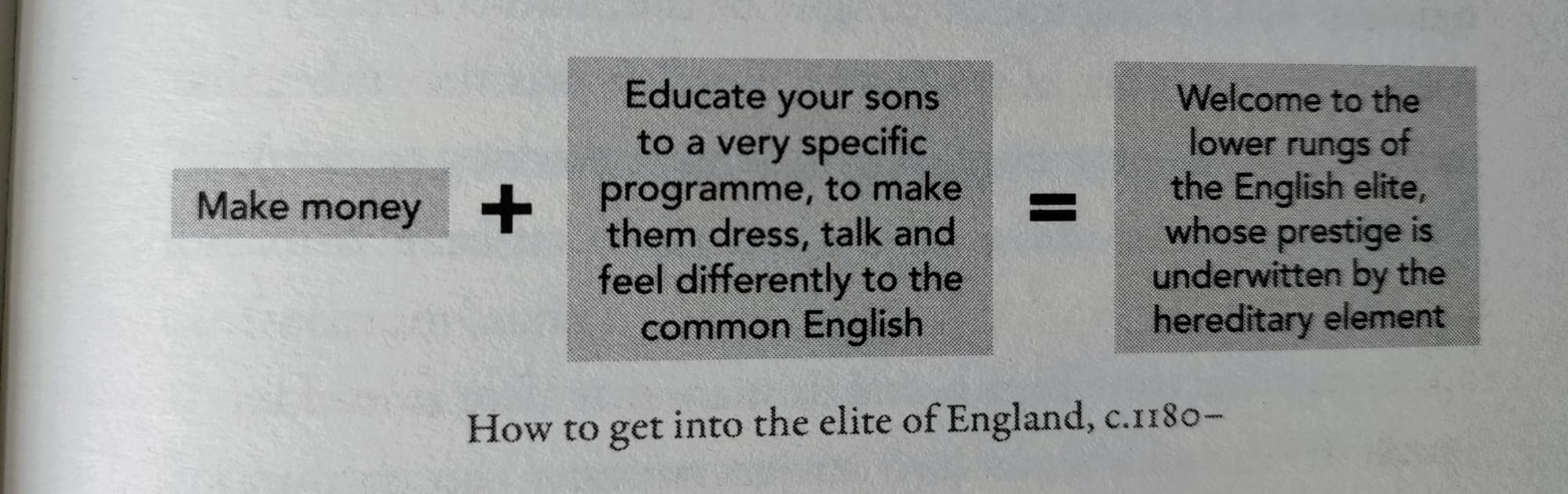
“The way into [the] new elite was clear: money, and a very specific type of education, based on the Classics and Law French, in Oxford, Cambridge and London.”
In 1577 we have the first designation of the “British Isles”, which meant that “Elizabeth Tudor was no mere English queen.” She was declared a heretic by the Pope and was open to assassination attempts at the hands of Catholics. She sent Francis Drake around the world. In 1588 the Spanish Armada set sail for England, ultimately defeated, which brought some sense of national unity (Hawes argues). This allowed the “regime to claim that the Protestant English were God’s chosen people.”
Although the church had been humbled, it still retained some power in the sense of being a widespread, or national, mass medium of communication. Controlling this institution was vital to the ruling elite, in much the same way that any widespread belief system or religion has. The common people, though, “got poorer still.”
Elizabeth died in 1603, leaving no heir. James VI of Scotland became James I, presented by Lord Salisbury as the sole way to avoid a civil war. He abandoned the war against the Catholics, and issued the King James Bible as an attempt to “hold the centre.” Guy Fawkes and others attempted a bombing of parliament in 1605.
Interestingly, Hawes argues that James (and his advisors, we can say) countered the disunity by “abolishing” England and forming a Great Britain. At this time, there was also mass emigration to the American colonies, perhaps some 500,000 to 4 millions peoples in the first half of the seventeenth century. For Hawes:
“The English empire rose because life was so bad for the common English.”
James I was succeeded by Charlies I in 1625. He oversaw a kind of civil war between the Empires of Great Britain and Parliament. England, Hawes writes, became something of a “failed state”, with local militias everywhere. Cromwell declared war, aiming to “save a nation” or, in Hawes's words, to “preserve the dominance of South-Eastern England", continuing his framing of the north/south divide as being central to our understanding of England.
Cromwell’s New Model Army of 1645 was manned by those “with true English hearts.” In our current strange age, we need to keep an eye out for these terms and devices being deployed as this may help us to recoginise the strings being pulled.
This was an age of movements, including the Levellers, a radical “populist tiger.”
“The price of Parliament’s victory was an uncontrollable religious-political radicalism.”
Charles was executed in 1649. England was placed under military rule, though this meant no change for the common folk. Similar promises are made to disaffected and voiceless citizens today, and people are easily herded into mobs.
More war followed, this time abroad against Holland and Spain. Subsequently there was an age of the Rule of the Major Generals (1655-7), which left the English with a “lasting horror of anything remotely like military rule.” The army disbanded following Cromwell’s death. Hawes asserts that they simply wanted their pay.
A Convention Parliament agreed that Prince Charles (the dead king’s son), an heir-in-exile, would be crowned. This period saw the last Great Plague (1665), the Fire of London (1666), and defeat in the Second Dutch War (1665-7).
The political elite of England split: the Tories maintained that a king was “paramount and ruled by right of bloodline,” whereas the Whigs believed that Parliament determined succession, attempting to limit the king’s power.
James III succeeded, becoming the first Catholic ruler since Mary. A challenge arose in the form of William, Prince of Orange (King of Holland in all but name). He feared a further English union or alliance with his enemy, French King Louis XIV.
“To keep Holland free, England had to stay Protestant.”
He launched an invasion in June 1688. After 3 weeks, he entered London unopposed. Hawes notes that ordinary Londoners “bought the story that he had come to defy Popery, preserve their laws and liberties – and restore a free Parliament, so that both King and People might flourish.” But he was only here, Hawes argues, as he desperately needed muscle against the French. Parliament agreed to fund him, but only if it were in control of the military. William was succeeded by Anne until Parliament selected George, the German son of Sophie, Electress of Hanover.
The Bank of England was founded in 1694 and with it a new, unique format in the world of international financial markets which was particularly attractive: loans were guaranteed both by a real king and a Parliament run by a broad-based elite.
Hawes writes that in 1709 the entity we are supposedly discussing was now known as Great Britain. This entity was at almost permanent war with France. He further recounts the rise of navy, which he argues was born from a desire to make money instead of recurring land wars across Europe (which led to loss of money). The navy became the “most class-blind institution in Europe”. This hybrid Great Britain-and-Ireland-and-Hanover empire roamed victorious, including in the Seven Years’ War (1756-63).
There was a triangle of goods which ran from the West Indies (such as rum, tobacco, tea, cocoa, coffee and refined sugars), leading to England, where people were becoming “chemically regulated” to new ways of living and working. What was unseen, he observes, were the slaves stolen from lands in Africa and transported across the horrifying Middle Passage.
Vast deposits of coal gave England a unique geological advantage at this time, and in turn supported a business-like elite who crushed the peasantry. But “disaster came” when London tried to impose a high tax, high spend approach on the American colonies.
In addition, as we have seen in our summary reading of Irish history:
“To control rebellious Ireland, a brand-new state was founded: in 1801 Great Britain became the United Kingdom.”
Income tax was also introduced, which was deeply unpopular.
Hawes, in setting the scene of Napoleon’s rise, asserts that Britain “was able to worry about making the world a better place” when Parliament abolished slavery. This is clearly an outdated, jingoistic, almost cretinous position to take. We can argue that Britain (or whatever term we want to use here) greatly benefitted from the slave trade, and that the move to “abolish” it, whatever that means, was driven by other factors than altruism, especially the impact on the French Empire.
Napoleon mobilised for war, but then abdicated in 1814, beaten on two fronts. Victoria ascended in 1837, with England/Britain/the UK asserting the “British Way” with “a tough nudge from the Royal Navy and the army where necessary. New lands were incorporated and ancient cultures forced to change.” There is a good deal of sanitising in Hawes's account of this time, and a failure to recognise that the Empire’s approach was, to use a less sanitised term, a form of bullying.
Hawes does concede when citing Disraeli that England remained two nations: poor, and rich, Saxon and Norman, North and South. The north had become more powerful due to the Industrial Revolution, and the Chartist movement subsequently placed some reasonable demands on the elite (such as universal suffrage, and vote by ballot), but the elite were suspicious of a transfer of power from south to north. When their Great Petition failed, they tried setting-up an alternative Parliament in the north. To counter/appease, the Revered Nathaniel Woodard proposed public boarding schools, where the northern elite could send their son to be trained in the ways of the southern elites. This is, Hawes admits, a “signature trick” of England’s ruling elite: inviting in new blood.
Victory in the Crimean War (1853-6) followed, with a partnership made with France against Russia. An Indian Mutiny (1857) was crushed, and “free trade imposed” on China in the Second Opium War (1856-60). But Hawes notes that the triumphant empire was an “illusion”. The United Kingdom, he writes, “was never a real hegemon”. The empire depended on Europe being stable and “politically agreeable”. This does seem to be an attempt at further deflection from the actions of Empire, though his purpose is perhaps in making a link to the First and Second World Wars.
He stressed the divisions of the Empire:
“From the moment they could use their votes, in 1885, the ordinary Irish, Scots and Welsh used them to make nationalist demands, openly or implicitly.”
The lines were also apparent in England, most notably in the south-east which went, and stayed, Conservative.
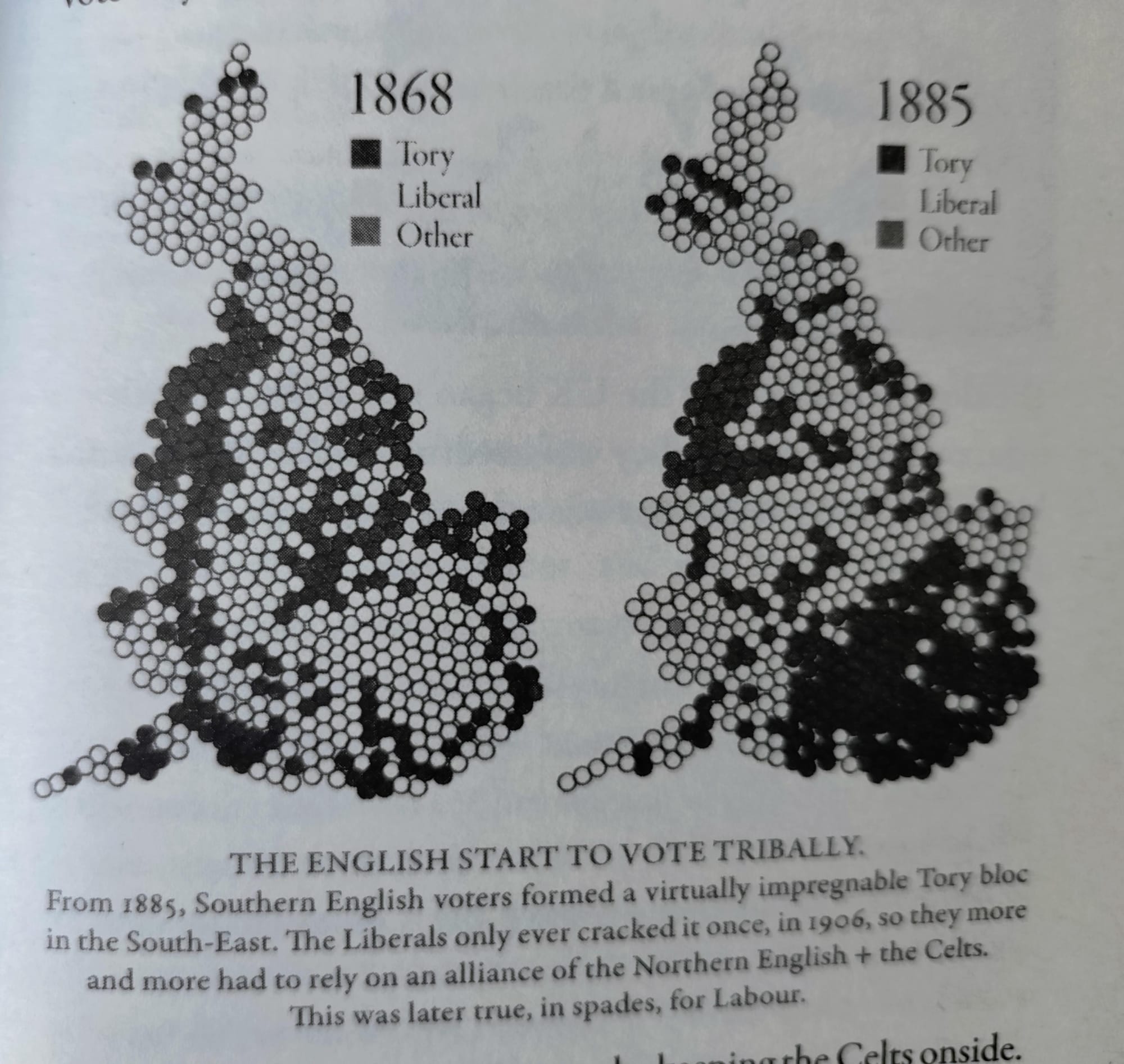
From 1885, the Conservatives “went populist, claiming to defend the rights of ordinary people against over-taxation, foreign competition, immigrants and do-gooding Liberal licensing laws.” In much the same way, we can see the Reform party appealing to the same sentiments.
Hawes argues that towards the end of the nineteenth century there were thoughts of a “degenerating race”, including army humiliation in Black Week (1899) during the Second Boer War. He does not, however, challenge or unpick the term “race”. As one of the sponsored tongues within society, this is an oversight on his part.
Two economies were emerging: London and its hinterland, with its financial services and investing capital, and “outer Britain”, with a low-skilled export industry. Once World War 1 commenced, outer Britain rose and parity was restored as investment made its way there. The Labour Party, Hawes notes, was born of “an incarnation of the Outer British Alliance”.
He further writes that “as other empires crumbled, the UK – and the British Empire – held (though only just, in Ireland).” And he notes that the “survival of Western civilization was in the balance” when the British fought against Nazi Germany. What did the Nazis represent, we can reasonably ask? Or, better yet, what does “Western civilization” mean to Hawes? As we learned in our summary reading of Yellow Peril, Western civilization is a process by which hierarchy is imposed upon the world, with identities formed and opposed. Perhaps we can assume that for Hawes western civilization means the lineage from ancient Greece through to the Roman Empire through to the Age of Enlightenment and, specifically, the German and British Empires of western Europe. The lines become blurred and muddied, bloodied, even, and there is ample room for hypocrisy.
Post-1947, he notes, the empire was “collapsing.” He notes that the Citizenship Act of 1948 gave every citizen of the United Kingdom and Colonies rights as a British subject. He writes, however, that “serving in the Empire in arms had given non-white colonial folk ideas”, which presents them as mischievous and cunning. It is difficult to know whether he has bitter tears in his eyes when writing:
“Multicultural England happened because the elite refused to let go of Empire.”
We can assume that he feels that multicultural England (multiculturalism in general, whatever this means) is/was a mistake. Again, as a sponsored voice within society we would like to think he has a sense of duty to the ways his words can shape a discourse, but perhaps he is a sponsored tongue for this very reason.
The Suez Crisis is described as a “last attempt to go without the Americans”. Hawes, to his credit, seems agitated by the USA, referring to the United Kingdom as a “military, economic and cultural satrap of the USA.”
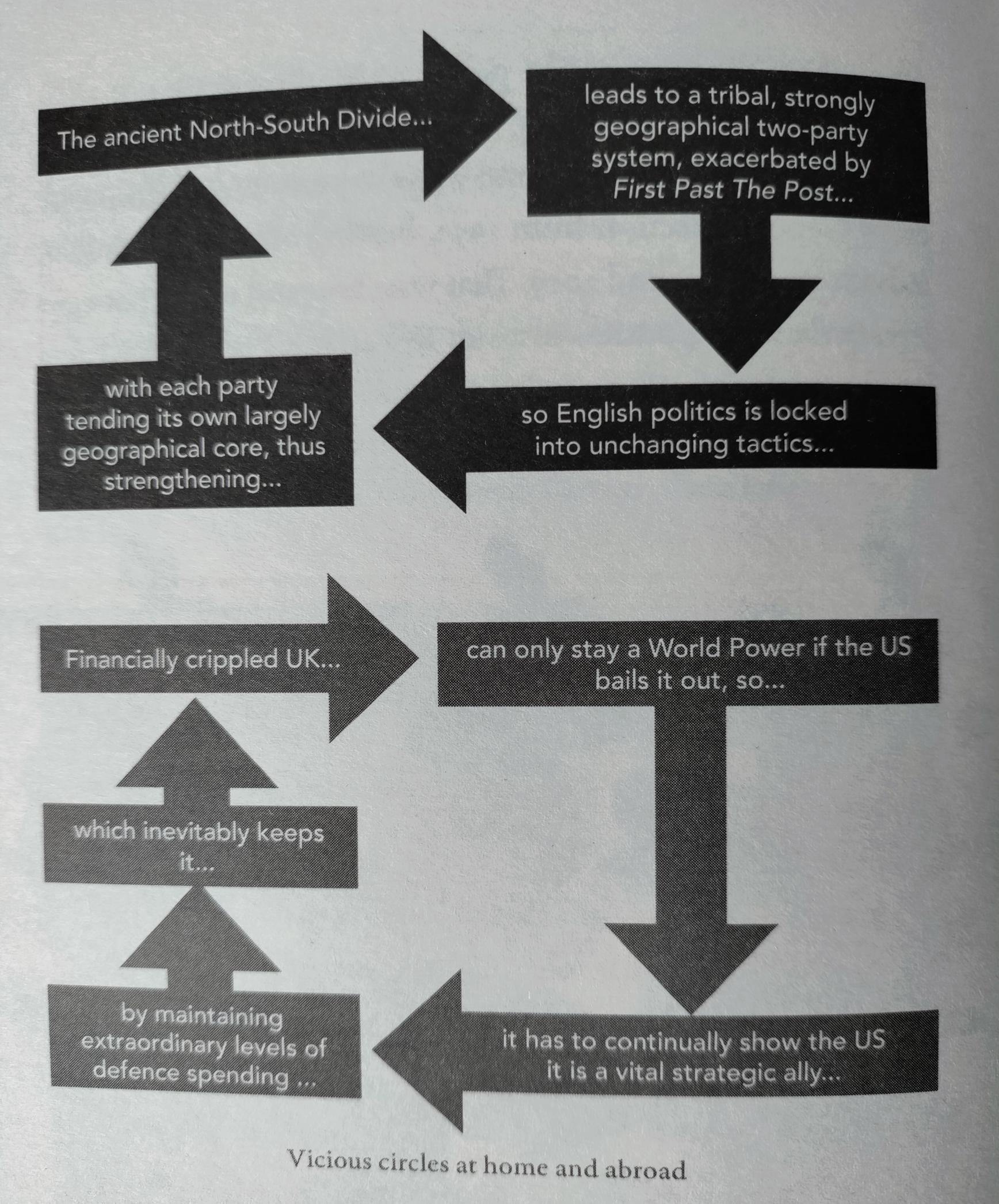
By the 1960s we have a new perspective on class. Jobs were full, and the middle-classes had new universities. Because so few attended, he notes, a degree practically guaranteed a professional career.
In the 1970s old taboos began to break down. He references football violence, graphic violence, soft pornography, and “men like Jimmy Saville and Gary Glitter” who used their fame and connections to abuse.
Emigration during this time was higher than immigration. Inflation hit upwards of 26%. There was ongoing violence and unrest in Northern Ireland. The UK needed a bailout from the International Monetary Fund (IMF). The entity was derided as the “sick man of Europe”.
Into the 1980s we have the rise of Neo-Conservatism (my term, not Hawes’s). For many, the Falklands War was a “cure for decades of hopeless decline.”
A Third Industrial Revolution followed with the era of the internet and globalisation which was a “gift” for England as the “mother tongue” of this was English. With the fall of the Soviet Union (1991) and the First Gulf War (1991), the UK became the USA’s “military wingman.”
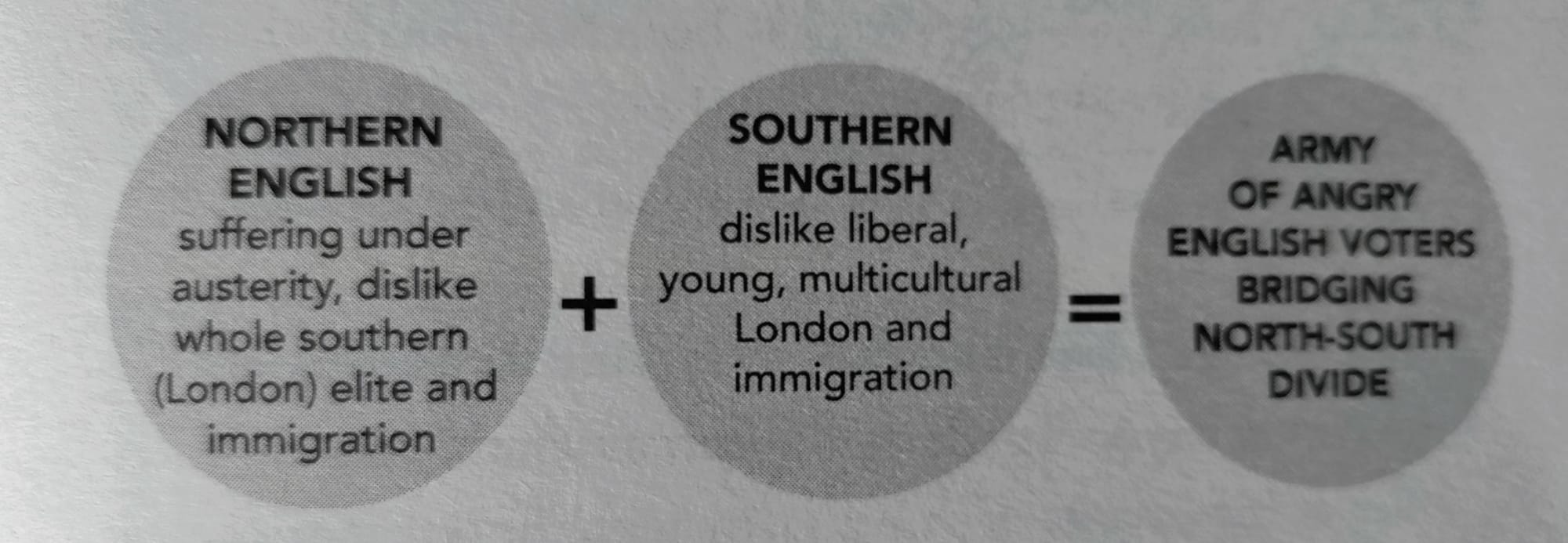
With Blair and Brown, “England’s economy, long split, became completely bizarre: a heavily state-dependent North funded by a wheeler-dealer, global London.”
The university of England was somewhat unique, he writes, but by 2000 was reaching a “critical mass”. In part, this led to contempt for the “class which the new university students left behind, culturally and geographically,” by which he means to setup the context for today’s current split. He writes that poor northerners and southern were now united for the first time. The peripheries of the south began to feel as “economically barren, as politically impotent, and as culturally despised as the North had so often felt.”
Hawes then turns to migration, and of course this is a primary factor impacting on the disaffectedness of today’s so-called working-class (though this term needs more examination). He writes that immigration was either “saving people in peril” such as Ugandan Asians in the 1970s, to Somalis in the 1990s, or the “old imperial links” of (primarily) the West-Indians and Pakistanis and Indians. But this was different for the old Warsaw Pact states of Poland when “everyone knew [they] were only here for the money.”
Although Hawes has limited space (and desire) to expand on the subject of immigration, he could have expanded this with a sentence to note that migrations of people is a constant process across history. His brief outline does imply this fact to a certain extent, if we choose to see the patterns. Nevertheless, we are in a situation now where a great mass of people have been told that people come to Britain/England/the UK in order to claim benefits or to target white women or to steal and pillage, which is clearly false.
Hawes closes by bringing some of his threads together by arguing that New Labour and its Coalition “inadvertently” created a new constellation of voters, which he puts into pill-form with a simple diagram:
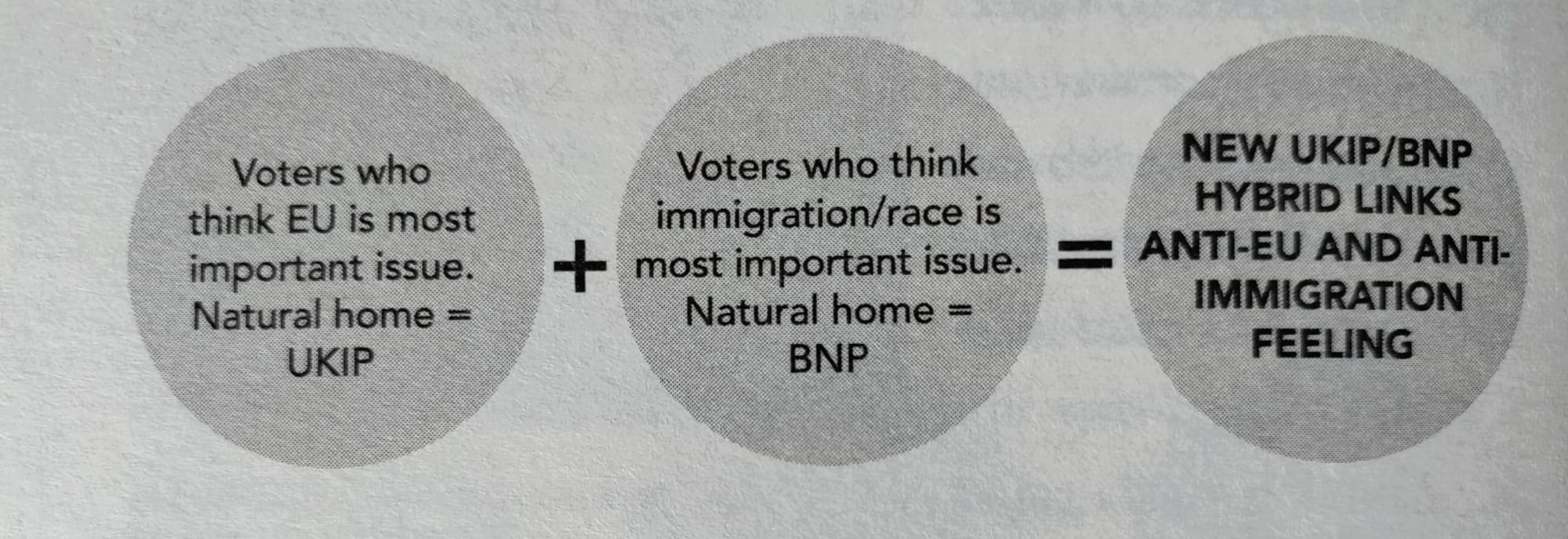
He notes that English nationalism grew through the 1980s and into the 1990s, with some emergence of Euro-sceptics in the Conservatives, slowly morphing and becoming embodied in the character of Boris Johnson (real name Alexander Boris de Pfeffel Johnson) as the cheerleader for a retreat from Europe.
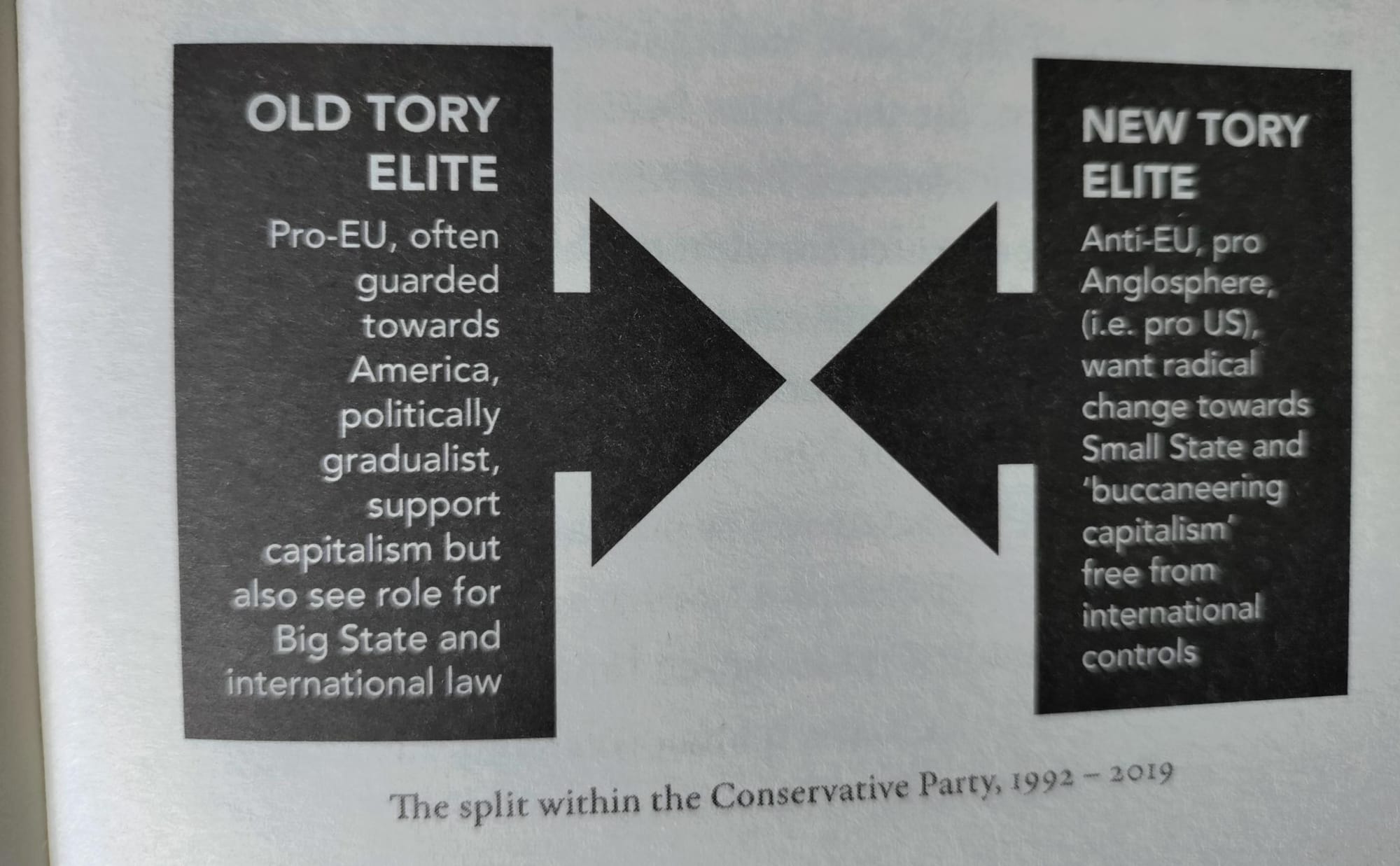
This was not focused on an “ideological crusade for unfettered capitalism” as it was in the 1990s, but was on a “last-ditch culture class-war between the English and the elite collaborators of a European occupation.” We can say, however, that the crusade remains, and always will be, no matter how it is packaged, a drive for more gains for the wealthy elite.
Philip Pullman, a significant sponsored tongue in British society, is cited on the front cover of this edition saying that Hawes's book is “extremely persuasive”. But for what, we might reasonably ask?
For one, we can say that the shortest history evidences the fragility of the English identity.
His history outlines that England was slowly born out of the Roman, Anglo-Saxon, and Norman-Frankish conquests and the ways in which the ruling elites balanced and contested power, both in the south-east of England as compared to the north, and in places such as Wales and Scotland, who both lay claim to be nations in their own right.
England was submerged into the entity of the British Isles and then again into the Empire of the United Kingdom, and then continued (in some strange way) into the post-colonial age. As far as I can tell, Englishness was an identify formed in opposition to the Anglo-Saxon conquests, and those people we might term English were actually Celts and Gauls, whose movements were vast and sporadic. The identify of Englishness was kept going by the post-colonial fun-fest age of association football and Fifa World Cups, where the St George's flag, appropriated from Georgia in eastern-ish Europe, has some relevance besides being painted on roundabouts or Chinese takeaways, and which is embedded every two years by the Euros or the World Cups. The beauty of this, however, which is a counter to the misled who blame their problems on others, is that the representatives of the teams themselves (both men and women's teams) reflects the people of the nation moreso than a few rallies led by cretinous snakeoil salesmen.