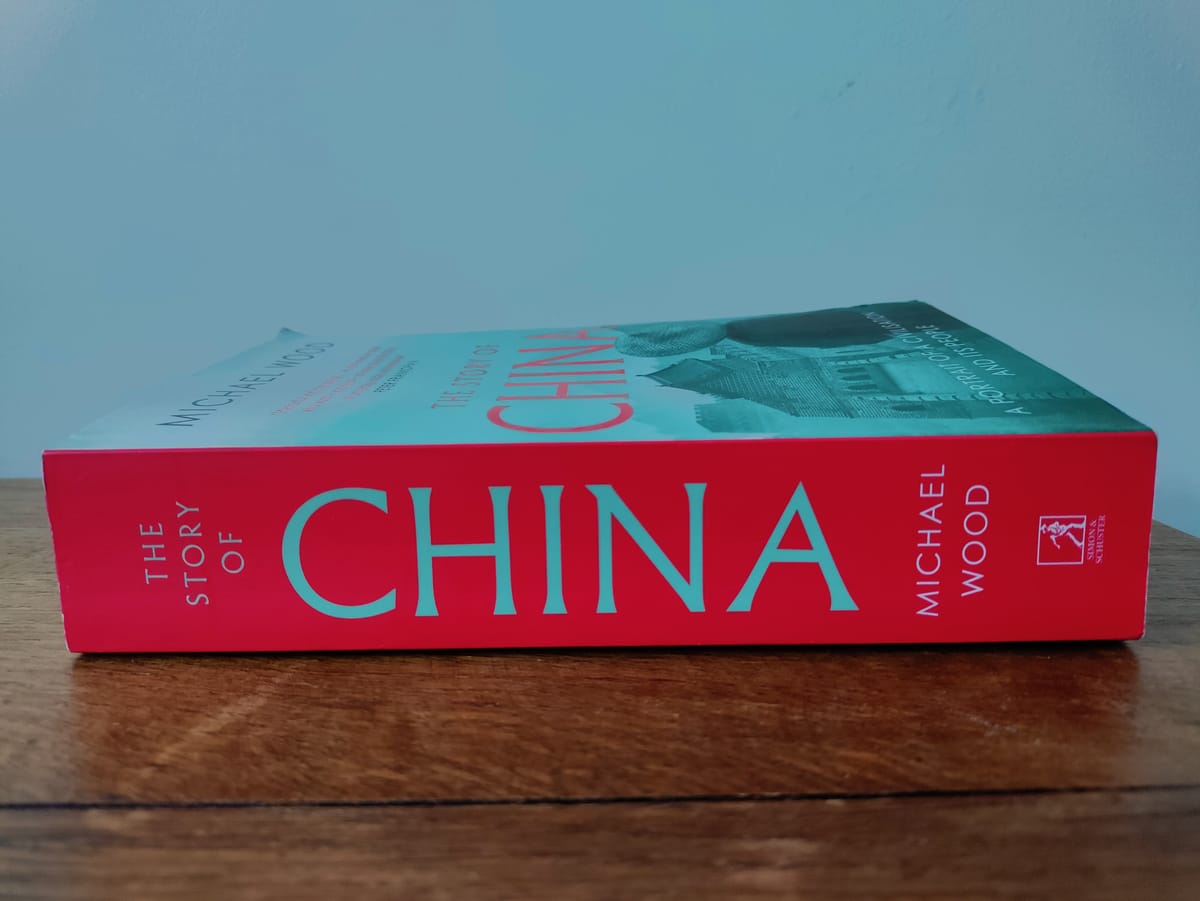
The Story of China (Michael Wood)
Summary of the key findings in Wood's narrative history.
Note: This reflection is meant to compliment and supplement our other readings on China to date. This is very much an information-gathering stage, so will be primarily summary of key points whilst trying to link thoughts across the other texts. I hope to be able to write a more considered 'analysis' at some point, perhaps with a drivig question in mind.
For Michael Wood, the first “fact” of Chinese history is its geography, which is a well-trodden pathway of historical narrative. He is specifically interested in the heartland of China and its two key rivers: the Yellow and the Yangtze. The Yellow, we learn, is a “constant, unpredictable and often terrifying character […] nothing like the benign Nile” or other such rivers of early civilizations such as the Tigris. For the early Chinese, there was “fear of the breakdown of society due to natural disasters”. As we shall see, the attempt to maintain a cohesive society, and the revolutions of revolt and uprising, unity and chaos, is a stream itself running through Chinese history.
He defines 'civilization' within an anthropological framework, whereby the definition of a civilization depends upon the following: it must consist of cities, have bronze-age technology, writing systems, large ceremonial buildings and temples, monumental art and our old favourite: social hierarchies.
Wood, much like Buckley Ebrey, cites the “incredible tenacity of cultural memory in China that reaches back to the Honghan culture of the third millennium BCE.” As we have seen, China lays solid claim to being the longest-running continuous civilization on Earth. But this does not mean that the land itself consists of a homogenous mass of people. As both Wood and Buckley Ebrey show, China is a land of many distinct peoples who are brought together (and sometimes splintered and fragmented) by the Mandate of Heaven which, “many scholars argue” was itself linked to early astronomical ideas. Wood illustrates his study with important examples, in this case the Taosi Star Platform.
The word for China, Zhongguo, is first recorded by the Western Zhou in 1,000 BCE. In prehistory, there were many distinct cultures within what is now China, and there were many different languages: “but beyond those divisions are deeply shared continuities – beliefs about ancestors and patriarchy, civility and conformity, the collective over the individual, family and auspiciousness.”
As we learned in Buckley Ebrey’s overview, the Chinese attribute a series of great inventors and leaders to their early civilization. King Yu the Great is an example of this, “he who controlled the flood” with the help of a Yellow Dragon and a Black Turtle. This is, Wood writes, no doubt a “bronze age tale”. The success of the dredging of canals stabilises communities and leads to the beginnings of ordered society. There is, as we expect, some embellishment to the tales told of the origins of society and the leaders whose stories were passed down, though it is noteworthy that the Chinese gave stature to people who solved problems or innovated.
Wood considers whether there is evidence of a real flood, and notes that one of the “largest freshwater floods of the Holocene” occurred in around 1,922 BCE of the Yellow River in the Jishi Gorge in Qinghai Province.
Although the Xia Dynasty is up for question (many scholars dispute or challenge its existence), there is clearly some trail of truth here. The centre of their kingdom was said to be in the “plain near the confluence of the Yellow River and the Luo River.” The Xia were conquered in around 1,550 BCE, succeeded by the Shang Dynasty who had their homeland further down the Yellow River plain. The discovery (or re-discovery) of this dynasty occurred in the 1920s and 1930s. In 1899, scholar Wang Yirong fell ill and received traditional Chinese medicine from a pharmacist which included ‘dragon bones’ which were found to be inscribed with primitive forms of writing. Captivated, his path of study led to Anyang, and excavations took place on a “heroic scale”. The key find, Wood notes, was writing, and the “archives of the Shang kings”, tens of thousands of oracle bones, divinations by scapulimancy.
This in turn allowed for a full chronology of the 17 generations of the kings of the Shang from 1,553-1,045 BCE. The Shang, writes Wood, “are not only China’s first political state; they are its first ancestors.” There is evidence of human sacrifice, Wood writes, but they were not in any way uniquely cruel compared to other world civilizations.
Importantly, the king was seen as an interpreter for the spirits. This in turn gave the king authority, and we can say almost certainly perpetuated it. The oracle bones were a “ritual conversation”, the king being a “mediator between heaven and earth." The first rulers of China, therefore, are not only inventors and problem-solvers, but already otherworldly, possessing powers above mere mortals. There is a clear inherent danger in terms of misleading and abuses of power, though it is important to note that we apply our own lens to this (numb as we are to abuses of power).
The Shang were contemporaries of Bronze Age Greece, Mycenae and Troy. They “bequeathed central aspects of the culture: rulership, ritual, divination and, crucially, writing.” In 1,046 BCE a vassal state, Zhou, rose against them. The story is told by “their victors”, which we may say is a common theme throughout humanity. Di Xin, the last king, is said to have “sank into megalomania and vicious cruelty,” but with such a passage of time, and with so much of history a matter of interpretation, we cannot know for sure what this chap was really like.
The Zhou originated to the west in the Wei river valley. Their ruler was King Wen, whose mother is said to have been a Shang princess, as was his wife. We may recall King Wen from Buckley Ebrey’s overview as being regarded as an exemplar of a wise ruler.
The decision to rise up was inspired by a tian meng, or a “heavenly sign which came to be interpreted as the mandate of heaven.” This has important political connotations for the dynasties which followed, and there is some clash between accepted narratives of this period. For example, the first “great historical narrative of Chinese history” is the Yi Zhou Su, the 'Lost Book of Zhou', which was rejected/excluded from the literary canon by early historians such as Mencius “whose idealised views of Zhou history could not accept the gruesome evidence of cruelty and mass human sacrifice that attended the victory.” Early on, then, not only do we see control of script/word being of vital importance, but also of what constitutes approved narratives and ideas.
Notwithstanding this controversy, the mandate of heaven (as idea) is regarded as a “Zhou conception”, and with it “the cyclical pattern of the narrative of China’s history was set.”
Indeed, the Zhou period is the first period from which extended texts have survived, including the I Ching ('Book of Changes'), the Shijing ('Book of Songs'), and the Shujing ('Book of Documents'). With the Shujing, history is seen to be a “crucial tool in validating power”, and “control of history is linked to the control of writing, which the state in turn monopolised through its scribes and ritual specialists”, which brings to mind the Church of Papal Europe. There was no creator God, however, though we should not discount the moral values of the first Chinese civilizations (or assume conception of a creator God is a necessary prerequisite for moral values). As Wood has it, the cosmos was “perceived as a moral order, and moral values were built into the way the earthly order worked.”
The Western Zhou lasted some 400 years, and influential thinkers from Confucius onwards “looked back on the Zhou as the ideal.” In the 6th century BCE, the state “fell into decline as regional powers fought for supremacy.” In addition, as if to emphasise the fragmentation of the coming age, “order broke down” and “violence and war became endemic.”
As we have already seen, the subsequent Warring States period was not only a time of great violence and loss of life, but also a golden age for Chinese philosophy, as well as coinciding with the so-called Axial Age.
“Chinese thought, it might be said, has revolved around two central questions: the harmony of the universe and the harmony of society, cosmology and politics.”
This is an interesting way of framing it because the modern-day Western neo-Capitalist-Christian perspective is one which often views China (and Asia as a whole) as devoid of a viewpoint on cosmology, with reductive assertions about China (and Asia as a whole) as encompassing a spirituality which aims to annul the individual, with a cold ad uncaring universe.
For Confucius, the “idea of just rule depended on moral education” rather than just a legal system, though it was to be a Legalist approach which would initially prevail in the first united China under the Qin.
In the West, whom Wood notes as the “inheritors of Roman law and Germanic custom”, we came to feel that “the government of men is always flawed, unless limited by a strong legal system […] ruled with the informed consent of the governed.” Today, we may question how well citizens are informed, and to what extent our consent may be said to be entangled within the many weeds and vines in the places of discussion.
The Qin were a “barbarian” kingdom on the “edge of mainstream civilization”, a “land of wolves and jackals.” It is another interesting theme of Chinese history that they are at times unified and ruled by peoples who are regarded as Other, but who (to greater and lesser extents), come to be subsumed within the Chinese culture.
Mozi (468-390 BCE) first proposed that the “remedy for universal disorder was the establishment of universal ruler”. In other words, the solution to the fragmentation and discord was to unite all under one. He also advocated for meritocratic appointments, but “with ideological conformity enforced within a strongly ordered society.” Once unified, then, the way to maintain the order was for strict social hierarchies and conformity – as we shall see, this pushes against human instinct for freedom of expression and critical thinking/questioning, which in some way explains the cycle of revolution and the mandate of heaven passing from hand to hand. Or: the proposal of a universal ruler, of a society in which all conform to a set code or set of principles or system of belief, is unsustainable.
The key text that “underwrote the unification” was 'The Book of Lord Shang' (4th century BCE). This is also referred to as the first “totalitarian manifesto.” In this text, the argument in favour of Legalism is put forward, in which “governmental power penetrates right to the base of social order […] every peasant is a diligent tiller of the soil, every soldier a brave and loyal supported of the state.”
There were also some practical reforms proposed, such as the division of society into counties, districts and villages, with five families mutually responsible for one another’s conduct, with the head member “personally liable for any crime”, and a population register (for information gathering). In some ways we can see the practicality of subdividing a vast land, but as we know from the tendrils of history, boxes and compartments are rarely smooth and can often change. The drive for mutual responsibility seems like an admirable aim, but we can also say there is scope for corruption and gaming of the system, or even of vindictive acts. In the modern age, particularly, we live in a very data-driven landscape, so the gathering of information across the land again seems like a suitable practice but something which can be abused.
In 255, the Qin annexed the Zhou royal lands. They then went on to overcome their six main rivals: “the speed of success was amazing.”
“Bringing order then was at the centre of Qin propaganda, and popular support for the unification was a major factor and a justification for the regime’s ruthless severity.”
We have previously learned that a recurring theme of China’s history is the dynastic changes and cycles of revolution. Wood has it that the “remarkable fact” of China is not the chaos and the fact that unity often disintegrated, “but that it always came back together.”
Wood proposes that Alexander the Great’s armies had “certain” contact with China, with evidence of Hellenistic finds in China, including ideas such as Pythagoras’ theorem. Also during the lifetime of the first emperor the Indian Emperor Asoka of the Mauryan Dynasty (268-232 BCE) “sent ambassadors to West Asia, Syria, and the Greek Mediterranean.” Furthermore, there are traditions which assert that Asoka sent “relics of the Buddha to China.” The world of the Eurasian plateua has been much more connected than we may at first assume.
The Qin were overthrown by “massive peasant rebellions”. The changing mandate was met with signs and omens such as in 211 when a meteor fell to the Earth and, when recovered, was seen to bear an inscription:
“The first emperor will die and his lands shall be divided.”
Clearly invented, or a prank of some kind, but it is interesting how much weight and meaning we give to signs and what we see with our eyes (or hear from supposedly trustworthy sources).
The main legacy of the Qin empire was the “principle that authority over a united China stems from a single source of power, which is both the executive and the dispenser of law.” As we shall see, this single source of power is perhaps overstated, with rulers being led by associates within the court, but we can certainly say that the single authority would time and again be the point of failure, which made it possible to revolt and overthrow.
The next period of Chinese history is the 400-year period of the Han Dynasty founded by peasant rebel Liu Bang. He had risen to the post of county scribe and local magistrate, and joined forces with Xiang Yu. As recounted in Sima Qian’s grand retelling, the two became rivals, with Liu eventually defeating Xiang. In 202 BCE, Liu was declared emperor of the new dynasty.
He began by “abolishing the most repressive Qin laws, while keeping their bureaucratic structures.” He also instituted changes to help the poor, such as land reform, reduction of taxes, and “lessening the hated burden of forced labour.”
Under Emperor Wu (ruled 141-87 BCE) and his successors, Confucianism was “rehabilitated”, with scholars devising a new curriculum to “serve the state.” The big “geopolitical” issue, however, was with the people beyond the borders who did not acknowledge their rule. For the Han, this was specifically the Xiongnu, who “extended along the northern edge of the empire, from the Irtysh River in today’s Kazakhstan to the Amur River in the northeast, and from Lake Baikal in the north to the middle stretches of the Yellow River where is crosses the Ordos plateau.”
From the 130s BCE, Wu mounted several large military expeditions, the scale of which are said to have exceeded “the armies with which Alexander the Great invaded Persia and India.”
Wood takes a detour at this point to consider the topic of history more broadly. For Wood, history is “one of the keys to Chinese culture”. This is not the same, he notes, as the histories of classical Greece, such as Herodotus or Thucydides, who Wood states were “writing for themselves.” History in Chinese culture is an accompaniment to the state, including those that preceded the times in which they were written.
“In China, history was written to endorse the assumption of the Mandate of Heaven.”
For Wood, Han China was an “agricultural civilization” and he argues that this lasted through to the modern age, when visitors such as Franklin King, touring the Far East in 1909, remarked:
“the remarkable maintenance of efficiency attained by Chinese farmers centuries ago and projected into the present, with little apparent decadence, merits the most profound study.”
Another European traveller of the 1920s observed:
“No other peasantry in the world gives such an impression of belonging so much to the soil.”
And yet the land was easy to be drawn into bankruptcy: “when big landowners bought up the farmland of […] tenants, the landless men had to become hired labourers, a pattern to be seen throughout Chinese history.” And we can say the same, notes Wood, of medieval Europe, the plains of Iraq during the Caliphate, and in the rice villages of India in the Cholom Empire.
As so often is the case, wealthy families accumulated land, and this spread of private manors marked the rise of the landed aristocracy.
We have seen just how important writing was as a tool of power in Chinese civilization. During the Qin Dynasty, writing was standardised, and the Han utilised this at every level. Scribes, for example, became an “essential” component of “an increasingly complex bureaucracy.” Wood is perhaps ungenerous when he asserts that this structure allowed the state to supervise, exploit, control and punish.
The Chinese civilization continued to spread outwards. The Han began to “put feelers out to the many kingdoms in Central Asia”. Sustained contact was made across Eurasia, with the opening of what would become known as the Silk Road. With this, the Han extended their imperial post system, with a network of forts, stations and watchtowers.
The Han fell, however, in a civil war which is captured in the Romance of the Three Kingdoms. In the south, the “warlords” Sun Quan ad Liu Bei; in the north “the generalissimo Cao Cao”. China broke into two along this north/south divide, and was “initially the longest period of division in its history, over 350 years.”
The Sui Dynasty followed this fragmented period. They “inaugurated a period of prosperity unseen for three or four centuries”. Emperor Wen is particularly noteworthy, but the Sui were brought into “disastrous wars against Korea” and they were defeated in 614 CE.
Next came the Tang Dynasty, with Li Yuan, a governor in northern China, declaring himself emperor in 618 CE. This period saw new elements come into China from elsewhere, and Wood notes that this dynasty was the largest Chinese empire pre-18th century.
They built upon the Sui to create a “centralised empire, with a postal system and an extensive network or roads and canals.” This period is also known for its significant cultural achievements, specifically poetry. Wood gushes that this dynasty was:
“humane and self-aware, full of empathy for the world and for people.”
This was also the time that Buddhism arrived in China, and Wood spends some time in adoration over the incredible character of Xuanzang. Trained since childhood as a “precocious Buddhist oblate”, in 629 CE he slipped through Gansu and Qinghai across the Yumen Pass, making his way to Turfan, around the Tuklamakan Desert, across modern-day Kyrgystan and Uzbekistan, from Samarkand south and into modern-day Afghanistan which, at the time, was still a “stronghold” of Buddhism. In 630 he reached Bamiyan, the “crossroads of Asia, the meeting place of Hellenistic, Central Asian and Indian cultural traditions.” He continued into India on his great voyage. “All this was preparation for the grand translation project he had in mind for when he got back to China.”
As well as voyaging outwards, China welcomed visitors. Chang’an (Xi’an), “became perhaps the greatest and most cosmopolitan city on Earth”, with Persians, Indians, Sogdians and Arabs, Christians, Jews, Zoroastrians and Muslims.
In turn, the Tang “bequeathed” a Chinese cultural empire across East Asia, Korea and Japan, much in the same way, Wood argues, “as Rome would hand down Latin culture across the West.” (We will examine the concept of ‘West’ and ‘East’ in a reading of Yellow Peril.)
Wood points towards this age being a time in which the “modern pattern of human cultures across the Eurasian landmass began to crystallise”, by which he means the so-called Arab Conquests, and the sacking of Rome by Germanic-speaking barbarians. It is left a tad unexamined, but it appears that by this he means the conditions for the schism of the church as well as the earth being tilled for the Crusades.
He makes a strong case that this age, in particular, refutes the idea of China being a “monolithic and unchanging civilization, inward-looking and resistant to outward influence”. He labels this view as a modern western viewpoint which is flawed. China has always been open to outside influences. This is in part due to their close connection to the Silk Road, which for the Chinese became “the natural axis of their mental map”, particularly for the Tang, whose dynasty stemmed from Gansu, on the edge of mainland China.
Returning to our friend Xuanyang, Wood writes that he had returned to China in 645, bringing “the accumulated wisdom of Buddhist India”. He notes that “the ancients had built the Chinese state on the foundations of a Confucian ethos whose whole ideology was key to an ordered cosmos, while Daoism had given the spiritual dimension of a traditional religion, and that these twin pillars had served the country well.”
During the Tang there was a great degree of high culture, such as the poets Li Bai and Du Fu, as well as scientific advances such as cast iron technology, and wood-block printing which led to mass printing.
As time went on, “fury with the luxury of the court intensified”, and in 755 we have the rebellion of An Lushan, the son of a Central Asian “sorceress, stepson of a Turkic Sogdian general.” He marched down from the north causing huge disruption and loss of life.
A primary source of this time is the legendary poet Du Fu, who, with his family, became refugees. This was one of the deadliest wars in history, and it is suggested that 30 million were displaced, killed, or died of famine. Wood compares 755 to the First World War in terms of beig a “psychological parallel.” The dynasty survived, however, into the so-called Late Tang era. After 812, China had a series of “short-lived dissolute rulers” before Emperor Jingzong was “murdered by a cabal of eunuchs.”
Why this decline and fall? Wood asks, before citing Ibn Khaldun, who refers to the “loss of ethos that binds the rulers to their aristocracy”. For some in China, Wood writes, it was felt that the “ethos had been eroded and religion was the problem”. In turn, Buddhism was regarded as an “alien” body whose core ideas were “nihilistic”. At times of social decay and unrest, there will always be a need to explain, and of course this can lead to apportioning blame here and there.
In 840, Emperor Wuzong ran with the policy of scapegoating Buddhism (comparable, perhaps, to the late Qing support for the Boxers), and there was a campaign of temple closures, “brutal, sweeping and destructive.” Alongside this was a “plunder of wealth” for the imperial family and nobles in order to pay their armies and suppress the rebellions.
But there were mutinies in the army on the frontier in 860. One peasant uprising gathered over 200,000 peasants, vagrants, beggars and pirates called the “Righteous Army.” Huang Chao rebelled in 874 in Henan. His family had been salt smugglers and privateers. In this new world of Tang literacy, we see a new way of forming solidarity, with Huang’s followers disseminating leaflets “railing against corrupt and greedy local officials, excessive taxes and unfair punishments.” He eventually took Canton in 879 with a “horrendous massacre.”
He then took Luoyang and then the capital Chang’an, in 881. The Tang court took refuge in Sichuan. A counter drove Huang out, and he was killed in 884. Wood makes a comparison to the later Taiping Rebellion, as well as with Chinese Communism, noting the class consciousness of the rebellion.
He also refers to this as a “system collapse”, a tactile term which would be interesting to apply in other scenarios outside of China, including to present-day USA and Britain. For Wood, the other great breakdowns in Chinese history were as follows:
- The collapse of the Mongol Yuan.
- The decline and fall of the Ming.
- The fall of the Qing.
These 4 crises, he writes, are “deep-rooted in China’s cultural memory, in historiography, literature, poetry and popular culture.” It is interesting that 2 of these 4 are so-called 'alien' or 'foreign' dynasties.
In between the Tang and the next dynasty, the Song (or Glorious Song) is the period of Five Dynasties, the Later Liang (907-23), Later Tang (923-36), Later Jin (936-47), Later Han (947-51) and the Later Zhou (951-60).
“Reunification happened through prolonged warfare, the accidents of history and strokes of luck in battle at crucial moments.”
In 960 the Song Dynasty was proclaimed by General Zhao (one of a pair of mythical 'dragon babies' found in baskets in Twin Dragon Alley), who would become Taizu. The Song were a regional state that ruled the Yellow River plain after the defeat of the Shang in 1,045 BCE. This dynasty, then, arose from the Shang “ancestral homeland.”
This new dynasty “was to be not simply a continuation of the dynastic cycle, but a revival of Confucian teaching, a return to the eternal wisdom of the Chinese state.” How far is the modern state of China a Confucian state? And how would this question be viewed in China? Perhaps we could say that there are strong undercurrents of Confucian practice and ideology in the state, though many of this conflicts with the class consciousness of Communism and Socialism. This would be an interesting area of study.
Taizu died in 976, and the “inal battles to consolidate the empire were achieved by his younger brother, Taizong, the other dragon alley baby. It is important to note here that, territorially, northern China was never under their rule, where the Liao remained in power.
Wood also notes that the Song “supremacy” was also very much “contingent on treaties”. This was, however, one of the most “brilliant epochs in Chinese history.” This is due, in part, to the fact that the Chinese never lost touch with its classical past, whereas in Europe, he argues, it was the Renaissance which enabled the continent to "rediscover" classical Humanism, “when modern scientific ideas began to develop, and when new conceptions of society and the individual emerged.” There is often a link made from ancient Greece, through Rome, and into colonial Europe, in terms of inheritance, but this is fraught with many pitfalls. In China the links are much clearer, the bonds stronger. For Wood, the comparison age of the Renaissance is the age of the Song.
One important element was the spread of printing, enabling the mass production of books. There was also the spread of a commercial economy and technological achievements. There was a “fertile exchange of people, goods and ideas.”
The old aristocracy had been destroyed, replaced by professional bureaucrats chosen through a “meritocratic entry system of imperial examinations”, and under the Song this was “radically expanded.”
This age was humane, cultured, and intellectual, in part shown through the world’s first national library, the first national university, and the first print culture. The capital, Kaifeng, was run by Confucian scholar-officials, and Taizu noted that “my chief councillors should be men who read books.” He is missing women here, but it is still admirable to consider this when we live in a society where book-learning if sneered at. This was a time of widespread literacy, with a huge demand for learning and for books, a “civilizational shift” such as the so-called West experienced with Gutenburg, Mantius, and Caxton.
The elite of the Song were not “hereditary nobles, or warlords, or bankers or merchants.” In saying this, the study that was necessary for positions of influence and power was much more open to those who had time and space, and time and space were often byproducts of wealth.
The thirst for learning was also reflected in scientific advancements such as the water-driven spinning machine, coke-fired blast furnaces, steel smelting process, the establishment of true north, and the magnetic compass. They also invented moveable type, though the use of this was limited due to the mass of Chinese script.
The Song were ultimately undermined by a “perfect storm” of natural disasters, foreign invasion, and failures of leadership. And for all the cultural praise, Wood writes that they were created by war, and “maintained by military power.”
In 1048, a vast torrent of Yellow River floods led the course of the river to adjust, and people were “swept away like fish”. Three harvests of crop failures led to “apocalyptic stories of starvation and cannibalism.” The government opened granaries and assisted the poor, whilst refugees were housed in camps. The numbers, however, were too great.
Wang Anshi is one of the most fascinating figures from this time: he had “effectively ruled China”, but, “disillusioned […] devoted his last years to search for inner truth.” In his younger years he had proposed reforms, sending a memo to the government: the Ten Thousand Word Memorial. He thought that the state should take over the management of commerce, industry, and agriculture. Upon becoming prime minister he instituted radical reform, including with regards education, the economy, taxation, trade, and a war on corruption. All of this will have echoes in the reforms of the Communists.
Wang’s chief opponent was Sima Guang, whom Wood cites as China’s greatest historian. He did not oppose the monarchical system, but considered how best to utilise it. Writing to the emperor:
“You will see in these pages, over these 1,400 years, that the history of China has been a story of violence and disorder in which periods of good order and harmony have been short, less than 300 years in all this span: and even then, not free of violence. Harmony in the state is therefore a very difficult thing to establish – and needs to be very carefully tended once it has been achieved.”
The Song sank into financial trouble, in part due to the spending on the military against neighbouring states. The Jurchen Jin rose, annexing smaller states and tribes. In 1122, the defeated the Liao-Khitan and made the Tanguts their vassals. They then took Kaifeng and marched the emperor and his court north to Manchuria.
Following this, China was once again divided by north and south, with this age sometimes known as the Southern Song. The south became rich and populous, with huge agricultural productivity, commercial wealth, and cultural resources. The Southern Song also created the first standing navy for defence.
In 1132 the court was established at Hangzhou, which would be “immortalised” in the pages of Marco Polo, who wrote that it was “the finest and noblest city in all the world.” This was a commercial city with a new phase or urban living, ad there was a spread of “mercantile ethos” across China and with it the rise of a merchant elite.
Wood spend some time praising “one of the greatest figures in Chinese civilization", Zhu Xi. His reinterpretation of “the fundamental concepts of Confucianism began to be taught nationwide in private academies and public schools.” His teachings formed the basis of the civil service exams from 1305 to 1905!
One of the key themes of his interpretation was around moral improvement – he was interested in what we might term behavioural psychology. “For Zhu, empathy, an understanding of the interconnectedness of life, was the basis of good human interaction.” The family was the starting point.
This period saw the arrive of the Mongols. They began “recruiting” Chinese generals and troops in the north. In 1271, Kubilai Khan, grandson of Ghengis, proclaimed a Yuan (‘primal force’), dynasty.
So-called alien rule was a shock, and would “lead to a deeply conservative and inward-looking reaction in the late fourteenth century.” The Yuan ruled through Confucian officials, with many foreigners in their “multi-racial, multi-lingual empire.” Their first achievement was in uniting China. Many scholars of the time, even, came to accept that the Mandate had passed to the Mongols.
There were positives to this time, including to the arts and culture, as well as the religious tolerance of the Mongols. Persian astronomers came to China, and Chinese scientists went to Iran. The contact between east and west “flourished”, writes Wood, already taking up the position that there are such things as “east” and “west”.
Khubilai died in 1292, and “factions split the court”. From the 1300s onwards, “the overextended Mongol empire began to break down into warring kingdoms.” The ebb and flow of unity and chaos and disorder of Chinese history continued.
Wood notes environmental factors, such as climate change and a mini ice age which affected rural Anhui to lowland England. There was a Great Famine in 1314-22 in Europe in which 1/10th of the population died. In China, there was a also a deadly plague, the “great pestilence”, and the Yellow River flooded, causing failed harvests, famines, and the movements of refugees. “Soon local revolts turned into full-scale rebellions as regional warlords declared themselves king.” Wood aptly observes the “old themes in Chinese history” where “revolution is a simple fact of life, a recurring cycle whenever powerful central authority loses its grip.”
Mongol power in the south began to disintegrate. There was an uprising of armies of farmers and rural bandits, sects such as the White Lotus, the Red Turbans, the Holy Lodge, “some touched by the strange afterglow of Manichaeism.”
In Hubei, 1338, a rebellion broke out just above the mountain passes, with the leader a peasant named Peng Hu, or “Peng the Virtuous”. The “storm of revolt” was drive by poverty and resentment, those old gnarled hands, as well as religion, which was “directed against Mongols but also Confucian elites.” This led to savage retribution against Yuan officials (most of whom, writes Wood, were Han Chinese, not ethnic Mongol).
To his credit, Wood does ensure to make comparisons to the so-called West and signpost some of the many atrocities, including the Holocaust, the Partition of India, and the time of the Deep South in the USA. Of course, these are all atrocities committed by peoples regarded as Western upon peoples regarded as Other, and we could extend this to make more comparisons about the system of oppression and tools of repression that the West uses against its own citizens.
As the Yuan fell, there was 17 years of civil war which was, Wood notes, a class war. The climax of the battle for China was between Yangzhou and Suzhou.
Zhuan Yuangzhang, born in 1328, whose life is recounted in his autobiography The Story of a Dream, had early years of family hardship before entering a Buddhist monastery. He then joined the Red Turbans in 1352, quickly rising to become a commander. He amassed a power base in Nanjing and marched on Suzhou for “lordship of mid-China”. The city fell in 1367 following a ten-month siege, with the city full of refugees ad starving people. Zhu “strictly ordered no plunder, no rape.”
“A peasant, then, had become a dynastic founder”, in much the same way as Mao Zedong.
This age was the Ming Dynasty, that is, Brightness, or Bringer of Light. For Wood, the Ming “defines our popular image of Chinese civilization: the Forbidden City, the Temple of Heaven, the Great Wall, Ming porcelain and painting [and] established a bureaucratic despotism.”
Once in power, Zhu chased the Mongols out of China. “The new China was to be a revival of Han culture.” Nanjing was made the capital. He initiated a census and land survey: “the emperor had a vision of China as a giant community of village-based peasants, peacefully engaging in farming and textile production.”
In his later years, the Hongwu Emperor became “increasingly suspicious and paranoid” with murderous purges. He got rid of the post of prime minister, “concentrating power in the person of the emperor.” He died in 1398, succeeded by his grandson, 20-year-old Jianwen (“establishing civility”).
His uncle, Prince of Yan, was “energetic and ambitious.” He revolted, leading to a three-year civil war, seizing the throne in 1403. He became Yongle, or “Everlasting Happiness.” Further purges occurred, with executions of all who opposed him. He razed the old Mongol capital and ordered the construction of Beijing.
From 1403-1453 there were the seven great voyages into south-east Asia, across the Indian Ocean, into the Persian Gulf, to India and to East Africa. The principal figure of this exploration was Zheng He, a high-ranking Muslim courtier and eunuch. His journeys brought back ideas, foods, plants, spices, and animals. These journeys were not with colonisation or conquering in mind, but to “establish a network of power and control.” Some may argue this is a matter of semantics, but the evidence suggests that these were altogether more peaceful and humane that what followed from western European nations. These aim of these voyages was to “establish or reinforce trading relations mutually beneficial to China.” Some would argue that China is practising this today also.
The voyages abruptly stopped, however, in 1433. For Wood, “the Confucian ethic was the cultivation of the Middle Kingdom, not the conquest or domination of other peoples.” Again, much the same could be said of today.
In 1492, Vasco de Gama sailed into Cochin, “where the locals told him of the great Chinese fleets that had some seventy years before […] This symbolic moment in world history, when the technological lead would pass to the Europeans, who would rise to world domination using Chinese inventions that Zheng He had carried with him: gunpowder, the stern rudder, the magnetic compass and paper charts.”
There was continued threat from the Mongols in the 1430s which led to annual expeditions against them. In 1449, the Zhengtong emperor was defeated in battle and captured. This led to a massive rebuilding of the Great Wall.
In the 15th century, small market towns began to open everywhere, and China had a population of some 200 million compared to Tudor England where it was 3 million. The growth of markets led to a new moneyed elite where “all aspects of culture […] were commercial commodities.”
As Matteo Ricci observed:
“It seems worthwhile to record a few more ways in which the Chinese differ from the Europeans. It is remarkable when we stop to consider it that in a kingdom of almost limitless expanse and innumerable population, abounding in resources of every kind, although they have a well-equipped army and navy that could easily conquer neighbouring nations, neither the emperor nor his people ever think of waging wars of aggression. They are quite content with what they have, and have no ambitions of conquest. In this respect they seem to me very different from the Europeams who frequently disturb their neighbours and are covetous of what others enjoy. While the nations of the west seem to be entirely consumed with the idea of supreme domination, they cannot even preserve what their ancestors have bequeathed them, as the Chinese have done for thousands of years.”
This difference must be explained in some part by the geographical space of Europe, though it cannot all be explained by this.
Ricci prepared a map of the world in 1602, and this shocked the Confucian scholars and burueacrats in terms of their perception of the cosmology of the world.
The economy was in decline in the 16th century. Taxable land shrank, and there were natural disasters and floods and famines. During this, Wood notes that China had one of its worst emperors, Wanli (1573-1619). There was great disaffection, and this was in part due to a wider dissemination of higher learning to an “enlarged educated middle class.”
“Under Mind law, anyone, even a commoner, could make a petition to the emperor.” But “remonstration was at one’s own risk.” This wasn’t an entirely open platform of free speech. Nevertheless, as we have noted, the study of history is highly valued in Chinese society. For Wood, the Chinese recognise the lessons of history as being “self-evident and so permanent, they hardly need plotting out. They are the currency of political debate.” This knowledge and reference of history seems much more guarded in English/British society, where wider knowledge, or more in-depth knowledge was, for a long time, reserved for a small elite.
Huang Dongzi, a member of the Donglin Academy, wrote “the single-most remarkable political tract in Chinese history” called Waiting for the Dawn. He argued in favour of a “reformed system of decentralised government, based on classical principles.”
This was in part due to the fact that over time “the outer reaches of the empire were no longer controlled by the centre”, and the southwest, in particular, had become a “hotbed of revolt.” There seems to be a great balance at play constantly in Chinese history between strict centralisation and autonomy for the periphery.
Beyond the border in Manchuria “a powerful state had risen.” In 1629 the Manchus attacked Beijing. In addition, “rebel bands joined together in protest over taxation and starvation”, which troubled the old landed families. It was another kind of class war, or chafing against the growing disparity. In 1635, a rebel army led by Li Zicheng defeated Ming governors in the central plain. They advocated:
“Be kind to the poor, divide the land equally and abolish the tax grain.”
In 1644, Li proclaimed himself king and advanced on Beijing. They sacked the capital and the last Ming emperor, Chongzhen, hung himself. Li proclaimed a Shun Dynasty (‘Obedient to Heaven’), but the Manchus took “advantage of the chaos” and swept south. They in turn proclaimed the great Qing (or ‘Purity’).
The image of the Qing is generally one of great decline, but for Wood, under the Qing, China “reached its highest level of material success and political stability.” This included Emperor Kangxi, “perhaps China’s greatest ruler,” from 1661-1722. He left an “astonishing cache of hundreds of letters and notes, which Wood feels amount to one of the greatest of all ruler autobiographies. He cites this passage:
“Before I die I am letting you know my sincerest feelings. The rulers of the past all took reverence for Heaven’s laws and reverence for the ancestors, as the fundamental way in ruling the country. To be sincere in reverence for Heaven and ancestors entails the following: be kind to men from afar and keep the able ones near; nourish the people; think of the profit of all as being the real profit and the mind of the whole country as being the real mind; be considerate to officials and act as a father to the people; protect the state before danger appears and govern well before there is any disturbance; be always diligent and always careful, and maintain the balance between principle and expedience, so that long-range plans can be made for the country. That’s all there is to it.”
Kangxi knew that the “greatest failure of the last Ming rulers had been a failure in leadership,” which is a clear line we may apply to the politics of Britain over the past century.
Kangxi and his advisors issued the Sacred Edict, comprising of 16 lines to instruct ordinary citizens on what we call today good citizenship. This was copied out and disseminated/posted everywhere, delivered in village lectures.
“It spoke to filial and brotherly love, generosity to family, keeping peace with neighbours, respecting farming, being frugal and not wasting valuable resources [..] support schools and colleges to promote education [..] encouraged the well-educated to elucidate the law to instruct and warn the ignorant […] show courtesy, good manners and work diligently.” I wonder what a similar outline of good citizenship would look like today in England?
Yongzheng, Kangxi’s successor, expanded on this in 1724 (as well as extending territory to include Xinjiang, Mongolia, and Tibet). “This was part of a huge educative programme under the Qing.” Language schools were founded with the “goal of genuine mass literacy training.” We have seen how writing was closely guarded, reserved for the elite, certainly in the earliest times. But now we have a drive for all to be literate. The education was didactic, however, and the main articulation was the “core ideas of rulership.” This was not a fully open system, and Wood notes that there were many persecutions of writers, and book burnings, as well as executions for dissent in Qing China.”
As Wood observes: “how to rule such a large population, and how to hold their allegiance, is still the key issue for any government of China.”
In Europe at this time there was the Thirty Years’ War, and in England a civil war. This in turn led to developments in the military. In addition, Britain saw an Industrial Revolution, and by 1805, with a huge navy, it had “become a society geared to war and industrial expansion.” European powers expanded into Nanyang, the southeastern sea bounded by Taiwan, the Phillipines, and Vietnam.
Yongzheng “had battled corruption and tax evasion, but Qianlong reversed his prudent fiscal policies […] from the 1780s the state’s finances became precarious while it experienced a rapid population rise.” And this, “fatefully”, is when the British arrived.
“With growing confusion in Europe in the wake of the French Revolution, Britain was moving its naval power to move outwards”. This led to the conquest of India which in turn made Britain a “global player.” The East India Company had been trading with Chinese merchants for over a century, “but in a strictly limited way.” For example, they were only allowed in the port of Canton (Guangzhou), only for 5 months of the year, and there were high taxes on foreign commerce. “This”, writes Wood, “is what Macartney sought to change.”
Qianlong was 82 at the time, “a ruler of immense experience, affable and masterful, cunning and sophisticated.” Macartney's attempts to woo the emperor were thwarted. “The British, they acknowledged, had come thousands of miles across the wild seas out of respect for Chinese civilization; but their demands, their diplomatic requests, were completely impossible.”
The Chinese had no need for British products and “saw no need to give them special treatment.” The British regarded this position, not to mention Qianlong’s response, as “arrogance.” The Chinese were, however, interested in European and Western ideas and products, including military technology.
Wood gives an honest account of Britain in this so-called Age of Enlightenment. He labels them as “predatory – if not militarily, then at least economically.” For their part, they concluded: “For all its evidence greatness and extraordinary longevity, China […] carried all the indications of its own decline.” Wood lists these indications as follows: population rise, inflation and decrease in tax revenues, enormous cost of maintaining its ruling class and the imperial structure, and the volatile situation in the south.
“The British soon became aware of the cracks behind the grand facade of the empire, the class tensions and the huge inequalities.”
Qianlong abdicated in 1796 at the age of 84, and his son, Jiaqing, succeeded. Qianlong still held power, however, until his death in 1799. From this point onwards, troubles increased rapidly. There were revolts in the south, and a huge outflow of silver to pay for opium and cotton. Scholars and other educated people began to suggest that there should be limits on imperial power. Although Wood does not examine this directly, it would be interesting to consider how much these thinkers may have been influenced by the events in other places in the world in terms of overthrowing and challenging imperial power.
From 1796-1804 there was the White Lotus Rebellion, which started as a tax protest but soon became strongly anti-Manchu and led to an astonishing 100,000 deaths. When we study the history of China the scale (particularly the scale of human death) is so unlike anything else in the world.
The infamous Opium War followed Jianqing’s death in 1820. The “trade” itself had began in the late 18th century when the British started smuggling the narcotic through Bengal into China through Canton. By the 1830s, opium had become a “serious social problem”. Trading was made illegal, with three decrees from 1799.
Emperor Daoguang appointed a new commissioner, Lin Zexu, “to move against the trade”. He wrote directly to Queen Victoria:
“We find that your country is sixty or seventy thousand li from China. The purpose of your ships in coming to China is to realize a large profit. Since this profit is realized in China and is in fact taken away from the Chinese people, how can foreigners return injury for the benefit they have received by sending this poison to harm their benefactors?
They may not intend to harm on purpose, but the fact remains that they are so obsessed with material gain that they have no concern whatever for the harm they can cause to others. Have they no conscience? I have heard that you strictly prohibit opium in your own country, indicating unmistakably that you know how harmful opium is. You do not wish opium to harm your own country, but you choose to bring that harm to other countries such as China. Why?”
Some entirely reasonable thoughts, we might say, but Lin undoubtedly overestimated the morality of Britain’s ruling class. This was published in The Times “as a direct appeal to the British public, among whom there was widespread revulsion about the trade.”
In 1839, many arrests were made, with seizure and destruction of the narcotics. The British organised a “task force” and attacked in 1840. The British moved up the Chinese coast, and in August 1842, the Qing governor signed the Treat of Nanjiing, the first of the so-called ‘unequal treaties’, which abolished the old Canton trading system and gave the British favoured nation trading status and four ‘treaty ports’. There was even an indemnity for the destroyed opium.
Wei Yuan, a strategist and close friend of Lin, developed the idea that “having always seen itself as a land power […] China had to take control of the seas around its eastern seaboard to protect itself from the encroachments of the Europeans.” He recommended publishing the issues as widely as possible “to awake the Chinese to the seriousness of Western presentation of the maritime seaboard of China.”
In the mid 1840s, a French missionary, Pere Gabet, travelled the land and summarised his thoughts:
“The Chinese have been able to preserve their empire for 4,000 years. Long ago they already had inventions that the Europeans proudly believed they had discovered, namely printing, gunpowder, the compass, silk weaving, the decimal system, so many other things. The Chinese have ancient classics full of the deepest wisdom, philosophical insights far superior to our classical antiquity. And unlike the Europeans they had the good sense to apply these ancient ideas to the actual practise of government which shows how intelligent they are […] They are not Christians but have hospitals for orphans […] for the old and the sick […] welfare offices where food is provided for the destitute and medicines for the sick […] along the roads the provide shelter for the free use if travellers. How dare one say that a nation that displays such enlightenment, generosity and wisdom is inferior in any way to we Europeans?”
But all was not ideal. Although there were forms of social support such as those outlined by Pere Gabet, and although there was dissemination about what makes an ideal citizen, there was still suffering and unrest. In the countryside, “even in quite isolated regions, the oppressed peasantry was increasingly coming under the influence of new ideas.”
Hong Xiuquan discovered the Christian conception of God through Yale-educated American Reverend Edwin Stevens, who was distributing Christian pamphlets. He headed to the hills, finding fertile ground for revolution, a “willing audience” to his ideas about a new age of justice, the “blasphemous Qing empire and its ‘foreign’ Manchu rulers.”
He organised village meetings, and cells spread across villages, with the Qing government sending troops to put down revolts.
“They were against Confucianism, against the Manchu emperor and the feudal landlords; they were for peasants and the poor,” at least in theory. They preached communal ownership and rights for women. Hong announced himself as God’s Chinese Son. BY 1852, he had an army of 100,000.
They defeated the Qing in the south and then marched on Nanjing, breaching it in 1853. Hong was enthroned, and a “blizzard of ideological announcements came pouring from the throne.” For example, there was a ban on opium, tobacco, alcohol, footbinding, prostitution, and gambling. In addition, China was to be “classless.” There were also some forms of gender separation and the death penalty for sex between men.
They sacked the rich cities of the south: Yangzhou, Changzhou, Suzhou, Wuxi, Shaoxing, Ningbo, and Hangzhou. There was a “profound disruption of society”, though the Qing still held the north in Beijing.
The British and other foreigners stepped up to supposedly help “crush the rebels”. In 1864, the Taipings were defeated and fell. Hong died, and in the 1950s was remembered by the Communist Party as “their heroic precursor.”
The scale of death was some 20-30 million over 16 years. And this did not end the violence or upheaval: every year between the Taiping Rebellion and 1911 there were rebellions somewhere in the countryside.
From 1860 to 1870 there was the Tongzhi Restoration, named after the emperor. This is comparable to the Meiji Restoration, but was largely seen as a failure. They tried to import western technology but “without any meaningful political change”. It sowed seeds, however, including the birth of so-called “democratic ideas” and the beginnings of the Chinese feminist movement.
They also sent ambassadors to the west, including Guo Songtao, friend of Zeng Guofan (architect of the Tongzhi Restoration), who visited Britain. He noted, in particular, Francis Bacon’s New Science as “the founding text of western modernity” (this is the phrase Wood uses rather than Guo’s words). An important point here is the reference to the emptiness of Latin and Greek classics, which alluded to the idea that Confucianism, too, may be outdated.
He also proposed a vast system of railways, which “will pass through the country rather as blood circulates in the human body.” This brings to mind the modern infrastructure of a place such as Britain, which has poor circulation, which in the end causes decay and stagnation.
Guo’s ideas were not taken up, the reception “muted.” He was “criticised and marginalised after his return.”
It was left to a new generation of thinkers to bring reform, people such as Kang Youwei, Liang Qichao, Lu Xun, Qui Jin, He Zhen. They would bring ideas into “an open clash with the Qin government and eventually bring the government down.”
Before then, as if the First weren’t enough, there was a Second Opium War, in which the British and French gained more “concessions.” Following this in 1894-95 there was a “humiliating defeat in a disastrous war with Japan”. The colonial powers, Wood notes, “gathered like vultures.”
Kang Youwei argued for a constitutional monarchy such as in Meiji Japan, and the young Guangxu Emperor supported the proposal, issuing the Hundred Day’s Reform. The proposal included the abolishment of the traditional exam system, introducing a more western curriculum, proceeding with rapid industrialisation, and accepting the principles of capitalism.
The reforms were never implemented. The Empress Dowager Cixi blocked this, and Guangxu was effectively placed under house arrest. In 1900 (that is, a year later), there was the Boxer Rebellion, which would lead to even more western presence. Wood cites the I Ching when writing that there are always two warnings of an impending crisis: “then with the third it materialises”. For Wood, the Taipings were the first, and the Boxers were the second.
The rebellion arose in Shandong, in the northeast, with no particular leader. It was another peasant uprising brought on by “famine, droughts, economic collapse and popular fury with the Qing government.” There were also floods, with dykes not properly maintained.
Martial arts clubs had always been a “hotbed of dissent” - the Boxers, “believing themselves to be possessed by the ancient spirits of China […] were thoroughly anti-imperialist, anti-colonial, and anti-Christian.” They swept up to Beijing and called for the killing of foreigners. The western powers portrayed them as crazed and barbaric, but the Boxers “had support from many of the peasants”. The Empress Dowager then supported them (or we could argue she appropriated and manipulated their disaffection), declaring war against the colonial powers. There are some corollaries to our age, such as the use of slogans, the targeting of disaffected young men, and an intelligentsia craving more power or money.
Foreigners in Beijing resided in the so-called Legation Quarter. A relief army of some 20,000 from 8 foreign powers were gathered. In 1901, the siege was broken, and “Beijing was stormed and the foreign powers took revenge in a rampage of looting and killing.” This included rape and murder. Back in Britain, the public were unaware: “war crimes committed by the bearers of civilization were not for the British public to read in their clubs or over their breakfast tables.” In our age of information, atrocities on such as scale are harder to hide, and therefore our news media industry does report on such atrocities, but the reporting is skewed and there is much sleight-of-hand.
In China, belief in the empire and in the “great edifice of Confucian values” had ebbed away. Further insult followed, with an indemnity imposed upon the Qing which equated to some 60 billion USD in today’s money. A famine in 1907 was short-lived, but some 25 million people died, once again showing the scale of devastation and trauma upon the long-running civilization.
Guangxu died in November 1908, and the Empress Dowager died a day later. 2-year-old Puyi was named as the successor (he had been Cixi’s choice). Public mood turned quickly against the Qing, with riots (including for food) and uprisings. One such was in Changshan, capital of Hunan, where a witness to these events was a young trainee teacher, Mao Zedong.
On October 10, 1911, there was an army mutiny in the treaty port of Hankou, in today’s Wuhan. This was known as the Wuchang Uprising. Their leaders were “followers of a revolutionary nationalist named Sun Yat-sen” a convert to Christianity who had been educated in Hawaii and then exiled in Japan.
“In December, a coalition of the army, bankers and the urban bourgeiose declared China a republic. Sun Yat-sen was summoned from exile and he founded the new Republic of China on 1 January 1912”.
By February, Puyi had abdicated.
1911-1949 is described by Wood as an “interstitial period” that “bequeathed many ideas”. There was lots of foreign investment, but the land was also “consumed by Japanese invasion, civil war and, finally, Communist revolution.” Sun Yat-sen declared three “people’s principles” to guide the new republic: nationalism, socialism and democracy. The new republic, however, was always “fragile, never united.” It was once more a time of warlords vying for position.
At the outbreak of the First World War, China was initially neutral, but from 1916 onwards provided hundreds of thousands of workers to the Allies, including some 140,000 to the Western Front and some 250,000-500,000 to the Eastern Front. In Britain, we are rarely taught/informed about the wider sacrifices given by people, with a image presented to us of white Europeas doing battle, when the reality is that they were called World Wars for a reason.
“It had been assumed that after the war, in recognition of its help to the Allies, this [Shandong] would return to China.”
But at Versailles in 1919, the Shandong peninsula was given to the Japanese. The reaction to this was one of “fury”. There were student demonstrations, including in Tiananmen Square. This led to the birth of the May Fourth or New Culture Movement.
“The young had spoken. And their ideas spread like wildfire.”
Lu Xun, a writer who was “against China’s ‘Great Revolution’, felt the revolutio had run its course and was now a deadening weight on people’s lives. He described China as a cannibalistic civilization ‘eating its own children.’”
The Communist Party was founded in 1921. For Marxists (in the generation following Marx, and especially Lenin himself), human history could be divided into defined phases. The primary stages of feudalism and capitalism led to ultimate development in socialist society. The great guides in China, Wood asserts, were Stalin and Lenin. In China, however, the revolution unfolded in the countryside rather than in the cities.
The Nationalist Kuomintang (KMT) government targeted Communists from 1927 onwards, murdering thousands. The Communists formed a guerilla army in Jinagxi and Fujian with support from Russia. Their infighting was paused in 1937 when the Japanese launched a full-scale invasion having been in Manchuria with the puppet ruler Puyi.
Chinese resistance in World War 2 is also noteworthy. They were regarded as “the fourth ally”, with some 40% of all Japanese casualties being in China. The Japanese surrendered in 1945, leaving the Nationalists and Communists to fight a “bitter civil war”. The Nationalists were backed by the West, especially the USA. The Red Army were victorious, and in autumn 1949 they took Beijing and founded a People’s Republic.
The first changes under Communist rule were “small, administrative reorganisations […] the countryside was still lawless, full of bandits and gangs.” By 1957, “Mao decided the revolution was not thoroughgoing enough”. According to Wood, they forged a “repressive state, in which words and thoughts were strictly controlled and class war was brutally wages.” Wood argues that this was a move towards a “totalitarian dictatorship.” This was further embedded in The Great Leap Forward, which was accompanied by “military metaphors as a war against nature” and pushed China to a famine.
“Gradually, the old bonds of Chinese society – of kinship and ancestors, parents and children, which had given the peasantry solidarity and sustained them through the hard times they had known so often through Chinese history – were deliberately and cruelly broken down in the name of an ideology that went against everything Chinese culture stood for.”
One example given by Wood is Xiaogang Village, which is documented in a report entitled “An Investigation of the Xiaogang Production Brigade’s Household Responsibility System in Liyuan Commune in Fengyang County.” This speaks of the “Great Famine in a microcosm” with the village becoming “destitute.”
“By the early 1960s, the imposition of Russian-style communism on the Chinese people had clearly failed. While still upholding Mao’s pre-eminent role in the civil war and the revolution, a reform-minded group including […] Deng Xiaoping, himself a veteran of the Long March, wanted now to demote him to a ceremonial role of chairman and take economic policy out of his hands.”
In 1964, Mao regained control and launched the Cultural Revolution, mobilising millions of young people, Red Guards, to “reignite the nation’s revolutionary fervour, attacking all figures of authority, whether the party, the universities, teachers or intellectuals in general.” In this, he also called on the young to smash the Four Olds: old customs, old cultures, old habits and old ideas. This was another “bitter time” for China.
Wood takes some time to carefully address some western elephants, such as Tibet. In 1920, it had been functioning as a “de facto independent country”. Mao invited the region to join the PRC in 1949 but the “Dalai Lama’s council refused it.” It was “invaded” in 1950, and a rebellion “crushed” from 1959-60. Wood claims that busloads of Red Guards were brought in to devastate Tibet’s old culture.
Wood also claims that the Cultural Revolution led to an “almost unquantifiable loss of cultural heritage” across China. Continuing his tirade, he states that the regime following 1949 “reproduced many of the most repressive features of imperial despotism: a centralised bureacracy; and entrenched and self-protecting elite; ideological conformity and the control of history’ corruption and nepotism.”
There were achievements too, he concedes, such as the unification of the state, great advances in public health (which would have made Lu Xun very happy), advances in education, literacy, and the status of women.
But by the 1970s the Chinese people had been “worn down and impoverished by thirty years of communist rule, by economic mismanagement and environmental disaster, by class war and devastating famine.” The society was “battered and exhausted by hardship”, the education system was in “chaos”, there was famine, and industry had stagnated or collapsed. Deng Xiaoping turned his back on communism, and “so began an unparalleled economic and social transformation.”
1978 is said to have been a turning point with what historians see as a second revolution. Deng, of the Hakka minority, born in Sichuan, joined the Communist Party in France when he was 15, and he “became convinced that western education was the key to modernisation.” Although he was purged and exiled during the Cultural Revolution, he made his way back to lead. “His goal was to use capitalism to build a socialist society, while not loosening the dictatorship of the party.”
“The key to modernisation is the development of science and technology. But unless we pay special attention to education it will be impossible to develop these areas. We must have knowledgeable and trained people; without them how can we develop? China is now at least twenty years behind developed countries in science, technology and education. As early as the Meiji Restoration, the Japanese began to spend a great deal of effort on them, right now we must work in the spirit of the Meiji Restoration and Peter the Great. To promote science and technology we must improve education.”
And this is perhaps the most important lesson that the current British society could take from China. Our education system is very segmented, with a private stream designed to mould the upper-class and the upper-middle class, the members of which occupy the majority of the positions of power and prestige and influence, whilst the state offer is confused, ill-considered, and treats its subjects (the children) as repositories for the stashing of information and skills which the state views as important. The state sector broadly aims to shape a functioning citizen, but only so that the state apparatus continues to grind and splutter. If there is to be development in British society, so that the land is not left as a decaying carcass, there must be a revolution in the education system. To be sure, there also needs to be some cultivation of culture, so that the people value and respect education, and this is perhaps why we can make some allowances for the period of 1949-1978, including events such as the Cultural Revolution, because great changes come also from a shift in the mindset of people. Sometimes this is forced upon them, such as through the traumas of war and strife and natural disasters. Perhaps this is the only way it can come, as during times of so-called peace, the culture is influenced greatly by the ruling class – their values will “trickle down” so that the citizens are a mirror, ultimately, of the rulers.
As in the times of Zheng He, or the late Qing, Deng went on fact-finding missions to learn. He visited such places as a Swiss power plant, Charles de Gaulles airport in France, container ports in Bremen, as well as to Japan and Singapore. In 1979, he visited the US, where he needed assistance to “help his great reform.”
Guangzhou on the Peral River in the south was to become the “testing ground.” The head of the party in Guangdong province was an old revolutionary comrade, Xi Zhongxun, father of Xi Jingping. This was to become the first Special Economic Zone (or SEZ). These zones were to become wildly successful.
The modernisation, as we know form our vantage point, was very successful. It mixed “the communist command economy” including cheap labour “with the energy of capitalist entrepreneurship” which also strives for cheap labour. A key feature of this period was the move to urbanisation.
By 1988, however, “reform stalled”. Living standards fell. “The push to modernise, some said, had been too fast, and too unregulated.” Unrest followed, as did student demonstration, notably at Tiananmen Square.
Following Deng, the SEZs were extended, such as in Shanghai. This era (of Jiang Zemin and premier Zhu Rongji) saw the return of Hong Kong and Macao, from the British and Portuguese respectively. By 2002, Jiang was replaced by Hu Jintao. There was a huge transformation in society, but “with it came huge divisions […] between rich and poor, and corruption on an unimaginable scale.”
Xi Jingping was appointed in 2012. He “saw his essential job as a rescue mission” of the party. The answer for him was to “renew the ideology” and “China was to seize the grand narrative.” Wood criticises Xi’s articulation of a “muscular intention” to glorify China, citing occupation of islands in the South China Seas, “uninhabited dots to which China had no historical claim.” Wood does not, however, explore the slippery ground of the term historical claim.
He is also hesitant on the Belt and Road Initiative. He notes that some observers regard this as a Chinese Marshall Plan, “a state-backed campaign for global dominance.” He notes the extraordinary scale of investment with suspicion. For Wood and many others, perhaps myself included, it could be that in the west we are suspicious of such global movements due to the fact that we have been raised in empires/nations which seek dominance and dispossession. It is strage to us for a nation-state to move in beevolent and co--operative ways, though history does show much co-operation between entities, we just so happen to focus on the clashes.
Wood also references an “assault of Muslim culture” in Xinjiang, but this feels tenuous at best, with not much exploration made on his part. Writing today, we might say that the most obvious example of assault on Muslim culture has been the actions of the imperial USA and its allies in the Middle-East, not to mention the rising tide of Islamophobia in the West.
“China today, we might say, is a hybrid Confucain-Leninst state with a market economy enriching its middle-class support.” The Chinese middle-class, he notes, is larger than the whole of the USA. “So far,” he writes, “the general public have accepted […] imbalance in exchange for better governance, management, public services and infrastructure, and less corruption. But the party must continue to deliver these in order to be seen as legitimate.” This seems like an entirely obvious point. We can say that most citizens of a nation would be content with some imbalances and inequalities within society if the society functions well and there is opportunity for all. The difficulty is when gross inequality is shadowed by failing infrastructure, rising costs of living, destitution, disaffectedness, a sense that the game is rigged and the people are voiceless. Welcome to Britain in the year 2025, where immigrants are evil, Muslims especially, where a great replacement is unfolding and a battle for Britain/England/White Christianity is taking place.
Admirably, however, Wood notes that China’s commitment to developing an “ecological civilization” is a serious ambition. He ends, however, almost gleefully, with an ominous warning:
“Since prehistory the Chinese saw those rhythms [that is: the patterns of history] mirrored in the patterns of the cosmos, in the movements of the stars and planets, and especially in the rare five-planet clusters that were seen to mark the changes of dynasties: the founding of the Xia in 1953 BCE, the Shang in 1576 BCE and the Zhou in 1059 BCE”. The next such event will be on the 8th September, 2040."
In this way, Wood is alluding to some kind of further dynastic change within China. We might also argue that this points to the change from the century of US imperialism to new global order spearheaded, or facilitated, by China.