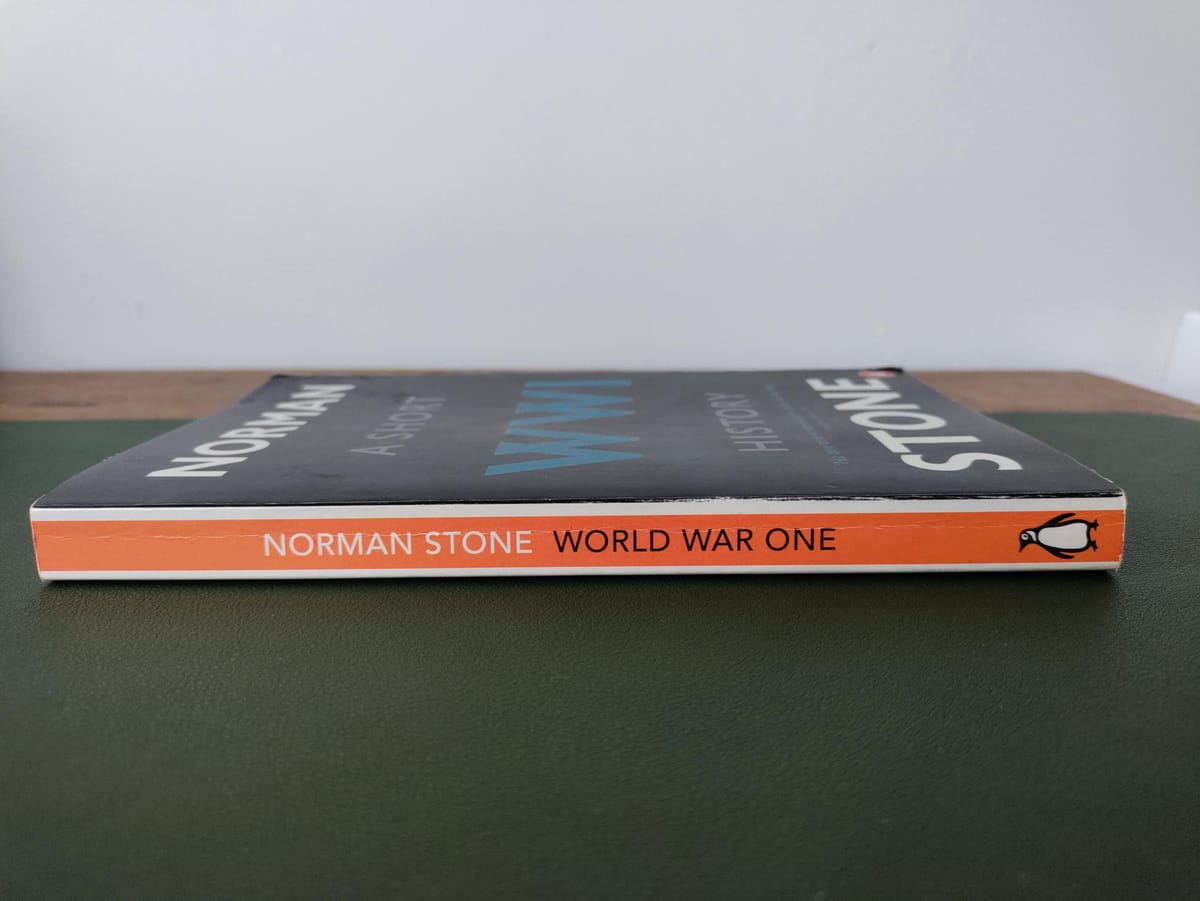
World War One: A Short History
Norman Stone's blow-by-blow account of the terrible war.
Growing up we were led to believe that had it not been for the British victories of the two world wars then we would be speaking German. Even today, people use this kind of bobbled assertion as a kind of distilled argument, and the shallowness is also to be found in assertions that Shari’a law is being imposed upon the land or the fantastic white race is being replaced and the white women corrupted by dirty foreigners. One thing we can be sure, however, is that the First World War was specifically devastating for Europe, and that it in some ways signalled a passing of the torch of world leadership to America as the apex predator.
Stone’s text is a blow-by-blow account of the years 1914-1918, neatly condensed into a text that can read in a couple of hours, containing some of the key elements of what would become known as the Great War.
He opens his text by referencing the Brest-Litovsk Treaty of 1918, a peace treaty which ended Russia’s participation in World War 1, and which created German satellites such as the Ukraine, Finland, and Lithuania, which all “re-emerged” once the Soviet Union collapsed. It is an interesting point at which to begin, because Russia in this regard serves a kind of link to some of the events of the Second World War, namely the opposition to Nazi Germany, as well as to the movements of the Great Game which preceded the First World War, not to mention the Cold War that followed the Second World War, and of course to modern-day events...
Stone writes, with a straight face, that World War 1 destroyed a “European civilization that had, before war broke out in 1914, been the proudest creation of the world.” There is a lamenting tone with his opening remarks as he mourns for a more united Europe. He praises, for example, the central power of Germany, in which Berlin was the Athens of the world. He makes a case for a Mitteleuropa, a kind of German commonwealth, and references Kaiser Willhelm II whose model was England. By 1900 the “non-European world “appeared to be disintegrating”, as India and Africa had been colonised and plundered, and the Ottomans and the Qinq had been infiltrated and lobotomised.
By 1911 there was an arms race in Europe, with the war industry (some people now refer to a military industrial complex) becoming the most powerful element in the economies of nations.
The Ottoman Empire was falling apart, and we know from past studies that the British actions in this region were contested with the Russians. The British and French were extending their spheres of influence, as were the Italians, which caused ripples in the Balkans. This in part led to anti-Austrian activity in the Southern Slavic lands of the Austro-Hungarian empire, Germany’s only real ally. The heir to the throne, Franz Ferdinand, was assassinated in Sarajevo, the capital of Bosnia. Germany pushed for mobilisation, which Stone notes was key, with the supply routes particularly important: “railways won wars.”
The mobilisation of Austro-Hungary was seen as a challenge to Russia: “would she protect her Balkan position” as well as her future in the Ottoman Empire and the Dardanelles Straits?
The German plan (the Schlieffen plan) was to attack France first, passing through neutral Belgium (how would Britain respond, they wondered?), before turning back to Russia, thus opening a two-fronted war. Stone writes that this essentially brought a key British foreign policy question to the top of the list, a question they had been asking since 1850: would Russia or Germany become the key enemy?
1914:
To begin, Stone writes, the plans of the combatants reflected a “short war illusion”. There were still many fortresses around Europe which could now be attacked with long-range howitzers. The war also began with “boots and saddles and bugles”, with cavalry charges such as in the Crimean War, but now there were infantry men who could hit them a mile away. The Germans were better prepared, with universal conscription and heavy artillery.
Stone’s blow-by-blow account ends with the stalemate by September, the front line fixed. The French had hopes of a Russian victory. They mobilised on the East Prussian border by mid-August but their advances were rebuffed, most significantly at Tannenburg, which was “an enormous defeat, the most spectacular of the war,” with some 100,000 lives lost. The Russians fared better against the Austro-Hungarians, who were “also victims of collapsing-empire syndrome, otherwise known as ‘overstretch’ – the contest between pride and reality.” The Eastern Front was twice as long with fewer troops. It remained a war “of movement, though the movement itself was generally meaningless.”
The Ottomans were generally seen as “backward, ripe for takeover”, particularly with the interest in the oil found in Mesopotamia. Turkey entered the war when Enver Pasha, nephew-in-law of the Sultan, a proponent of the Young Turks nationalism, claimed two German ships and bombarded Russian ports. He then invaded via the Caucasus, suffering an “enormous reverse”. In late 1914, the British "offered" Constantinople to the Russians.
1915:
Stone looks to the British victory over Napoleon for a consideration on how they could overcome the stalemate with Germany. He notes that “a singularity of British history was that civilians controlled the armed forces, whereas in Germany they took their orders from the military.” Winsto Churchill, as First Lord of the Admiralty, deployed the navy, first in Australia to stop German exports. But this didn’t have the intended impact.
There was a well-documented massacre and deportation of some 700,000 Armenians on the grounds that their loyalty was dubious. The Turks continued to put up a resistance against the Allied troops, including a commander by the name of Kemal.
For the central powers, there was the “looming danger” of Italy and Romania entering the war, giving Austria-Hungary a third and fourth front. Italy signed a treaty with the Allies in April. The border was Austria was mountainous, serving as a natural barrier.
Meanwhile, the general Falkenhayn was trying to persuade Russia to abandon the war. He pushed them into retreat and, this accomplished, sought to knock out Serbia and “establish a land route to Turkey.”
With such condensing, Stone’s text at times reads like a football match report, or a kind of season overview, though I don’t mean this to be trite or offensive in terms of this being an actual war in which millions died.
1916:
In December of 1915 the Allies held a military conference at the Palace of the Princes de Conde. 1916 promised to be better, Stone asserts with hindsight. The Russians had overcome a munitions crisis; the British were producing a land army (the so-called ‘New Army’ - which brings to mind the 'New Model Army' of Cromwell). Germany knew, Stone writes, that time was not on their side. They targeted the French at Verdun. This became “transformed into a national epic […] and France was galvanised.” Three quarters of a million casualties, both French and German. But it “broke the French army, or at any rate strained it to such a degree that the country never really recovered: France’s last moment as a Great Power.” Stone argues that when France fell in 1940, it was in part because “her people did not want to go through Verdun again.”
The only “might-have-been”, writes Stone, of the war itself was whether Falkenhayn could have helped the Austrians against Italy. By this we can take it to mean the outcome of the war, which could lead us to propose that the war was more of a desperate attempt by the German and Austro-Hungary empires for survival, trapped as they were in the centre between the British and Russians.
The French and British armies adjoined at Amiens, “astride the river Somme,” a place of no particular strategic significance. The general idea was to “launch an enormous bombardment” with waves of infantry emerging from the trenches. 20,000 died in a single day, “the worst disaster in the whole of British military history.” By September, commander Douglas Haig prepared a new weapon, the tank. He did not, however, deploy it. More important was the creeping barrage.
In 1916, Stone writes, “the world of nineteenth-century Europe died.” The symbol of this was the death of Franz Joseph, the old emperor of Austria. He had been born in 1830, just as the age of railways and parliamentary liberalism was starting. Now, nationalism was sweeping in, the masses involved as never before.
1917:
Stone writes how great wars “develop a momentum of their own”. In 1917, each party was looking for a “knock-out blow” in the words of David Lloyd George. The Germans proclaimed submarine warfare, which in turn risked the entry of the USA on the side of the Allies due to their trade links with Britain. The Germans targeted their torpedoes on civilian ships which were supplying Britain, though this was against international law. Sinkings began, however, though defences against these were identified, in part by New Zealand physicist Sir Ernest Rutherford who helped with the invention of the hydrophone to detect underwater noise. Depth charges were one innovation.
On US intervention, Stone writes that “public opinion was not in favour. It had to be forced.” Arthur Zimmerman, the new foreign secretary for Germany, sounded out the Mexicans for an alliance, but this was sent via a coded telegram which the British deciphered. President Wilson declared war on the 6th April “with storms of outrage.”
Stone writes that this “saved the Allies”, specifically their financial problems, as this extended British credit. In turn, “raw materials flowed to the Allies.” Aircraft ascended in importance, becoming more efficient, and with such uses as aerial photography.
The Russian army, however, was breaking up. By 8th March, on International Women’s Day, working-class wives of the capital staged a demonstration against the rising price of bread. Trying to suppress this, and invited to fire upon the crowd, the authorities “collapsed.” In Russia, one thing became essential: to get rid of Tsar Nicholas II. Duma politicians arranged a provisional government. “The Soviet” was the representative body. But the causes of the Revolution did not go away: “on the contrary, matters worsened.”
Stone argues that “one of the great engines present in any real revolution (there have been some surreal ones) was inflation.” Into this situation stepped Lenin. He and his followers, ‘Bolsheviks’, proclaimed:
“Bread for the people, land to the peasant, peace to all peoples.”
In the summer, Britain moved, and this entered the history books to be referenced as ‘Paschendale’ the name of a small village “on a ridge that had some local tactical significance.” There were some 400,000 casualties. Stone writes that “Third Ypres” was to do more to disaffect that British educated classes than anything Lenin ever wrote.
1918-1919:
The Russian army had disintegrated. An armistice was arranged at Brest-Litovsk, which Stone had opened his account with. This gave, amongst other things, self-determination to the non-Russian peoples of the Tsarist empire. The satellite states (Finland, Georgia, Ukraine and so on) were created. Germany transferred forty divisions from east to west. There was a clear choice: push for outright victory, or try for peace. Their output, Stone concludes, was at its maximum.
British morale at this point was lower than at any point in the war, summarised in the phrase “we’re here because we’re here because we’re here.” The new principle would be “defence in depth” with Paschendale as the model. The Germans advanced, pushing the British back to Amiens. But Stone argues that they pushed/advanced too much, with reserves better utilised (or more accessible) for the allies.
The French had developed a light a fast-moving tank. Two generals, Debeney and Mangin, developed tactics of the Blitzkrieg which would become famous in 1940: tanks, fast-moving infantry, and aircraft flying low to keep German gunners’ heads down.
“Foch then discovered how this war was to be won: he stopped. No more battery with light weapons against reserves. The answer was to suspend the attack where is had succeeded, and attack somewhere else, keeping the enemy reserves on the move.”
The German army morale broke in July. The Kaiser asked Ludendorff what had gone wrong, and he responded that the men were just not fighting anymore – thousands were surrendering.
On the 9th November, the Kaiser abdicated (escaping to Holland), and Republic was declared. An immediate armistice followed.
“The terms were harsh: Germany would not be able to fight again. The Allies took over the Rhine. There was no occupation of Germany – as things turned out, a fatal decision.”
President Wilson arrived in Europe in December, representing a “sort of new world order.” The chief treaty was signed at Versailles in June 1919. European empires were greatly extended but “within ten years […] these empires were falling apart and within a generation were finished.”
For Stone, the primary area concerning Germany was money. They were formally blamed for the war itself, and expected to pay reparations, which the French would then use as a device to prevent the German economy from ever recovering. And out of this defeat came Hitler and his people.
In summary, Stone’s account is a condensed account of the war. I can’t see that we have much here that we didn’t learn in GCSE history, with perhaps much more focus on Germany than on Britain, which is an interesting lens with which to view the war. There is an omission of the contributions and sacrifices made by subjects of each empire, though in part we can say that Stone is macro-summarising the war, so the experience of the combatants and casualties is very much at the margins.