Yellow Peril
Overview summary of the key ideas underpinning Yellow Perilism and the considerations for our time.
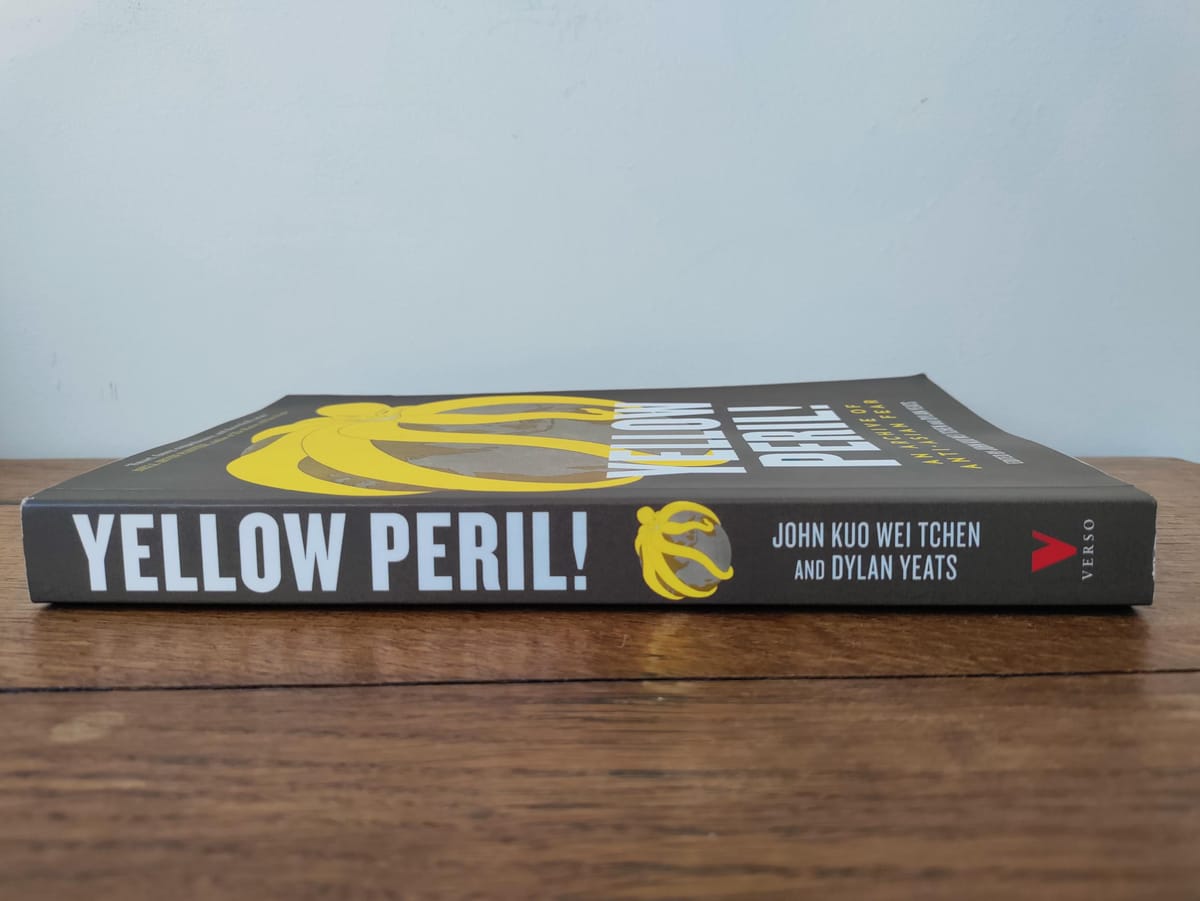
Yellow Peril: An Archive of Anti-Asian Fear is a valuable resource for an exploration of the creation of binary oppositions such as West/East, Us/Them, as well as the imperial and colonial mindset and framework. It also outlines the battles of narrative that we face today, not only in terms of Anti-Asian sentiment but of other nefarious mindsets such as Islamaphobia, both of which “flourish in our contemporary everyday culture.”
We are presented with a series of images and excerpts from key texts which the authors, John Kuo Wei Tchen and Dylan Yeats, abbreviate and analyse. The front cover displays a yellow octopus with a malicious grin wrapping its tentacles around the Earth. The octopus is used as a pejorative which, the authors note, is a “continuity of a visual political language”, which their text examines. The pathway taken is to identify patterns of the visual presentations of the Other, as well as the theoretical underpinnings.
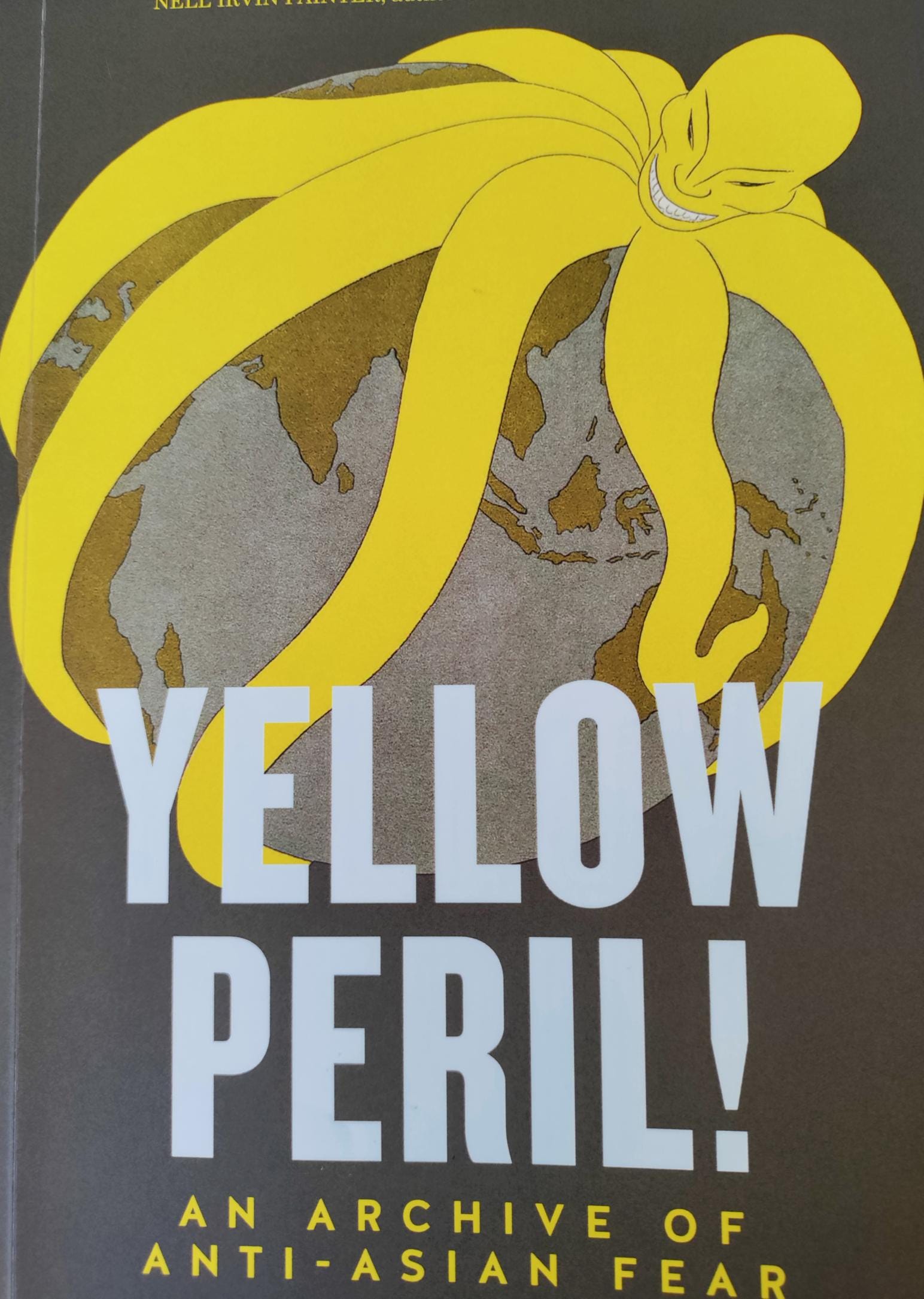
There is, they write, “a long tradition of European-originated visuals representing some part of Asia as competing with and threatening ‘The West’”. The images are sometimes “benign”, though others, such as the one represented on the cover, are much less ambiguous.
The authors idenitfy Dr Fu Manchu, a character “who uses his Western intellect and Eastern cunning to try to destroy Western civilization and bear it at its own game of world conquest.” The character, in the texts of Sax Rohmer, organises the colonised against the British, though when the film studio MGM adopted the novel for American audiences they “dropped the colonial history”. In the film, the so-called Devil Doctor commands:
“Conquer and breed. Kill the white man and take his women!”
There are plenty of links to past studies, including Angela Saini’s Superior, which is a key text for understanding the myth of race. In short: race originated in the colonial age as a means of classification for justifying colonial exploitation of people and lands.
The term Yellow Peril is examined by the authors who note that “yellow” is used as a racial signifier, first used to refer to South Asians in a 1684 publication entitled “New Division of the Earth, According to the Different Species of Races of Man that Inhabits it, Sent by a Famous Voyager." The “peril” is a warning, a potential for injury, “at your own risk,” with links to early Christian morality in terms of spiritual temptations, giving into temptation, and taboo.
The term as a whole is attributed to Kaiser Wilhelm II (‘die Gelbe Gefahr’). He is said to have had a prophetic dream of a seated Buddha riding a vicious dragon storm upon Europe. This is represented with the caption:
‘Peoples of Europe, Defend Your Holiest Possessions’
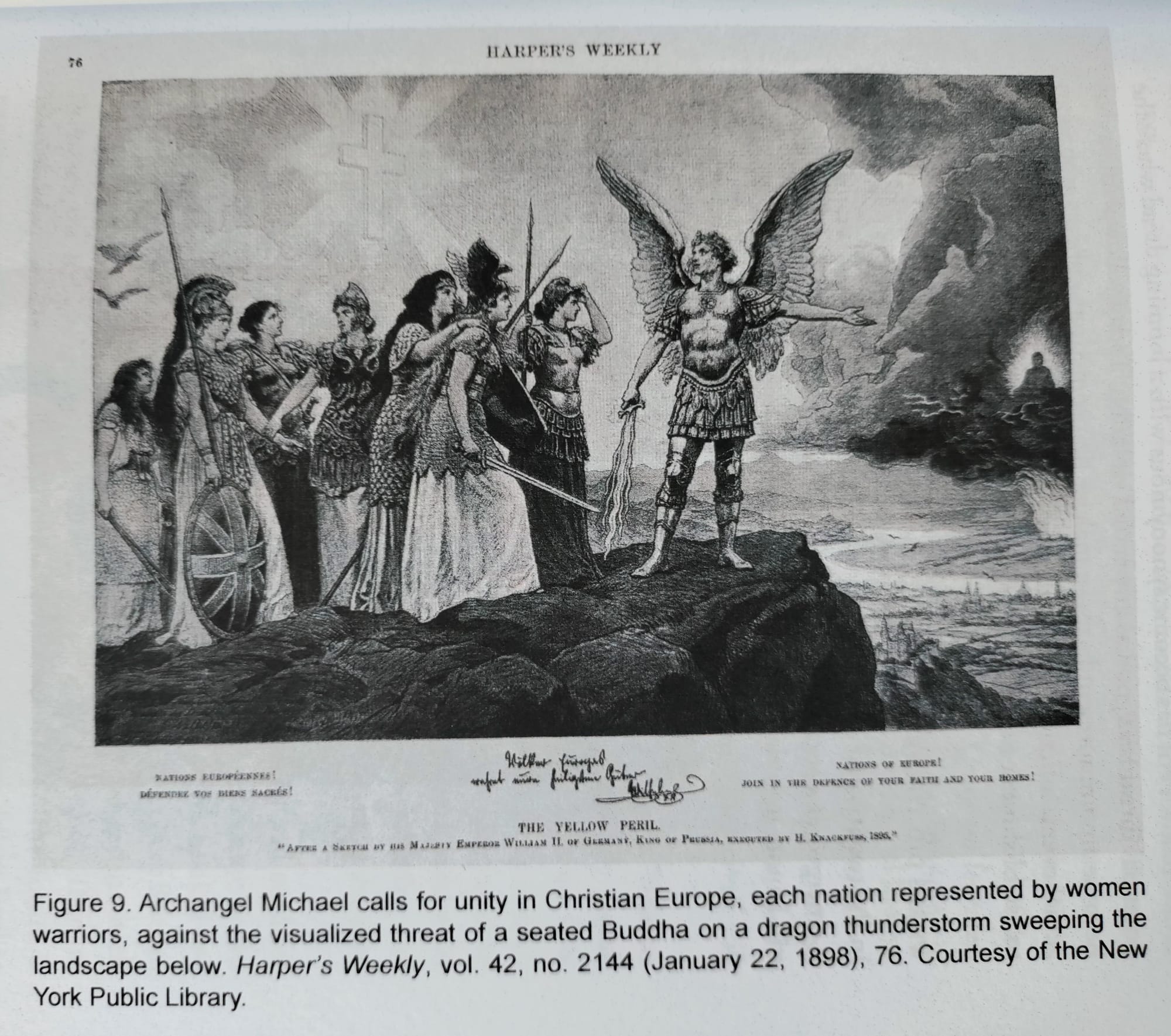
We can read this in many ways, of course: the possessions of the elite landowning aristocracy, the virtue of women, the economic goods of the states. Importantly, once we notice the themes and tropes, we begin to see these being deployed in modern society, so that we can recognise the bias at play and the intended manipulation.
“In an age of tribalism, war against a common foe brought unity.” We can certainly say this about ages of tribalism, and the ruling class have a tricky balance in terms of keeping enough fragmentation to keep everyone in their place, as it were, or to continue to enjoy the fruits of their power, and being vulnerable to overthrow from the exterior (power contested). In this way, the authors note that for the West/Europe (more on these terms shortly) non-Christian heathens and nomadic warrior Mongols were a great tool for fear in much the same way Islamic extremists serve a purpose today.
The authors subsequently note the presentation of the Asian Oriental as a “mad scientist”, with outbreaks of flu or virus focused upon, including the times of Covid and the rumours of where it had originated. The West and Europe is regarded as an innocence which is corrupted, or polluted, by the influence of the Other.
One of the central questions of the book, then, is how do Yellow Peril fears survive in the political culture of the USA, Britain, Europe, and the so-called West today? Following this, we need to understand what are the origins of this approach, and how is it deployed against us (or for what purpose)?
Many will see the ideas and themes in the text as overstated, or perhaps label the authors as paranoid, but as they note in their epilogue:
“Yellow Perilism is neither misinformation nor the figment of overactive imaginations. It is a structured tradition of concepts and practices hardwired into the political culture of Western Enlightenment modernity itself. Globalized especially by the British and Anglo American expansionism, its patterning is a relational and recurrent process of identity formation and disidentification.”
The differentiation between West/Other or West/East is one of the starting points, then. We have seen that this has some roots in the Ancient Greek presentation of the Persians. The authors claim that our perception of this dichotomy has been embedded through generations with a “call and response” mechanism.
The “genealogy” of Yellow Peril includes and connects Mongols and Muslims, Jews and Japanese, “it is for all times and all places", and of course we may say that this framework comes from a place of fear. The nations of the colonial age were from the embattled European warring states period, and the drive for innovation from military supremacy enabled them to conquer other places, which of course would influence their own mindset that the world was a place of conquer or be conquered. For the authors, “yellow perilism is hardwired into the formulation of western civilization itself.”
They cite Walter Benjamin who proposed that sometimes fragments of a seemingly distant past appear as a flash of lightning in the present. This causes us to look at our surroundings differently. The struggle for power (in noticing the grip/shaping) helps us to understand a new pattern of meaning.
“Suddenly we can literally re-connect or remember pieces of a puzzle.”
Can the same be said of learning, such as when we study a history, identify patterns, notice our connectedness, identify omissions and gaps, recognise cycles and flaws?
“The production of history expresses political and cultural power while also actively silencing other versions.”
We must be careful, then. We have already seen that history is a constructed narrative, and there will always exist bias and selection. An important part of the process of learning is to consider across the spectrum of opinion, and in some cases we are called to take a position.
The study here includes a visual study, which the authors note arises from the assertion that vision is a kind of “master” sense. This is a reference to Immaneul Kant (visualising as master aesthetic), with links to the European Enlightenment, whereby other senses were subordinated as “animal senses”. Speaking and storytelling became a “borderland between the so-called superior sense of light and the lower senses”.
For the authors, European colonialism was a response to the spread of Islam. With this in mind, we have a master narrative of the early Europeans “in the cosmos” voyaging outwards into the “heart of darkness” in order to claim and to “describe” - in the way, naming became vital, such as with the term “Indian”. (We might also reference Palestine.)
“In this Manichean colonialist clash, the European male discovered his nemesis – the other Other.”
This calls to mind what we learned in our short study of Persia and how this informed Greek identify as well as the supposed inheritors of the ancient Greek traditions.
“We are exploring the ramifications of a Eurocentric way of knowing, desiring, and exercising power.”
The villainous yellow peril Other “stabilizes” the western identity and gives justification to actions. Sometimes the Other is seen as beastly, barbaric, deviant, and at other times it is seen as sickly (such as the Ottomans), or stagnant (such as the Qing), where Europe was seen as a “virtuous opposite of an outdated, senilic Asia.”
We are reminded once again of Superior and other studies where “it must first be said [that] ‘race’ is a historical-cultural construct with no basis in biology.”
The authors approach their study in three parts:
- The imagined mythos of “the West”.
- The Westernization of Europe as expansion elsewhere.
- Within the sphere of the USA.
Their first section approaches the ‘decolonization’ of scholarship. Cultures tend to place themselves, quite naturally, in the middle of their origin stories. Western Europe laid claim to ancient Greece and the Latin culture of ancient Rome. They emphasised racial superiority over “non-white”, non-christian (“and for many, non-Protestant Christian"), non-property owning peoples.
In the mid-15th century the Pope divided the “discovered” world between Spain and Portugal. The authors use the example of maps to outline how people make “visual-historical claims”. And this was most certainly a bold claim for a person to make, albeit one who, it was believed (and is still believed) to represent God on the planet. He looked at a map and said to his two buddies: this half is yours, and this half is yours.
Prior to this, however, the authors examine the creation of "Asia" as a place. They note the meaning of the word in Arabic, Aramaic, Ethiopian, and Greek: “to rise”, “burst forth”, “went out”, “was or become beautiful”. By the 5th century CE, Asia was becoming associated with vulgarity, luxurious splendour, qualities “antithetical to Greek values.” And of course the ancient Greeks are lauded in the modern-age in the West, which perhaps explains the antipathy towards anything seen as East of Greece, including the Middle East and Asia.
There followed a schism in the church, with the West versus the East and its “orthodoxy.” With the Renaissance, “civilization” and “progress” moved westward, with the west becoming more synonymous with Christianity. Africa and Asia were portrayed as heathens. The taxonomist Carl Linneaus (1708-1776) formulated “the four races of mankind”, ranging from primitive Africans to the civilized Europeans, with Asians or “Mongoloids” as a kind of semi-civilized peoples.
Jack Goody argues in ‘The Theft of History’ (2006) that the west has laid down and claimed our modern conceptions of time and space in the sense of such things as the dates of history (measured BC), including years, months, and weeks. Although the conception of day and night clearly corresponds to an everyday experience, we know that different cultures have measured time differently according to such things as the seasons or the positions of the sun and moon. With regards space, the west has laid claim to this in the example of longitude, where Greenwich was chosen as the basis, including for time.
He also notes that one of the first subjects of Greek writing was the war against Persia, who were classified as barbarians which, he asserts, is an “ethnocentric judgement.”
The authors examine Lewis and Wigan’s attempt in 'Where is the West? Where is the East?’ (1997) to define the West geopolitically. Latin Christendom, derived from the Holy Roman Empire, and including Greece, closed off Byzantium and Russia from the delineation of West. But they note, in turn, that central European states have been “unstable”. What we know of as the West was unanchored from Europe following World War II, as it included the USA and Canada, as well as Australia and New Zealand. The West was no longer West of the East, and moreso once we consider Japan, part of the G7, so that the East, in a sense, was enclosed. In this way the West became a kind of “proxy for the developed world.”
They note that the term “Orient” originally referenced Arabic, Syrian, and Coptic, languages, with the term becoming synonymous with Islam. The European colonial expansion pushed this term eastwards to southeast Asia. The “pseudo-racial Orient” arises from the partitioning of humanity.
But humanity cannot be partitioned. We are fragmented, no doubt, but we are still one. As the authors note, human genome studies have calculated that 99.9% of our DNA across the homo sapiens species is the same. In this way, if there is any racial classification that makes any sense it is to say we are all one race. Following this, they note that we think of places and continents as being fixed in the same way we think of people and races to be fixed, but this is quite obviously flawed. We know from a very brief study of human history that we are migratory and nomadic, settler and cultivator, and that nation states are a relatively recent invention.
They reference Spencer Wells who distills a way to understand the vast temporal and spatial scale of human movements:
Imagine, then that apes appear on New Year’s Day. In that case, our first hominid ancestors to walk upright – the first ape-men, in effect – would appear around the end of October. Homo erectus, who left Africa around 2 million years ago, would appear at the beginning of December. Modern humans wouldn’t show up until around 28 December, and they wouldn’t leave Africa until New Year’s Eve! In an evolutionary eye-blink, a mere blip in the history of life on our planet, humans have left Africa and colonized the world.
The authors establish the importance of the connectedness of the Eurasian landmass, something that has been apparent in our studies on China, Persia, the Middle East, and Korea, and will no doubt inform our future studies. Historians have often presented the relationship between nomadic steppe pastoralists and sedentary agricultural societies a being parasitic, violent, or both. The pastoralists are presented as barbaric, and the settled as civilized. The authors assert that this an anachronistic reading.
They note that key inventions/innovations from nomadic peoples, such as horseback riding, the wagon and cart, and the spoke-wheeled chariot, have been key developments and have complimented the settled agriculturalists.
“[the] heroic world of chariot-driving warriors was dimly remembered in the poetry of the Iliad and the Rig Veda […] from this time [2100 BC] forward the people of the Eurasian steppes remained directly connected with the civilizations of Central Asia, South Asia, and Iran, and, through intermediaries, China.”
Irene J Winter, in ‘Homer’s Phoenicians’ (1995) calls into question the legitimacy of classical literary texts (such as Homer), in which we read fact from fiction. She writes:
“Less a mirror of their time than a deflector, the Homeric texts elevate an ideal of the warrior-hero at the very moment that Greeks were embarking upon mercantile ventures not unlike those of the very Phoenicians whom the texts disparage.”
In this way, the texts were used as a kind of propaganda against the Other, a theme we noted in the reading of Persia. In much the same way, the Bible is used a fact in order to legitimise mad actions.
Adam Kuper in ‘Greeks and Multiple Barbarians’ (2005) writes that a sense of Greek unity was forged only when isolated city-states came together against Darius and his son, Xerxes. They then used the term ‘barbarian’ to refer to their common enemy. There was a sense that the nature of barbarians was servile, or that they were “homeless anarchists” like the Scythians. They were incapable of independence, of democracy, “devoid of civic values.” We see the same views deployed by the USA and Britain today when considering the Global South, and we see the same patchwork of ideas from the colonial age.
The authors argue that European colonialism arose from a need to defend against the incursion of Islamic powers. They cite Pope Urban II’s letter and his call to arms:
“O what a disgrace if such a despised and base race, which worships demons, should conquer a people that has the faith of omnipotent God and is made glorious with the name of Christ.”
Indeed, the Crusades were a unifying force:
“Let those who have been fighting against their brothers and relatives now fight in a proper way against the barbarians.”
And soon enough there was a new threat from the East in the form of the Mongols. Matthew Paris, in ‘That Detestable Race of Satan’ (1240), calls for unity against Genghis Khan and the Tartars.
Scott D Western argues in ‘The Story of Gog and Magog’ (1998) that “thirteenth-century Europeans attempted to explain the baffling, sudden appearance of the Mongols, a race unrecorded in the Bible, by making them Jewish.”
Suzanne Conklin Akbari, in ‘Placing the Jews in Late Medieval English Literature’ (2002), cites Edward Said when noting that anti-Arab polemic is “fundamentally the same as anti-Semitic polemic.” In this, both Jew and Arab/Muslim become Oriental too. Historically, anti-Semitism refers to all people referred to as Semitic, that is, based on Semitic languages, such as Arabic, Phoenician, Aramaic, Maltese, Ge’ez.
Medieval Christians viewed Jews and Muslims as the same. They were people who “privileged the carnal over the spiritual”. The Jewish, however, were viewed as both inside and outside the Christian community itself, given that Jesus was himself Jewish, though this was a “shadowy presence prior to Christianity” and of course usurped, fulfilled, and was perfected through Christ and the Christians.
John V Tolan explores the fear of Arabs and Muslims in ‘Christians or Saracens’ (2003), noting that the earliest Christian authors describing the Muslim conquest:
“the Muslim invader was a scourge sent by God to punish his wayward flock.”
This soon moved to Christiological heresy:
“This image of Saracen idolatry provided a useful caricature with which the Christian author could justify and glorify the killing of Muslims and the conquest of Muslim territories.”
Gerard Delanty argues in ‘The Westernization of Europe’ (1995) that the “epochal moment” in which the West broke with the East was in the year 1492 with the Seizure of Grenada from the Muslims who were later expelled from Spain in the 17th century:
“This event gave rise to the doctrine of the purity of blood, which became the core of European racism in subsequent ages and a major legitimation of ‘ethnic cleansing.’”
In the Age of Discovery, which was a renewal of the idea of the Crusades, the Europeans failed to defeat the Ottomans but were able to gain lands elsewhere. With this, Europe began to “shed itself of its association with Christendom”. It was the encounter with non-European peoples and “in resistance to Ottoman expansion that the idea of Europe itself became the focus for the construction of a specifically European identity.”
There was a “colonising thrust across the Atlantic”, the idea of a “limitless frontier”, the creation of an Old and a New World, and new access to the “cultural repository” of the New World.
The expansionist West created markets for system of exchange, what Adam Smith later “formulated as the secrets to wealth-making – trading coveted goods from afar in exchange for more plentiful goods nearby.”
New social contracts were formed with a social system of men making money. There were some key outcomes such as:
- White women were deemed unable to represent themselves.
- The New World indigenous were seen as unfit to own land.
- The enslaved African was seen as unit to own his own labour.
- The Oriental was seen as unfit to lead enlightened civilization.
The new elites of this New World Order were the settled-colonial-liberals. The West became “entitled”, if not destined, to lead and to own. The authors note that the “competitive empire building dragged European states into war against each other many, many times.” Some argue that this influenced the potency of European colonialism, that this made them military states or something akin to the Warring States of pre-Qin China.
One example of this was the Great Game between the British and the Russia empires. Analysts at the time argued that the Ottomans and Chinese had stagnated, and so they all scrambled for control of these vast empires. Japan entered as a player from 1895, which in turn led our old friend Willhelm II to become anxious. The rise of Japan, in particular, frightened the West who had enjoyed a few centuries of accumulating successes: what if Asians had a Manifest Destiny, too?
The racial logic of expansionism was also upset by the Ethiopians defeating Italy, the Boer defeating the British, and the aforementioned Japanese defeating the Russians. White supremacy came to be questioned.
With this in mind, the authors return to the origins of race science. They note Diderot and Linnaues’s attempts to carve and to classify. The “supposed inferiority of others seemed to explain European power, and the fear of racial degeneracy justified colonial conquest.” There was a sustained move for systematic organisation of nature, including human beings, looking at skull sizes, forehead angles and so on. This crazed racial science “still informs Anglo-American common sense today.” Africans are regarded as primitive, Asian civilization is stalled, Oriental males (read, especially: Arabs, Muslims) are “patriarchal and oppressive.”
Linnaues categorised human beings as follows:
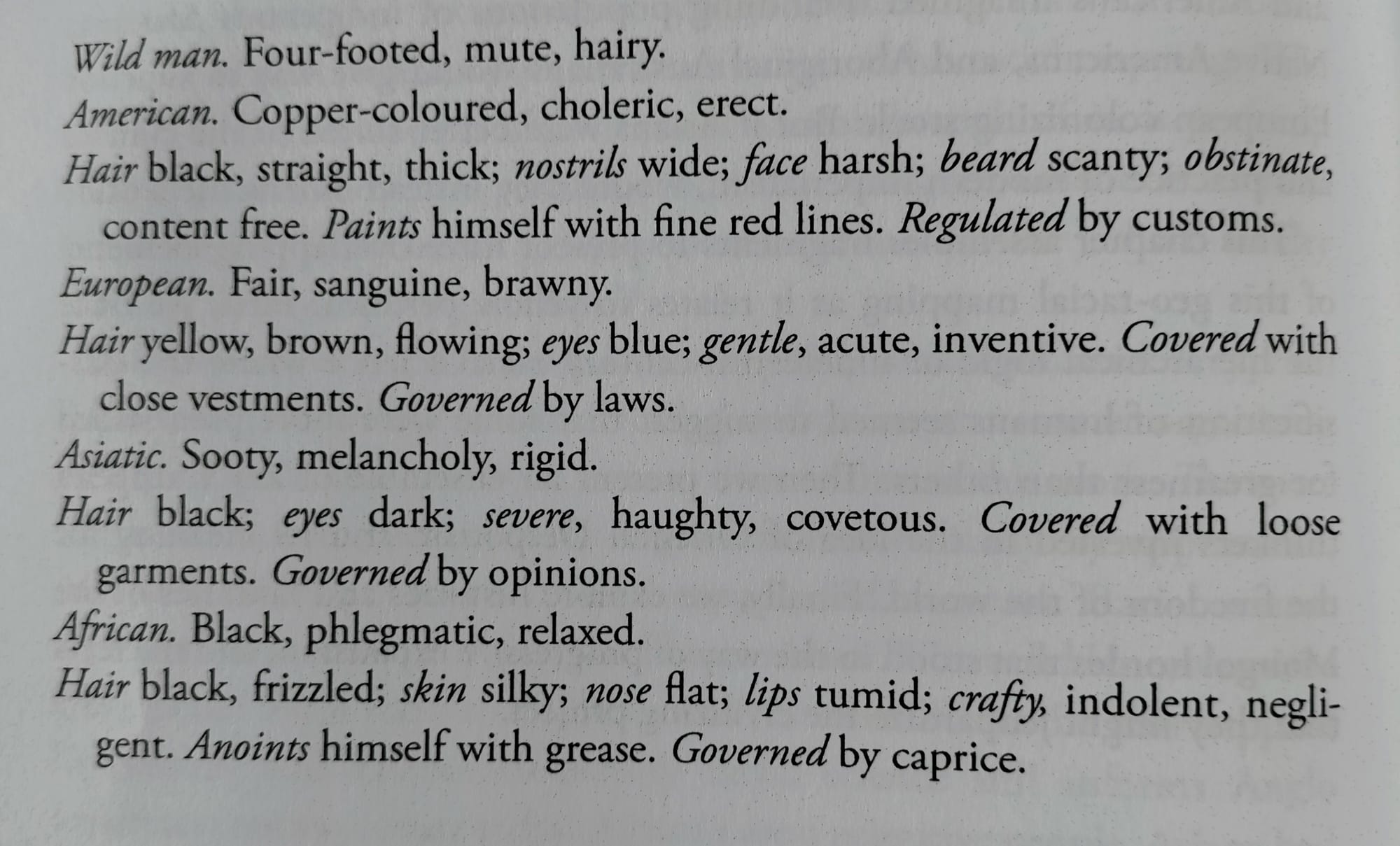
Johan Friedrich Blumenbach appears to be the first (on record) of associating race with colour. His colleague, Christoph Meiners argued that the Caucasus Mountain range near Georgia was the dividing line between European and Asians, hence the term ‘Caucasians’.
Robert Chambers, in ‘The Development of Colour’ (1844) linked “leading characteristics […] of the various races of mankind” to a representation of stages of development. He then attempted to link colour to development. The authors note that this then established justification for a range of Eurocentric practices, including Social Darwinism, Eugenicsm and Aryanism.
“The Mongolian, Malay, American, and Negro, comprehending perhaps five-sixths of mankind, are degenerate.”
The authors cite Hegel in his ‘Philosophy of History’ (1837), articulating the claim that “the capacity for individual freedom is not possible” in the East of the Mongols, which for him included India and China (“farther Asia”). For Hegel, Egypt and Persia were included as Caucasian peoples. Crossing the Indus, however, the European “encounters the most repellent characteristics, pervading every single feature of society.” He also argued that the Persians were the first historical people, with Zoroaster’s light shining and illuminating. Light, of course, was antithetical to darkness. He argued that there was a trajectory of this light through Persia to Greece to Rome to Germany (where he was writing, of course). He also noted that in Persia (unlike India or China) there is found the separation of man from nature.
“It is here, then, that we first found […] that no objective world remains free – that the nations are not enslaved, but are left in possession of their wealth, their political constitution, and their religion.”
Robert Kurfirst, in ‘John Stuart Mill’s Asian Parable’ (2001), examines how Mill presented the Chinese as “automatons”, a “nation of much talent” who had become “stationary [and] have remained so for thousands of years.” He himself feared despotism as it prevented true expression, turning citizens into apes or steam-engines. He was worried for the West, arguing that there needed to be “unanimity among the instructed, on all the great points of moral and political knowledge.”
“Instead, all Mill found around him was a consensus about the appropriateness of a life consumed with material pursuits and a political system in which mediocrity was the order of the day.”
Gregory Blue writes in ‘Gobineua on ‘China as Menace’’ (1999) that the hideous Count had argued that Europeans should not colonize other lands because the “inferior races” would overwhelm them. He “drew particular attention” to Chinese emigration and a “spectre of a Chinese wave” flooding through Europe. His vision was one of a “new fifth century” in which “yellow” “hordes” would “explode” upon Europe. His final work was a five-hundred page poem entitled Amadis in which there is a final cosmic conflict between white and yellow races.
Sir H J Mackinder (1861-1947) proposed his “heartland” thesis, suggesting that Europe must use its sea power to prevent the development of Asia’s land power. In the author's words, Mackinder saw the history of Eurasia as the “history of antagonism between East and West over control of Central Asia, which he considered to be the ‘pivot’ on which world history turned.”
Mackinder further observed that “the ideas which go to form a nation, as opposed to a mere crowd of human animals, have usually been accepted under the pressure of a common tribulation, and under a common necessity of resistance to external force […] the idea of England was beaten into the Heptarchy by Danish and Norman conquerors”.
He warned against the rise of the Russian Cossacks, stating: “Russia replaces the Mongol Empire […] Her pressure of Finland, on Scandinavia, on Poland, on Turkey, on Persia, on India, and on China, replaces the centrifugal raids of the steppemen.”
To emphasise just how much the yellow peril strain/belief infected decision-makers, we have President Theodore Roosevelt, who compared Mongols to North American Comanches and Apaches. He describes the Mongol conquest as “hideous” and “noxious” - “they were savages as cruel as they were brace and hardy.”
We also have Jack London (1876-1916), who wrote that “the menace to the western world lies, not in the little brown man, but in the four hundred millions of yellow men.” The Chinese, he wrote, had been “dozing [...] through the ages”, but the Japanese had been awoken and given new life with the ideas of the West, which in turn, if they continued to conquer, “leaven” the Chinese:
“We have had Africa for the Afrikaner, and at no distant day shall we hear “Asia for the Asiatic!” Four hundred million indefatigable workers (deft, intelligent, and unafraid to die) aroused and rejuvenescent, managed and guided by forty-five million additional human beings how are splendid fighting animals, scientific and modern, constitute that menace to the Western world which has been well named the ‘Yellow Peril.’”
With the genocide and extermination in Palestine running its terrible course, with the final stage and final solution following the starvation likely to be some kind of forced removal, many commentators have surveyed the actions of the USA over the past few decades and anticipated that the next battle to be waged will be with China. The flashpoint, they argue, is likely to be Taiwan, but there may be other less-obvious ones. It will be especially important to look for signs of the manufacturing of consent for both the American and British public about how China is being portrayed.
Nowadays we have barely an hour of time pass without “The West” being deployed as a phrase. It has become embedded in our brains. What does it mean? Based on our readings so far, we can say that it originated to refer to Europe in order to differentiate itself from Islam, before growing into the Age of Discovery/Colonialism, becoming defined in opposition to X, Y or Z. There were powerful racial tones impacting this relating to fear, as well as historical threats such as the Mongols. This was then applied to the Russians, the Japanese, the Chinese, and has since returned to Islam.
Whilst the Great Game against the Russians meant pushing east into India and China, and then west into Afghanistan and Persia, the USA played their own Great Game, though without a readily signified enemy until perhaps the Cold War. Initially they pushed west and south into Native territory and into Mexico, and then as an established state they pushed into the Far East, opening Japan in 1852, occupying parts of China during the Boxer Rebellion, as well as the Philippines.
Whilst the colonial/imperial actions were for the most part successful, it is important to note that there were two paramount events which challenged the idea of white supremacy, namely the Haitian Revolution and the rise of Meiji Japan.
Ashis Nandy argues in ‘The Psychology of Colonialism’ (1988) that colonialism affects both colonised and coloniser. Using the example of India, he states that “the long-term cultural damage colonialism did to the British society was greater." For one, it limited the cultural role for women, emphasizing supposedly masculine traits over feminine traits. Colonialism also emphasised values such as competition, achievement, control, and productivity, institutionalising violence and Social Darwinism. Anyone regarded as a “social deviant”, or who were critical of the values of this society, were ostracised or moved away. This enabled a small elite to exert cultural dominance.
Gary Okhiro, in ‘Perilous Frontiers’ (1994) references historian Walter La Feber when noting that the USA had a “vastly increased emphasis on race” when considering repression within the States, complementing their expansion abroad in order to align whites with Europe. He writes that American history, “as told by the founding fathers” was an account of the triumph of present over past, including from east to west.
He writes that Charles H Pearson was perhaps “the most influential architect of the modern day yellow peril.” He argued that European imperialism would lead to a population explosion among peoples of colour, led by Asians. He did not believe that racism or yellow perilism was irrational or fantastic; instead, he held that it was important for the purpose of sustaining social order, motivated by fear of change between Europe and Asia.
James L Hevia, in ‘Spectres of the Great Game’ (1998) explores the Great Game operations as “information-oriented”, whereby one way in which Britain aimed to contain Russia was through use of local knowledge across vast expanses of territory. This was a battle for information and for networks. He also notes how imperialists are perpetually haunted: their own fear is of being dismantled leads to a “permanent state of unease”, with the world “perpetually on the brink of chaos” which brings to mind the mentality of Israel and of the United States, not to mention the society as presented by Orwell in 1984 in which the state needs to first and foremost know, and through this to contol.
The authors turn to consider what this all means for America. They note that “Nineteenth-century white Americans inherited a colonial Enlightenment liberal tradition that defined manly individuality against internal and external hordes, US expansion westward, and Americanized and whitened generation of ‘poioneers’”.
There was a perpetual deferment of the American Dream, with a common tactic to blame “them” for the difficulties of the common man. In the 1960s, for example, it was the Russian Commies; in the 1980s the Japanese Capitalists.
“The reliance on scapegoats to protect the deferment of the promise is at the core of American political culture.”
We are starting, perhaps, to see the tide turn now towards Israel, with the American public much more aware of how they have funded Israel’s actions in past decades, including the most-recent genocide against the Palestinians. Whilst much of the media and influential public figures have shielded Israel for the past two years, there is now a shift in some of the outward stance as the final solution draws near. But the movement has already moved towards blaming the Israeli Zionist lobby. There is a potential for an undercurrent of anti-Jewish sentiment, which is dangerous, though another distraction (perhaps towards the East) may be a way of diverting the public attention.
The authors note that “society-wide fearmongering breeds political scapegoating,” and we can certainly trace a line of constant fear through the 20th- and 21st-century in American politics and mass media. It is simple to chart these fears, from Chinese to Muslim, the Red Scare, and in Britain from Irish to Islam. The authors happens to focus on the USA, but there is much we can bring for the UK context.
The authors cite fears of “the mob” following the French Revolution, which no doubt still concerns the elites of society who much prefer to have others on the stage than themselves. In the USA following the Revolutionary period, there were concerns about immigration of Catholics, suspicion of Mormons, as well as French Canadians. There is always fear. There was a Chinese Exclusion in 1882, with Japanese, Koreans, Indians, Italians, Russians, and Jews the target of further exclusion and expulsion.
Nowadays there is a focus on building a wall against Americans coming from the south, with taskforces such as ICE created. It is a concerning trend, but one that appears to have precedent. What would the equivalent be here in the UK, and what would be the conditions for this to arise?
Writing on Chinese immigration, Yeats cites the Federation on Chinese Exclusion, ‘Memorial to Congress’, from 1901, which argued that “the free immigration of Chinese would be for all purposes an invasion by Asiatic barbarians, against whom civilization in Europe has been frequently defended, fortunately for us.” They continue:
“It is our inheritance to keep it pure and uncontaminated.”
In just this small passage we have all the red flag terms: invasion, barbarians, civilization, Europe, inheritance, pure, uncontaminated, a word which leads us into the next subject, that of the Other as a kind of virus in society.
Karen Shimakawa argues in ‘National Abjection’ (2002) that Asians are perceived to threaten the “body” of the nation in terms of germs, virus, and contamination. This is a recurring theme of our generation, with issues such as SARs and COVID outbreaks. East Asia is regarded as a place of mad experimentation, or of disgusting living conditions, which threatens the survival and cleanliness of the west.
The authors make reference to The Overland Monthly, 1908, and a piece about a wave of violence against South Asian immigrants. Two perspectives are offered: on the one we have Girindra Mukerji, who writes that the new America was “discovered” by Columbus with the intention of finding India, and that the aborigines of America were first named ‘Indians’. He asserts that his emigration (from his homeland), and others like him, is driven by American (and Canadian) capitalists demanding cheap labour. In contrast, Agnes Foster Buchanan writes that the “Hindu Invasion” is the “latest racial problem with which we of the West have to deal with.” She continues, noting that the Hindu is able to “subsist on incomes that would be prohibitive to the white man.” She is critical of the Mohammedans, who force their women to be veiled or hidden away. Interestingly, she notes that Indians are “full-blooded Aryans”, the “last brother of our own race”, highlighting just how deep-rooted obsession with race was at that time.
W E B Du Bois writes in the North American Review (1926) following the First World War , and with the rise of the KKK, that:
“The wages of war is Hate; and the End, and indeed the Beginning, of Hate is Fear.”
Germany feared the Jew, he writes; Americans feared the Negro; England feared the Indian. He writes that, above all, “wealth feared democracy.” Against fears, he argues that we can have one of three positive attitudes:
1 – Reason and examination.
2 – Force, which is out in the open, such as with Fascism.
3 – Force, which is in secret, harnessing the power of the mob.
There were further fears in the 1980s and 1990s of the Japanese “attacking” US jobs, with some claiming that the US workers were not as industrious or efficient, which of course brings to mind other de-industrialised regions and exported labour. There was much demonizing of the Japanese at the time, with the argument that Japanese companies had, in the words of Robert B Reich in 1992, “rigged their capital markets in ways that undermine American corporations.” He attempted to counter this fearmongering, noting that the fears were in part historical (in the sense of Pearl Harbour), but also in terms of economics (in the form of stagnation). There was also the sense that with the easing of Cold War tensions, a new enemy/threat was needed. He wanted, in the end, for Americans to join together. Yeats notes (2013) that since the late 1990s “politicians have tried to use the threat of China to tarnish their political opponents.” Any link to an external threat, then, contaminates the person, particularly in the political arena.
In the wake of 9/11, pundits and political commentators compared the event to Pearl Harbour, which was a reasonable comparison to make in terms the attack being on “US soil”. But, the authors note, “instead of looking inward for answers, the Bush administration prepared America for yet another round of the apocalyptic contest of Good vs Evil, us versus them”. In this way we see how the Great Game led/fed into the Cold War which led/fed into today’s military Orientalism, the War on Terror and the Axis of Evil.
The authors note that the US never left the Pacific theatre after World War II, and argue that Yellow Peril fears “promote an American culture of war-making.” Indeed there are many who argue that the so-called Military Industrial Complex is the key driving force behind all the US actions, that they are, in fact, the ‘deep state’ antagonists.
The authors reference fiction writer Tom Clancy and his 1994 book Debt of Honor in which the Japanese fly a plane over the Capitol building, and his Executive Order (1996) in which China and India join to support the creation of an Iranian-Iraqi-led united Islamic Republic from Egypt to Bangladesh, which overestimates the unity of the various people of the so-called Middle East not to mention raising questions over why India would want this.
Literature and media with the Yellow Peril framework is abundant, and although there are some relatively positive examples (one example given is Mr Miyagi from the Karate Kid franchise), the scales are weighed heavily towards negative presentations of the Other.
The authors note Samuel Huntington, who proposed in his “influential book” Clash of Civilizations and the Remaking of World Order (1996) that “transnational ‘cultural’ units would replace Cold War superpowers”, positing a “crass set of arbitrary and ahistorical ‘civilizations’ modelled after Blumenbach’s early nineteenth-century classification.” He concluded with a future-war “vignette” in which, in the authors' words, Hispanic immigrants “erode American patriotism to the point where China feels secure in finally invading the US.”
These “schemas” are much too basic, and they “mask” the actual power politics and shifting alliances. For example, the US has used Islamic fundamentalism with support, arms and training for the Taliban when the Soviets invaded Afghanistan in the early 1980s.
“Like the imperial conflicts a century ago, belief in the US as exceptional and detached from world events is the necessary precondition for accepting the logical of civilizational clash.”
They reference Dr Martin Luther King, who spoke as follows:
“When machines and computers, profit motives and property rights, are considered more important than people, the giant triplets of racism, materialism, and militarism are incapable of being conquered.”
John W Dower argues in ‘Patterns of a Race War’ (1986) that World War II was also a race war, exposing the hypocrisy of the treatment of blacks in the USA (and other “immigrants”), as well as Japan’s military successes in attacking western colonial outposts, which challenged the “entire mystique of white supremacism.”
“The dehumanization of the Other contributed immeasurably to the psychological distancing that facilitates killing.”
Rey Chow, in ‘The Age of the World Target’ (1998), writes concerning the predominant image of World War II being the mushroom clouds over Hiroshima and Nagasaki. The country, and many others, continue to believe that the atomic bomb was the best way to end hostilities. For Chow, the US has a “perpetual conviction and self-legitimisation of its own superiority, leadership, and moral virtue.” She writes about their “collective fantasizing” of the foreign or alien body, usually Communist or Muslim. This leads to war, which becomes a moral obligation.
She further points out that following the end of the Cold War, the US “by necessity seeks other substitutes for war”. This included drugs, poverty (or the poor), and illegal immigrants. She proposes that the US way of winning wars is with bombs, so this becomes complicated when the war is within its own borders, as they try to identify the necessary “violence to stop the violence.”
Dan Gilbert (1911-1962), an influential evangelical Christian writer and an early advocate for General Douglas Macarthur’s aborted presidential run, writes, in ‘Why the Yellow Peril Has Turned Red’ (1951), about the Biblical prophecy of a red advance “powered from out of Asia’.
“From out of Asia, the power of the North – Russia – will get the men and materials for the assault on southern and western Europe, and finally on Palestine itself.”
He also splutters and froths about Communism being anti-God which will lead to Christians being murdered, and yellow peril establishing a pagan religion of materialism, or Confucianism being “confusionism”, lamenting the belief of the “army of 200,000,000, described in Revelation”, and their oriental religion in which individual personality is denied, as well as God being denied a personality.
Matthew Jacobson and Gasper Gonzales note in ‘Orientalism and Brainwashing in The Manchurian Candidate’ (2006) that the US had been at war in Asia for some time, from the “oft forgotten” Philippine-American War (1899-1902) in which one field general advocated killing all Filipinos over the age of 10.
We then have the US actions in Japan, including the firebombing of Tokyo and the atomic bombs dropped on Hiroshima and Nagasaki, followed by American troops in Korea where the civilian death toll was some 2 million, with a civilian to soldier death ratio of 70% compared to the 40% of World War II. We then have the US invasion of Vietnam where their troops routinely destroyed villages, hamlets, farmland, forest, and animals, leaving more than 879,000 orphans and 1 million widows.
The authors state that the American audience were introduced to the Oriental as antagonist through Hollywood throughout the 1950s. They also make reference to Edward Said’s structuring of the dualism of West/East as being Masculine/Feminine, implicating an encounter where the West possesses, controls, and conquers.
Myra Mendible, in ‘Post-Vietnam Syndrmome’ (2008), explores the so-called Vietnam Syndrome (otherwise known as PTSD or shell shock), noting that it has been highly politicised and referenced. There is an interesting link to Israeli actions today when she writes:
“As a basis of national feelings, humiliation or its perceptions exacerbates collective feelings of vulnerability or powerlessness in the citizenry. It can lead to brutal retaliations and mass bloodshed, triggering cycles of violence that can persist for generations. Social psychologist Evelin Gerda Linder argues that when a group is convinced of their humiliation, ‘terror, war, and genocide can result if this belief is fed by humiliation entrepreneurs who exhort their followers to exact revenage with grand narratives of humiliation and retaliation.’”
The link is clear here. The holocaust as a trauma, the creation of Israel as a state and the process by which this was achieved (dispossession of the Palestinians, ethnic cleansing against the Palestinians, the practice of terrorism against the Palestinians) led necessarily to a sense of vulnerability in Israel in the sense that they know (this much is clear from the Zionist founding fathers like Jabotinsky) that they are the antagonists against decency, that they are the invaders, the colonists, the thieves, the murderers, the rapists, the Goliaths, and this becomes self-perpetuating with each generation regardless of the rhetoric and system of manipulation.
John Esposito in ‘Islam and the West: A Clash of Civilizations’ (1999) notes the disinformation in the West surrounding supposed Islamic jihadists, which the authors note is a symptom of “US academic and policy assumptions”. Esposito references Bernard Lewis’s The Roots of Muslim Rage and Samuel P Huntington’s The Clash of Civilization and how these have influenced policymakers and journalists about how Islam is “diametrically opposed” to the faith and agenda of the West.
He writes that the reader is never asked to consider why Islamic activists oppose the West. There are many factors why this is the case: imperialism, Israeli actions, support for oppressive regimes (such as the Shah of Iran). It is not that the fanatical or radicalised Muslim hates the people in the US or Britain, Portsmouth, Ireland, or that they hate Jesus Christ, or democracy. It mostly comes down to the regular, relatable issues that all of us may feel: an external power has caused pain and misery; the community or society around us is corrupted; I or my loved ones have limited opportunities or we are denied a voice. Many people respond to these conditions with anger and frustration (after some attempt to change things, perhaps, or to raise awareness of the issues). For some, these can be in violent or destructive ways, attacking property or people, targeting entities or groups, and this is where terrible things can happen from terrible circumstances. How this response is presented to us can differ according to who or what is being targeted.
But as James Piscatori observes, there is another reason why Islam is presented to use, the people, as fanatical:
“Islam was fanatical because it ran counter to imperial interests.”
With this in mind, Muslims are presented to much of us in the West as an angry and wild mob, crazed sexual predators who wish to impose Shari’a law upon society. The authors reference a 2010 FBI training session entitled ‘Militancy Considerations: Violence and Adherence to the Torah, Bible, and Koran’ which states:
“The growth of Muslim populations in the West augurs the inexorable spread of Sharia into western societies.”
In their epilogue, the authors consider how we can counter Yellow Perilism and “other practices of racial scapegoating.” One way we can do this is to confront our collective past. Whilst the authors are focused on the USA, we can say that this is a process which we can all achieve. The US, they argue, is always striving, always looking ahead, which may be a result of their relative youth as an entity, but may also be related to the horrors of their actions, such as the extermination of natives, and their actions taken around the world.
They note that this will always be challenging because fragmentation works in the state’s favour:
“If the political culture can’t quite deliver its promises, it will appease the white working class by creating an external enemy and blaming the victim.”
“With a national ethos still framed by Manifest Destiny and the right to ‘life, liberty, and happiness’, the free and easy access to energy, rare earths (for high technology), raw materials and other ‘necessities’ to keep the American Way of Life is commonly believed to be sacrosanct.”
Any resistance is a threat, and will be presented in such a way. The key is to make this process visible so that we can recognise the pattern-making, the strings being pulled.
They also argue that people need to recognise the harm and injustice that western imperialism has caused, which is a difficult thing for many to do, especially if they do not feel connected to the actions of elite imperials or distant generations.
The authors also propose that there is a responsibility for “naming injustice” as well as having contact with people regarded as Other. This is a good practice in life generally.
They also feel we need reconstruction – we should move away from Us/Them frameworks towards a new vision of the world and of society. Again, in an age of information, this is vitally important due to the dangers of misinformation.
To finish, the authors quote Edward Said:
“No one can deny the persisting continuities of long traditions, sustained habitations, national languages, and cultural geographies, but there seems no reason except fear and prejudice to keep insisting on their separation and distinctiveness, as if that was all human life was about."